How bird spikes work (and what birds actually experience)
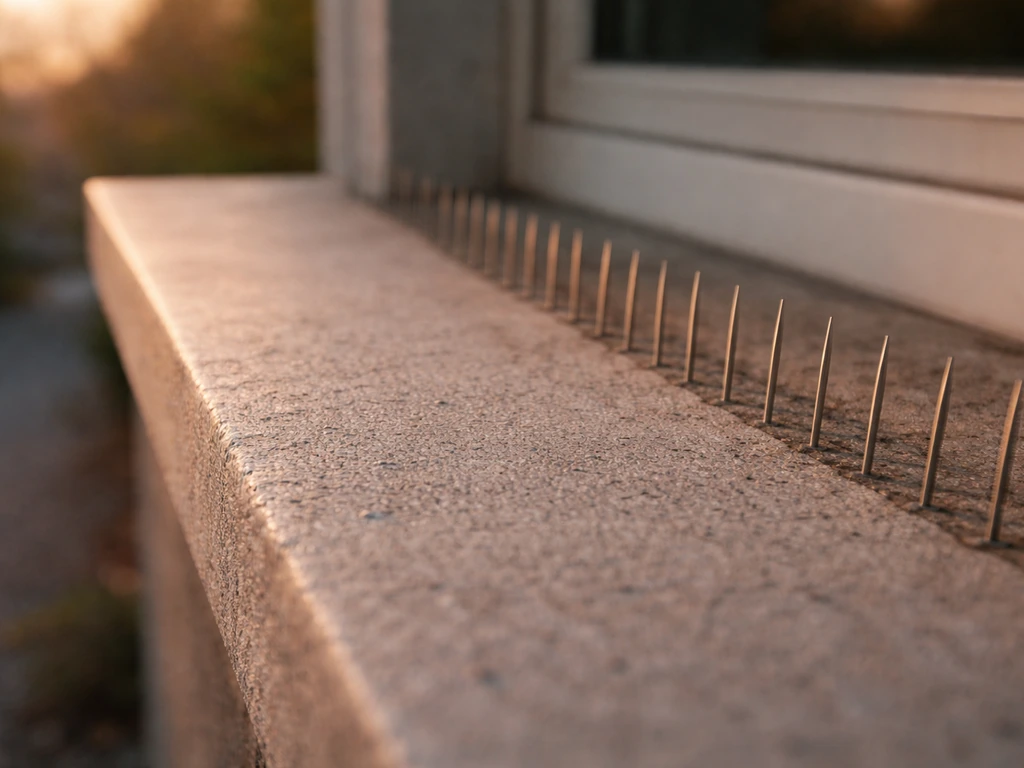
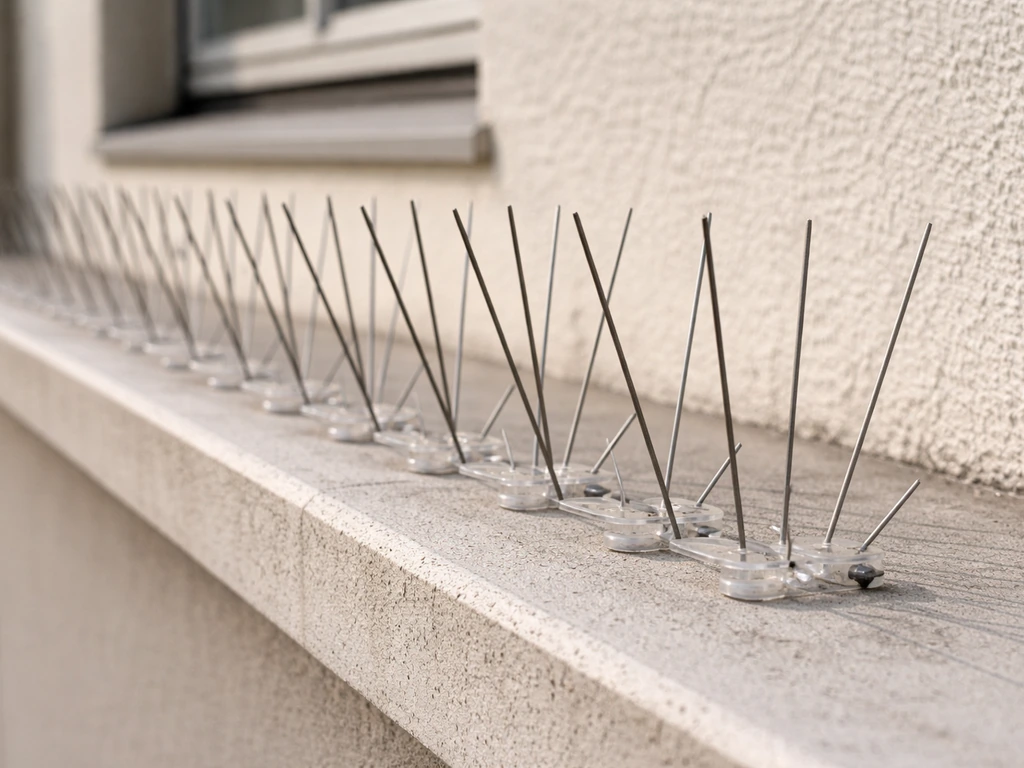
Bird spikes are not pointed weapons aimed at birds. They work by eliminating the flat, stable landing surface birds need to perch comfortably. A system like the AviAngle, for example, converts a standard 90-degree ledge into a 45-degree slope so birds cannot gain secure footing. As a bird attempts to land, the overhanging spike rods interfere with normal wing closure, disrupting the bird's ability to settle. That interference is enough to make most birds give up and move on.
For standard spike strips on flat ledges, the mechanism is simpler: the rods physically occupy the space a bird would normally step into, resulting in a light prick or uncomfortable pressure on the feet when contact occurs. Bird B Gone describes this contact as "uncomfortable but harmless," which tracks with what the installation physics actually suggest. Bird feet are touching blunt or semi-pointed stainless steel rods, not razor edges. The intent, and in properly installed systems the reality, is deterrence through discomfort, not through pain or injury.
It's also worth understanding what spikes are not designed to do. They are not electric, chemically treated, or spring-loaded. If a bird does not attempt to land, there is zero interaction. The system is entirely passive. This is what makes them one of the more straightforward deterrent tools available, and part of why questions about whether bird spikes are humane tend to get a nuanced but generally positive answer from animal welfare organizations.
What counts as harm: injury vs stress vs fatalities
"Harm" is doing a lot of heavy lifting in this conversation, so it's worth unpacking it. There are at least three distinct categories of harm that could apply to birds near spikes: psychological stress, minor physical injury, and death. These are not equivalent, and conflating them is a major source of the misconceptions that circulate online.
Psychological stress from repeated deterrence attempts is real but low-consequence for most species. Birds are behaviorally flexible. When a surface is consistently uncomfortable to land on, most birds simply redirect to another site after a few failed attempts. That's not a welfare crisis, it's a mild inconvenience for the bird and the intended outcome for the installation.
Minor physical injury, such as a small abrasion or a brief prick to the foot, is possible on contact. This is the category most relevant to spike use. Wildlife rehab frameworks that classify injury types (broken feathers, blood feathers, chronic soft tissue wounds) are occasionally applied to spike-related cases, but these more serious injury patterns are associated with repeated trauma from entanglement or gaps in spike arrays, not from routine deterrence contact. For the vast majority of landing attempts on a properly installed system, physical contact results in momentary discomfort and the bird flying off, not a wound requiring treatment.
Fatalities from bird spikes are genuinely rare and typically involve specific failure scenarios rather than the spikes functioning as designed. The myth that spikes routinely kill birds does not hold up to scrutiny. In a related r/Ornithology discussion about anti-bird spikes harming fledglings, commenters argued that birds are able to fly back and forth and that spikes are designed to make landing uncomfortable rather than to injure birds blank" rel="noopener noreferrer">The myth that spikes routinely kill birds does not hold up to scrutiny.. What actually causes harm, when it does occur, is addressed in the next section.
When harm is more likely (bad placement, damage, species/behavior)
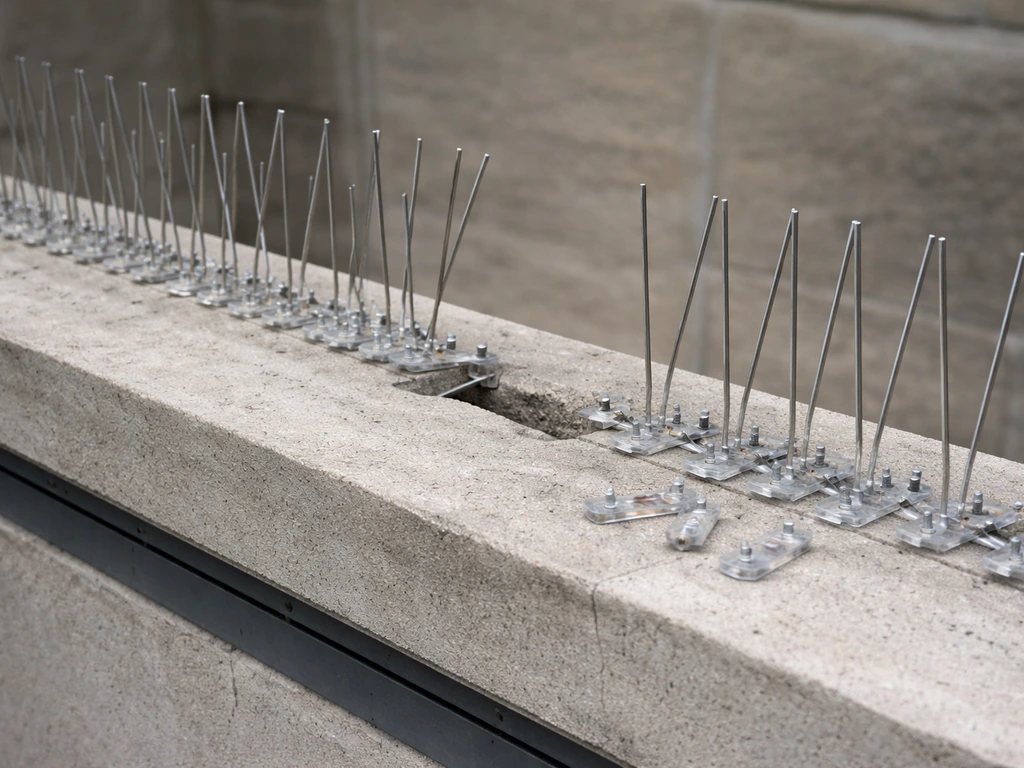
This is the section that matters most if you're evaluating a real installation. Several specific conditions elevate the risk of actual harm to birds, and they all come down to deviations from correct installation and maintenance.
- Gaps in spike coverage: Bird Barrier's own specifications state that space left between the ends of Dura-Spike strips "will present a landing opportunity." When birds land in those gaps, they can become partially wedged between spike sections, which is where entanglement and leg injuries become a real possibility rather than a theoretical one.
- Incomplete ledge coverage: Spikes need to cover the complete ledge. Partial coverage doesn't just reduce effectiveness, it can funnel birds into confined areas between spike strips where contact becomes more forceful and sustained.
- Nesting over damaged or sparse spikes: Bird Barrier's FAQ specifically warns that birds can build stronger nests using the spike structure as a scaffold when coverage is inadequate. A bird nesting in a spiked area with gaps faces sustained exposure to the rods, which can cause chronic foot or leg injuries over time.
- Incorrect overhang and setback: Installation specs for systems like Dura-Spike call for tips no more than 2 inches from the back wall and an overhang of at least half an inch past the ledge's outer edge. Deviations from these measurements change the geometry of the deterrence and can result in birds landing partially in the spike field rather than being redirected away from it.
- Species mismatch: Spikes are sized for specific bird species. A strip designed for pigeons may not deter smaller songbirds effectively, and a small bird that lands between rods sized for a larger species faces a different contact scenario than the one the product was designed for.
- Damaged or bent spikes: Rods that have been bent, broken, or corroded can create unintended sharp points or snag points that were not present in the original design.
The BC SPCA's best-practices guidance makes the point plainly: bird spikes must be properly placed to be effective. That statement carries a welfare implication too. Improper placement doesn't just fail to deter birds, it can actively create hazardous conditions that a correctly installed system would avoid entirely.
How to check your spike setup for humane, safer deterrence
If you have spikes already installed, or you're evaluating a site where spikes are in use, here's a practical inspection process. Bird-X's AviAngle manual requires periodic visual inspections and flags inadequate installation conditions as needing corrective action immediately. That's a reasonable standard to apply to any spike system.
- Walk the full length of every treated ledge and look for gaps between strip sections. Any gap wide enough for a bird to stand in is a problem. Fill gaps by adding sections or replacing damaged strips.
- Check that spikes extend to the back wall within the specified distance (typically no more than 2 inches for most ledge spike products) and overhang the outer edge by at least half an inch.
- Look for bent, broken, or corroded rods. These should be replaced, not just straightened, since bent metal changes the contact geometry in ways that can be more harmful than the original design.
- Look for nesting material. If birds have started building nests over or inside the spike array, the deterrent has failed and you have an active welfare problem. Remove nests carefully (checking local wildlife protection rules first) and address the installation gaps that made nesting possible.
- Check fastening. Loose spike strips can shift over time, creating gaps or redirecting rods in unintended directions. Verify screw counts and adhesion per the manufacturer's specifications.
- Reassess species. If the birds landing in or near the spikes are noticeably smaller or larger than the species the product was rated for, consider whether the spike gauge is appropriate for the actual bird population using the site.
The RSPCA also emphasizes monitoring to ensure deterrents do not trap birds. The RSPCA’s humane wildlife deterrents guidance notes that some deterrents, including netting, can trap or kill wild birds if they are not installed or maintained properly deterrents (specifically netting) can trap or kill wild birds. A visual check every few months, plus a more thorough annual inspection, is a reasonable maintenance schedule for most installations.
Bird-safe alternatives and coexisting solutions today
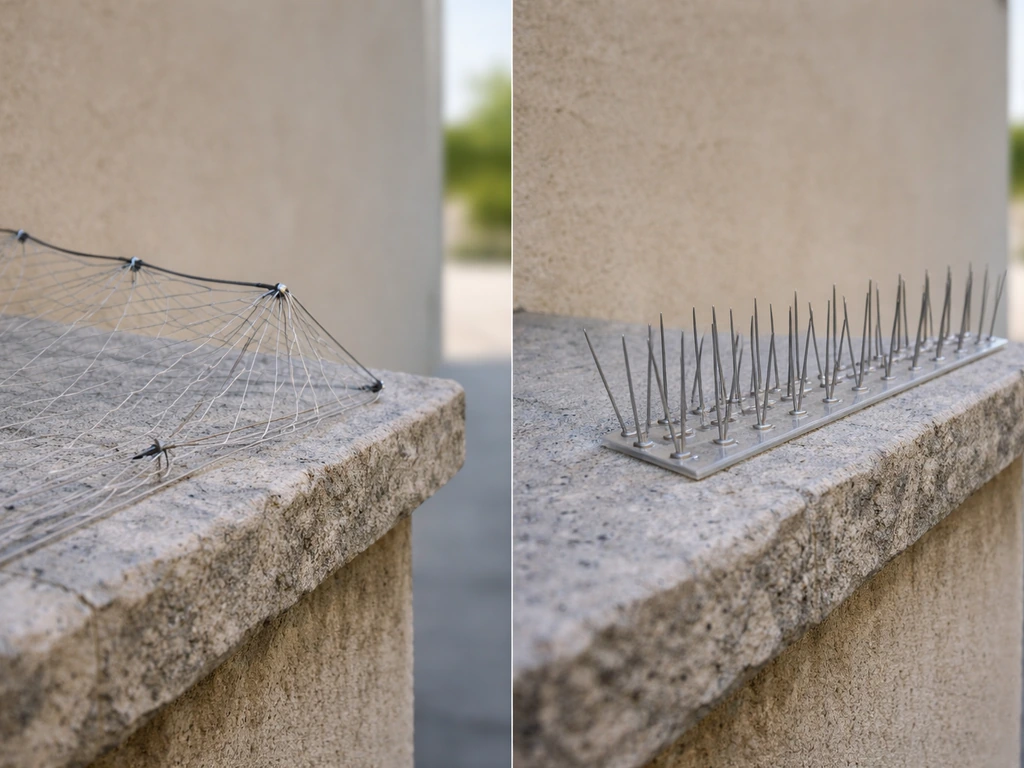
Spikes are not always the right tool, and in some situations a different approach will give you better deterrence with less risk. Here's a practical comparison of the main options alongside spikes.
| Method | How it works | Welfare risk | Best for | Limitations |
|---|
| Bird spikes | Physical exclusion via rod contact and footing disruption | Low when correctly installed; moderate when gaps or damage are present | Ledges, sills, rooflines with specific target species | Requires precise sizing, coverage, and maintenance; nesting risk if incomplete |
| Bird netting | Physical barrier preventing access to a defined area | Low to moderate; entanglement possible if incorrectly tensioned or maintained | Large open areas, eaves, fruit trees, aircraft hangars | Installation complexity; must be checked regularly for trapped birds |
| Ledge angle systems (e.g., AviAngle) | Converts flat ledge to 45-degree slope, removes stable footing | Very low; no rod contact involved | Architectural ledges where appearance matters | Higher install cost; surface-specific |
| Visual deterrents (reflective tape, predator decoys) | Startle/avoidance response | Negligible | Gardens, small structures, short-term situations | Birds habituate quickly; not reliable long-term |
| Acoustic deterrents | Distress or predator calls deter landing | Low physical risk; some stress | Large open areas, airfields | Noise limitations; habituation; not suitable for residential areas |
If you're considering netting as an alternative, it's worth understanding how the welfare risks differ. Questions about whether bird netting can harm birds follow similar logic to spikes: the product itself is not designed to injure, but installation quality and maintenance are what determine whether harm actually occurs. Along those lines, concerns about birds becoming trapped in netting are more commonly documented than entanglement in spike arrays, particularly when netting is installed with insufficient tension or not inspected regularly.
One often-overlooked consideration for installations near rooftop equipment: spike strips placed near satellite dishes or antenna mounts may affect signal reception if improperly positioned. If you're dealing with that scenario, it's a separate factor to weigh when deciding on placement, and there are resources specifically addressing how bird spikes interact with TV reception that are worth reviewing before finalizing your layout.
For most urban and suburban pigeon problems on ledges and sills, well-installed stainless steel spikes remain one of the most reliable and cost-effective solutions. For more sensitive sites, architectural nesting areas, or where visual impact is a concern, ledge angle systems or professional-grade netting are worth the additional investment.
What to do if birds are injured or dying near spikes
If you find a bird injured near a spiked surface, the first step is to assess whether the bird is in immediate danger from its current location. If it's on or near an active road, a cat's territory, or another hazard, carefully contain it in a ventilated box lined with a towel and place it somewhere warm, dark, and quiet. Do not attempt to give it food or water before getting professional guidance.
Contact your nearest licensed wildlife rehabilitator or a local SPCA/RSPCA branch as quickly as possible. These organizations have the training and legal authorization to handle injured wild birds, and in most jurisdictions it's actually illegal to keep a wild bird without the appropriate license. In the US, the USDA APHIS wildlife services offices can direct you to appropriate local resources. In the UK, the RSPCA's emergency line covers injured wildlife.
If you're finding multiple injured or dead birds near the same spike installation, that's a clear signal the installation has a problem. Document what you're seeing (photos of the spikes, location, species involved, dates) and report it to whoever manages the building or installation. Persistent harm from a single installation is almost always traceable to a specific installation defect, and fixing that defect is both the humane and the legally sensible course of action. Network Rail's guidance on working near protected birds, for instance, establishes that ongoing harm from building features that could be corrected is not a defensible position, and many countries have similar compliance frameworks.
After the immediate situation is handled, revisit the inspection checklist above. Identify the gaps, damaged rods, or coverage failures that allowed birds to make sustained contact with the spike array. In most cases, correcting the installation solves the problem entirely. If the site has conditions that make correct spike installation genuinely impractical (irregular ledge geometry, very high bird pressure from multiple species), switching to a different deterrent method altogether is a reasonable outcome, not a failure.