Yes, birds can be pests, but the label depends entirely on context. A bird becomes a pest when its presence causes damage, disease risk, or safety hazards that exceed what a person or community is willing to tolerate and that justify some form of management response. Not every pigeon on a ledge is a pest, and not every crow raiding a corn field qualifies for emergency action. The answer is genuinely situational, and that matters because it changes what you should do next.
Is Bird a Pest? When Birds Become Problem Species

Marcus Whitmore
23 Jul 2026
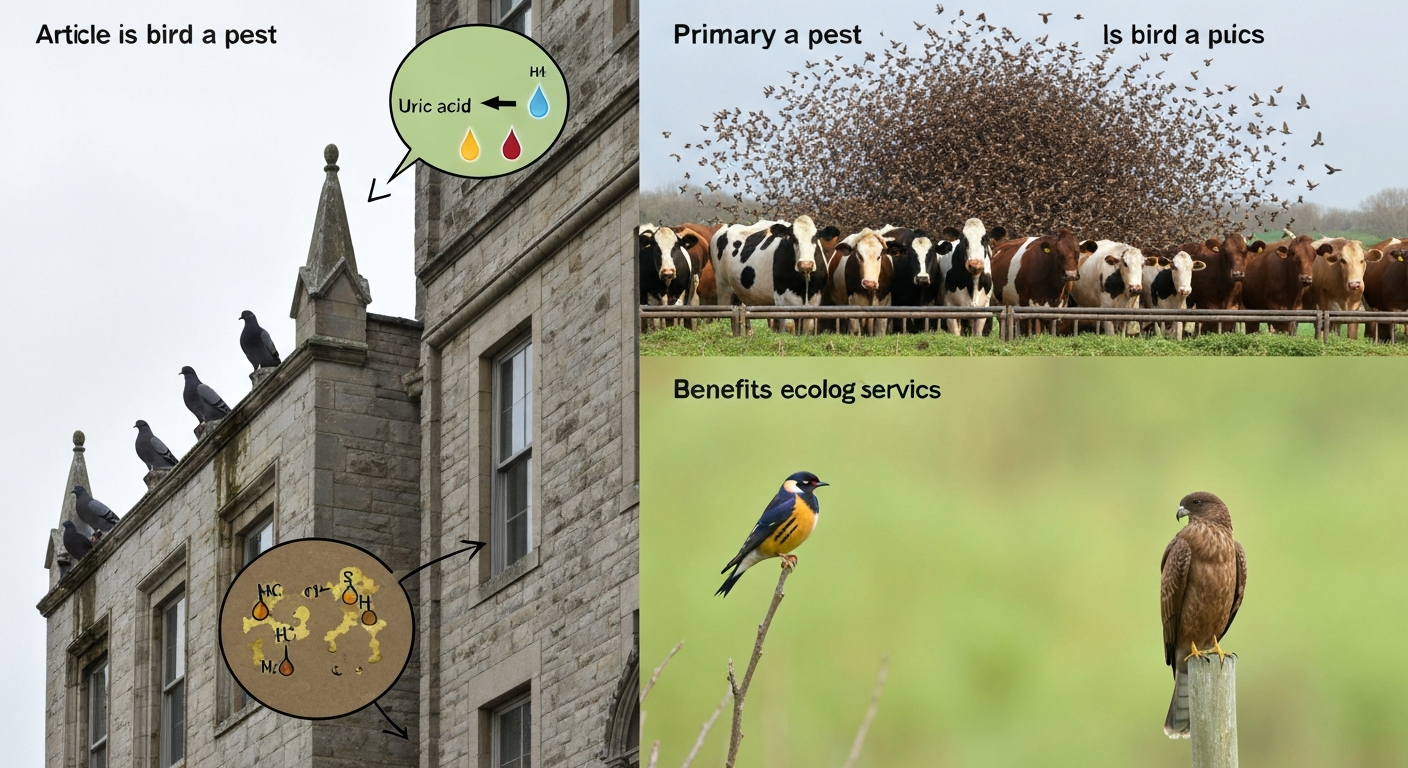
This article is written for anyone who has landed on that question with a practical concern: researchers trying to understand avian ecology, property owners dealing with roosting birds, farmers watching their stored grain disappear, aviation professionals managing airfield safety, and pet owners wondering what risks nearby birds might pose. I'll walk through the formal definitions, the most commonly implicated species, what the evidence actually says about real risks, how to assess whether you have a genuine problem, and what your legal and ethical options are.
What actually makes an animal a pest?
The word 'pest' gets thrown around loosely, but in regulatory and agricultural science it has a more precise meaning. The International Plant Protection Convention (IPPC), under the FAO, defines a pest as 'any species, strain or biotype of plant, animal or pathogenic agent injurious to plants or plant products.' That definition is specific to phytosanitary contexts, meaning it applies when you're evaluating damage to crops and plant materials. But the concept extends further in integrated pest management (IPM) literature, which frames a pest as any organism whose damage exceeds acceptable thresholds for a particular place, time, and management objective.
The threshold concept is important because it resists the reflex to label any nuisance animal as a pest requiring eradication. FAO-aligned IPM frameworks require you to actually measure damage and compare it against an economic or safety threshold before intervening. A few starlings at a bird feeder are not a pest situation. Ten thousand starlings consuming and contaminating stored total mixed rations on a dairy operation are. The difference isn't species, it's scale and measurable impact.
Outside of agriculture, similar threshold thinking applies to safety and public health. An urban pigeon flock that leaves occasional droppings on a park bench presents trivial risk. The same species roosting in dense numbers inside a warehouse ventilation system, where dried excreta can become aerosolized, is a documented occupational health concern. Context, scale, and exposure pathway determine whether 'bird' becomes 'pest.'
When and why birds get classified as pests
Birds earn pest status through a combination of ecological behavior, human land use, and economics. The classification is rarely permanent or universal. It depends on who is affected (a farmer, an airport, a heritage conservation officer), what the damage is (grain loss, aircraft collision risk, stone corrosion), and what management tools are available. USDA Wildlife Services, state extension programs, and international regulatory bodies all evaluate bird pest status through this kind of stakeholder-and-damage lens rather than by making blanket judgments about species.
Several conditions tend to push a bird species into pest territory: high population density near human infrastructure, dietary overlap with human food resources (grain, livestock feed, fruit), nesting behavior that conflicts with building use, congregation near aircraft movement areas, or disease reservoir status combined with frequent human contact. Non-native introduced species are disproportionately represented in pest classifications, partly because they often lack the natural predators and population controls that keep native species in ecological balance.
The species most frequently identified as pest birds
Multiple government and extension agencies, including USDA APHIS Wildlife Services and Cornell Cooperative Extension, consistently identify a short list of species responsible for the majority of documented agricultural and urban damage in North America and Europe. The pattern is clear and well-supported by survey data and longitudinal studies.
| Species | Primary pest contexts | Legal status in U.S. (MBTA) |
|---|---|---|
| European starling (Sturnus vulgaris) | Dairy/livestock feed depredation, grain contamination, aircraft strikes, fruit damage | Not protected (introduced species) |
| Rock/feral pigeon (Columba livia) | Urban fouling, infrastructure corrosion, stored food contamination, aircraft strikes | Not protected (introduced species) |
| House sparrow (Passer domesticus) | Grain loss, stored feed contamination, building fouling | Not protected (introduced species) |
| Canada goose (Branta canadensis) | Turf/grass damage, water contamination, aircraft strikes (large body mass = high strike risk) | Protected (MBTA); management requires permits |
| Common crow / American crow (Corvus brachyrhynchos) | Crop raiding (corn, other grain), orchard damage | Protected (MBTA); management requires permits |
| Red-winged blackbird / Common grackle | Concentrated sunflower and cereal crop damage, fruit damage in orchards | Protected (MBTA); management requires permits |
A few points are worth emphasizing about this list. The three non-native introduced species (starling, pigeon, house sparrow) receive the most management attention partly because they are legally easier to control in the United States without federal permits. The native protected species (geese, crows, blackbirds) require coordination with USFWS and/or state agencies before lethal control is permitted. That legal asymmetry shapes a lot of on-the-ground pest management decisions.
Starlings: a case study in scale
European starlings were introduced to North America in the 1890s and now number in the hundreds of millions. A USDA/UNL review, 'European Starlings: A Review of an Invasive Species with Far‑reaching Impacts,' summarizes their introduction to North America in the 1890s, their population expansion, documented agricultural impacts, and discusses earlier aggregate economic estimates such as those by Pimentel et al. (2000) USDA/UNL review — European Starlings: A Review of an Invasive Species with Far‑reaching Impacts (and discussion of Pimentel estimates). Their pest status in agricultural settings is well-documented. A producer survey in Washington State estimated bird-related feed losses at roughly $55 per cow in some regions. Longitudinal Ohio studies measured excreta contamination of stored total mixed rations, projecting measurable impacts on milk production. Large dairy operations hosting thousands of foraging starlings have reported case-level losses running into tens of thousands of dollars. Starlings also appear repeatedly in the U.S. wildlife strike database for aircraft. Whether or not you find them worth worrying about depends almost entirely on where you are and what you're protecting, but the data on their impact in high-density agricultural contexts is solid.
Blackbirds and crop damage
Red-winged blackbirds, common grackles, and some related species cause concentrated damage to fruit, sunflower, and cereal crops. Proceedings from the Vertebrate Pest Conference document repeated, localized crop losses and generally recommend exclusion netting and targeted harassment as cost-effective first responses for high-value fruit crops. The damage is real and well-measured, but it tends to be highly localized rather than uniformly distributed across farming regions.
Pigeons and urban infrastructure
Feral pigeons are documented as causing physical and chemical deterioration of urban infrastructure. The chemistry is specific: uric acid in pigeon excreta reacts with limestone, marble, copper, and bronze surfaces, forming copper urates and accelerating stone decay. Heritage science literature (including work by Bernardi and colleagues) has demonstrated these reactions experimentally. In practical terms, this means that dense pigeon roosts on historic stone buildings, copper-clad roofs, and bronze outdoor sculptures represent a genuine conservation and maintenance cost, not just an aesthetic complaint.
Invasive birds: what the term means and how it creates pest problems
Invasive and pest are related but not identical concepts. The IUCN and Convention on Biological Diversity define an invasive alien species as a taxon introduced outside its native range by human actions that establishes, spreads, and causes negative impacts on biodiversity, ecosystem services, or human economy. An invasive species becomes a pest when those negative impacts cross the threshold described earlier: measurable damage to agricultural production, built infrastructure, native biodiversity, or human health and safety.
Common introduction pathways for invasive birds include intentional release (the European starling in North America was a deliberate introduction), escape from captivity (parakeets and parrots in European cities), and range expansion facilitated by habitat modification. Once established, introduced birds often lack the predator pressure and resource competition that regulate their populations in their native ranges, which is one reason they can build up in numbers that create pest-level impacts. Starlings, pigeons, and house sparrows are the canonical examples in Western contexts.
Invasive species risk assessments, as outlined in IUCN guidance, combine pathway analysis, establishment potential, spread rate, and measurable impacts before triggering regulatory or management action. This matters practically: not every introduced bird causes damage, and not every introduced bird that causes some damage warrants a costly management response. The framework asks for evidence of impact at a level that justifies intervention.
The real risks pest birds pose
Agricultural crop and feed damage
The economic impact of birds on agriculture is real but frequently overstated in popular reporting. Widely cited aggregate figures from Pimentel and colleagues (2000) estimated losses from starlings and house sparrows at roughly $800 million to $1 billion annually, but those numbers are broad, dated, and based on extrapolations that other researchers have flagged as methodologically uncertain. More recent, site-specific studies paint a more granular picture: starling depredation at large dairies can be economically significant for individual operations, and regional grain-loss surveys for house sparrows report losses in the range of 2 to 12 percent in localized farmland studies. The take-home is that damage is real and measurable at the farm level, but blanket national-scale figures should be treated with appropriate skepticism.
Property fouling and corrosion
Beyond aesthetics, large volumes of bird droppings cause genuine structural and chemical damage. Dense accumulations on metal roofing and HVAC systems can block drainage, retain moisture, and accelerate corrosion. The uric acid chemistry described for pigeons applies to any species that roosts in large numbers on a surface over time. Cleaning costs for commercial buildings with significant pigeon roosts can run into thousands of dollars annually, and in heritage contexts the damage to irreplaceable stone and metal can be permanent.
Disease transmission
The disease picture deserves a calm, evidence-based reading. CDC and NIOSH guidance identifies three main pathogens of concern in bird dropping accumulations: Histoplasma capsulatum (a soil and organic-matter fungus that thrives in large accumulations of bat and bird droppings), Cryptococcus neoformans (a yeast associated with pigeon droppings), and Chlamydia psittaci (the bacterium causing psittacosis, primarily a risk from psittacine birds but documented in other species). The reality is that casual outdoor exposure to bird droppings carries very low risk for healthy adults. Risk becomes meaningful in specific high-exposure scenarios: workers disturbing large, dry accumulations in enclosed spaces like attics, crawlspaces, or decommissioned structures. In those contexts, NIOSH recommends respirators and controlled cleanup procedures. For most people in most situations, bird droppings are a sanitation issue, not a health emergency.
Threats to pets
For pet owners, the most practical concern is disease exposure through contaminated water sources (bird droppings in standing water, birdbaths shared with wildlife) and, for small pets kept outdoors, predation risk from raptors. Psittacosis is a real risk for pet birds that share airspace or contact with wild birds carrying Chlamydia psittaci. Salmonella contamination from wild bird droppings around outdoor feeding stations has been documented and can affect pets that investigate or consume the droppings. These are manageable risks with basic sanitation, but they are worth knowing about.
Bird strikes and aviation safety
Bird-aircraft collisions are the aviation industry's most extensively documented wildlife hazard. USDA APHIS Wildlife Services maintains the National Wildlife Strike Database, which records thousands of strikes annually in the United States alone. Canada geese represent a disproportionate risk because of their large body mass: a single strike from an adult Canada goose can cause catastrophic engine or airframe damage. Rock pigeons and European starlings appear frequently in the database due to their abundance at and near airports. The economics are substantial, combining aircraft repairs, schedule disruptions, and the cost of airport wildlife hazard management programs. Aviation professionals and airport operators are legally required under FAA guidance to assess and manage wildlife hazards, and bird species identification is a core competency in that work.
Birds also do a lot of good, here's the balance sheet
A complete picture of birds and pest status requires acknowledging what birds contribute, not just what they damage. This is not a rhetorical gesture: ecosystem services from birds are documented and economically significant in their own right, and they affect the cost-benefit analysis of management decisions.
- Insect pest control: many bird species (barn swallows, purple martins, warblers, chickadees) consume enormous quantities of insects that would otherwise damage crops, gardens, or cause human nuisance. A single purple martin colony has been estimated to consume millions of insects over a breeding season.
- Seed dispersal and pollination: frugivorous birds disperse seeds across landscapes, contributing to forest regeneration. Hummingbirds and some other species are documented pollinators of native plant species.
- Carrion removal: vultures and corvids perform rapid carcass processing that reduces disease transmission from rotting animal matter.
- Rodent control: owls, hawks, and kestrels are effective predators of mice, voles, and rats, providing biological control in agricultural landscapes.
- Recreational and cultural value: birdwatching is one of the most popular outdoor recreation activities in the United States, generating billions of dollars annually in equipment, travel, and associated spending.
The point is not that pest birds are secretly beneficial and shouldn't be managed. It's that management decisions should be made with the full picture in view. Removing all corvids from an agricultural area to reduce grain raiding might also remove a population of rodent predators that was providing net benefit. IPM frameworks are designed to account for exactly this kind of interaction.
How to assess whether you actually have a bird problem
Before calling a pest control company or reaching for deterrents, it's worth running through a structured assessment. The guidance from USDA Wildlife Services, UC ANR IPM, and Cornell Cooperative Extension all converge on the same basic framework: identify, measure, contextualize, then respond proportionately.
- Identify the species: Are these protected native birds under the Migratory Bird Treaty Act, or introduced non-native species with no federal protection? This determines your legal options before anything else.
- Quantify the damage: Estimate feed loss in weight or cost, document roof or building fouling area, photograph crop damage, or record aircraft strike incidents. Impressions are not enough — you need a number to compare against a threshold.
- Assess the scale: How many birds are present? Is it a small transient group or a resident roost? Population counts or estimates help determine whether the problem is seasonal or year-round.
- Check seasonality and recurrence: Is this a predictable seasonal pattern (migrating flocks stopping over) or a persistent established roost? Seasonal problems often resolve with minor habitat modification; established roosts require more active intervention.
- Identify attractants: What is drawing the birds? Exposed feed, open water, roosting ledges, artificial lighting at night, or nearby natural habitat? Removing attractants is almost always more effective long-term than deterrence alone.
- Evaluate exposure pathways for health risk: Are droppings accumulating in enclosed spaces where aerosolization is possible? Is there a pet or immunocompromised person with frequent exposure? Higher-risk scenarios warrant faster action.
- Consider proximity to aviation: If you manage or work at an airport or near approach/departure paths, bird activity should be documented and reported through established Wildlife Strike reporting channels regardless of immediate damage.
Non-lethal ways to manage bird problems
The regulatory and scientific consensus is that non-lethal methods should be the first line of response in almost all situations. They are often effective, they avoid the legal complexity of lethal control for protected species, and they tend to produce more durable results because they address the underlying attractants rather than just removing individual birds. Here is a practical overview of the main approaches.
- Exclusion netting: Physical netting over crops, building facades, loading dock openings, or roof spaces is one of the most effective tools available. When properly installed, it prevents access without harming birds. It requires maintenance and correct specification for the target species.
- Habitat modification: Removing or modifying what attracts birds — covering feed storage, eliminating standing water, removing invasive fruiting plants, trimming trees used as roost sites — produces lasting reductions in pressure that deterrents alone cannot match.
- Physical deterrents: Spikes, angled ledge systems, and wire systems prevent perching and roosting on specific surfaces. These are well-suited to ledges, signs, and HVAC equipment. They are not appropriate in all contexts and require correct installation.
- Auditory and visual deterrents: Distress calls, propane cannons, reflective tape, and predator decoys can be effective for short periods, particularly on open agricultural land, but birds habituate to static or repetitive stimuli quickly. Rotating methods and using them in combination improves efficacy.
- Hazing: Active hazing using trained dogs (border collies are commonly used for geese management), drones, or human disturbance can disperse birds from specific areas. Airport wildlife managers use hazing as a primary non-lethal tool.
- Sanitation: Regular cleaning of droppings and removal of nesting materials from buildings reduces reinfestation pressure and eliminates the disease risk from accumulated material. Large enclosed accumulations require PPE and professional handling.
- Feed management: On farms and dairies, covered feed storage and rapid cleanup of spilled grain removes the primary attractant for starlings, sparrows, and pigeons.
When to escalate: wildlife control, public health, and aviation authorities
Most bird problems can be managed with the on-site steps described above. But there are specific situations where professional or regulatory involvement is appropriate or legally required.
- Call a licensed wildlife damage management professional if: non-lethal methods have been applied consistently for at least one season without adequate reduction in damage; the species involved is legally protected and lethal control is being considered; or the scale of the problem (thousands of birds, significant structural or agricultural damage) exceeds the resources of a typical property owner.
- Contact your state or local health department if: workers or residents are regularly exposed to large, enclosed accumulations of bird droppings in poorly ventilated spaces; a respiratory illness cluster occurs among people who have been disturbing such accumulations; or you find a large number of dead birds of unknown cause, which may warrant disease surveillance.
- Report to aviation authorities if: you experience or witness a bird strike at or near an airport; you identify a persistent bird aggregation (especially large-bodied species like geese or herons) on or near an airfield. In the U.S., the FAA Wildlife Strike Reporting System (STRIKE) is the formal channel. Airport operators have a regulatory obligation to maintain wildlife hazard management plans.
- Contact USFWS or your state wildlife agency before taking any lethal action against a species you believe may be protected under the Migratory Bird Treaty Act. Misjudging the legal status of a species can result in significant penalties.
Legal and ethical considerations you need to know
In the United States, the Migratory Bird Treaty Act (MBTA) protects most native bird species from take, possession, and disturbance of active nests. The three most commonly managed pest species (European starling, rock pigeon, and house sparrow) are not covered by the MBTA because they are non-native introduced species. However, this exemption does not mean anything goes: state-level protections may still apply, and methods of control that result in the incidental take of protected species can still trigger liability.
For native protected species, including Canada geese, crows, and virtually all native blackbirds, any lethal control requires a federal depredation permit from USFWS and often a state permit as well. Permit applications require documentation of damage, evidence that non-lethal methods have been tried, and a management plan. Canada geese have specific additional regulations governing nest and egg destruction during the breeding season.
Ethical practice goes beyond legal minimum compliance. IPM frameworks emphasize proportionality: the management response should match the scale and severity of the problem. Lethal control of thousands of protected birds to prevent minor nuisance damage is ethically indefensible and practically counterproductive, as it depletes non-target species and often fails to address the underlying attractants. Record-keeping is both a legal and an ethical responsibility: document what species you observed, what damage occurred, what methods you used, and what the outcome was. This creates accountability and provides data that improves future management.
Clearing up common confusions and sibling questions
Are starlings a nuisance bird?
Yes, in a documented and economically meaningful sense in the right context. European starlings are among the best-studied pest bird species in North America, with solid evidence for feed depredation at dairies, grain contamination, orchard damage, and aircraft strike risk. They are not protected under the MBTA in the U.S., which makes them the most legally accessible target for control. Whether they are a nuisance on your specific property depends on whether they're present in numbers that cause measurable damage to something you care about. For a concise answer to the question 'are starlings a nuisance bird', see the dedicated clarification in this article for context-specific guidance.
The 'black bird problem'
When people search for information about black bird problems, they're usually thinking about crows, grackles, starlings, or red-winged blackbirds. The actual pest management picture varies by species. Crows and ravens are highly intelligent, legally protected native birds that are challenging to deter; any control beyond hazing and exclusion requires permits. Starlings and grackles have stronger documentation of crop and feed damage. All of these species tend to form large flocks in fall and winter, which is when most complaints peak.
Examples of pest birds
The table earlier in this article covers the most commonly cited examples with evidence for each. See examples of bird pest for a longer list and species-specific impacts. Beyond that list, mute swans are increasingly managed as invasive pests in parts of the eastern United States due to their impact on aquatic vegetation and aggressive behavior near waterfowl. Monk parakeets (Myiopsitta monachus) are an established invasive species in Florida and parts of the eastern U.S. with documented impacts on agricultural crops and electrical infrastructure from their large communal nests.
What does 'invasive bird' mean?
An invasive bird is a species introduced outside its native range (usually by human action, deliberately or accidentally) that establishes a self-sustaining wild population and causes measurable negative impacts. This is a narrower definition than simply 'non-native': many non-native species are present in areas outside their natural range without causing significant harm. The invasive label requires demonstrated impact. For a concise invasive bird meaning, this article defines it as an introduced species that establishes self-sustaining populations and causes measurable negative impacts. European starlings, house sparrows, and feral rock pigeons meet that standard clearly in North America.
The Plague Inc question: is it a bird?
If you found this article while trying to answer a question from the game Plague Inc., you are in the wrong place in the best possible way. In Plague Inc., the 'Is it a bird?' question is a gameplay mechanic about transmission routes for your fictional pathogen, not a real ornithological question. Real bird-transmitted diseases exist (avian influenza being the most significant), but the game's scenarios are fictional and have no bearing on actual bird pest management. If you're curious about real disease risks from birds, the disease transmission section above is where to look. If you meant the in-game question rather than real-world biology, see Plague Inc.'s 'Is it a bird?' gameplay mechanic for how the game models transmission routes.
The 'two trains and a bird' puzzle
This one comes from mathematics, not ornithology. The classic 'two trains and a bird' puzzle is a mental arithmetic problem: two trains travel toward each other at set speeds, and a bird flies back and forth between them until they meet. The question asks how far the bird traveled. The elegant solution bypasses the infinite series calculation by simply computing the bird's flying time multiplied by its speed. It is a genuinely charming puzzle, but it has nothing to do with bird pest management or bird biology.
Where to go from here
If you've read this far, you should be in a position to make a clear-eyed judgment about your situation. The core question, whether a bird is a pest, has a useful answer: it depends on species, scale, context, and what damage is actually occurring. The evidence-based path forward is to identify the species, document the damage, exhaust non-lethal options first, and then navigate the legal framework for whatever comes next.
- For researchers: USDA APHIS Wildlife Services publishes species-specific damage management guidance documents that are peer-reviewed and regularly updated. FAO's IPM resource library covers threshold-based pest assessment methodology in depth.
- For pet owners: Consult your veterinarian if you suspect your pet has been exposed to wild bird droppings, particularly if your pet is a bird that may have had contact with wild psittacine species. Basic sanitation around outdoor water and food stations significantly reduces exposure risk.
- For aviation professionals: The FAA Wildlife Strike Database and USDA Wildlife Services Airport Wildlife Hazards Management Program provide the authoritative framework for strike reporting, species identification, and wildlife hazard management plan development.
- For property owners: UC ANR IPM and Cornell Cooperative Extension both provide free, publicly accessible, species-specific management guidance for common pest birds including pigeons, starlings, and geese.
- For farm operators: USDA Wildlife Services offices in each state can provide free technical assistance for assessing bird damage and designing non-lethal management systems before considering permit applications for lethal control.
Bird Mortality Guide covers the full range of questions that sit at the intersection of bird biology, human safety, and evidence-based risk assessment. Whether you're trying to understand what actually harms birds, what risks birds pose to people and pets, or how to separate folklore from documented fact on topics like this one, the goal here is always the same: give you the real answer, with the evidence behind it.
FAQ
What makes an animal a “pest”?
A pest is a contextual, socio‑economic designation: any species whose presence or activity causes unacceptable harm (economic loss, health/safety risk, environmental damage or interference with human objectives) at a particular place and time. Integrated Pest Management (IPM) frames pests by measured damage versus thresholds and calls for proportionate responses.
Is a bird a pest?
A bird becomes a pest when its behavior causes measurable, unacceptable impacts — for example crop or feed loss, structural fouling or corrosion, disease risk from accumulated droppings, threats to companion animals, or safety hazards such as bird strikes at airports. Whether a species is a pest depends on context, scale and local thresholds.
Which bird species are most often classified as pests?
Commonly implicated species include European starlings, rock/feral pigeons, house/English sparrows, Canada geese, and some corvids (crows, grackles, blackbirds). These species frequently appear in agricultural, urban and aviation damage records.
What is an invasive bird and how does that relate to being a pest?
An invasive alien species is a taxon introduced outside its native range by humans that establishes, spreads and causes negative impacts on biodiversity, ecosystems or human well‑being. Many invasive birds (e.g., European starling) become pests where their abundance and novel behaviors create measurable damage or displacement of native species.
What real risks do pest birds cause?
Documented risks include: agricultural losses (fruit, grain, feed contamination), fouling and chemical corrosion of buildings and outdoor metalwork from guano, localized disease risks from accumulations of droppings (histoplasmosis, cryptococcosis, psittacosis) especially in enclosed sites, predation or conflict with pets, and serious safety and economic impacts from bird–aircraft strikes.
How common are disease risks from bird droppings?
Disease transmission to the public from casual outdoor contact is low. The principal concern is inhalation of dust from dried, concentrated droppings in enclosed or occupational settings (attics, barns, long‑used roosts). For large accumulations, agencies recommend controlled cleanup with respiratory protection and trained personnel.