
An invasive bird is a species introduced outside its native range that has established a self-sustaining population and is causing, or is likely to cause, measurable harm to the environment, the economy, or human health. That last part matters: a bird is not invasive just because it showed up somewhere new, and it is not invasive just because it is aggressive or loud. [The U. S.
Invasive Bird Meaning: Definition, Types, and What to Do

Marcus Whitmore
18 Jun 2026
Geological Survey defines an invasive species](https://www. usgs. gov/faqs/what-invasive-species-and-why-are-they-a-problem? page=0) as an introduced, nonnative organism that spreads beyond its original introduction site and can harm the environment, the economy, or human health.
The ecological label requires evidence of harm, and understanding that distinction changes how you should respond when you spot an unfamiliar species in your yard, at an airport, or near a wildlife area.
What 'invasive' actually means in ecology

The word gets misused constantly, so it is worth being precise. The U.S. National Invasive Species Information Center (NISIC) defines invasive species as non-native organisms whose introduction causes or is likely to cause economic or environmental harm, or harm to human health. USGS adds a useful layer: the species must also be spreading or expanding its range from the point of introduction. Executive Order 13112, the federal order that shapes U.S. invasive species policy, uses nearly identical language. The IUCN frames it similarly at the global level, describing invasive alien species as those introduced outside their natural range that negatively impact native biodiversity or ecosystem services.
Three things need to be true at once: the species arrived from outside its native range, it is now reproducing and spreading without human help, and it is causing documented or reasonably anticipated harm. A single escaped parrot that does not survive the winter is not invasive. A flock of European Starlings displacing native cavity-nesting birds across an entire continent very much is.
Invasive vs. non-native vs. introduced: the terms are not interchangeable
This is one of the most common points of confusion, and it is worth clearing up because the label you use determines how authorities respond and what options you have.
| Term | What it means | Example |
|---|---|---|
| Non-native (alien) | Arrived outside its native range, by any means | Ring-necked Pheasant in North America |
| Introduced | Deliberately or accidentally brought by humans | European Starling, released in New York in 1890 |
| Established | Reproducing successfully without human support | House Sparrow populations across the U.S. |
| Feral | Domesticated or captive animals living wild | Escaped Monk Parakeets nesting in utility poles |
| Invasive | Non-native, established, AND causing measurable harm | Common Myna displacing native birds in Australia |
A species can be non-native without being invasive. The Ring-necked Pheasant is non-native in North America but is generally not considered ecologically invasive because its populations depend heavily on human management and its impacts on native species are limited. By contrast, the European Starling ticks every box: introduced, self-sustaining, and actively competing with native cavity nesters like bluebirds and woodpeckers for nest sites. The reality is that calling any unfamiliar bird 'invasive' is a judgment call that requires evidence, not just novelty or nuisance behavior. Starlings are often described as nuisance birds, but whether they count as invasive depends on whether they are harming native ecosystems or human health in your area.
Why invasive birds spread, and the damage they do

Invasive birds thrive for predictable reasons. They tend to be generalist feeders that can exploit a wide range of food sources. They often tolerate human-modified landscapes, which means urban sprawl, agriculture, and deforestation actually work in their favor. Most critically, they arrive in environments where local predators and competitors have no evolutionary experience with them, so the natural checks that kept their populations in balance back home simply do not exist.
The ecological damage runs across several categories. Competition is the most studied: invasive birds take nest sites, food, and territory from native species that cannot adapt fast enough. Predation is a serious issue on islands especially, where ground-nesting seabirds evolved without mammal predators and are devastated by introduced species. Habitat alteration happens when invasive birds change vegetation through heavy grazing, roost fouling, or seed dispersal of invasive plants. Disease transmission is a lesser-discussed but real pathway, as introduced birds can carry pathogens and parasites that native species have no immunity to. At a larger scale, competitive exclusion can reduce local bird diversity measurably over decades.
Common examples and how to spot them in your area
In North America, the three most frequently cited invasive or highly problematic introduced bird species are the European Starling, the House Sparrow, and the Monk Parakeet. In Australia, the Common Myna and Rose-ringed Parakeet cause significant native bird displacement. In Hawaii, a long list of introduced passerines has contributed to the extinction of dozens of native honeycreepers. In Europe, the Rose-ringed Parakeet has established large feral populations in the UK, Spain, and Belgium.
Identifying whether a bird is genuinely invasive in your specific location requires more than a field guide. The same species can be invasive in one region and non-native but benign in another, depending on what native species are present and whether the ecology is vulnerable. Your best tools are the eBird range maps maintained by the Cornell Lab of Ornithology, your state or country wildlife agency's official invasive species list, and iNaturalist observation records filtered to your county or region. These sources show not just whether a species exists in your area but whether its population is expanding, which is the ecological red flag.
- European Starling: chunky, short-tailed, iridescent black plumage with white speckles in winter; loud, mimics other birds; forms massive murmurations in winter
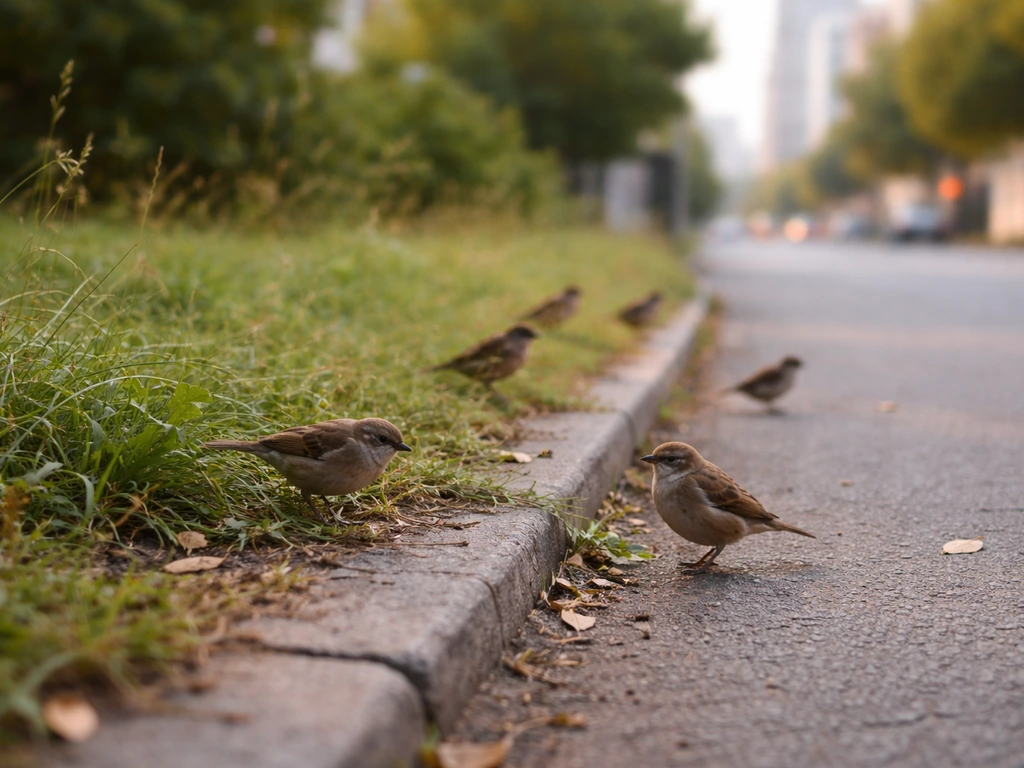
- House Sparrow: small, streaky brown, thick bill; males have a black bib; nests in cavities and building crevices; extremely common near human structures
- Monk Parakeet: bright green with a grey chest, long tail, loud call; builds large stick nests communally, often on utility poles or stadium lights
- Common Myna (relevant in Australia, Hawaii, parts of South Africa): brown body, black head, yellow eye patch and bill, white wing patches visible in flight
- Rose-ringed Parakeet: bright green, long tail, red-and-black ring around neck of males; established in urban parks across Western Europe and parts of the Middle East
If you are trying to determine whether a bird you are seeing qualifies as a pest species in a broader sense, that question overlaps with but is not identical to the invasive label. Starlings and House Sparrows, for instance, are widely classified as pest birds even in regions where their ecological invasiveness is debated.
Real human safety risks, and the ones that are mostly myth
Invasive birds do create genuine human safety and health concerns, but the risks vary significantly by context. Separating real hazards from folklore helps you respond proportionately.
Aviation and bird strikes
This is one of the most serious and well-documented risks. Large flocks of starlings and other gregarious species create significant bird strike hazards at airports. The FAA's Wildlife Strike Database records thousands of bird-aircraft collisions annually in the U.S. alone, with flocking species disproportionately represented because a single encounter can involve dozens or hundreds of birds simultaneously. Aviation professionals and airport wildlife managers treat invasive, flock-forming species as a priority hazard, which is one reason starling management around airports is actively funded and regulated.
Disease and contamination
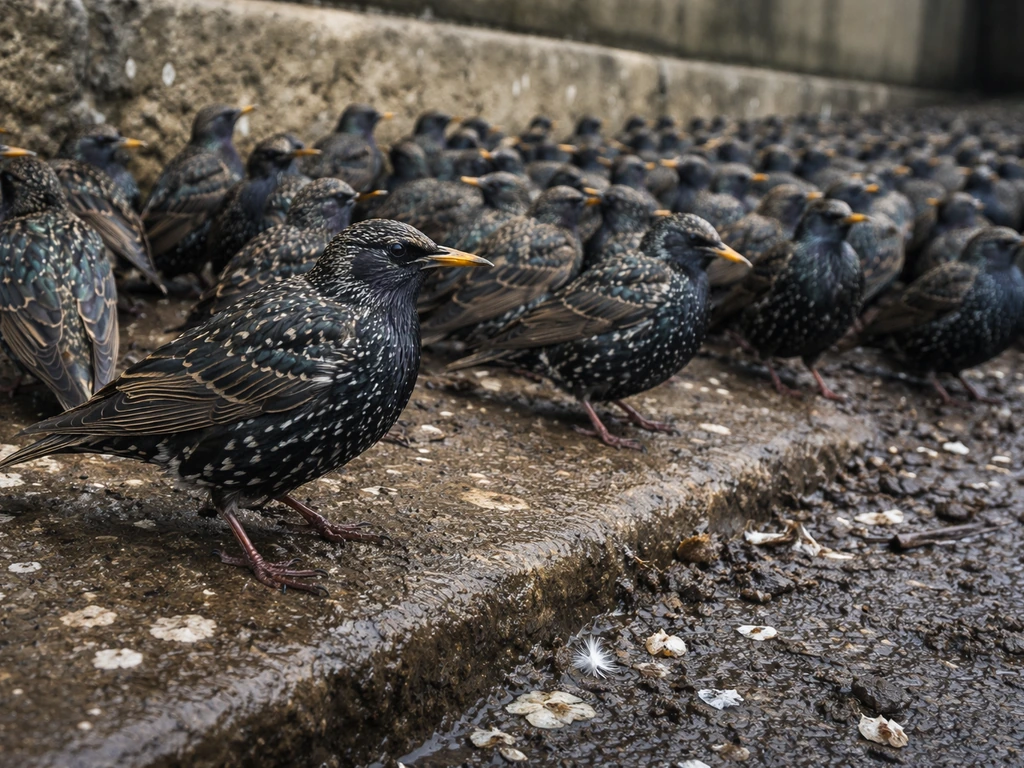
Large roosts of invasive birds, particularly starlings, produce significant volumes of droppings that can contaminate soil and water sources. Histoplasma capsulatum, the fungus that causes histoplasmosis, grows in nitrogen-rich bird droppings and can cause serious respiratory illness in humans who disturb dried roost material. This is a real, documented risk for anyone cleaning up large roost sites without appropriate respiratory protection. Salmonella transmission via feeders frequented by House Sparrows is also documented. The risks are real but are specific to exposure scenarios, not casual proximity.
Attacks, bites, and property damage
Direct attacks on humans by invasive birds are rare. Monk Parakeets can bite if handled, but they do not typically attack people unprovoked. Property damage from large roosts is concrete and costly: acidic droppings degrade building materials, clog gutters, and damage vehicles. Noise from communal roosts can be significant. These are nuisance and economic concerns more than acute safety threats. If you are searching for information about aggressive bird behavior more broadly, that question is somewhat separate from the invasive species discussion. The black bird problem is similar in that not every aggressive or nuisance bird is automatically invasive without evidence of ecological harm.
The myth: 'invasive birds are dangerous because they're aggressive'
The reality is that invasiveness is an ecological category, not a behavioral one. Plague Inc. Is It a Bird is a game premise people use to talk about how disease spreads, which can confuse players about what “invasive” means in real ecology plague inc is it a bird. A bird can be ecologically invasive and completely indifferent to humans. Conversely, a native bird defending a nest can be far more aggressive than any introduced species in your yard. Do not assume an invasive species is a direct personal threat, and do not assume an aggressive bird is invasive.
What to do if you think you're dealing with an invasive bird
The most important first step is confirming that the species is actually invasive in your specific location, using the resources above. Once you have done that, your options depend heavily on the scale of the situation and your jurisdiction.
- Verify the species: Use eBird, iNaturalist, or your state or national wildlife agency's invasive species list to confirm the bird is established and listed as invasive in your area, not just non-native or unfamiliar.
- Report the sighting: Most wildlife agencies have online reporting tools for invasive species observations. In the U.S., you can report via the NISIC or your state's department of fish and wildlife. In the UK, the Non-Native Species Secretariat maintains a reporting portal. Early detection data genuinely helps management responses.
- Contact the right authority: For property damage or roosting issues, contact your state or local wildlife agency or a licensed wildlife control professional who specializes in avian conflicts. For aviation-related bird hazards, airport wildlife biologists and FAA Wildlife Strike Reporting are the correct channels.
- Do not attempt DIY trapping or handling: Many invasive bird species are protected in certain jurisdictions despite their status, and federal laws like the Migratory Bird Treaty Act have exceptions that are not always intuitive. Handling birds without permits can expose you to legal liability and disease risk.
- Do not feed them: Supplemental feeding increases local population density and can accelerate range expansion. If you suspect invasive birds are using your feeders, removing food sources is the single most effective thing you can do at the individual level.
- Modify habitat where possible: Blocking nest entry points, using bird-deterrent materials on ledges and roost sites, and removing food attractants are legal, evidence-based steps that do not require permits in most jurisdictions.
If your concern is more about pest bird behavior in general rather than ecological invasiveness specifically, your local cooperative extension service or a certified wildlife biologist can help you navigate whether your situation calls for a management plan, simple habitat modification, or just a clearer identification of what you are actually seeing. For readers looking for practical context, there are clear examples of bird pest behavior that overlap with invasive species risks pest bird behavior. The invasive label carries real legal and ecological weight, and getting it right matters both for your response and for the data quality of the broader conservation record.
FAQ
If a bird shows up in my area but does not seem to spread, does that still count as an invasive bird?
A bird can be non-native and still not meet the invasive definition because the key requirement is measurable harm (or a reasonable likelihood of harm) plus a self-sustaining, spreading population. If the bird is present but declines after seasonal conditions, it is generally not treated as invasive.
What’s the safest way to confirm an “invasive bird meaning” situation before taking action?
For species identification, rely on multiple traits (size, beak shape, call, and nesting behavior) and cross-check with region-specific records. A bird that looks similar to an invasive species may be a native relative, and mislabeling can lead to the wrong actions.
Can the same bird be invasive in one state but not invasive in another?
Yes, the invasive label is location-specific. A species may be invasive where it lacks natural checks and native competitors are vulnerable, but behave differently in other regions due to climate, predators, and available habitat.
If invasive birds are dangerous to people, does that automatically mean any bird that seems risky is invasive?
Health and safety concerns do not always equal invasive status. Bird strike risk, droppings exposure, and salmonella from feeders are hazard pathways, but a bird still needs ecological evidence of harm (or likely harm) to be classified as invasive.
How should I decide whether my problem is ecological harm (invasive) versus nuisance or pest behavior?
Start with what you are seeing, then determine the threat pathway. For airport-scale bird strike risks, timing around migration and large roost formation matters. For backyard issues, the practical question is whether the bird is displacing native nesters or simply behaving as a nuisance.
What legal or permitting issues should I be aware of before trying to control a suspected invasive bird?
Most jurisdictions require reporting or permits for removal, especially for established populations. In many places, it is illegal to handle, transport, or kill protected native birds, and invasive control often has specific rules about methods and seasons.
Are eBird or iNaturalist sightings enough to classify a bird as invasive where I live?
Use your wildlife agency’s invasive species list and verify whether the species is documented as expanding in your county or region. Citizen observations help, but you should treat them as supportive evidence until they align with official invasive listings and range trends.
If a bird aggressively defends its nest in my yard, does that mean it’s an invasive bird?
Not necessarily. If the bird is aggressive only when defending a nest, it may be native and invasive rules may not apply. The invasive concept focuses on non-native origin, self-sustaining spread, and harm to ecosystems, not on temperament toward people.
Should I stop bird feeding if I suspect an invasive bird is visiting my yard?
Feeding can increase local activity of certain introduced species, but the invasive risk comes from broader ecological impacts like nest-site competition or spreading. If you have invasive birds around feeders, consider reducing or removing attractants while also confirming whether they are harming native species.
Who should I contact if I think there is an invasive bird problem at a site near my home?
Contact a certified wildlife biologist or your state or local wildlife agency for location-specific guidance, especially for large roosts or when health exposure is a concern. If you cannot identify the bird with confidence, reporting helps, and they can advise on next steps without you risking unsafe handling.