Bird banding is not inherently cruel. When done by trained, permitted banders following established welfare protocols, the evidence consistently shows that injury rates are low, stress is brief and recoverable, and long-term survival is not meaningfully reduced. The honest answer, though, is that it depends heavily on how it's done: band fit, handling time, species-appropriate technique, and bander competency are the variables that separate responsible science from genuine harm.
Is Bird Banding Cruel? Ethics, Safety, and How It Works

Marcus Whitmore
7 May 2026
What bird banding actually is and why researchers do it
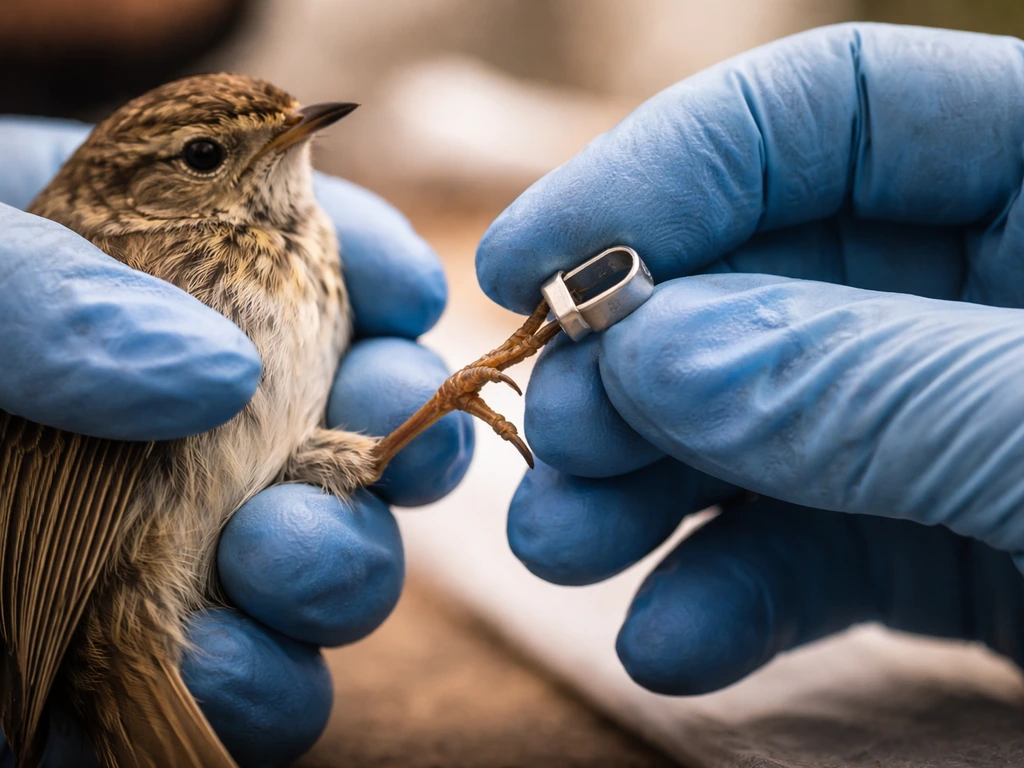
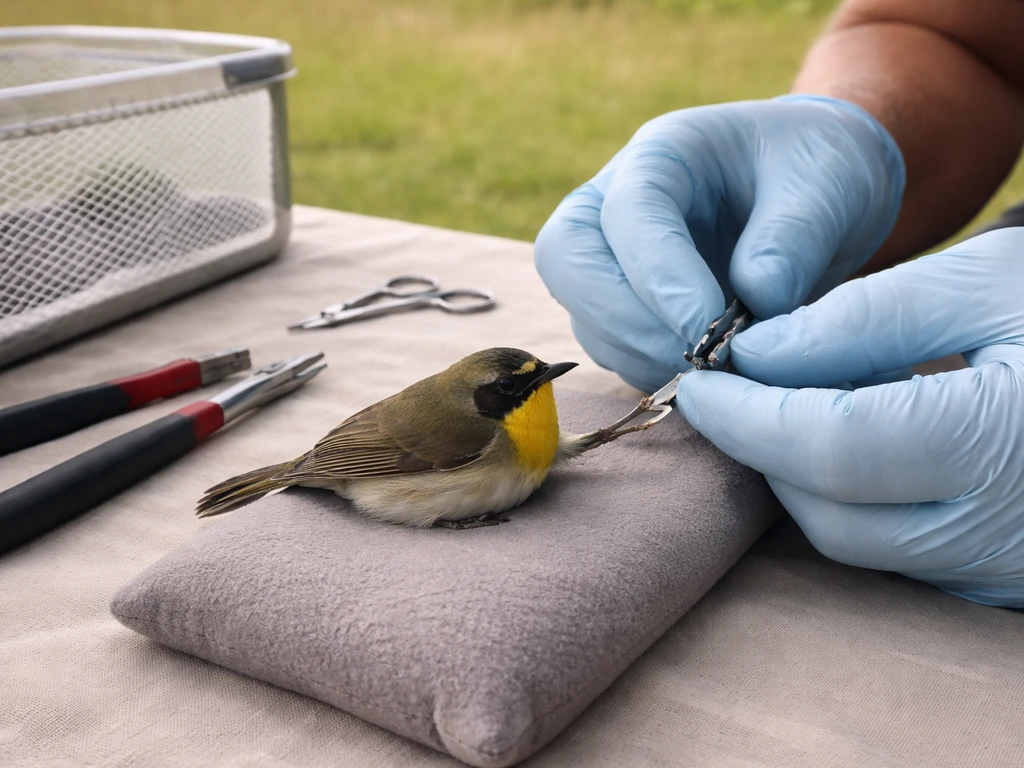
Bird banding means attaching a small, individually numbered marker, usually a metal or plastic leg band, to a wild bird so it can be identified if encountered again. In North America, standard bands are aluminum or stainless steel. Many programs also use color band combinations on the legs so individual birds can be identified through binoculars or a spotting scope without ever needing to be recaptured.
The reason researchers put up with all the effort and regulation is that individual identification over time unlocks demographic data you simply can't get any other way. Survival rates, productivity, migration routes, site fidelity, population trends: all of these come from mark-recapture analysis. Programs like MAPS (Monitoring Avian Productivity and Survivorship) use constant-effort banding stations specifically to track whether bird populations are stable, growing, or declining. Without banding data, managers are essentially guessing when they make conservation decisions.
How banding actually works, and where harm could occur
The basic sequence at a banding station goes: capture, extraction, processing, and release. Each step has its own welfare risks if handled carelessly.
Capture
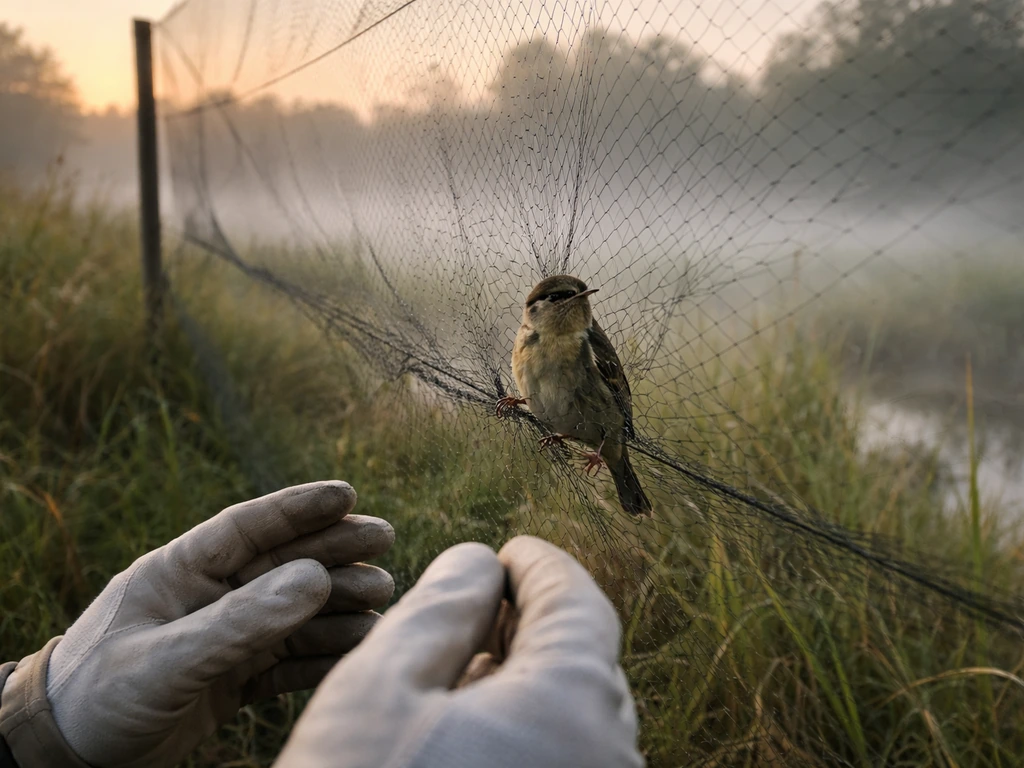
Most songbird banding uses mist nets, fine mesh nets strung between poles that birds fly into and become lightly entangled. Other methods include Potter traps, cannon nets for waterfowl, and specialized traps for raptors or hummingbirds. The capture phase is actually one of the higher-risk moments: research on corticosterone stress responses shows that leaving birds in mist nets for more than 3 minutes significantly elevates their adrenocortical stress response. That same entanglement time complicates any attempt to measure a bird's baseline stress hormone levels afterward, because the net experience itself has already shifted them.
Extraction and handling
Removing a bird from a mist net requires specific technique that takes real practice. Done wrong, it can cause wing, leg, or even spinal injuries. Done correctly by an experienced bander, it takes seconds. The BTO in the UK is explicit that birds should be handled for the minimum time required to confirm identification and apply the ring, a principle every major banding program shares.
Band application
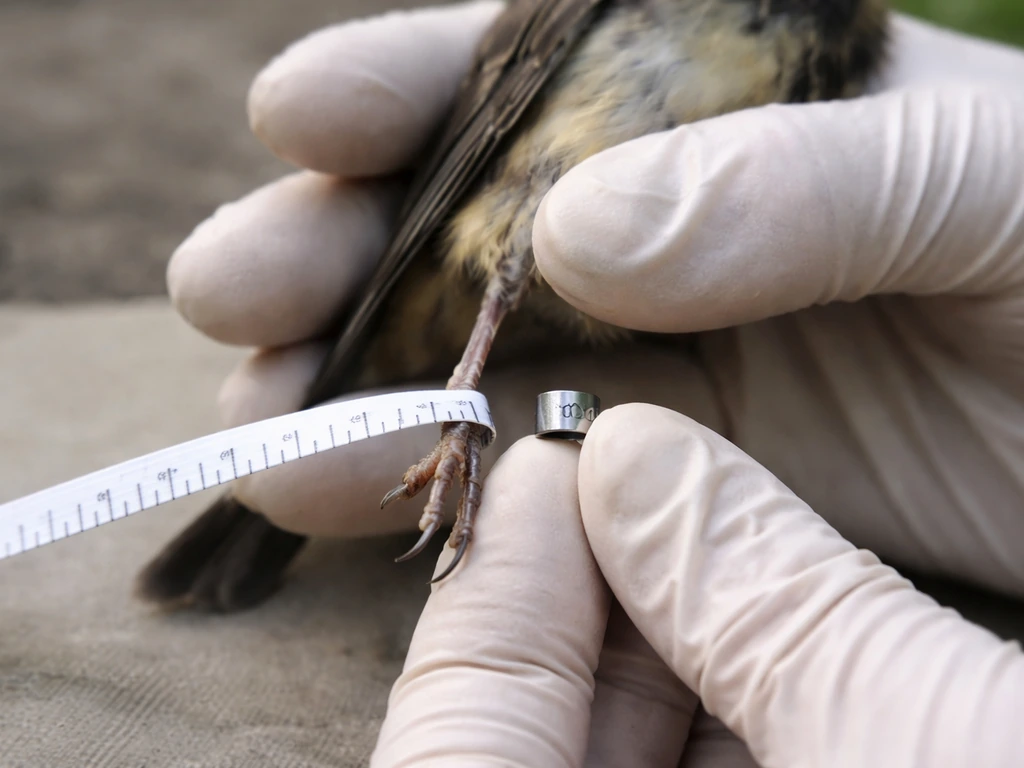
Fitting the correct band size is probably the single most important welfare variable in the entire process. A band that is too tight constricts circulation; one that is too loose can snag on vegetation or catch a toe. The North American Banding Manual includes species-specific band size tables, and Canadian operational guidelines explicitly list 'use correct band size and banding pliers' as a core ethical and operational requirement. Banders are trained on this before they ever touch a bird. If you see a program that doesn't reference these standards, that's a red flag.
Release and recovery
After processing, birds are released, usually at the capture site. A well-run station monitors for birds that seem disoriented or injured before letting them go. Any injuries that occur during capture or banding are supposed to be documented, and programs operating under major councils share that injury and mortality data across organizations. One of the most significant studies in this space compiled over 20 years of injury and mortality records from 22 bird banding organizations across the U.S. and Canada, covering more than 345,000 records across 188 species. The fact that this kind of large-scale risk quantification is even possible reflects how seriously the field takes welfare documentation.
Is it cruel: what the evidence actually says

The research paints a nuanced picture. Yes, capture and handling cause a measurable short-term stress response, detectable through elevated corticosterone levels. That's real, and researchers who study baseline stress hormones have to design their protocols carefully because the capture event itself changes the data. But short-term stress is not the same as lasting harm, and the evidence on injury rates and long-term survival tells a more reassuring story for programs operating within welfare guidelines.
Capture-related mortality does occur, and the field acknowledges it rather than hiding it. Studies on blank" rel="noopener noreferrer">mist-net mortality in passerines show it can be quantified using recapture data from previously banded birds, and ethical programs track and report it. The numbers are low in well-run operations, but 'low' isn't zero, and that's an honest framing. A bird that dies in a mist net because it wasn't checked frequently enough is a welfare failure, not an acceptable outcome.
On the question of long-term survival, cumulative stress research has looked at carry-over effects from handling stress during migration, showing that the physiological impacts of repeated capture events can compound in some contexts. This argues for reasonable limits on how often individual birds are processed and for keeping handling times short every single time. It does not argue that banding itself is categorically harmful.
The reality is that 'cruelty' implies either intent to cause suffering or reckless disregard for animal welfare. Properly permitted banding programs operate under explicit codes of ethics that put bird safety as the primary responsibility. The North American Banding Council's Banders' Code of Ethics is direct: the bander is responsible for minimizing stress, injury, and death risk, and must handle each bird carefully, gently, quietly, and in minimum time. That's not the framing of a cruel practice. It's the framing of a practice that takes welfare seriously and builds accountability into its structure.
Who can legally band birds and what oversight exists
In the United States, you cannot legally band migratory birds without a Federal Bird Banding and Marking Permit issued through the USGS Bird Banding Laboratory, because those birds are protected under the Migratory Bird Treaty Act. Canada's Bird Banding Program issues scientific permits and explicitly requires banders to follow ethical and scientific standards for capture, handling, and marking. The UK's BTO requires ringers to hold a license and follow the BTO Code of Conduct, with connections to the Animals (Scientific Procedures) Act 1986 in research contexts.
The U.S. permitting structure uses a master bander framework: someone new to banding operates as a sub-permittee who must coordinate with the master bander on administrative and permit-linked responsibilities. This is an oversight chain, not just a paperwork formality. It means inexperienced handlers aren't working unsupervised on birds. Additional species-specific authorization requirements apply too: banders who want to work with hummingbirds or eagles, for example, must demonstrate additional training and experience before the BBL approves that authorization. Endangered or threatened species require a USFWS Section 10 recovery permit on top of the standard banding authorization.
Banders are also required to keep accurate records and file reports according to the North American Bird Banding Manual. This isn't bureaucracy for its own sake: it creates an accountability trail that makes welfare problems visible and correctable at the population scale, not just the individual-bird scale.
What a responsible banding program looks like in practice
If you're evaluating a specific banding program, whether you're a researcher, a curious observer, or someone considering volunteering, here are the concrete things to check:
- Verify the lead bander holds a current federal or national banding permit appropriate for the species being banded. In the U.S., ask to see their BBL permit authorization; in Canada, a Bird Canada scientific permit; in the UK, a BTO ringing license.
- Ask about training requirements: did banders complete supervised training with a qualified trainer before handling birds independently? Competency gatekeeping before authorization is a standard requirement in well-regulated programs.
- Check net monitoring frequency. Mist nets should be checked at least every 30 minutes, and more frequently in hot weather or high-activity periods. Leaving birds in nets longer than necessary is one of the most common and preventable welfare failures.
- Ask whether the program uses the North American Banding Manual species band-size tables to select correct band fit. Improper band size is the most direct route to leg injury.
- Look for injury and mortality documentation protocols. A credible program records adverse events, doesn't just ignore them.
- For species-specific programs, confirm the bander has the appropriate species authorization, especially for hummingbirds, raptors, or federally threatened or endangered species.
- Ask whether the program follows a written operations protocol or code of ethics, such as the NABC Banders' Code of Ethics or BTO Code of Conduct.
One thing to keep in mind: low recovery rates in small birds, sometimes below 0.1% in some species, can make it seem like welfare outcomes are unknowable. They're not. Research programs draw on long-term recapture datasets, not just band recovery reports, to estimate survival and quantify handling-related risks. A program that cites 'we never hear about problems' as its welfare evidence is not the same as a program that actively tracks recapture outcomes.
Less invasive ways to monitor birds
Banding is not the only tool available, and responsible researchers increasingly combine it with non-capture methods to get better data while reducing how often birds need to be handled.
| Method | What it can do | Main limitation |
|---|---|---|
| Passive acoustic monitoring (PAM) | Detect species presence and abundance, track movements over large areas without capturing individuals | Cannot identify specific individuals; doesn't provide survival or productivity data |
| Radar | Track large-scale migration movements and timing at a landscape level | No individual identification; species identification often difficult |
| eDNA | Detect species presence from environmental DNA shed into water or air; no handling required | Still developing for birds; does not provide demographic data like survival |
| Color banding / resighting | Identify individuals in the field with binoculars, reducing need for recapture | Requires initial banding event; resighting probability varies by species and habitat |
| Biologging / telemetry | Track individual movement and behavior continuously | Attachment devices can have non-trivial welfare costs; meta-analyses show some negative survival effects depending on attachment method and device size |
Biologging deserves a careful look here, because it's sometimes proposed as a welfare-friendlier alternative to banding. The evidence is mixed. A meta-analysis on bio-logging devices found negative effects on several bird traits including survival in some contexts, and the attachment method matters: implantation tends to reduce negative effects compared to external harnesses in studies that have compared the two. The point is that 'alternative' doesn't automatically mean 'lower welfare impact.' Every monitoring method involves trade-offs, and the best programs match the method to the specific research question rather than defaulting to one approach.
This connects naturally to related welfare questions: wing clipping, feather plucking, and caging wild birds all involve different types of physical intervention or confinement with their own welfare profiles. For the same welfare reasons, caging a wild bird is a very different situation from authorized, time-limited banding. Wing clipping is a different kind of intervention, and welfare impacts depend on the technique and whether it causes injury. Banding sits at the lower end of invasiveness when done correctly, precisely because it is brief, the bird is released, and the marker is designed to fit without restricting normal movement or behavior.
The bottom line
Bird banding done well, by trained, permitted banders following species-appropriate protocols, minimum handling time, correct band fit, and proper net monitoring, is not cruel. The scientific and ethical consensus supports it as an acceptable and valuable conservation tool. The risks are real but measurable and manageable, and the accountability structures in North American and UK banding programs are designed specifically to keep those risks low. What would make banding cruel is ignoring those standards: leaving birds in nets too long, using wrong band sizes, skipping training, or failing to document harm. Those are failures of practice, not evidence that banding itself is unethical.
FAQ
How can I tell if a specific bird banding program is being run responsibly or carelessly?
Look for evidence beyond testimonials: the program should report both capture methods and handling-time targets, plus injury or mortality rates derived from recapture or station monitoring. A good sign is that they document problems and retrain or adjust protocols, not that they simply claim “everything is fine.”
What’s more important for bird welfare, the bander’s skill or how long birds stay in the net?
Banding stations usually use standardized net checks and release rules, so “checked frequently enough” matters as much as the bander’s skill. If a station cannot explain their net-monitoring cadence or how often nets are cleared, that is a practical welfare red flag.
If the same bird gets caught multiple times, is that automatically more harmful, and how do programs manage it?
Many programs set caps on how often an individual is processed, but the actual limits depend on study design and species. If you volunteer, ask whether your local protocol includes handling-frequency rules for repeat captures, and whether those rules change for breeding vs migration periods.
Why do low recovery rates make banding welfare hard to interpret, and what should I look for instead?
No. “We didn’t recapture the bird” does not mean “nothing went wrong.” Programs use separate calculations for survival and account for detectability, because small birds can have very low recovery or reporting rates. An evaluation should ask how they estimate survival, not only what proportion gets recovered.
What band-fitting mistakes are most likely to make banding harmful?
Improper band size can cause harm, so the ethical requirement is not just selecting a band from a table, but using the correct method for measuring legs and fitting with the right pliers. If a program can’t describe how they confirm band fit for that species, or they skip standardized sizing steps, the welfare risk rises.
Do color bands on top of metal bands increase welfare risk, or do they help reduce recaptures?
Color band visibility can reduce the need for recapture, but welfare still depends on attachment method and whether bands interfere with normal movement. Ask whether the program has data showing that their color-marking approach reduces recaptures without increasing snagging or injury.
What should happen if a banded bird appears injured or very stressed during processing?
If a bird is injured or disoriented, responsible programs have a clear decision pathway for immediate care, transfer to appropriate wildlife rehabilitation when permitted, and documentation. A major welfare failure is “release anyway” after visible injury or handling stress.
Is capture-related mortality ever acceptable in banding, and do good programs track it transparently?
It’s possible, but it’s not supposed to be a hidden metric. Ethical programs quantify and report capture-related mortality and then analyze what operational factor is most associated with losses, such as net type, net checks, weather, or extraction technique. If a program refuses to discuss mortality reporting, treat that as a governance concern.
How do researchers justify longer processing times without increasing harm?
Some projects prioritize minimizing handling time by using rapid identification, standardized data entry, and efficient processing stations. Others may spend more time on specialized measurements, which can raise handling duration for certain species or research questions. The ethical question is whether extra time is necessary, bounded, and species-appropriate.
What should I check regarding permits and training when I see banding being done?
Permits and oversight matter because they create accountability for protocol, training, and authorized species or methods. If a program bands outside the permitted framework, or cannot provide evidence of authorization and training responsibility chains, you should assume welfare standards are not assured.
Is bio-logging always a better alternative to banding from a welfare standpoint?
Bio-logging is not automatically “gentler,” because attachment can affect survival or behavior, even if handling is reduced. If someone proposes tags instead of banding, ask what attachment method they use (for example, internal vs external), what the expected sample size and duration are, and what welfare-related endpoints they monitor.