
Bird spikes will not affect your TV or satellite reception in any meaningful way under normal installation conditions. The physics behind this answer matters, though, because there are specific edge cases where metallic spikes mounted very close to an antenna or satellite dish feed could theoretically produce a measurable signal change. The reality is that the risk depends almost entirely on material, distance, and placement relative to the antenna's near field or a dish's illuminated aperture. Plastic spikes carry essentially zero electromagnetic risk. Metal spikes mounted several feet away from the antenna also pose no practical concern. Problems only become plausible when conductive spikes end up directly attached to or within a few inches of the active receiving element, and even then, the effect competes with far more common causes of reception loss like tree growth, coaxial cable degradation, and weather.
Do Bird Spikes Affect TV Reception? Evidence & Guidance

Quick verdict
No, commercially installed bird spikes do not meaningfully affect TV reception when placed at normal rooftop distances from antennas or satellite dishes. The theoretical electromagnetic mechanisms exist but require very specific, close-proximity conditions to produce any measurable signal change. Plastic spikes are electromagnetically inert at TV frequencies. Stainless steel spikes have low enough conductivity and small enough physical size relative to UHF and VHF wavelengths that their scattering cross-section is minimal unless they are in direct contact with or within a few inches of an antenna element. Across installer forums, technical literature, and manufacturer documentation, there is no documented, controlled study showing that commercially sold bird spikes placed near a rooftop TV antenna produced a quantified drop in signal-to-noise ratio or caused service outages. The greater story here is that what birds themselves leave behind, specifically droppings, nests, and debris, actually can affect reception, and spikes help with that.
How bird spikes work
Bird spikes are passive physical deterrents designed to make landing surfaces uncomfortable or inaccessible for birds, particularly pigeons, starlings, gulls, and corvids. They do not electrocute, trap, or injure birds, they simply remove flat perch space by turning it into an uneven field of upright rods. Understanding this design helps clarify why they interact so minimally with radio-frequency equipment.
Construction and materials
Most consumer and commercial bird spike products consist of a flat base strip, typically polycarbonate, UV-stabilized plastic, or a thin stainless steel channel, with upright pins or rods bonded or welded into it. Pin lengths generally run from about 1 inch to 5 inches, and the pins themselves are either stainless steel wire (most common in durable commercial products) or rigid plastic. Pin diameter is usually between 1 and 3 millimeters. The base strips are typically 12 to 24 inches long and designed to be glued, screwed, tie-wrapped, or clipped onto ledges, beams, antenna crossbars, dish rims, gutter edges, fence tops, windowsills, and roofline ridges.
Where they get installed
In residential and commercial settings, property managers install bird spikes on the surfaces that attract the most roosting activity: roof ridges, gutters, ledge copings, parapet walls, HVAC condenser tops, and, importantly for this discussion, on or near rooftop antenna masts, dish mounting poles, and satellite dish rims. The last category is where the electromagnetic question becomes relevant, even if the practical risk remains low.
The electromagnetic theory: how spikes could (and mostly do not) affect signals
The question of whether any metal object affects a nearby antenna is not speculation, it is documented in antenna engineering textbooks and IEEE literature. A standard reference is Antenna Theory (Balanis), electrically small scatterers, near‑field scaling and loading effects A standard reference is Antenna Theory (Balanis) — electrically small scatterers, near‑field scaling and loading effects.. The mechanism is called antenna loading, and it describes how conductive objects placed inside an antenna's near field can alter the antenna's input impedance, radiation pattern, and efficiency. So the theoretical pathway exists. The more useful question is whether commercially sized bird spikes generate enough of that effect to matter at real-world distances.
Near-field and far-field regions
Every antenna has a reactive near field that extends to roughly the distance of one wavelength divided by two pi (approximately λ/(2π)) from the antenna element. At UHF TV frequencies, say around 600 MHz, the wavelength is about 50 centimeters, putting the reactive near-field boundary at roughly 8 centimeters from the element. At VHF low band (around 60 MHz), the wavelength is about 5 meters, so the reactive near field extends to nearly 80 centimeters. Conductive objects inside that zone can measurably change the antenna's impedance and efficiency. Objects further away still scatter RF energy, but the magnitude of the coupling drops off rapidly with distance and rarely produces a perceptible effect on received signal quality.
Why spike geometry matters
A conductive rod scatters RF energy in proportion to its conductivity, physical size relative to wavelength, orientation to the incoming signal, and distance from the antenna element. Stainless steel bird spike pins are typically 50–100 millimeters long and 1–2 millimeters in diameter, electrically small relative to VHF and UHF wavelengths. Electrically small scatterers produce scattering cross-sections far below those of full-size reflectors or even half-wave dipoles, so each individual spike introduces a very small perturbation. A dense strip of 20 or 30 metal spikes mounted directly on an antenna boom does produce cumulative scattering and could alter the antenna's pattern, but the same strip mounted on a roof edge 1 meter from the antenna is outside the reactive near field at UHF and will produce negligible coupling.
The satellite dish case: aperture blockage
Parabolic satellite dishes work by reflecting incoming signals from the dish surface toward a central feed horn. Any object that shadows part of the dish's reflective aperture or blocks the path between the dish surface and the feed horn introduces aperture blockage, which reduces gain and distorts sidelobes. This is the most legitimate signal-loss mechanism associated with bird spikes on satellite dishes. Metal spike strips glued to the rim of a dish are generally far enough from the illuminated aperture to matter very little. But spikes physically attached across the dish face, or along the feed support arm very close to the feed horn, could shadow a meaningful fraction of the aperture and produce a few decibels of gain loss. In DVB-S and DVB-S2 satellite systems, link margins are sometimes only 3–5 dB, so a loss of even 2–3 dB from aperture blockage can push a marginal signal below the threshold and cause outages.
Digital reception thresholds
Both terrestrial digital TV and satellite TV use digital modulation with steep cliff-edge performance curves. ATSC (North American terrestrial digital) has a threshold-of-visibility around 14. The Standard Handbook of Broadcast Engineering documents ATSC 8‑VSB (terrestrial ATSC 1.0) having a threshold-of-visibility (TOV) of approximately 14.9 dB signal-to-noise, below which visible pixelation and dropout begin ATSC 8‑VSB threshold-of-visibility ≈14.9 dB S/N. 9 dB signal-to-noise, below which visible pixelation and dropout begin abruptly. DVB-S and DVB-S2 have similar threshold behavior. A signal comfortably above threshold will absorb small losses without any visible effect. A signal already close to threshold, a common situation for fringe-area terrestrial viewers or poorly aimed dishes, can tip into failure from any additional loss, whether that loss comes from a storm, coaxial cable degradation, or, in principle, a conductive object in the wrong place.
What the evidence actually shows
Here is the honest position: the electromagnetic theory that predicts bird spikes could affect reception under specific conditions is well-established. But a thorough search of peer-reviewed antenna literature, IEEE publications, manufacturer installation datasheets, and professional installer forums turns up no controlled laboratory or anechoic-chamber study that specifically tested commercial bird spike products on or adjacent to TV antennas or satellite dishes and measured a quantified dB change in signal or noise ratio. The absence of such a study is not proof of no effect, it reflects that the effect, if present, has not been considered significant enough to investigate formally.
Installer forums and property management communities occasionally discuss bird control measures near antennas, but the anecdotal content is fragmentary and inconsistent. Some installers mention fitting spike strips to dish rims without incident. Others recommend keeping spikes off the dish hardware entirely as a precaution. No consistent pattern of spike-induced reception failures emerges from those discussions. Terrestrial antenna manufacturers like Antennas Direct do advise keeping antennas away from nearby metal objects and recommend testing reception before permanent mounting, but these warnings apply to large adjacent metal structures, not to small spike strips installed at distance.
The practical conclusion is that the documented cases of bird spikes causing measurable TV reception degradation are essentially absent from the record. The theoretical risk is real but bounded by conditions (conductive material, direct contact or very close proximity, pre-existing marginal signal) that responsible installation practices already avoid.
Metal vs plastic spikes: does material change the RF risk?
Material is the single most important factor in whether a bird spike product carries any electromagnetic risk at all. The conductivity difference between stainless steel and polycarbonate plastic is roughly ten orders of magnitude, which translates directly into scattering behavior.
| Material | Typical conductivity | RF scattering behavior | Risk near antennas |
|---|---|---|---|
| Polycarbonate / nylon plastic | Effectively zero (insulator) | Negligible dielectric scattering only | No practical risk |
| Stainless steel (304/316) | ~1–2 × 10⁶ S/m | Measurable scatter if in near field; low individual cross-section | Low risk at normal rooftop distances; higher if mounted directly on antenna hardware |
| Aluminum | ~3.5 × 10⁷ S/m | Higher scattering than stainless steel; stronger near-field coupling | Moderate risk if in reactive near field; keep away from feed horn |
| Galvanized steel | ~5–8 × 10⁶ S/m | Intermediate scattering | Low to moderate risk depending on proximity |
| Copper (rare in spike products) | ~5.8 × 10⁷ S/m | Strong scattering; strong near-field loading | Higher risk if close to antenna element; uncommon in spike products |
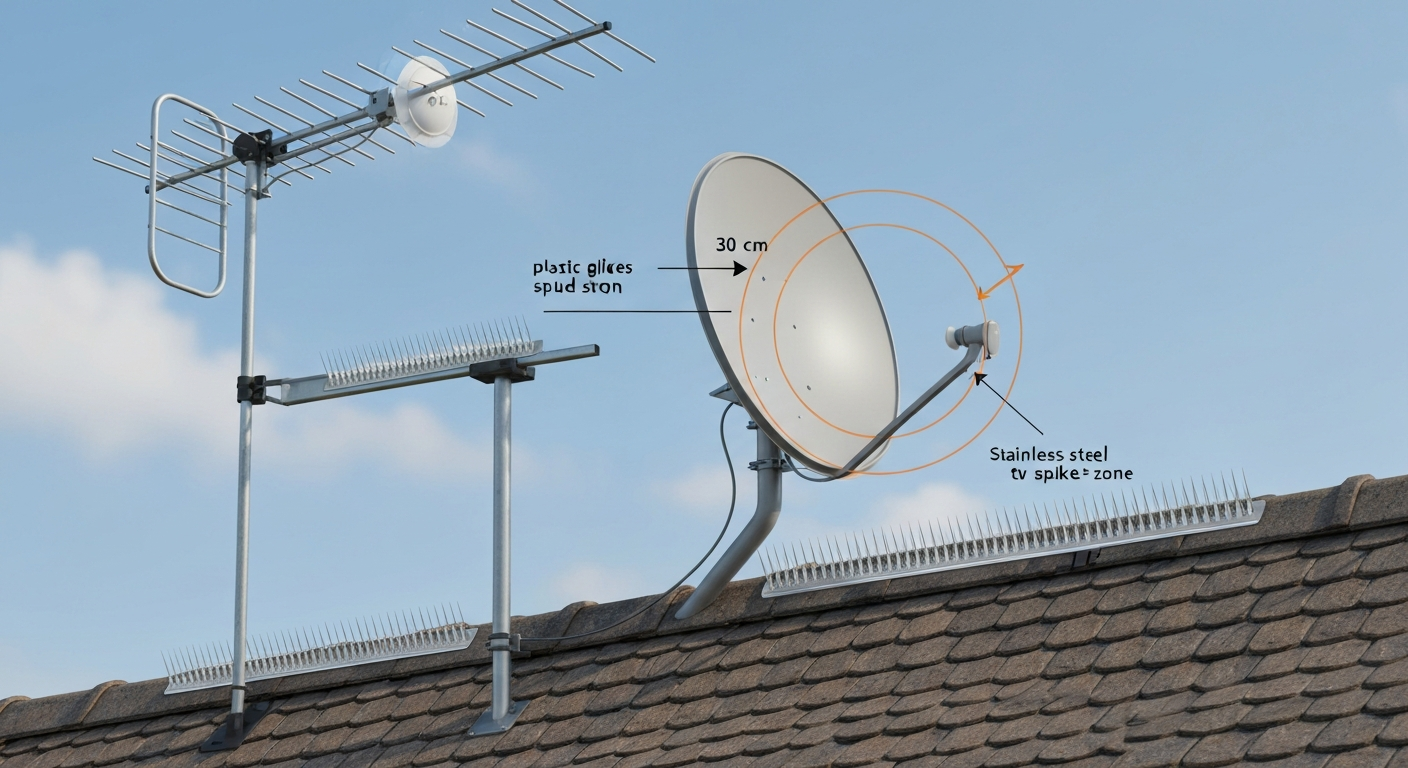
For properties with antennas or dishes where signal margin is a known concern, choosing plastic spike products for any hardware mounted directly on or within 30 centimeters (about 12 inches) of the antenna is a straightforward way to eliminate the electromagnetic variable entirely. Plastic spikes function just as effectively as deterrents, birds respond to the physical geometry, not the material.
Line-of-sight considerations matter separately from conductivity. Even a plastic or wooden object positioned to block the direct path between a satellite dish and the sky, or between a Yagi antenna and the broadcast tower direction, can reduce signal by blocking or scattering the incoming wavefront. For satellite dishes, nothing should cross the beam path between the dish and the satellite arc. For directional terrestrial antennas, nothing should sit in the main lobe pointing direction within a few meters of the antenna.
Recommended safe distances and mounting practices
No single published standard covers bird-spike clearances from all antenna types, because the relevant distance scales differ by frequency and antenna design. The guidance below draws from antenna engineering principles and the closest available manufacturer installation documentation.
- Keep any metal spike strips at least 30 cm (12 inches) from any active antenna element, boom, or driven element. Some commercial antenna manufacturer installation guides cite this distance as a minimum clearance from nearby metal structures for panel and directional antennas.
- For satellite dish installations, do not mount spike strips on the dish face, the feed support arm, or within 15 cm of the feed horn. The dish rim is generally acceptable for plastic spikes. Metal spikes on the rim are lower risk but should be tested after installation.
- For terrestrial Yagi or log-periodic antennas, avoid mounting metal spike strips directly on the antenna boom or element crossbars. Spike strips on the mast itself, below the antenna, are generally fine if the mast is already a metal structure the antenna is designed to mount on.
- For omnidirectional terrestrial antennas, the same 30 cm clearance principle applies. Metal objects in the immediate cylindrical near field around the antenna can change its omnidirectional pattern into an uneven one.
- Regardless of material, do not allow spike strips to cross or shadow the primary beam direction of a directional antenna or the illuminated aperture of a parabolic dish.
- After any installation of metal spike products near antenna hardware, run a signal strength check using the TV's built-in signal meter or a dedicated antenna analyzer before declaring the installation complete.
Fitting spikes near antennas and dishes without compromising signal
Most reception problems traced to bird control measures happen not because spikes are inherently disruptive, but because they were installed without thinking through placement relative to the antenna's geometry. A systematic approach eliminates most of the risk.
- Before installation, check the TV signal strength display (most digital TVs have a menu option for signal strength or quality percentage) and note the baseline reading. Record it — you will want it for comparison after installation.
- Choose plastic spike strips for any location within 30 cm of antenna elements or the satellite dish feed assembly. The deterrent effectiveness is identical to stainless steel for the birds that matter at residential scale.
- If using stainless steel strips on mast sections below the antenna or on roof edges near the dish mount, ensure the strips run parallel to the existing mast structure rather than extending toward the dish aperture or antenna elements.
- Use UV-stable adhesive or nylon tie-wraps rather than metal clamps or brackets that themselves add conductive mass near the antenna.
- After installation, recheck signal strength and quality. A drop of more than 2–3 percentage points on a system that was previously marginal warrants relocating or replacing the spike strips near the hardware.
- Document which spike products were installed and where. If a future fault occurs, this record saves troubleshooting time.
For satellite dishes specifically, the most common legitimate installation concern is birds perching on the dish rim or feed support arm, which is where property managers most often want to apply spikes. Plastic spike strips glued to the upper rim of the dish body have been used in commercial and marine satellite installations without reported signal issues in forum-level documentation. Metal spike strips on the dish rim are a higher-caution option: the rim is at the edge of the illuminated aperture, and a dense metal strip there could produce minor diffraction effects. Test after installation if margin is important to you.
How spikes change droppings, nests, and debris, the effects that actually affect reception
Ironically, the strongest argument for bird spikes near antenna and dish installations is not that spikes are electromagnetically safe, but that birds themselves cause real, documented interference problems that spikes can prevent.
Bird droppings on dish surfaces
Bird droppings deposited on a satellite dish reflector surface are a recognized cause of signal degradation. Droppings are semi-conductive when wet and dielectrically lossy even when dry, and a significant accumulation on the dish face changes the reflective properties of the surface, effectively acting as radome contamination. Satellite installation guidance from marine and commercial antenna manufacturers, including Intellian, specifically warns that radome contamination reduces received signal. The same physics applies to the main reflector. A dish heavily soiled with pigeon or gull droppings can lose several decibels of gain, which in a tight link budget is enough to cause intermittent outages.
Nesting material
Starlings, sparrows, and pigeons readily nest in the structural cavity behind a satellite dish, in the junction box at the base of an antenna mast, or in the angle between a Yagi antenna's boom and its mount. Nesting material, which typically includes twigs, insulation fiber, feathers, and fecal matter, can physically block the feed horn inlet on a satellite dish, introduce moisture, and create electrically lossy material near active components. Nests are heavier and more damaging than droppings alone, and removing them often requires fully disassembling the mount.
What spikes actually do to this problem
By eliminating flat landing perches on and around antenna hardware, spikes reduce the frequency of roosting and nesting events near the equipment. Fewer roosting birds means fewer droppings on reflective surfaces and fewer nesting attempts in structural cavities. The net effect on reception is positive: droppings and nests are well-documented interference mechanisms, and spikes reduce their accumulation. This is the practical justification for fitting bird deterrents to dish and antenna installations, and it is a more concrete benefit than any theoretical electromagnetic concern is a risk.
Bird welfare, humane considerations, and spikes versus netting
Given this site's focus on separating fact from folklore about bird harm, it is worth addressing the welfare question directly. The site covers whether bird spikes hurt birds and whether they are humane as dedicated topics, so a brief summary is appropriate here: when properly installed, bird spikes physically exclude birds from landing surfaces but do not injure, trap, or kill them. The deterrent is entirely passive and geometry-based. If you’re wondering whether bird spikes are humane, see our guide "Are bird spikes humane" for a focused discussion of welfare concerns and humane alternatives.
Bird netting is the common alternative for enclosed or semi-enclosed antenna installations, particularly for dish installations under a building overhang or inside an equipment enclosure. The comparison matters for this discussion because netting introduces its own signal effects (dielectric and minor blocking) and, unlike spikes, carries a documented entanglement risk for small birds. For more on whether bird netting can injure or entangle wildlife, see does bird netting hurt birds. The site covers in detail whether birds get stuck in bird netting and whether bird netting hurts birds, both of which are more serious bird-safety concerns than those associated with spikes. For open rooftop antenna and dish installations where either product could be used, spikes generally present a lower bird-welfare risk than netting, while both present negligible electromagnetic risk when installed at appropriate distances.
Regulatory and signage notes
In most jurisdictions, bird spikes are legal for use on privately owned structures and equipment, including antenna masts and satellite dishes, as a non-lethal deterrent method. In the United States, the UK, the EU, and Australia, passive physical exclusion devices are generally permitted for pest bird species (pigeons, starlings, house sparrows). Protected native species are a different matter: in the US, the Migratory Bird Treaty Act prohibits disturbing active nests of protected species, so if you discover an active nest in antenna hardware before installing spikes, removal of the nest itself typically requires waiting until the nesting cycle is complete or obtaining a depredation permit. Signage is not legally required for residential rooftop spike installations in most jurisdictions. Commercial property managers in some regions may need to document exclusion methods as part of integrated pest management records, check local regulations if managing a commercial or industrial site.
Troubleshooting checklist: reception loss near bird spike installations
If you have installed bird spikes near antenna or dish hardware and noticed a reception change, or if you are troubleshooting an existing installation, work through this list before concluding that the spikes are the cause. The reality is that spikes are typically not the culprit, and other causes are far more common.
- Check coaxial cable connections at both ends. Corroded F-connectors or push-on connectors are the single most common cause of sudden signal quality drops and are entirely unrelated to bird deterrents.
- Inspect the cable run for physical damage: kinks, compression from staples, UV cracking on outdoor runs, or water ingress at any unweatherproofed connector.
- Check for bird droppings or nesting material on the dish face or near the feed horn. Clean the dish surface and test again before suspecting the spike installation.
- Verify the dish or antenna aim has not shifted. Mounting hardware loosened by wind, thermal cycling, or a bird landing impact can move a dish off satellite by a fraction of a degree — enough to drop signal.
- Identify whether any new metal spike strips are within 30 cm of the active antenna element or within direct line of sight of the satellite dish feed. If yes, test signal with the strips temporarily removed.
- Use the TV's signal quality meter, not just signal strength. Quality (which reflects carrier-to-noise ratio) is more informative than raw signal level for diagnosing near-field interference effects.
- Compare signal quality at different times of day. If reception varies with temperature or weather but not with the spike installation date, the cause is atmospheric or cable-related, not the spikes.
- If replacing metal spike strips with plastic ones near antenna hardware resolves the problem, that confirms the conductive spikes were contributing. Document the finding and the replacement.
Choosing spikes or alternatives: a practical decision guide
For most residential and commercial antenna and dish installations, bird spikes are the right choice among available bird deterrent options. They are durable, maintenance-light, low-cost, and, when selected and placed appropriately, electromagnetically inert. The decision framework simplifies to a few questions.
- Is your signal margin comfortable (strong signal, well above threshold)? Then either plastic or metal spike strips at reasonable distances present no practical concern. Install, test once, and move on.
- Is your signal marginal (fringe-area terrestrial or dish signal only a few dB above threshold)? Use plastic spike strips for any hardware within 30 cm of antenna elements or the dish feed. Test after installation.
- Are birds nesting inside enclosed antenna hardware or behind dish mounting brackets? Consider sealing those cavities with wire mesh or metal flashing (non-conductive options where adjacent to active elements) rather than relying solely on spikes.
- Is bird netting being considered instead? For open rooftop applications near antenna hardware, spikes are generally preferable because netting can shift position in wind, potentially crossing the beam path, and carries higher entanglement risk for small birds.
- Do you need to protect a historic structure or rental property where permanent adhesive or screw mounting is not feasible? Clip-on plastic spike strips exist for temporary or non-invasive installation on standard mast diameters.
The bottom line is that the fear of bird spikes disrupting TV reception belongs in the same category as many bird-related myths this site addresses: the concern sounds plausible, the physics offers a theoretical pathway, but the documented real-world effect is essentially zero under normal installation conditions. The far more evidence-supported story is the opposite one. Birds on and around antenna hardware actively degrade reception through droppings, nesting, and physical displacement of mounts, and well-placed bird spikes reduce all three. Install them thoughtfully, choose plastic where proximity is a concern, test signal before and after, and the deterrents will improve your setup, not harm it.
FAQ
Quick verdict: do bird spikes affect TV reception?
Short answer: usually no, but sometimes — if conductive spikes sit within the antenna's near field or directly shadow a dish's illuminated area or feed, they can measurably alter impedance, pattern or gain and so reduce reception. Nonconductive plastic spikes are far less likely to cause RF effects. In practice, properly placed spikes rarely cause noticeable reception loss for most rooftop TV antennas and dishes.
How do bird spikes work (physically and practically)?
Bird spikes are arrays of slender rods or blades fixed to a base to prevent birds landing and nesting. They are sold in metal (stainless steel, aluminum) or plastic versions. Mechanically they present an unpleasant landing surface; electrically, conductive spikes can act as small scatterers or reflectors when placed near antennas.
What electromagnetic mechanisms could make spikes change TV reception?
Three main RF mechanisms: 1) Near‑field loading/impedance change — conductive objects inside the reactive near field (≈λ/2π) perturb input impedance and matching. 2) Scattering/diffraction — rods near the radiating region can scatter energy and alter the antenna's radiation/reception pattern or create multipath. 3) Aperture blockage/shadowing — spikes that shadow a dish's illuminated area or block the feed cause gain loss and increased sidelobes. The magnitude depends on size, conductivity, orientation and proximity.
How large are the relevant distance scales (near field) for VHF/UHF TV and satellite L‑band/C‑band?
Guideline scales: for a small antenna the reactive near field extends roughly to ≈λ/(2π). At VHF (100 MHz, λ≈3 m) that's ~0.5 m; at UHF TV (600 MHz, λ≈0.5 m) that's ~0.08 m (8 cm). For satellite L‑band (1–2 GHz) the near field is a few centimeters. Practically, anything within a few centimeters to tens of centimeters of the driven element or feed can matter; for large dishes the critical region is the dish's illuminated area and feed/support shadow rather than the far rim.
Do metal spikes scatter RF compared with plastic spikes?
Yes. Metals (stainless steel, aluminum, copper) are conductive and reradiate/reflect RF; plastics are dielectric and mostly nonconductive, producing only weak dielectric scattering. Conductivity differences are large, so metal spikes have a far greater potential to perturb antennas than plastic spikes of comparable geometry.
Are there documented, peer‑reviewed studies showing commercial bird spikes cause TV/satellite outages?
No peer‑reviewed lab studies specific to marketed bird‑spike products and TV/satellite reception were found. The theoretical mechanisms and many antenna texts document how nearby metal can affect antennas, but controlled studies explicitly testing commercial spikes on TV/satellite antennas are not present in the reviewed technical literature. Installer anecdotes are fragmentary and inconsistent.