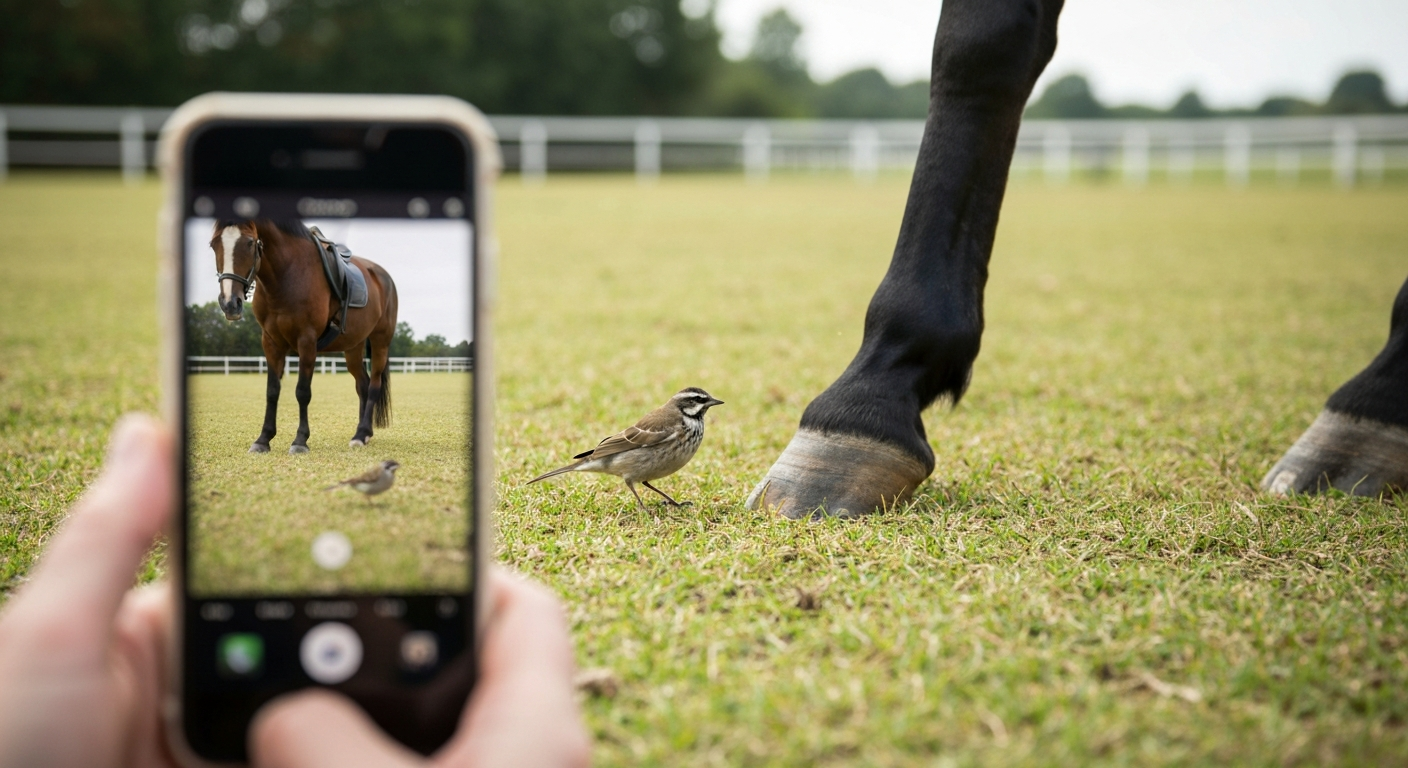
When a horse steps on a bird, the outcome ranges from minor fright to immediate death, and the single biggest factor is not luck but physics: hoof size, shoe type, the hardness of the ground under both of them, and the bird's own body mass. Most ground-feeding birds hit by a full-weight hoofstrike on a hard substrate will not survive. Smaller birds, softer footing, and barefoot horses shift the odds slightly, but crush injuries to the thorax, internal organs, or skull are serious even when the bird appears to be moving after the event. If you filmed it on an iPhone, that footage can help a wildlife rehabilitator triage the bird, but video alone cannot confirm internal injuries or prognosis. For more detailed guidance on what to do when a horse steps on bird, see the horse steps on bird resource (0886df75-f42e-4379-b9a6-b16e9f802300).
Horse Steps on Bird Shot on iPhone: Survivability and Evidence

What usually happens: survivability and most likely outcomes
Wildlife rehabilitation and postmortem datasets explicitly list being stepped on or crushed as a recognized cause category for bird admissions and mortality. That tells you something important right away: birds do survive this sometimes, or they would never make it to a rehabilitator. But the data also reflect that crush injuries from large animals carry a poor prognosis in most cases. The injuries documented in veterinary forensic and pathology texts after blunt or compressive trauma to birds include external fractures, internal hemorrhage (hepatic, pulmonary, and vascular), thoracic wall compromise, air-sac rupture, and spinal or neurologic damage. Any one of those can be fatal without immediate skilled intervention, and a single hoofstrike can produce several at once.
The bird's size matters enormously. A horse hoof under a 500 kg animal can exert hundreds of kilograms of force concentrated on a small area during the impact phase. A pigeon weighing 300 grams or a sparrow at 25 grams has essentially no structural resistance to that load. Larger birds, waterfowl with dense bone structure, or birds that receive only a glancing contact rather than direct compression fare somewhat better, but even there the prognosis without professional assessment is uncertain. Blunt-trauma research in poultry (using EEG to evaluate loss of consciousness) shows that outcomes vary with body mass and strike geometry, and researchers are explicit that findings from domestic poultry cannot be extrapolated without caution to wild species with different skeletal architecture. Biomechanical and slaughter‑science literature documents that blunt or compressive force methods can cause immediate brain concussion or internal organ rupture, with required force and injury patterns varying by body mass, skeletal geometry, and the site of impact Biomechanical and slaughter‑science literature documents that blunt or compressive force methods can cause immediate brain concussion or internal organ rupture, with required force and injury patterns varying by body mass, skeletal geometry, and the site of impact.. The honest answer is that survivability is genuinely unpredictable without hands-on triage, which is why getting the bird to a professional quickly matters more than any on-scene diagnosis you can make.
How hoof contact actually injures a bird
Crush versus puncture: two different injury patterns
Crush injury and puncture injury are mechanically distinct and produce different clinical pictures. A flat, broad hoof contact area (common in barefoot horses or horses wearing wide web shoes) distributes force across a larger surface. The bird is more likely to die from compression of internal organs, fractured ribs, or thoracic cavity collapse than from a discrete penetrating wound. Puncture, by contrast, happens when the toe or heel caulk of a shod horse, or the edge of a shoe with a sharp rim, contacts the bird at a narrow point. That concentrates force into a very small area and can drive fragments of bone, shoe edge, or debris into the body cavity. Both mechanisms are serious, but puncture injuries are sometimes easier to see and easier to misread: a small surface wound with a show of blood can look minor while the internal damage is not. Crush injuries with no visible external wound can be just as lethal or more so.
How hoof type and substrate change the force delivered
Systematic reviews of horseshoe biomechanics confirm that shoe type and trimming state materially alter the peak pressure and contact area under a hoof. Shod horses with standard steel shoes produce a different pressure distribution than barefoot horses or horses with certain therapeutic footings applied. Studies using foam sole supports, for example, show increased contact area and reduced peak pressure at any given load. That difference translates directly to how force is transmitted to a small object under the hoof. Substrate also plays a significant role: experimental hoof-impact studies show that hard surfaces like concrete or compacted asphalt amplify the instantaneous deceleration force on impact compared with turf, sand, or softer arena surfaces. A bird stepped on in a concrete barn aisle faces a materially worse set of physics than one stepped on in a grass paddock, even if the horse's weight is identical.
| Factor | Lower injury risk | Higher injury risk |
|---|---|---|
| Horse weight | Light pony or miniature horse | Full-size draft or sport horse |
| Hoof/shoe type | Barefoot, well-trimmed, wide web shoe | Caulked shoes, calks, or narrow shoe edges |
| Substrate | Deep sand, rubber matting, turf | Concrete, asphalt, packed gravel |
| Bird size | Larger, heavier bird (duck, goose) | Small songbird, sparrow, finch |
| Contact type | Glancing or partial contact | Full-weight direct strike |
What your iPhone footage can actually tell you
Video is useful evidence, but it has hard limits, and understanding both sides of that helps you use it well. What footage can reliably show: the approximate location of hoof contact on the bird's body (head, thorax, abdomen, wing, leg), whether the contact was direct and full-weight or glancing, the substrate type, whether the horse was shod, the bird's immediate post-contact behavior (movement, posture, vocalizations), and the approximate time elapsed between contact and any behavioral response. All of that is genuinely valuable for a rehabilitator doing remote triage.
What footage cannot tell you: internal injury status, whether the bird is in neurological shock or just behaviorally stunned, whether movement after the strike represents normal motor function or involuntary reflex activity, or whether the bird will stabilize or deteriorate over the next hour. A bird that appears to walk away in the clip may have fractured ribs and active internal hemorrhage. A bird that appears motionless may have injuries compatible with survival if treated promptly. Do not let what looks like a positive outcome on video delay you from seeking professional help.
iPhone evidence checklist: preserving and using your recording
If you filmed the incident, a few practical steps will make your footage as useful as possible to a wildlife professional evaluating the bird.
- Do not edit, trim, or apply filters to the original clip. Keep the raw file intact on the device until you can share it.
- Check the file metadata: open the clip in the Photos app, swipe up, and confirm the timestamp and GPS data are embedded. This documents when and where the event occurred, which matters for legal and clinical records.
- If your iPhone supports slow-motion (240fps at 1080p on most recent models), and you recorded in slow-mo or have the opportunity to film the aftermath, do so. Frame-by-frame review of slow-motion footage can help identify the exact point of hoof contact and the bird's immediate post-impact posture.
- Film a short contextual clip immediately after: show the substrate, the approximate position of the horse, and the bird's current location and behavior. Include a reference object (your hand, a shoe) near the bird to help the rehabilitator gauge the bird's size.
- Back up the original to iCloud or email it to yourself before you do anything else with the phone. Wildlife incident documentation can occasionally become relevant to landowners, land managers, or permit holders.
- Note the time elapsed between the hoofstrike and when you first filmed the bird post-incident. That interval matters for assessing neurological signs.
- If multiple people filmed the event from different angles, collect all recordings. Complementary angles can clarify contact location and force direction.
Reading the visual and audio clues in your footage
Movement and posture after impact
After a crush event, a bird that is walking, flapping symmetrically, and holding its head upright is in a better clinical position than one that is recumbent, tilting, or showing asymmetric limb use. Asymmetric or non-weight-bearing limbs suggest fracture or neurological damage. A fluffed posture with eyes partially closed is a classic shock presentation and should be treated as urgent regardless of how minor the incident looks on video. Head tilting or circling, if visible in footage, points toward vestibular or cranial injury. The reality is that even experienced rehabilitators cannot diagnose internal injuries from video, but these posture cues help prioritize how quickly you need to act.
Vocalizations, the squeak, and what they mean
Some birds produce a sharp audible sound at the moment of hoofstrike. This sound, sometimes described in online discussions as a squeak, is worth understanding correctly. See additional examples and explanation under the topic horse steps on bird squeak for more context on that audible cue. It may be an involuntary expulsion of air from the respiratory system or air sacs under sudden thoracic compression, not necessarily a distress call. Air sacs are a significant part of avian respiratory anatomy and can be ruptured or compressed by thoracic trauma, producing both audible sounds and subcutaneous emphysema (air under the skin). If you hear or see what sounds like a squeak or a gasp on the recording, that is a signal that thoracic compression occurred, not just peripheral contact, and it raises the probability of internal injury. Post-impact distress vocalizations (repeated calling, alarm notes) are different from this and indicate the bird is conscious and responsive, which is a better sign.
Reflex activity versus purposeful movement
One of the most common mistakes people make when reviewing footage is interpreting reflex movement as recovery. Birds, like all vertebrates, can display involuntary limb or wing movement for seconds to minutes after catastrophic neurological injury. If you see the bird moving immediately after the strike but that movement looks uncoordinated, repetitive, or inconsistent (paddling, wing-beating without directionality, tremoring), that pattern is more consistent with reflex or agonal activity than with purposeful locomotion. Do not take video movement alone as a sign that the bird is fine and does not need help.
On-scene assessment: what to check when you find the bird
Before you touch anything, spend 30 to 60 seconds observing from a short distance. Unnecessary approach adds stress that can worsen shock in an already compromised bird. What you are looking for from a distance:
- Is the bird upright or recumbent? Recumbent and unresponsive is urgent.
- Is it breathing? Watch for chest movement or open-mouth breathing. Open-mouth breathing at rest indicates respiratory distress.
- Are both wings held symmetrically against the body, or is one drooping or extended?
- Is there visible bleeding, and is it pulsatile (arterial) or slow seeping?
- Is the bird responding to your presence (turning its head, attempting to move away)? A bird that shows no response to a nearby human is in serious trouble.
- Is the head held upright, or is there tilting, drooping, or circling?
If the bird is alert and attempting to flee, it may have enough intact function to survive with professional help. If it is unresponsive, recumbent, breathing with visible effort, or showing neurological signs, the priority is immediate, careful containment and transport to a professional. Do not attempt to move the head or neck if you suspect spinal injury. Do not try to splint, bandage, or medicate the bird yourself unless directed by a rehabilitator or vet. Do not offer food or water: aspiration is a real risk in a compromised bird, and oral intake can worsen internal injuries. Do not leave the bird in a high-traffic area where it may be stepped on again or disturbed by other animals.
Immediate actions and field first aid
Once you have made the decision to intervene, the goal is to reduce stress and prevent secondary deterioration while you get the bird to a professional. Wildlife veterinary guidance is consistent on the core steps: minimize handling, provide warmth, quiet, and darkness, and move quickly.
- Place the bird gently into a ventilated cardboard box or pet carrier lined with a non-slip towel. The container should be just large enough for the bird to sit without being thrown against walls during transport.
- Puncture or cut small ventilation holes in the lid if using a closed box. Keep the container covered to reduce visual stress.
- If there is active external bleeding, apply gentle steady pressure with clean gauze or a folded cloth. Do not remove the gauze once applied; add more on top if it soaks through.
- Do not apply pressure to the neck, chest, or abdomen. If bleeding is from those areas, cover loosely and get moving.
- Keep the bird warm but not hot. Room temperature is fine; a cold bird in shock is a bird deteriorating faster.
- Do not offer food, water, or any supplement. Aspiration risk is real, and you cannot assess swallowing function in a compromised bird.
- Keep the environment quiet. Talking loudly, playing music, or letting children or pets approach the carrier all add stress that worsens shock.
- Transport as quickly as possible to the nearest licensed wildlife rehabilitator or avian veterinarian.
For obvious limb fractures, a very gentle temporary measure is to wrap the affected leg or wing loosely in soft gauze before placing the bird in the carrier, only if you can do this without causing further pain or manipulating the bird more than necessary. This is a secondary consideration. Getting to a professional fast is the primary one.
When and how to contact the right professionals
In the United States, most wild bird species are protected under the Migratory Bird Treaty Act, which means that possessing, treating, or transporting them without authorization is technically restricted. The practical guidance from the U.S. Fish and Wildlife Service is consistent: get the bird to a licensed wildlife rehabilitator as quickly as possible. Short-duration transport for the purpose of getting to a rehab facility is generally understood as necessary, but prolonged private care without a permit is not. The relevant legal and ethical takeaway is to make contact with a professional promptly rather than managing the bird at home for days while deciding what to do. Most states maintain directories of licensed rehabilitators through their wildlife agency websites. The USFWS also provides contact resources for locating permitted facilities.
When you call a wildlife rehabilitator or avian veterinarian, the information they need is specific and the footage you have on your iPhone becomes genuinely useful at this point. Tell them: the species of bird if you can identify it (or describe its size and markings), the approximate time of the incident, the substrate and whether the horse was shod, what the bird looked like at the scene, whether there was visible bleeding or obvious fracture, and the bird's behavior since you contained it. If you have slow-motion footage showing the contact point on the bird's body, offer to send it before you arrive. Many rehabilitators can do a preliminary triage assessment from video and will tell you how urgently they need to see the bird.
If you cannot reach a wildlife rehabilitator quickly, a general-practice veterinarian can provide emergency stabilization even without avian specialization. Explain the injury mechanism clearly: crush trauma from a hoofstrike, possible internal hemorrhage, potential thoracic or spinal involvement. That framing helps a vet prioritize pain management and monitoring over less urgent interventions. Outside the U.S., similar frameworks apply: check your national wildlife protection legislation and locate your nearest permitted facility before the emergency rather than during it.
Prevention: managing the risk before it happens
The injury pattern this article describes is preventable in most managed settings. Wildlife facility investigations and NGO reports document multiple cases of birds being stepped on or crushed in shared-access enclosures and walk-through exhibits, which underscores that the risk is real and recognized by the industry. The Humane Society's blank" rel="noopener noreferrer">Investigation of SeaQuest (Humane Society report documenting public interactions and injuries to exhibit animals) documents multiple incidents of birds being stepped on or crushed in walk‑through enclosures. For horse owners and equestrian land managers, the practical measures that reduce the risk are well-supported by the underlying biomechanics.
- Reduce hard-surface areas in paddocks and barn aisles where wild birds congregate at ground level. Rubber matting and sand substrates measurably reduce peak hoof impact force.
- Do not deliberately feed wild birds in or immediately adjacent to horse turnout areas. Grain scatter from horse feeding is a major attractor.
- Use wider spacing and physical barriers between horse pathways and bird-frequented areas in managed or exhibit settings.
- Supervise equine-public interactions in spaces where ground-feeding birds are present, particularly in mixed-use equestrian and wildlife settings.
- Consider the seasonal timing of ground-nesting and ground-feeding activity in your region when planning access and exercise routes.
- If you manage an equestrian facility, brief staff on the risk and establish a protocol for what to do when a bird is found injured on the property, including keeping the contact details of a local wildlife rehabilitator on hand.
The same logic applies to dog owners. While the force dynamics are different (a medium-sized dog produces less peak pressure than a horse), the crush and puncture risk to small birds from a dog's paw is a recognized injury mechanism and shares the same basic management approach. Keeping dogs away from ground-feeding bird areas, especially during fledgling season, reduces incidents significantly.
How viral footage can mislead: separating fact from social-media folklore
Clips of horses stepping on birds circulate periodically on social media, and the comment sections are reliably full of confident but incorrect claims. If you saw a clip labeled "horse steps on bird reddit," the same forensic and veterinary principles described here apply, treat the bird as potentially seriously injured and seek professional help rather than relying on online commentary. A few of the most common ones are worth addressing directly. The first is that a bird that moves after a hoofstrike is fine and needs no help. The reality is that post-impact movement can be reflex activity entirely consistent with severe internal injury, as covered above. A bird appearing to walk away in a clip can die from internal hemorrhage within the hour. The second claim is that small birds are too fast to be stepped on by a horse and that if it happened, the bird must have been sick already. That is not supported by injury reports: ground-feeding behavior near foraging horses is normal for many species, and healthy birds are stepped on in managed settings regularly. The third is that the squeak sound heard in some clips means the bird deflated or was killed instantly. In practice, that sound more likely reflects thoracic air-sac compression, which is a significant injury indicator but not automatically lethal and not diagnostic on its own.
If your footage goes viral before you have the bird to a professional, that adds a layer of pressure that is worth managing calmly. Document what you actually did: when you found the bird, what it looked like, when you contacted a rehabilitator. That record is useful both for your own legal clarity under applicable wildlife protection laws and for any public response you want to give. The footage, whatever the comment section says, is evidence of what happened, and using it accurately is more useful than either catastrophizing or dismissing it.
FAQ
Short answer: If a horse steps on a bird filmed on an iPhone, will the bird usually survive and what injuries are typical?
Briefly: survival is uncommon when a hoof directly crushes a bird’s body or skull, but outcomes depend on bird size/species, exact strike location, hoof/shoe type, and substrate. Typical lethal mechanisms are blunt (crush) trauma causing fractures, internal hemorrhage (thoracic/hepatic/pulmonary), spinal/neurologic injury, or pneumothorax/air‑sac rupture. Smaller birds struck on soft parts (muscle, wing tip) can sometimes survive with care; larger birds or direct cranial/thoracic strikes are often fatal. Hoof configuration (shod vs barefoot, studs, shoes that concentrate pressure) and hard substrates (concrete, asphalt) increase instantaneous forces and worsen injuries.
How do bird size, species and anatomy affect survivability?
Smaller birds typically need less force to cause fatal injury, but their lightweight skeletons can sometimes ‘give’ versus heavier bones of large birds. Species with robust keel and thorax (ducks, larger raptors) sustain different internal injuries than small passerines. Skull strikes, neck compression, or thoracic crushing are most likely to be fatal across taxa. Published welfare and blunt‑force studies show outcomes vary by body mass and skeletal geometry, so you cannot reliably predict survivability without inspection.
How do hoof and shoe types change the injury risk?
Shoes and trims alter contact area and peak pressures: narrower shoes or studs concentrate force (higher peak pressure) and raise injury risk; wider support or sole‑support devices increase contact area and reduce peak pressure. Therefore a shod hoof with a small contact patch on a hard surface is more likely to cause severe, focal crush injuries than a barefoot hoof on soft ground.
What role does substrate (ground surface) play?
Substrate is critical. Hard, non‑deformable surfaces (concrete, asphalt) produce higher impact and deceleration forces at hoof strike, increasing instantaneous pressure on a trapped animal. Soft or deformable surfaces (deep sand, turf, rubberized arena footing) absorb energy and lower peak forces, sometimes reducing severity of crush injuries.
On‑site assessment checklist for someone who found a bird after a hoof strike (quick, actionable steps)
1) Ensure scene safety (calm horse/dog, traffic). 2) Approach slowly, speak quietly. 3) Look for obvious signs of life: breathing (sternal/abdominal movement), blinking, head movement. 4) Observe from a short distance before touching—note posture, wing symmetry, bleeding, open‑mouth breathing, inability to stand. 5) If alive and not moving much, gently contain in a ventilated box lined with a towel; do not prod. 6) Keep the bird warm, dark, and quiet; cover the carrier to reduce stress. 7) Do NOT give food or water, do NOT try to repair bones, and avoid excessive handling. 8) Photograph wounds and the scene (including hoof/shoe and substrate) before moving the bird if safe to do so.
How should a bystander who filmed the event on an iPhone document it to be useful for assessment or investigation?
Practical iPhone documentation steps: 1) Preserve original video—do not crop or re‑export if you’ll need metadata. 2) Record additional stills of the scene (hoof/shoe, underside of shoe if available, substrate, bird position) and any witnesses. 3) Use iPhone slow‑motion (Slo‑Mo/120–240 fps) or check if the original clip contains high‑frame‑rate segments—these can reveal timing, exact contact point, and whether the hoof slid or compressed. 4) Note and save date/time and GPS if available; screenshot the file info or use the Photos “Info” pane to record metadata. 5) Make a lossless backup (AirDrop to another device, export original via Finder/Files, or upload to a cloud without re‑encoding). 6) If you plan to share, keep an original unaltered copy to preserve evidentiary value.