
For most species, under properly supervised conditions, bird ringing is not cruel in any meaningful sense. The scientific consensus is that short-term handling causes temporary stress, and metal leg rings on most passerines and waders carry very low rates of injury or mortality. The headline figures: a Danish national programme recorded an overall mortality rate of 0.16% across its ringing operations, and a large North American review of over 620,000 captures found incidents affecting fewer than 1% of birds. That said, the answer genuinely depends on the species, the ring type, and the skill of the ringer. Flipper bands on penguins have caused measurable population-level harm. Poorly fitted colour rings can injure legs. And handling stress is real, even if it is transient. So the honest answer is: ringing done well, by trained and licensed people using appropriate equipment, is a low-harm practice with significant conservation value. Done poorly, it can injure or kill birds.
Is Bird Ringing Cruel? Evidence, Risks, and Safeguards

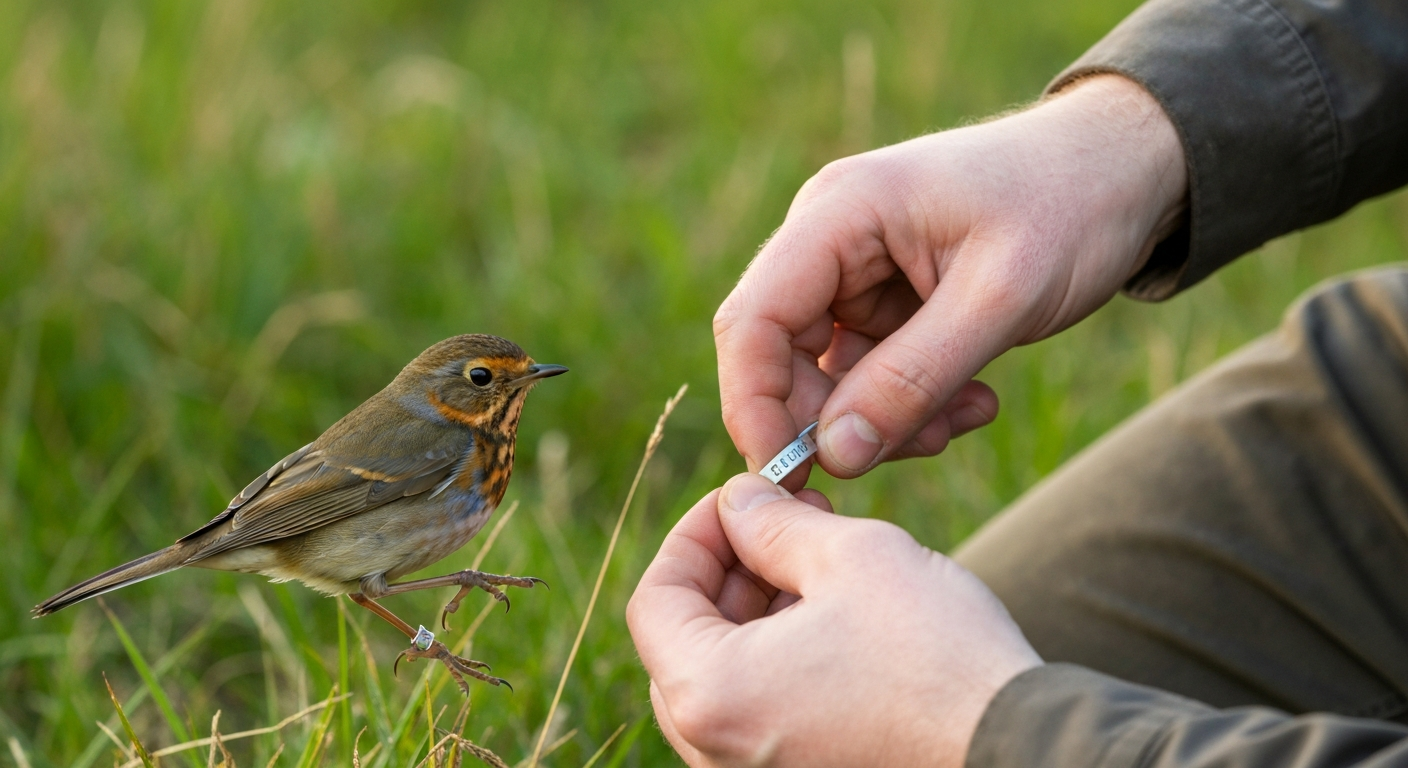
What bird ringing actually is, and why researchers do it
Bird ringing (called banding in North America) means fitting a uniquely numbered ring or band to a bird's leg so that if it is ever recaptured or found dead, it can be identified. The practice has been running systematically since the early 20th century and now underpins almost everything we know about migration routes, survival rates, breeding ecology, and how bird populations respond to climate and habitat change. The European Union for Bird Ringing (EURING) maintains a data bank holding over 10 million encounter records contributed by dozens of national schemes. The USGS Bird Banding Laboratory holds electronic North American records from 1960 onward. These are not trivial datasets: they are the backbone of evidence used to set conservation policy, manage protected areas, and model population trends.
Beyond conservation research, ringing programs feed directly into aviation safety, pest management, and disease surveillance. Knowing where individual birds go, how long they live, and when they concentrate near airports are exactly the kinds of facts that aviation professionals need. For researchers and curious readers, the point to hold on to is this: the data these programs generate is irreplaceable, and no current non-invasive technology fully replaces the long-term, continent-scale information that ringing provides.
How rings and tags are actually fitted
The standard metal ring is a small, pre-sized aluminum or aluminum-alloy band stamped with a unique number and a return address. It is closed around the tarsus (lower leg) using pliers specifically designed for the purpose, forming a loose cylinder that can rotate freely around the leg without gripping it. Sizes are standardized: a tiny 'A' ring for a goldcrest or wren weighs fractions of a gram, while larger rings are used for raptors, waterfowl, and seabirds. The guiding principle is that the ring should be snug enough not to slip over the foot but loose enough to rotate with no restriction to blood flow.
Beyond the standard metal ring, researchers use a range of auxiliary markers when individual identification in the field is needed without recapture. These include colour rings and flags (plastic bands in coded colour combinations read from a distance), Darvic plastic leg rings, wing tags, neck collars, nasal saddles, and electronic tags such as RFID transponders and geolocators. Each marker type carries its own risk profile. Metal rings on passerines: very low risk. Flipper bands on penguins: documented significant harm. Geolocators: debated, with some studies showing small but real body-condition costs in species where device mass exceeds about 3% of body weight. The type of marker matters enormously when evaluating welfare.
| Marker type | Typical species | Main welfare concerns | Risk level (relative) |
|---|---|---|---|
| Metal leg ring (aluminium) | Passerines, waders, raptors, waterfowl | Rare abrasion if incorrectly sized; very low injury rate | Very low |
| Plastic colour ring / flag | Passerines, shorebirds | Material accumulation, contact inflammation, toe entrapment if poorly fitted | Low to moderate depending on fit |
| Flipper band (stainless steel) | Penguins | Documented ~16% lower survival, ~39% lower reproduction in king penguins | High (now largely replaced) |
| Geolocator / data logger | Migratory passerines, seabirds | Body condition cost if >3% body mass; affects flight in some species | Low to moderate (species-dependent) |
| RFID transponder (subcutaneous) | Penguins, seabirds, some raptors | Minor implantation risk; largely replacing flipper bands | Very low |
| Wing tag | Raptors, corvids, large waders | Feather abrasion, social signalling disruption in some studies | Low to moderate |
| Neck collar | Geese, swans, cranes | Neck feather wear; risk of entanglement if poorly fitted | Low to moderate |
What happens to a bird during capture and fitting
The most common capture method for small passerines is the mist net: a very fine mesh net strung between poles in which birds become gently entangled. The ringer extracts the bird by hand, measures it, weighs it, fits the ring, and releases it. Handling time for an experienced ringer is typically under five minutes for a common passerine. For raptors or larger birds, cannon nets, bal-chatri traps, or decoy traps are used. The bird does not experience pain during ring fitting when done correctly, but it does experience a strong stress response.
That stress response is measurable. Plasma corticosterone (the primary avian stress hormone) rises rapidly in captured birds, often reaching detectable elevations within two to three minutes of handling. This is why research protocols for collecting baseline blood samples specify collection within three minutes of capture: samples taken later reflect the handling stress itself, not the bird's background physiological state. The stress is real, but it is also transient. Corticosterone in feathers is a long‑term, integrated measure of avian stress physiology, Bortolotti et al. (Functional Ecology, 2008) Corticosterone in feathers is a long‑term, integrated measure of avian stress physiology — Bortolotti et al. (Functional Ecology, 2008). Most birds show behavioural recovery within minutes to hours of release, and there is no good evidence that a single ringing event causes lasting physiological damage to healthy, well-handled birds of typical target species.
That said, there are genuine short-term risks. Birds can injure themselves thrashing in nets if they are not extracted promptly. Some species, particularly heavy-bodied birds caught in mist nets, can suffer leg injuries from struggling. Birds held in hot conditions can overheat rapidly. The Spotswood et al. review, drawing on over 620,000 captures, found that incident risk was not uniform: it varied significantly by species, body size, and capture method. Larger-bodied birds, waterfowl, seabirds, and some corvids and finch species showed elevated incident probabilities. This is exactly why reputable programs train ringers to adjust protocols for different species and why the North American Banders' Study Guide sets species-specific guidance.
Long-term impacts: when ringing causes real harm
The clearest evidence of long-term harm from marking comes from penguins. A ten-year controlled study of king penguins published in Nature found that birds with stainless-steel flipper bands had approximately 16% lower survival and roughly 39% lower reproductive output than unbanded birds. That is a substantial fitness cost, not a marginal effect. Similar patterns have been reported in Adélie, Magellanic, and African penguins, where banded birds showed reduced foraging efficiency, presumably because the band increases drag in the water. The consequence of these findings was significant: many research programs have moved away from flipper bands toward RFID transponders implanted subcutaneously, which carry far lower welfare costs.
For passerines, the long-term picture is more reassuring but not entirely clean. A study of colour-ringed Marsh Tits found a leg or foot injury rate of 1.5% in colour-ringed individuals compared with 0.2% in unringed birds, with one probable ring-related fatality. Research has identified three main injury mechanisms for plastic colour rings: material (usually dirt or plant matter) accumulating under the ring and constricting the leg, contact inflammation where the ring edge touches the foot, and toes becoming trapped by partly-unwound flat-band colour rings. These are not hypothetical risks. They happen. But they are preventable with correct ring selection, proper fitting, and follow-up monitoring, which good programs mandate.
The Denmark and Faroe Islands national ringing programme, analysing data from 1999 to 2018, reported an overall mortality rate of 0.16% across its operations, with higher combined injury and mortality rates for larger species and certain capture methods. This is consistent with the broader picture: well-run programs on typical target species produce very low but non-zero harm rates, with identifiable risk factors that allow targeted improvement.
What the science actually measures
When you read research on ringing welfare, you will encounter a few core types of data. It helps to know what each one tells you and what it does not.
- Capture-related incident rates: counts of injuries or deaths recorded at the time of banding or shortly after, usually expressed as a proportion of total captures. The Spotswood et al. figure of 4,782 incidents from 620,997 captures gives a rate of roughly 0.77%. This is an upper-bound estimate because not all incidents lead to lasting harm, and it is simultaneously a likely under-estimate because not all incidents are observed or reported.
- Mortality rates from ringing-casualty encounter records: when a bird ringed alive is later recorded as a ringing casualty (dead at or near capture), that encounter feeds into mortality rate calculations. Clewley et al. identified 1,646 such records in European EURING data but emphasised substantial under-reporting and data-quality limits. These figures should be read as minimum estimates.
- Survival and reproductive output comparisons: the most powerful welfare evidence comes from longitudinal studies comparing banded and unbanded individuals, like the Saraux et al. penguin study. These control for confounding factors and measure real population-level costs over time. They are the gold standard but require years of fieldwork to produce.
- Corticosterone measures: plasma CORT measured at capture reflects acute stress. Feather corticosterone (feather CORT) integrates HPA-axis activity over the entire feather growth period, giving a medium-term picture of chronic stress exposure. Bortolotti et al. validated feather CORT as a long-term stress metric in 2008. Neither measure on its own tells you whether harm is permanent, but together they help researchers distinguish transient capture stress from ongoing physiological burden.
- Injury incidence comparisons: studies comparing injury rates in ringed versus unringed populations (like the Marsh Tit colour-ring study) provide direct evidence of ring-attributable harm. These are more informative than total injury counts because they control for baseline injury rates in the population.
One honest caveat applies to all of this data: under-reporting is a consistent problem. Ringers who observe an incident are required to report it in most schemes, but incidents that occur after release are largely invisible unless the bird is recaptured or found dead. The true rates of ring-related injury are almost certainly higher than any published figure, though not by an order of magnitude for well-run programs on typical species.
Summing up what the evidence shows
Pulling together the key data points produces a reasonably consistent picture. For small to medium-sized passerines and waders ringed with correctly-sized standard metal rings by trained operators, incident rates are low (below 1% in large reviews), long-term survival effects are not detectable in most species, and the stress of capture, while real, appears transient. The situation is meaningfully different for penguins fitted with flipper bands, where long-term fitness costs are large and well-documented, and for any species fitted with incorrectly sized or poorly monitored colour rings, where leg injury is a real risk.
| Evidence type | Typical finding | Confidence level | Key caveat |
|---|---|---|---|
| Capture-incident rate (large programs) | ~0.16–0.77% of captures | Moderate-high | Under-reporting likely; varies by species and method |
| Long-term survival (passerines, standard rings) | No detectable effect in most studies | Moderate | Few long-term controlled studies exist for non-seabirds |
| Long-term survival (king penguins, flipper bands) | ~16% lower survival | High | Effect is species and marker-type specific; flipper bands largely abandoned |
| Reproductive output (king penguins, flipper bands) | ~39% lower output | High | Not generalisable to leg-banded species |
| Colour ring leg injury (passerines) | 1.5% vs 0.2% baseline (Marsh Tit study) | Moderate | Risk varies with ring material, fit, and monitoring frequency |
| Acute stress response | Rapid corticosterone rise within 2–3 min of capture | High | Transient in most species; chronic effects not well-quantified for ringing specifically |
| Mortality from ringing casualty records (Europe) | 1,646 records in EURING data; rate calculations uncertain | Low-moderate | Substantial under-reporting; minimum estimate only |
The reality is that ringing is not a zero-harm activity. But the harm is quantifiably small for most species under proper conditions, is concentrated in identifiable risk factors (wrong marker type, large species, heavy-bodied birds in mist nets, poor fit), and has been progressively reduced as the field has acted on evidence. The penguin flipper-band story is the strongest example of the field doing exactly what it should: detecting harm, publishing it, and switching to better methods.
The legal and ethical safeguards behind ringing programs
Ringing is not something anyone can pick up and do. In the UK, the British Trust for Ornithology operates a formal permit and graded training system with permit grades ranging from Trainee through to Trainer, issued under licence from statutory conservation bodies. A new ringer must train under supervision, demonstrate competency, and receive endorsements before operating independently. Species restrictions mean that some particularly sensitive birds require additional permits. The BTO actively enforces these requirements.
In North America, banding migratory birds without authorization is a federal offence under the Migratory Bird Treaty Act. Permits are issued through the USGS Bird Banding Laboratory and the US Fish and Wildlife Service, and many states add their own permitting requirements on top. The North American Banding Council publishes comprehensive bander manuals covering handling protocols, band sizing, minimum handling times, and mandatory incident reporting. See the North American Banders' manuals and Study Guide (NABC banding manuals) for specific technical guidance on handling, band sizing, minimum handling times, and incident reporting. These are not voluntary best-practice guides: they are the technical standards against which permit holders are evaluated.
Ethical oversight extends beyond legal compliance. Most institutional ringing programs operating within universities or research bodies are subject to animal ethics committee review under the same frameworks applied to any vertebrate research. This means that the conservation justification, the methods, the expected harm rates, and the mitigation measures all have to be reviewed and approved before fieldwork begins. Programs that cannot demonstrate that benefits outweigh welfare costs do not get approved.
- Use rings of the correct size for the species, verified against standardized size tables in banding manuals.
- Minimise handling time: the North American bander guidance recommends completing processing as quickly as possible to reduce stress and corticosterone elevation.
- Extract birds from mist nets promptly, especially in hot, cold, or wet conditions, to prevent exposure injuries.
- Avoid mist-netting in extreme weather conditions where thermoregulatory risk is elevated.
- Check colour-ringed individuals in the field regularly and remove or replace rings showing signs of wear, discolouration, or tightening.
- Report all observed incidents (injuries, deaths, escapes, ring loss) to the national scheme using standardised codes.
- Choose the lowest-impact marker type adequate for the research question: standard metal ring if individual field-identification is not required, avoid flipper bands on penguins, consider RFID where logistics allow.
- Only ring species for which you hold the appropriate permit endorsement and have received species-specific training.
What to do if you find a ringed or distressed bird
If you find a ringed bird that appears injured, the most useful thing you do is record the ring number exactly as it appears (including any letters, the ring diameter, and the colour scheme if it has colour rings), note the species if possible, and report it to your national ringing scheme. For guidance on choosing safer cat collars and reducing risks to birds, see cat collar bird warning. In the UK that is the BTO; in the US, reports go to the USGS Bird Banding Laboratory online reporting tool. This data is genuinely valuable: encounter records feed directly into survival analyses and allow schemes to flag particular rings or localities with elevated injury rates.
If the bird has an obviously constricting ring, swollen leg, or is unable to perch, treat it as an injured bird and contact a licensed wildlife rehabilitator or veterinarian. Do not attempt to remove a ring yourself unless you have no other option and the bird is in immediate danger: incorrect removal can cause additional injury. If you are a pet owner wondering whether a ring on a captive bird is appropriate, the welfare considerations are somewhat different from wild-bird ringing. A related example is a viral clip titled "bird freaks out when owner smashes cage," which illustrates the acute stress birds show when physically constrained and why careful handling and monitoring are essential a viral clip titled "bird freaks out when owner smashes cage". If you're wondering "are bird harnesses cruel", there is specific guidance on harness welfare, fit, and monitoring for captive birds that addresses those concerns directly. Questions about bird restraint and fitting devices in captive contexts, whether rings, harnesses, or other markers, all touch on related welfare principles around fit, monitoring, and the stress response birds show when physically constrained.
The bigger picture: why the benefits justify the practice
Ringing has directly shaped conservation decisions that have protected species at population scale. Survival rates calculated from ringing data inform IUCN assessments, national red-list decisions, and the identification of critical stopover sites for migratory birds. Without ringing, the case for protecting many migratory flyways and wintering grounds would be far weaker. For aviation professionals, the same databases inform bird-strike risk models by establishing which species concentrate near airports at which times of year. The harm from ringing, at the scale of individual birds, is real but small and concentrated in avoidable risk factors. The harm from not knowing what these populations are doing, at the scale of species and ecosystems, would be considerably larger. For a related literary exploration, see the piece titled what is the encaged bird fearful of.
The field has also demonstrated genuine responsiveness to welfare evidence. When the penguin flipper-band data showed measurable population-level costs, researchers changed their methods. When colour-ring injury studies identified specific mechanisms of harm, scheme guidelines were updated. That is the opposite of indifference to welfare. It is a research community applying the same evidence standards to its own practices that it applies to everything else it studies.
FAQ
What is bird ringing (banding) and why is it done?
Bird ringing (also called banding) is the attachment of a small, usually lightweight, identifying ring or marker to a bird’s leg (or, historically, flipper bands on penguins) to permit individual identification on recapture or resighting. Purpose: track survival, movements, migration routes, demographics, breeding site fidelity, and causes of mortality; provide data for conservation, population monitoring, and aviation/wildlife‑strike management. Modern programmes use standardized databases (e.g., EURING, USGS BBL) to aggregate records for research and management.
Is bird ringing cruel? What does the evidence say?
Overall verdict: ringing is not inherently cruel but it is not risk‑free. Large multi‑site datasets and reviews show a low but non‑zero rate of injury and mortality associated with capture and marking. Examples: Spotswood et al. (2012) analysed >620,000 captures and documented 4,782 incidents (injury or death) linked to capture/banding; national analyses report program-level mortality rates on the order of ~0.1–0.3% with higher rates for some taxa and methods. Strong, species-specific exceptions exist (e.g., flipper bands on penguins produced substantial long‑term survival and breeding penalties in multiple studies). Interpretation requires distinguishing short‑term handling stress (rapid corticosterone rise within minutes) from measurable long‑term fitness impacts documented for particular ring types/species.
What types of data are used to judge ringing welfare and what should readers expect to see in studies?
Core evidence types: 1) large capture/incident datasets (counts of injuries and mortalities per capture effort); 2) controlled longitudinal comparisons of marked vs. unmarked individuals (survival and reproductive output); 3) physiological stress measures (plasma corticosterone for acute response, feather corticosterone for integrated stress during feather growth); 4) case series documenting ring‑related injuries (leg lesions, trapped toes, entanglement); 5) species‑ or method‑specific field experiments and monitoring. Good studies report denominators (number of captures/bands), species breakdown, method of capture, and follow‑up/resighting effort to detect delayed effects.
Which species or ring types are highest risk?
Risk is heterogeneous. Larger-bodied waterfowl, seabirds, and certain species with heavy foraging/pecking behaviour show elevated incident probabilities. Historic flipper/wing bands on penguins produced consistent long‑term negative effects (e.g., Saraux et al. 2011 found ~16% lower survival and ~39% lower reproduction in flipper‑banded king penguins). Some plastic colour rings in passerines have caused leg injuries via material accumulation, inflammation, or partially unraveled rings. Species‑ and ring‑type risk profiles are common in the literature and underpin species‑specific safeguards.
How much stress does handling and ringing cause to a bird?
Acute handling stress: plasma corticosterone often rises within ~2–3 minutes of capture, so short handling causes a rapid hormonal stress response; studies emphasise collecting baseline blood samples within ~3 minutes if needed. Feather corticosterone provides a medium‑term integrated index of stress during feather growth. Most field protocols aim to minimize handling time because shorter procedures reduce acute stress responses, and empirical work generally shows brief handling has transient physiological effects for many species, while long‑term effects depend on ring type and species.
What injuries have been documented from rings and how common are they?
Documented injuries include leg/foot inflammation, tissue erosion, trapped toes, ring abrasion, and occasional entanglement leading to mortality. Incidence is low but measurable: e.g., a colour‑ringed Marsh Tit study reported 1.5% injury incidence vs. 0.2% in unringed birds; broader capture‑incident datasets report overall incident proportions well below 1% for many national programmes, but reporting is incomplete and some ring types (e.g., flipper bands) have higher, clearly harmful rates.