When a bird stops playing, it almost always means something has changed, and your job is to figure out whether that change is normal biology or an early warning sign. Most of the time, reduced play in a pet or captive bird traces back to one of a handful of causes: molting, seasonal hormonal shifts, a boredom plateau from stale enrichment, a social disruption, or the early stages of illness. The hard part is telling those apart, because birds are prey animals that hide weakness well, and by the time the problem is obvious, it has often been building for a while. This article walks through how to read the signs, what to check first, when to act urgently, and how to prevent the cycle from repeating.
Why Bird Stop Playdays: Causes, Safety Checks & Prevention

Marcus Whitmore
13 Jul 2026
What this article covers and who it's for
Whether you're a pet owner watching your parrot ignore its favorite toy, an avian researcher documenting behavioral time-budgets, or an animal-safety professional assessing a captive bird's welfare, the core question is the same: why has this bird stopped playing, and what do I do about it? See the related brief guide on why bird stop for a concise overview. This article addresses that question from a science-grounded perspective, covering behavioral definitions, normal versus abnormal variation, emergency signs, medical causes, environmental and social factors, diagnostic steps, practical interventions, and long-term prevention. I'll also briefly flag a separate meaning of 'why bird stop playday' that circulates in gaming communities, so we're all talking about the same thing. The focus here is real-bird biology and welfare.
What 'stopped playing' actually means in birds
Play in birds is not just cute behavior. It is a measurable, ethologically defined set of activities that researchers categorize into three main classes: solitary or object play (manipulating toys, chewing wood, exploring novel objects), social play (wrestling, chasing, mutual preening games, mock-vocalizations), and locomotor play (acrobatic flight, hanging, swinging within context). These behaviors are well documented across parrots and corvids, and in a 2012 analysis published in PMC, play behavior correlates with relative brain mass in birds, which means it reflects genuine cognitive engagement, not just random activity.
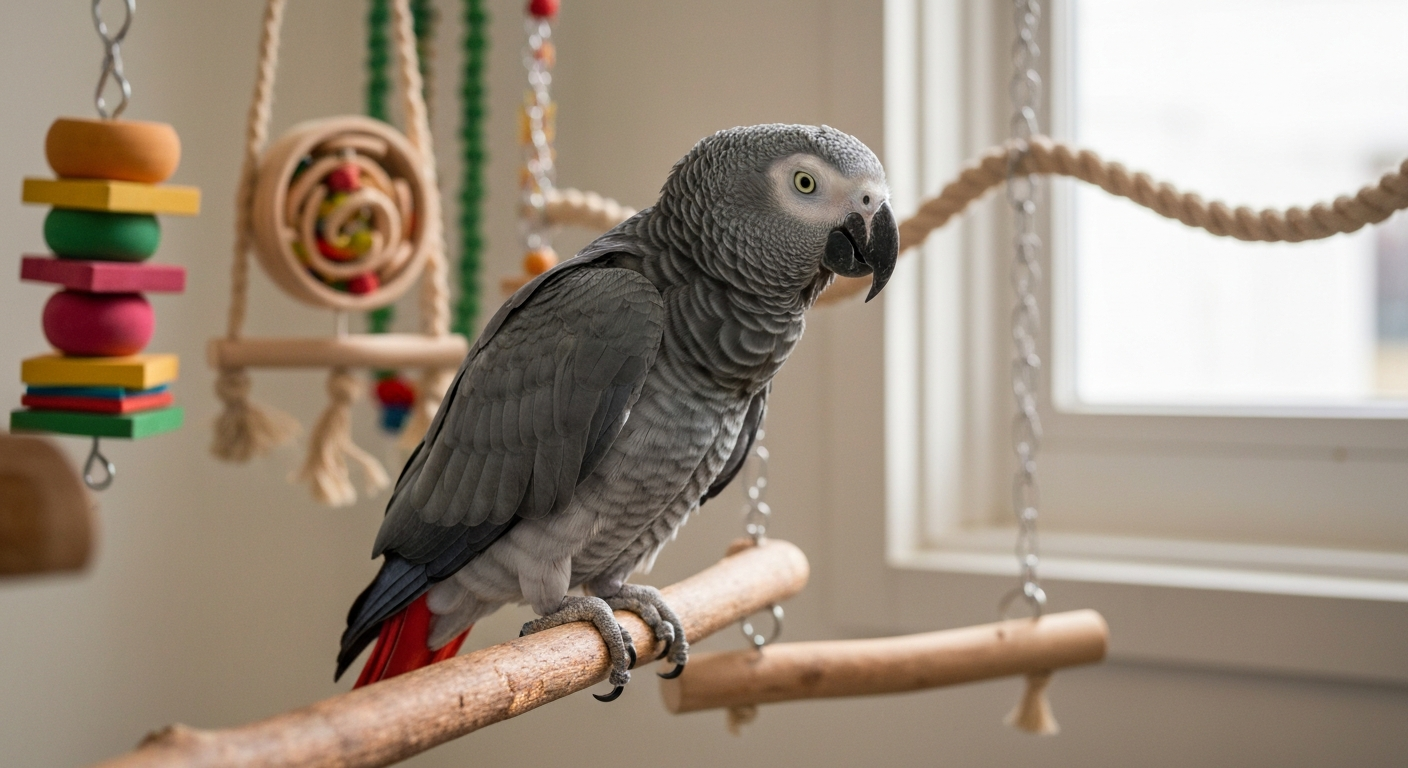
What owners mean when they say their bird 'stopped playing' typically maps onto one or more of these measurable changes: less time spent manipulating toys or exploring, a longer lag before approaching previously preferred objects or people, fewer and simpler vocalizations, more time spent fluffed up or resting with eyes partially closed, altered preening patterns (either obsessive or nearly absent), and reduced initiation of social interaction. These are the behavioral markers that avian professionals use to assess welfare and track decline. A bird's individual baseline matters enormously here. An active, vocal African grey that suddenly sits quietly on one perch for most of the day is a very different clinical picture from a naturally quiet, sedentary individual doing the same thing.
Normal reasons a bird plays less
Not every dip in playfulness is a problem. There are several well-understood biological and seasonal reasons a bird will naturally reduce or suspend play behavior, and knowing these can save you a lot of anxiety and unnecessary vet visits.
- Molting: Active feather replacement is energetically expensive and physically uncomfortable. During a heavy molt, most birds rest more, vocalize less, and show reduced play. This is normal and typically resolves as the molt completes.
- Seasonal hormonal cycles: Many parrot species experience predictable annual shifts in reproductive hormones. During breeding season hormonal surges, some birds become territorial, irritable, or withdrawn rather than playful. Others redirect all energy toward nesting behaviors.
- Age-related changes: Juvenile birds typically play more than adults, and senior birds often slow down further. A fifteen-year-old cockatoo that plays less than it did at age five is not necessarily ill. Expect gradual age-related behavioral changes similar to those in mammals.
- Circadian and seasonal light cycles: Birds are highly sensitive to photoperiod. Shorter winter days or abrupt changes in artificial lighting schedules can shift sleep-wake timing and reduce daytime activity, including play.
- Post-fledgling developmental phases: Young birds sometimes go through quieter consolidation periods after intensive early learning phases. This is normal developmental pacing.
The key word in all of these is gradual. Normal biological changes unfold over days to weeks, the bird continues to eat, maintains normal weight, holds its feathers normally, and shows no other concerning signs. If the change is abrupt or the bird is showing additional symptoms alongside reduced play, biology alone is unlikely to be the full explanation.
Normal variation versus something worth worrying about
The clinical threshold for concern comes down to three variables: speed of onset, duration, and whether other signs accompany the change. A bird that plays less during a known molt, resumes normal behavior within two to three weeks, and maintains its weight and eating habits is almost certainly fine. A bird that abruptly stops all play and social interaction over the course of a few hours to a couple of days, especially alongside any change in posture, breathing, droppings, appetite, or weight, is telling you something different.
The Merck Veterinary Manual guidance on pet bird disorders emphasizes that acute or progressive behavioral decline from an individual bird's established baseline is the signal that warrants diagnostic evaluation. The phrase 'from baseline' is critical. You are not comparing your bird to some average. You are comparing it to its own recent normal. This is why knowing your bird's everyday behavior is the single most useful diagnostic tool you have.
| Feature | Likely Normal | Warrants Veterinary Evaluation |
|---|---|---|
| Onset | Gradual over 1–3 weeks | Abrupt, hours to a few days |
| Duration | Resolves with molt/season | Sustained beyond 3–5 days with no improvement |
| Appetite and weight | Maintained | Reduced intake or measurable weight loss |
| Droppings | Normal color and consistency | Changes in color, volume, or consistency |
| Posture | Normal feather position | Persistent fluffing, hunching, or tail-bobbing |
| Breathing | Silent and regular | Labored, open-mouth, or audible respiratory sounds |
| Concurrent signs | None | Any additional behavioral or physical changes |
Emergency signs: when to act right now
Some signs accompanying a bird's refusal to play are not 'watch and wait' situations. They require immediate transport to an avian-capable emergency clinic. Do not wait until your regular vet opens the next morning. The following signs constitute a veterinary emergency.
- Collapse or unresponsiveness
- Severe labored breathing, open-mouth breathing, or tail-bobbing at rest
- Seizures or marked ataxia (uncoordinated movement, falling off perch)
- Heavy, uncontrolled bleeding
- Acute severe lethargy combined with inability to perch
- Sudden complete refusal to eat combined with rapid visible weight loss
- Suspected inhalant exposure (overheated non-stick cookware, solvents, pesticides)
PTFE toxicosis, caused by inhaling pyrolysis products from overheated non-stick (Teflon-coated) cookware, is worth singling out here because it is genuinely rapid and lethal. Cornell's College of Veterinary Medicine and a 2025 Frontiers in Veterinary Science toxicology review both document that birds can progress from apparent normality to collapse and death within minutes to hours of exposure at high temperatures. If a bird was active and playful, then suddenly became still or breathless after you used the stove, treat it as a PTFE emergency: immediately move the bird to fresh outdoor air, shut off the heat source, and go directly to an emergency vet. This is not a myth. Birds' highly efficient respiratory systems that make them such sensitive environmental indicators also make them uniquely vulnerable to aerosolized toxins.
For bleeding, apply gentle but firm pressure with clean gauze and seek urgent care. For collapse or suspected seizure, keep the bird warm (a loosely draped towel and a warm but not hot surface), minimize handling and stress, and transport immediately. Do not attempt prolonged home treatment without professional guidance.
Medical causes to investigate
If there are no emergency signs but the reduced play is persistent and accompanied by any supporting signals, medical investigation is warranted. Here are the most common medical causes, with the observable indicators that point toward each.
Infectious disease
Chlamydia psittaci (psittacosis), avian bornavirus (which causes proventricular dilatation disease), polyomavirus, aspergillosis, and systemic bacterial infections all reduce activity and play as part of their clinical picture. The presentation varies: psittacosis often shows respiratory signs and weight loss; bornavirus can produce neurologic signs or chronic wasting; aspergillosis typically presents as chronic respiratory compromise and fatigue. Lethargy and reduced play are among the earliest and most consistent nonspecific signals across all of these.
Pain and musculoskeletal problems
A bird with a fracture, arthritis, pododermatitis (bumblefoot), or soft-tissue injury will often reduce play before any visible lameness becomes obvious. Watch for reluctance to use a particular limb, preference for sitting low in the cage, avoiding climbing, and reduced willingness to fly or land on perches. Avian medicine principles texts note that pain-associated behavioral changes commonly precede obvious physical signs, which is why owners sometimes describe their bird as 'just being quiet' weeks before a lesion is found.
Parasites and dermatologic causes
External parasites including Knemidokoptes scaly mites, feather mites, and lice create persistent pruritus, discomfort, and feather damage that predictably suppresses normal play. A bird that is constantly self-directed, scratching or over-preening but disengaged from toys and social interaction, may have a parasitic load. Diagnosis requires visual examination and skin or feather scrapings under microscopy. The reality is that parasitic causes are often missed because they are not the first thing owners think of, yet they are among the more treatable once identified.
Toxins and heavy metals
Lead and zinc are the most common heavy-metal toxicoses in pet birds. For species-specific toxin sensitivities, see what is death rite bird weak to. Lead exposure typically comes from old paint, stained-glass solder, or jewelry; zinc from galvanized cage hardware, padlocks, or certain toys. Both present with a variable combination of gastrointestinal signs, lethargy, neurologic signs, and anemia. The bird may simply seem 'off' and disinterested before more specific signs develop. Blood metal levels and whole-body radiographs (to identify metallic foreign material in the GI tract) are the key diagnostics. Poison control providers including the Pet Poison Helpline and ASPCA Animal Poison Control Center can guide case-specific management alongside your vet.
Nutritional deficiencies
Hypovitaminosis A is a chronic and unfortunately common problem in seed-heavy diets. It impairs mucosal and respiratory health, causes poor feather quality, and reduces overall activity. Calcium and vitamin D deficiency, documented to cause nutritional secondary hyperparathyroidism, produce weakness, tetany, and eventually collapse in severe cases. A bird on an all-seed or nutritionally narrow diet that plays less and has poor feather condition should have a nutritional history taken, body condition assessed, and blood calcium measured.
| Medical Cause | Key Observable Signs | Primary Diagnostic Steps |
|---|---|---|
| Infectious disease (psittacosis, aspergillosis, bornavirus) | Lethargy, respiratory signs, weight loss, GI or neurologic signs | CBC/chemistry, PCR or culture, choanal swab, radiographs |
| Pain or musculoskeletal injury | Limb guarding, low perching, reduced flight, appetite change | Physical/orthopedic exam, radiographs |
| External parasites (mites, lice) | Pruritus, over-preening, feather damage, skin crusting | Visual exam, skin/feather scraping, microscopy |
| Heavy metal toxicosis (lead, zinc) | GI upset, lethargy, neurologic signs, anemia | Blood metal levels, whole-body radiograph |
| Aerosolized toxins (PTFE, solvents) | Acute respiratory distress, rapid collapse | Emergency care, history of exposure |
| Nutritional deficiency (vitamin A, calcium/D3) | Poor feather quality, weakness, tetany, reduced activity | Dietary history, blood calcium, body condition score |
Environmental and social causes
Not every quiet bird is sick. Environmental and social factors are among the most common reasons for reduced play, and they are also the most actionable because you can often fix them without a vet visit.
Boredom and enrichment plateau
Birds, especially parrots and corvids, habituate quickly to unchanging environments. The Association of Avian Veterinarians' enrichment and play guidance specifically separates object, solitary, and social play categories when assessing welfare, because all three need to be addressed in captivity. A cockatoo that was given the same three toys six months ago and has never had them rotated out is not going to engage with them the way it did initially. Enrichment plateau is real, and it looks almost identical to early illness: the bird sits more, interacts less, and seems generally disengaged. The distinguishing feature is that appetite, weight, posture, and droppings all remain normal.
Loneliness and social disruption
Many parrot species are highly social and experience genuine distress when their social environment changes. The loss of a bonded companion (human or avian), a change in the primary caregiver's schedule, or the addition of a perceived rival can all suppress play and social interaction. A bird that previously played heavily with a specific person and now sees that person less will often show what looks like a behavioral shutdown, reduced vocalization, reduced play, increased feather-directed behavior.
Inadequate cage setup, lighting, and temperature
Cage size, perch variety and placement, available flight space, and lighting all affect behavioral output. Birds need access to full-spectrum or near-full-spectrum light to regulate circadian rhythms properly. A cage placed in a dark corner or a room with inconsistent artificial lighting produces behaviorally suppressed birds. Similarly, temperatures outside a species-appropriate range (roughly 65–85°F or 18–29°C for most common pet parrot species) shift energy toward thermoregulation rather than play. Sudden routine changes, including moving the cage, changes in household noise levels, or changes in the owner's schedule, can also trigger temporary behavioral withdrawal.
How to observe and document what's happening
Before you intervene or call an expert, spend 24 to 48 hours systematically observing and recording. A behavior log does not need to be elaborate, but it should be consistent. Note the time of day, what the bird was doing, for how long, and any contextual factors. The goal is to establish whether reduced play is isolated to certain times (morning, post-feeding, around a specific person) or uniform throughout the day, and whether it has been worsening, stable, or fluctuating.
- Weigh the bird every morning before feeding, using a gram-accurate scale. A loss of more than 5–10% of body weight in a week is significant in most small-to-medium parrots.
- Record droppings: normal droppings have three components (dark solid feces, white urates, clear liquid urine). Document any change in color, consistency, volume, or smell.
- Note posture at rest: is the bird holding its feathers tightly or fluffed? Is it sleeping during the day more than usual?
- Observe breathing: any tail-bobbing, open-mouth breathing, or audible sounds at rest are immediate red flags.
- Take short video clips of the bird at rest and during attempted interaction with toys or people. These are invaluable for an avian vet who cannot observe the bird continuously.
- Check the cage and toys: inspect for sharp edges, broken parts, or potential heavy-metal hazards (galvanized clips, painted or soldered metals). Remove anything suspect.
- Review recent changes: new foods, new cage accessories, cleaning products, cooking events, visitors, schedule changes in the past two to four weeks.
Practical troubleshooting checklist and step-by-step interventions
Use this sequence to work through the most common causes systematically before escalating to veterinary care, unless emergency signs are present (in which case skip everything and go directly to the vet).
- Check for emergency signs (see the list above). If any are present, stop here and go to an avian emergency clinic.
- Weigh the bird and check droppings. If weight is down more than 5–10% from recent baseline, or droppings have changed noticeably, call an avian vet today.
- Assess the environment: review lighting (is the bird getting 10–12 hours of appropriate light?), temperature (appropriate species range?), and cage placement (drafts, direct sun, high-traffic stress?).
- Audit recent changes: new foods, new cage items, cleaning products, cooking events, visitors, schedule shifts. Identify and reverse any obvious stressors.
- Rotate or replace toys and enrichment. Introduce one or two novel items and observe response within 24–48 hours. Improved engagement toward novel enrichment strongly suggests environmental boredom.
- Increase direct social interaction for 15–30 minutes twice daily, especially if the bird's routine recently changed. Observe whether play behavior returns in this context.
- Review diet: if the bird is on a predominantly seed-based diet, this is a reasonable time to begin a conversion toward a nutritionally complete pellet diet supplemented with fresh vegetables, under gradual transition.
- If no improvement within 5–7 days after addressing environmental and social factors, or if any medical signs are present, schedule an avian veterinary examination.
Re-evaluate after each intervention step before adding another variable. If you change the toys, the lighting, and the diet simultaneously, you will not know what helped. Address one category at a time where the situation is not urgent.
Long-term enrichment and prevention
The most consistent predictor of a bird that remains playful and engaged over years is an enrichment program that is actively managed rather than set-and-forgotten. The AAV's enrichment and play guidance distinguishes object, social, and locomotor play categories for a reason: you need to address all three to maintain behavioral health. Here are the strategies that hold up across species and settings.
- Rotate toys on a regular cycle (every one to two weeks), returning 'retired' toys after a gap. Familiarity breeds disinterest, but brief absence can restore it.
- Introduce foraging opportunities: hide food in puzzle feeders, wrap treats in paper, or layer food in foraging boxes. Foraging is one of the highest-value enrichment categories for parrots because it mirrors their natural time-budget in the wild, where food search occupies a large proportion of their day.
- Use positive reinforcement training: even short five-to-ten-minute daily sessions build cognitive engagement and strengthen the human-bird bond. Target training, trick learning, and station training all qualify.
- Provide safe, supervised out-of-cage flight time daily if the bird is flight-capable. Physical exercise is not separable from behavioral engagement, and cage-bound birds are consistently more behaviorally suppressed.
- Maintain social contact appropriate to the species. Highly social species (many parrots, corvids) need predictable, consistent interaction to stay behaviorally healthy.
- Optimize diet: a varied, nutritionally complete diet that includes formulated pellets, fresh vegetables, and appropriate fruits reduces the risk of nutritional deficiencies that suppress activity and behavioral health.
- Keep a stable and predictable daily routine. Birds are sensitive to schedule disruption, and predictability reduces baseline stress, which supports play and exploration.
When and how to contact an avian veterinarian
An avian-experienced veterinarian, rather than a general small-animal practitioner, is the appropriate resource here. Avian medicine requires specific training and equipment, and the diagnostic approach differs substantially from mammalian medicine. The following situations warrant a call or appointment.
- Any emergency sign listed earlier: call an avian emergency clinic immediately.
- Reduced play sustained beyond 5–7 days with no clear environmental cause identified and addressed.
- Any measurable weight loss or change in droppings.
- Suspected toxin exposure (heavy metals, PTFE, aerosols, pesticides).
- Feather-damaging behavior that appears alongside reduced play (must rule out medical causes before attributing to behavioral primary FDB, as large-scale psittacine surveys confirm).
- Any bird that is new to your home and has not had a baseline wellness exam.
When you call or arrive, bring as much of the following as possible: your behavior log and any video clips, the bird's approximate recent weight measurements, a fresh fecal sample in a clean sealed container (collected within the last 4–6 hours), a list of all foods, supplements, and cage materials, and a timeline of any recent environmental or household changes. The vet's typical first-line workup for a bird presenting with reduced activity and nonspecific signs includes physical exam with weight and body condition assessment, a direct fecal wet mount for protozoa and yeast, choanal or crop cytology, CBC and plasma biochemistry panel, and whole-body radiographs. blank" rel="noopener noreferrer">Proceedings: Association of Avian Veterinarians (clinical approach and first-line diagnostics) outlines these quick, high-yield first-line diagnostics: fecal direct smear/wet mount, choanal/crop cytology, whole-bird radiographs, and in-clinic CBC/chemistry. Emergency and Critical Care, Clinical Avian Medicine (IVIS / veterinary chapter on diagnostics) summarizes this stepwise avian diagnostic approach, recommending focused history, physical exam with weight and body condition, direct fecal wet mount, CBC and plasma biochemistry, radiographs, choanal/cloacal swabs or PCR for suspected infections, and targeted tests such as metal screening, crop cytology, and endoscopy guided by findings blank" rel="noopener noreferrer">Emergency and Critical Care — Clinical Avian Medicine (IVIS / veterinary chapter on diagnostics). From there, targeted tests such as metal screening, specific PCR panels, and endoscopy are guided by initial findings.
Guidance for aviation and animal-safety professionals
If you are an animal-safety or aviation professional assessing captive or semi-captive birds in an institutional or operational context, the framework above applies with some procedural additions. Standardized behavioral observation protocols should establish individual baselines at intake or during routine wellness periods, so that 'reduced play or activity' can be defined against actual data rather than general norms. Activity time-budgets, documented weekly or bi-weekly using scan sampling or focal observations, provide the most defensible baseline for later comparison.
When reduced play is observed in an institutional setting, priority examination items include body weight against recent records, respiratory rate and effort at rest, fecal assessment, and a review of recent environmental exposures including any maintenance, cleaning, or construction that could introduce aerosolized toxins or heavy-metal sources. Risk mitigation should address the same categories covered above: toxic exposure screening, enrichment adequacy, social and environmental stability, and access to timely avian veterinary care. For collections housing multiple birds, any acute behavioral change in one individual should prompt a check of cage-mates and a review of shared environmental factors.
A note on gaming and card-game meanings
Search traffic for 'why bird stop playdays' includes a fair number of users coming from the Yu-Gi-Oh card game world, where Droll and Lock Bird is a hand-trap card that stops certain draw and search effects. If that's what brought you here, the short redirect is: yes, this site covers real birds, not card mechanics. If you were asking whether Droll and Lock Bird is banned in Yu‑Gi‑Oh (search: is Droll and Lock Bird banned), check the current official tournament banlist for the card's legality status. The questions around what Droll and Lock Bird stops, whether it negates, and its current ban status are covered in dedicated card-game content. If you meant whether Droll and Lock Bird stops drawing or search effects in card games, see the dedicated Droll and Lock Bird card guide for a concise explanation Does Droll and Lock Bird stop drawing?. What you'll find here is evidence-based information on actual bird biology, welfare, and safety. That said, if you also happen to own a parrot, welcome, the rest of this article is for you.
Your summary action plan
If your bird has stopped playing and you want a single quick-reference checklist, here it is. Work through it in order.
- Check for emergency signs (collapse, labored breathing, seizures, heavy bleeding, suspected toxic exposure). If present, go to an avian emergency clinic now.
- Weigh the bird and observe droppings. Any significant weight loss or abnormal droppings: call an avian vet today.
- Start a behavior log: record times, durations, posture, appetite, and any other signs. Shoot short video clips.
- Review the environment: lighting schedule, temperature, cage location, recent changes in household routine, new products, or cooking events.
- Remove any obvious hazards: galvanized hardware, suspect toys, aerosol or chemical sources near the bird.
- Rotate enrichment and increase direct social interaction for 48–72 hours. Observe response.
- Review diet. If seed-heavy, begin a gradual nutritional upgrade with veterinary guidance.
- If no improvement within 5–7 days after addressing environmental and social factors, schedule an avian vet appointment with your behavior log, video, fecal sample, and dietary history in hand.
- After resolution, establish a routine of weekly weigh-ins, regular enrichment rotation, and a structured daily social and foraging schedule to reduce the likelihood of recurrence.
FAQ
What does it mean when a bird 'stops playing'—how is play defined in birds?
In avian ethology, play includes solitary/object play (manipulating toys), social play (games, mock-fighting, vocal exchanges) and locomotor play (running, aerial maneuvers). "Stopped playing" means a measurable drop from the bird’s normal baseline in these behaviors—less time manipulating preferred toys, reduced vocalizations or social games, longer latencies to approach people/toys, or a simpler/repetitive interaction pattern.
How do I tell normal variation from a problem requiring attention?
Compare to the bird’s baseline. Short, transient drops (a day or two) during molting, after new household events, or during hormonal periods can be normal. Concerning patterns are abrupt or progressive declines over several days with other changes (weight loss, reduced appetite, increased sleep/closed-eye rest, changes in droppings, abnormal posture or breathing). Any drop accompanied by the emergency signs below requires immediate action.
What immediate signs are emergencies and need urgent veterinary care?
Emergency signs: collapse or unresponsiveness; severe labored or open-mouth breathing; seizures or marked ataxia; heavy bleeding; acute inability to perch or stand; rapid severe lethargy or sudden anorexia and weight loss. For suspected inhalant toxicosis (e.g., overheated non-stick cookware) move the bird to fresh air and seek emergency care immediately.
What first-aid steps should an owner take before reaching a vet?
For inhalant exposure: get the bird into fresh air, turn off the source, and transport urgently. For bleeding: apply gentle pressure with clean gauze and seek care. For collapse/seizures: keep the bird warm, quiet, and transported immediately. Avoid prolonged home treatments or unverified remedies—contact an avian vet or poison-control center for guidance.
What medical conditions commonly cause reduced play or activity?
Common medical causes: systemic infections (psittacosis, polyomavirus, avian bornavirus, aspergillosis), pain or orthopedic injury (fracture, arthritis, pododermatitis), parasitic/dermatologic disease (mites, lice), toxins (lead, zinc, aerosolized PTFE), nutritional deficiencies (vitamin A, calcium/vitamin D), and metabolic or neurologic diseases. Many of these produce nonspecific lethargy and reduced engagement.
What diagnostic steps will a veterinarian typically perform?
A stepwise avian diagnostic approach: focused history (diet, exposures, housing, new birds), physical exam with accurate weight and body-condition score, baseline tests—fecal direct smear, choanal or crop cytology, CBC and chemistry, whole-bird radiographs, and targeted swabs/PCR or metal screening as indicated. Further testing (endoscopy, advanced imaging) is guided by initial findings.