
There is no responsible "best bird poison" to recommend, and this article won't pretend otherwise. What I can do is explain what people typically mean when they search that phrase, walk through the real science of toxic birds, identify the human-made compounds that actually kill birds (and the serious legal and ecological consequences of using them), and point you toward lawful, evidence-based options if you're dealing with a nuisance bird problem. Whether you're a researcher trying to understand avian toxicology, a pet owner worried about household hazards, or an aviation professional managing wildlife near a runway, there's useful, factual information here.
Best Bird Poison, Legal, Ethical Context, Risks & Alternatives

Marcus Whitmore
14 Jul 2026
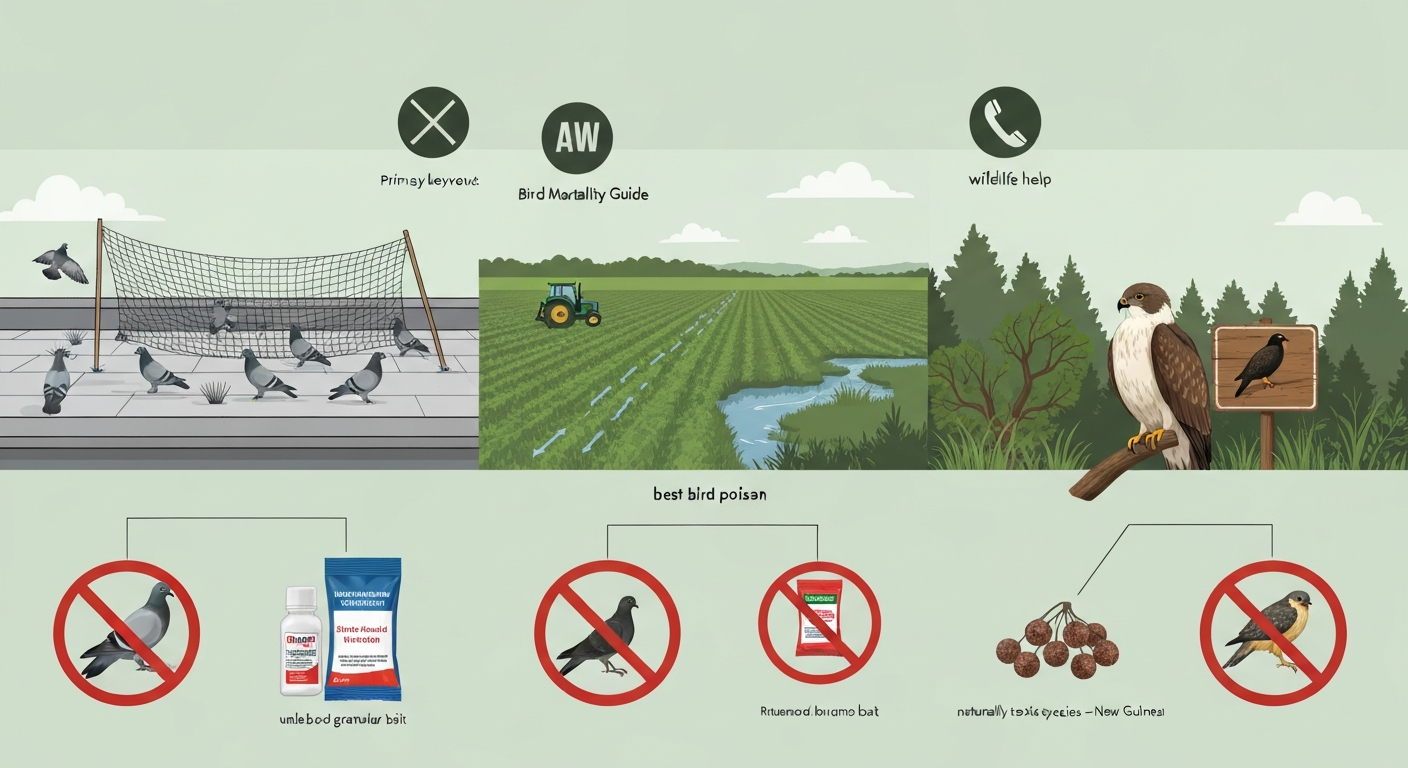
What people actually mean when they search "best bird poison"
Search intent here is genuinely mixed. Some people searching this phrase are homeowners frustrated with pigeons or starlings. Some are researchers interested in avian toxicology. A few are curious about naturally toxic bird species after reading a wildlife article. A small number may have a legitimate professional need, such as licensed pest control operators or agricultural managers aware that EPA-registered avicide products exist. And yes, some searchers may be looking for ways to harm protected species illegally. This article is written for the first four groups. For anyone in the last group: poisoning protected birds is a federal crime in the United States, and the penalties are real.
The scope here covers naturally poisonous bird species and their toxins, the classes of human-made compounds that are documented to kill birds (including how they spread through food chains), how to recognize a poisoned bird and what to do about it, the downstream risks to ecosystems and aviation safety, and the legal landscape around any attempt at lethal bird control. We finish with humane, lawful alternatives and a directory of resources.
Why this article won't give you instructions for poisoning birds
This isn't squeamishness. The Migratory Bird Treaty Act (MBTA, 16 U.S.C. 703-712) prohibits the take of most native migratory birds in the United States, where "take" includes killing, capturing, injuring, or even possessing a live or dead bird, its feathers, nests, or eggs, without authorization. The Bald and Golden Eagle Protection Act layers on additional, stringent protections for those species, with permits issued narrowly by the U.S. Fish and Wildlife Service. The Endangered Species Act creates further liability for any action that harms listed bird species or their habitat. Together, these laws mean that poisoning almost any wild bird you can name in the U.S. is, at minimum, a federal civil violation and, in many circumstances, a criminal offense.
Beyond the legal risk, uncontrolled bird poisoning carries serious ecological consequences. Toxicants do not stay where you put them. They move through food chains, contaminate water and soil, and kill nontarget animals including protected raptors, scavengers, pets, and sometimes people. The research on this is unambiguous, and I'll walk through it in detail below. The takeaway up front: effective, lawful bird management exists, and it does not require poison.
Poisonous, venomous, and toxic to eat: these are not the same thing
A lot of confusion in online discussions about "bird poison" comes from conflating three distinct concepts. Poisonous means an organism is harmful when touched or consumed. Venomous means an organism actively delivers toxin through a bite, sting, or specialized mechanism. Toxic to eat is a subset of poisonous that refers specifically to danger through ingestion. Understanding the distinction matters because the science around birds is genuinely counterintuitive.
| Term | Definition | Bird example | Risk to humans |
|---|---|---|---|
| Poisonous | Harmful on contact or when consumed | Pitohui, Ifrita kowaldi | Skin/mucosal irritation if handled; low systemic risk |
| Venomous | Actively injects or delivers toxin | No confirmed true bird species (disputed minor cases) | Essentially none from birds |
| Toxic to eat | Dangerous when ingested as food | Historically, some quail during migration (coturnism) | Rare; associated with specific dietary conditions |
| Toxic for birds (exogenous) | External compounds that kill birds | Rodenticide-exposed raptors, pesticide-killed songbirds | Secondary exposure risk, especially to pets and children |
The reality is that very few birds are poisonous, no bird is confirmed venomous in a meaningful biological sense, and most of what kills birds toxicologically comes from human-made compounds introduced into the environment. Each of those categories deserves its own careful treatment.
Birds that are actually poisonous: pitohuis, ifrit, and batrachotoxins
Until 1992, the textbook answer to "are any birds poisonous? For more on naturally toxic species, see the section on what bird is poisonous, which summarizes documented cases like pitohuis and ifrit (cf858660-79ba-49ff-b40a-b7cd61db5961). " was a flat no. Then Jack Dumbacher and colleagues published findings on the hooded pitohui (Pitohui dichrous) of New Guinea, demonstrating that its skin and feathers contained batrachotoxin alkaloids, the same neurotoxins found in poison dart frogs. A follow-up study in 2000 confirmed that the monotypic Ifrita kowaldi (the blue-capped ifrit, also New Guinean) carries the same class of compounds. These remain the best-documented cases of naturally poisonous birds in the world.
Batrachotoxins work by forcing voltage-gated sodium channels in nerve and muscle cells to stay permanently open. Normally, these channels activate briefly to generate an electrical signal and then inactivate. Batrachotoxins block inactivation, causing continuous nerve firing, muscle depolarization, and, at sufficient doses, cardiac arrest. They are among the most potent naturally occurring toxins known. The frogs that carry them are lethally toxic to humans in the microgram range.
The pitohui and ifrit, however, accumulate their toxins from diet rather than synthesizing them endogenously. Research has identified melyrid beetles of the genus Choresine, found in New Guinean forests, as the probable dietary source. This is the same mechanism seen in poison dart frogs in captivity, which lose their toxicity when removed from their natural diet. In other words, these birds are not intrinsically poisonous factories; they are toxic because of what they eat in a very specific geographic context.
Distribution and practical risk
Both pitohuis (several species across the Pitohui genus, now taxonomically reorganized) and Ifrita kowaldi are endemic to the montane and lowland forests of New Guinea. You will not encounter them in North America, Europe, Australia, or anywhere else outside that island. Cornell Lab taxonomy updates and BirdLife range data confirm this restricted distribution. For the vast majority of readers, the risk of handling a naturally toxic bird is zero.
That said, if you handle live or dead New Guinean forest birds as a researcher or field biologist, standard precautions matter: wear gloves, avoid rubbing your eyes or mouth, and wash thoroughly afterward. Skin and mucosal irritation from handling pitohuis has been documented by local hunters and researchers. Systemic poisoning from casual contact is not a realistic threat given the concentrations involved, but it is not zero either.
Are any birds venomous? The current scientific answer
The short scientific answer is: probably not in any ecologically significant way, though the subject keeps generating interesting edge cases. If you're also curious about aggressive or dangerous species, see the related discussion on what is the most violent bird. True venom delivery requires a specialized mechanism, typically a gland connected to a hollow tooth, spine, or spur that actively injects toxin. Birds lack teeth entirely, and while spurs exist on some species (certain pheasants, jacanas, sheathbills), there is no confirmed case of a bird using a spur to deliver a toxin in the way a snake or bee does.
The most-discussed candidate is the spur-winged goose (Plectropterus gambensis) of sub-Saharan Africa, which has wing spurs and, in some populations, accumulates cantharidin from blister beetles it eats. Whether this constitutes functional venom delivery is contested among researchers. The pitohuis and ifrit, described above, are poisonous but not venomous by accepted definitions. So the answer to "is there a venomous bird?" is that the scientific consensus remains skeptical, though the biology of avian chemical defense continues to be actively studied.
Human-made toxicants that kill birds: the real story
The compounds that actually kill large numbers of birds are not natural venoms or exotic alkaloids. They are pesticides, rodenticides, heavy metals, and industrial chemicals introduced into the environment by humans. Understanding these compounds is where the science really matters, both for preventing bird deaths and for recognizing what's happened when you find a dead or dying bird.
Organophosphate and carbamate insecticides
Organophosphates and carbamates inhibit acetylcholinesterase, the enzyme that clears the neurotransmitter acetylcholine from synapses. When this enzyme is blocked, nerve signals pile up uncontrollably, producing a cascade of symptoms: muscle tremors, seizures, excessive salivation and secretions, weakness, and death from respiratory failure. USGS National Wildlife Health Center retrospective records document multiple large avian mortality events in the U.S. tied to anticholinesterase pesticides, and these compounds remain among the most common causes of acute poisoning deaths in wild birds. Granular formulations are especially dangerous because ground-feeding birds mistake the granules for seeds or grit.
Second-generation anticoagulant rodenticides (SGARs)
SGARs, including brodifacoum, bromadiolone, and difethialone, are persistent anticoagulants that work by depleting vitamin K-dependent clotting factors, causing internal hemorrhage over days to weeks. Global reviews, such as 'A review: poisoning by anticoagulant rodenticides in non‑target animals globally (review) | PMC', document persistent SGAR residues and widespread secondary poisoning in raptors and scavengers. They were designed to kill rodents that developed resistance to first-generation warfarin-type products. The problem is that SGARs are extremely persistent in liver tissue and bioaccumulate efficiently up the food chain. A raptor or scavenger that eats a SGAR-poisoned rodent may accumulate a lethal dose through multiple sublethal prey items, a process called secondary poisoning.
A peer-reviewed analysis compiling SGAR residue data from 951 terrestrial raptor carcasses collected across North America and globally from 1989 to 2021 quantified probabilities of SGAR-linked coagulopathy, finding pervasive exposure across many raptor species. The researchers developed toxic equivalence factors for brodifacoum, bromadiolone, and difethialone specifically to help estimate population-level impact. This is not a fringe concern: SGAR contamination in raptors is one of the most consistently documented wildlife toxicology findings in the scientific literature.
Registered avicides: Avitrol and Starlicide
Two EPA-registered products are specifically designed for certain bird control applications. Avitrol (active ingredient 4-aminopyridine) is classified as both an avicide and repellent; it causes distress behaviors in birds that eat treated bait, which in turn disperses flocks, though birds that consume a high dose die. Starlicide (DRC-1339, compound 3-chloro-4-methylaniline hydrochloride) is a slow-acting avicide reviewed in EPA and APHIS dossiers and labeled for specific agricultural and nuisance-bird situations, primarily targeting starlings and blackbirds near feedlots. Both products are Restricted Use Pesticides under FIFRA, meaning they may only be purchased and applied by certified pesticide applicators. Using them without certification, or outside label directions, is a federal violation.
Lead and heavy metals
Lead poisoning in birds is well-documented and ongoing. Waterfowl and shorebirds ingest spent lead shot or lead fishing weights directly. Scavengers like bald eagles and California condors ingest lead fragments in gut piles left by hunters using lead ammunition. Lead causes neurological damage, immunosuppression, anemia, and death. The California condor recovery program has been substantially complicated by chronic lead exposure from this source. Other heavy metals, including mercury (via aquatic food chains) and zinc (from galvanized metal ingestion by pet parrots), also cause documented avian mortality.
Neonicotinoids and other systemic insecticides
Neonicotinoid insecticides (imidacloprid, clothianidin, thiamethoxam, and related compounds) are systemic: when applied as seed coatings or soil treatments, the entire plant, including pollen and seeds, becomes toxic. Birds that eat treated seeds or insects killed by neonicotinoids may suffer lethal or sublethal effects including disorientation, weight loss, impaired migration, and reduced reproduction. The research on sublethal neonicotinoid effects on migratory songbirds is a growing and scientifically active area.
How toxicants spread: food chains, bioaccumulation, and habitat contamination
Toxicants rarely stay where they are applied. This is the fundamental challenge of any chemical approach to wildlife management. Organophosphates break down relatively quickly but can contaminate soil and water during their active window, killing invertebrates that birds rely on for food. SGARs and many heavy metals, by contrast, are lipophilic and persistent: they bind to fat tissue and liver, concentrating as they move up the food chain in a process called biomagnification. A mouse with a sublethal liver burden of brodifacoum passes that burden to the owl that eats it; if the owl eats several such mice, its cumulative dose may reach a lethal threshold.
Wetlands are particularly vulnerable because they concentrate runoff and serve as feeding grounds for a wide variety of birds, fish, and amphibians. Neonicotinoids and organophosphates applied to adjacent agricultural fields move into wetland systems with irrigation runoff and rainfall, reducing invertebrate populations that waterfowl and shorebirds depend on during migration and breeding. The National Pesticide Information Center explicitly flags this pathway in its rodenticide and insecticide fact sheets, noting secondary poisoning hazards to wildlife, pets, and nontarget species.
Signs of poisoning in wild and pet birds
Recognizing a poisoned bird early, whether it is your pet parrot or a wild raptor in your yard, can make a difference in outcome and can also generate the diagnostic information needed to identify what happened and whether a wider contamination event is occurring. The clinical signs vary by toxin class.
| Toxin class | Primary signs | Timeline | Notes |
|---|---|---|---|
| Organophosphates / carbamates | Tremors, seizures, excessive salivation, lacrimation, weakness, respiratory distress | Rapid (minutes to hours) | Classic SLUD signs: salivation, lacrimation, urination, defecation |
| Anticoagulant rodenticides (SGARs) | Lethargy, pale or bruised skin/mucous membranes, blood in droppings, difficulty flying, subcutaneous hemorrhage | Days to weeks after exposure | Birds may appear fine, then collapse; hemorrhage may be internal |
| Lead / heavy metals | Neurological signs (head tilt, circling, inability to stand), greenish droppings, lethargy, weight loss | Subacute to chronic (days to months) | Green droppings in lead-poisoned waterfowl are a classic field sign |
| Avitrol (4-aminopyridine) | Distress vocalizations, flapping, seizures, disorientation | Rapid (minutes) | Designed to produce alarm behavior; high doses are lethal |
| Starlicide (DRC-1339) | Lethargy, labored breathing, incoordination progressing to death | Hours to 1-3 days | Slow-acting; targets cellular respiration |
| Neonicotinoids | Disorientation, inability to navigate or fly normally, reduced body weight | Sublethal to lethal over days | Sublethal effects on migration documented in field studies |
Safe handling precautions
If you find a wild bird showing signs of poisoning, resist the urge to pick it up with bare hands. Wear nitrile or latex gloves. Organophosphate residue on feathers can be absorbed through skin. Place the bird in a ventilated box lined with a clean towel, keep it in a dark, quiet place, and contact a wildlife rehabilitator or veterinarian immediately. Do not attempt to give the bird food or water; a seizing or disoriented bird can aspirate liquids and die. Note the location precisely, what the bird was doing when found, whether there are other affected or dead animals nearby, and whether there is any obvious bait, treated grain, or dead rodents in the area. This information is critical for diagnosis and for any subsequent regulatory investigation.
What to do immediately if you find a sick or dying bird
The steps are straightforward but the order matters. First, protect yourself: gloves on before you touch anything. Second, document the scene with photographs before moving the bird or any surrounding material. Third, contain the bird safely (ventilated box, minimal handling, dark and quiet). Fourth, contact the right people.
- Call a licensed wildlife rehabilitator in your area. The National Wildlife Rehabilitators Association (NWRA) and the International Wildlife Rehabilitation Council (IWRC) maintain searchable directories.
- If it is a pet bird, call your avian veterinarian immediately; if after hours, contact an emergency veterinary clinic and mention suspected toxin exposure.
- Contact the ASPCA Animal Poison Control Center (888-426-4435, 24/7) for guidance on specific toxins; a consultation fee applies.
- For wild bird mortality events involving multiple birds or suspected pesticide use, contact the USGS National Wildlife Health Center (608-270-2400) or your state wildlife agency.
- If pesticide misuse or illegal poisoning is suspected, contact the U.S. Fish and Wildlife Service Office of Law Enforcement or your state's wildlife law enforcement division.
- Collect as much information as you can: GPS coordinates or address, date and time, number of affected animals, species if identifiable, any nearby agricultural activity, bait stations, or dead rodents, and what the bird was doing when found.
For diagnostic purposes, if a bird has already died and you want to document the cause, the USGS publishes detailed protocols for collecting, preserving, packaging, and shipping avian carcasses and tissues. Proper chain-of-custody handling is essential if the sample might be used in a legal or regulatory investigation. Do not freeze a carcass in a frost-free freezer, as the freeze-thaw cycles degrade tissues. A standard freezer at -20°C, double-bagged with the bird wrapped in paper (not plastic directly against the carcass), is the basic protocol.
Secondary poisoning, ecosystem effects, and aviation safety
Secondary poisoning is not an abstract concern. It is one of the most consistently documented problems in wildlife toxicology, and it is directly relevant to anyone thinking about using rodenticides or avicides near areas with wildlife. When a rat or pigeon dies from a toxicant, it becomes a poisoned food source. Raptors, corvids, foxes, and domestic pets that scavenge or prey on poisoned animals accumulate the compound themselves.
The SGAR data is the clearest example. Brodifacoum, the most potent common SGAR, has been detected in liver tissue from barn owls, red-tailed hawks, great horned owls, and Cooper's hawks across North America at frequencies suggesting that exposure is the norm rather than the exception in many areas. Population-level effects on some raptor species are being actively studied. Bald eagles, protected under their own federal statute, are among the species documented with SGAR liver residues.
For aviation professionals, the picture is more specific. Poisoning birds near airports does not necessarily solve a bird-strike hazard and can create new ones. A dead or dying bird on or near a runway attracts scavengers, which can increase the very bird activity the poisoning was meant to reduce. Carcass accumulation from a poisoning event can pull raptors and vultures into the airport environment. The FAA's Wildlife Hazard Management guidelines recognize this dynamic, which is why wildlife hazard management plans at airports are expected to use integrated, multi-method approaches rather than relying on lethal control alone. Additionally, killing protected species near an airport without proper permits exposes airport operators to federal liability under the MBTA and ESA.
The legal framework: what's protected, what's permitted, and the risks of getting it wrong
The legal landscape around bird control in the United States is more restrictive than most people realize. The MBTA covers an enormous number of species, not just rare or endangered ones but also common birds like mourning doves, house sparrows in some interpretations, and virtually every migratory songbird. The question of which species are and are not covered has been subject to regulatory revisions, and the safest practical assumption is that any wild bird you're considering controlling may be protected unless you have confirmed otherwise with your state agency or a wildlife attorney.
- Migratory Bird Treaty Act (MBTA): covers take of most native migratory birds; violations can be criminal misdemeanors (up to 6 months imprisonment and $15,000 fines per bird) or felonies for commercial take
- Bald and Golden Eagle Protection Act: take of either eagle species without a federal permit is a federal crime; fines up to $100,000 and up to one year imprisonment for first offenses
- Endangered Species Act: harming listed bird species or their habitat, including through pesticide application, can trigger civil and criminal liability
- FIFRA: using a pesticide inconsistently with its label (including on nontarget species not identified on the label) is a federal violation; Restricted Use Pesticide misuse carries additional penalties
- State laws: most states have their own wildlife protection statutes that may be more restrictive than federal minimums; local ordinances may add further restrictions, particularly in urban areas
There are legitimate, legal avenues for lethal bird control in specific circumstances. Agricultural producers dealing with crop damage from blackbirds or starlings may work with USDA Wildlife Services, which can deploy registered avicides under FIFRA-compliant protocols with appropriate permits. Airports and other facilities with documented safety hazards may obtain depredation permits from the U.S. Fish and Wildlife Service. The key is that these processes exist, they require documentation of actual damage and failure of nonlethal methods, and they involve certified applicators and regulatory oversight. The idea that you can simply buy and apply something to kill birds on your property is, for the vast majority of situations, legally wrong.
Lawful, humane alternatives for managing nuisance birds
The good news is that effective, legal bird management does not require poison and in most cases does not require killing birds at all. Integrated, nonlethal approaches are not only more legally defensible but are typically more effective long-term, because they address why birds are using a site rather than just removing individuals who are quickly replaced by others.
Exclusion and physical deterrents
Bird netting installed over rooftops, ledges, eaves, and agricultural structures is the gold standard for long-term exclusion. When properly installed, it is highly effective for pigeons, starlings, and sparrows. Bird spikes (stainless steel or polycarbonate) prevent roosting on ledges, beams, and signs. Electric track systems deliver a mild deterrent shock that conditions birds to avoid treated surfaces. These methods require upfront investment but are durable and require no ongoing chemical use or permits.
Habitat and food source modification
Birds are using a location because it provides food, water, shelter, or nesting opportunities. Removing or restricting access to those attractants is frequently the most durable solution. Securing garbage and compost, eliminating standing water sources, removing berry-producing ornamental plants near problem areas, and adjusting outdoor lighting (which attracts insects and in turn birds) can significantly reduce bird pressure without any lethal component.
Sensory and visual deterrents
Propane cannons, distress call broadcast systems, laser deterrents (particularly effective in low-light conditions for roosting birds), reflective tape, and predator decoys can all be effective in specific contexts. Birds habituate to static deterrents over time, so rotation and variation in the deterrent type and placement are important. These systems are widely used in agricultural settings and at airports as part of active bird dispersal programs.
Trained avian deterrents: falconry and dogs
Falconry-based bird abatement, using trained hawks and falcons flown by licensed falconers, is one of the most effective and biologically meaningful deterrents available. The presence of a real predator triggers instinctive evasion behavior in target species in a way that decoys and recordings cannot sustain long-term. Licensed bird abatement companies operate at airports, landfills, golf courses, agricultural facilities, and urban rooftops. Border collies trained in bird dispersal are highly effective for open-ground situations, particularly on golf courses, parks, and turf farms dealing with Canada geese.
When to hire a licensed wildlife control professional
If the problem is large-scale, involves potentially protected species, is associated with a safety-critical facility like an airport, or has persisted despite initial nonlethal efforts, the right move is to hire a licensed wildlife control professional or contact USDA Wildlife Services. These professionals carry appropriate permits, are trained in species identification and regulatory compliance, and have access to tools and methods that are not available to the general public. The National Wildlife Control Operators Association (NWCOA) maintains a directory of certified operators.
Guidance for specific audiences
Researchers and field biologists
If your interest in bird toxins is scientific, the relevant tools are USGS collection and preservation protocols for carcasses and tissues, established chain-of-custody procedures, and institutional or federal permits (scientific collecting permits, banding permits) that cover your specific activities. Any work involving the collection or handling of protected species requires permits from the U.S. Fish and Wildlife Service and, in most cases, state-level authorization as well. Handling naturally toxic species like pitohuis in New Guinea requires standard laboratory protective equipment at minimum; peer-reviewed field reports describe skin and mucosal effects from unprotected handling and are worth reviewing before fieldwork.
Pet owners
For owners of pet parrots, cockatiels, finches, and other companion birds, the most relevant toxicology is household rather than environmental. Many common household items are lethal to birds at exposures that would be trivial for humans or other pets. Polytetrafluoroethylene (PTFE, the nonstick coating on cookware) releases fumes when overheated that cause rapid fatal pulmonary edema in birds; this is probably the most common cause of sudden unexpected death in pet birds in domestic settings. Avocado (persin toxicity), chocolate, xylitol, heavy metals from old paint or improperly glazed ceramics, and secondhand tobacco smoke are all documented toxins for companion birds. If your pet bird is exposed to any of these, call your avian vet and the ASPCA Animal Poison Control Center immediately.
Aviation professionals
Wildlife hazard management at airports is governed by FAA Advisory Circular 150/5200-33 (Hazardous Wildlife Attractants on or Near Airports) and AC 150/5200-36 (Qualifications for Wildlife Biologist Conducting Wildlife Hazard Assessments). Airports certificated under 14 CFR Part 139 with documented wildlife strikes or wildlife hazard conditions are required to develop and implement a Wildlife Hazard Management Plan (WHMP). These plans must be developed by qualified wildlife biologists and typically incorporate habitat modification, physical deterrents, active harassment, and, where legally authorized, lethal control under USDA Wildlife Services coordination. Bird strikes involving protected species should be reported through the FAA Wildlife Strike Database. Carcass management near runways should follow USDA guidance to avoid creating secondary attractants.
Where to get help
The following organizations and resources are the authoritative starting points for bird toxicology, wildlife response, and professional pest management in the United States.
- USGS National Wildlife Health Center (NWHC): wildlife mortality investigation, diagnostic testing, pesticide mortality event records — nwhc.usgs.gov, (608) 270-2400
- National Pesticide Information Center (NPIC): free expert guidance on pesticide toxicology, rodenticide fact sheets, and exposure questions — npic.orst.edu, 1-800-858-7378
- ASPCA Animal Poison Control Center: 24/7 toxicology hotline for pets and companion animals — (888) 426-4435 (fee applies)
- U.S. Fish and Wildlife Service Office of Law Enforcement: for reporting suspected illegal take or poisoning of protected species — tips.fws.gov
- USDA Wildlife Services: for agricultural and public safety bird control situations, including avicide program coordination — aphis.usda.gov/wildlife-damage
- National Wildlife Rehabilitators Association (NWRA) and International Wildlife Rehabilitation Council (IWRC): directories of licensed rehabilitators — nwrawildlife.org, theiwrc.org
- State wildlife agencies: for state-specific permitting, reporting requirements, and licensed wildlife control operator registries
- National Wildlife Control Operators Association (NWCOA): directory of certified, licensed wildlife control professionals — nwcoa.com
- ASPCA and state veterinary medical associations: for referrals to avian veterinarians and emergency exotic animal clinics
What to take away from all of this
The search phrase "best bird poison" covers a lot of genuine human curiosity, and most of it points toward legitimate questions: about natural avian toxins, about what's killing birds in the environment, about what to do when you find a sick bird, and about legal options for nuisance situations. See the section on worst bird production for examples of large-scale, human-caused avian mortality. The honest answers are more interesting than the sensationalized versions. Naturally poisonous birds exist and have genuinely fascinating chemistry, but they live in New Guinea and pose essentially no practical risk to anyone reading this. For related coverage of avian behavior, see our piece on the worst bird parents. The compounds that actually kill birds at scale are human-made, well-documented, regulated, and in most cases moving through food chains in ways that affect many more species than just birds.
If you have a nuisance bird problem, start with exclusion, habitat modification, and professional deterrents. If you need to go further, talk to a licensed wildlife control operator or USDA Wildlife Services before reaching for any chemical option. If you've found a sick or dead bird, document the scene, protect yourself, and contact your state wildlife agency or a licensed rehabilitator. And if you're working in research or aviation, the regulatory and procedural frameworks exist specifically to help you do the work lawfully and safely. The information and the right professionals are accessible; the worst outcomes almost always come from bypassing them.
FAQ
What do people usually mean when they search for “best bird poison” and why is clarification important?
Searchers may be looking for: (a) information about naturally poisonous or rarely venomous bird species, (b) toxicants that kill or repel nuisance birds, (c) veterinary/toxicology info for treating poisoned birds, or (d) ways to manage bird hazards (e.g., at airports). Clarification is important because attempting to poison birds can be illegal, unethical, dangerous to people and other wildlife, and harmful to ecosystems and aviation safety. Responsible content should distinguish scientific facts from advice for harming animals and instead emphasize legal, humane, and safety‑focused options.
Are there poisonous or venomous birds in nature?
Yes, but they are rare and geographically restricted. Several New Guinea passerines (notably pitohuis and Ifrita kowaldi) contain potent batrachotoxin alkaloids in their skin and feathers. These toxins likely come from dietary sources (melyrid beetles) and act on voltage‑gated sodium channels, causing neurotoxic and cardiotoxic effects in predators and handling humans. These poisonous bird taxa are not native to most regions and pose no justification for lethal control in places outside their range.
What human‑made toxicants are commonly implicated in bird mortality?
Human‑made agents include: (1) pesticides/anticholinesterases (organophosphates, carbamates) that can cause acute mortality; (2) avicides/regulated products such as 4‑aminopyridine (Avitrol) and DRC‑1339 (Starlicide) used under strict labels for specific situations; (3) anticoagulant rodenticides (especially second‑generation compounds like brodifacoum, difethialone) that cause primary and widespread secondary poisoning; and (4) lead and other heavy metals from ammunition, fishing tackle, or industrial sources. These compounds differ in mode of action, persistence, and non‑target risk.
What are the legal constraints on killing or poisoning birds in the United States?
Several federal laws restrict harming birds. The Migratory Bird Treaty Act (MBTA) prohibits take (including killing, injuring, possessing) of most native migratory birds without authorization. The Bald and Golden Eagle Protection Act protects eagles and their parts. The Endangered Species Act protects listed species and habitats. Many avicides and pesticides are regulated by EPA and may be Restricted Use Pesticides requiring certified applicators and adherence to label instructions. Violations can carry civil and criminal penalties. State and local laws may add further restrictions.
Why are labels and EPA registration important for pesticides and avicides?
Under FIFRA, pesticides must be registered by EPA and used only according to labeled directions. Labels are legal documents specifying approved uses, application rates, safety measures, buffer zones, and certification requirements for Restricted Use Pesticides. Using a product contrary to its label or selling restricted products to uncertified users is unlawful and increases risk of non‑target harm and legal liability.
What signs suggest a bird has been poisoned?
Clinical signs vary by toxicant but may include: lethargy, ataxia or loss of coordination, tremors or seizures, respiratory distress, drooping wings, regurgitation, bleeding or bruising (with anticoagulants), sudden unexplained death, neurologic deficits, and abnormal posture. Observing multiple sick/dead birds in the same area is a red flag for environmental toxicant exposure.