
Bird scarers are not inherently dangerous, but several types carry real, documented risks to birds, people, livestock, pets, and aircraft when misused or poorly managed. The hazard level depends almost entirely on which type you are using, where you deploy it, and whether you follow the applicable regulations. A reflective tape streamer is about as dangerous as a flag. A high-powered green laser near an airport flight path is a federal crime. Loose pond netting can silently kill waterbirds over weeks. The honest answer is: it depends, and the details genuinely matter.
Are Bird Scarers Dangerous? Risks, Evidence, and Safer Options

Marcus Whitmore
26 Jul 2026
What are bird scarers, exactly?
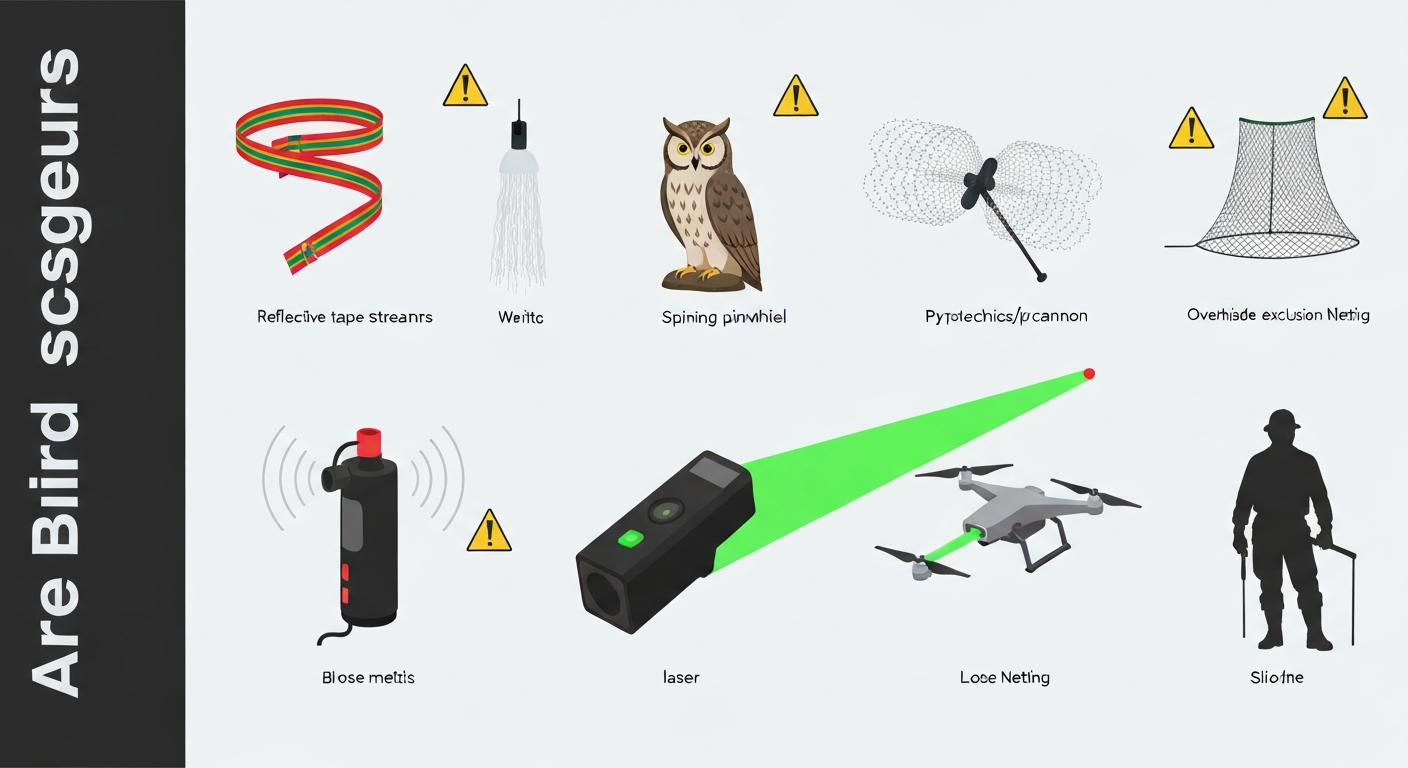
Bird scarers are any device, method, or technique used to deter, disperse, or exclude birds from a specific area. They are used across a wide range of settings: airports managing wildlife strike risk, farmers protecting crops, fish farmers guarding ponds, golf course managers, orchard growers, and homeowners trying to keep pigeons off rooftops. The category is broad enough to include everything from a plastic owl on a post to a trained peregrine falcon flying active patrol. It helps to understand the main categories.
Types of bird scarers
- Visual deterrents: reflective tape, predator decoys (plastic owls, hawk kites), scare-eye balloons, holographic strips, moving pinwheels, and scarecrows. Low-risk physically but habituation is fast.
- Auditory devices: propane cannons (gas exploders), distress-call broadcasts, pyrotechnic shell crackers and screamers, ultrasonic emitters, and acoustic systems such as Sonic Net. Noise levels vary enormously, from ambient sound to 100-125 dB impulses at source.
- Pyrotechnic and flare-type devices: banger cartridges fired from pistols, shell crackers, and aerial flares. Designed to alarm birds at distance; carry fire, debris, and noise hazards.
- Laser deterrents: handheld or automated green laser systems aimed at roost or foraging sites after dark. Effective at range but carry human, animal, and aviation safety considerations.
- Drones and UAVs: remote-controlled aircraft that herd birds from runways, fields, or rooftops. Growing use in aviation and agriculture; interact directly with airspace rules.
- Exclusion hardware: netting, overhead wire systems, bird spikes, post-and-wire systems, and mesh. These physically prevent access rather than startling birds. Among the most reliable methods long-term, but installation quality is critical.
- Falconry and trained raptors: live birds of prey flown by licensed falconers to provide a credible, moving predator presence. Widely used at airports, wineries, and landfills. Expensive, highly effective, and requires specialist licensing.
- Habitat and landscape management: removing food sources, modifying vegetation, draining standing water, and managing grass height. Not a "device" per se, but consistently cited by USDA Wildlife Services as a foundation layer for any deterrence program.
How bird scarers work, the science of deterrence
Most bird scarers exploit two basic biological responses: the startle reflex and learned predator avoidance. A loud bang or a sudden visual surprise triggers an immediate flight response. A hawk-shaped silhouette or a real falcon overhead taps into the same hard-wired predator recognition that has kept birds alive for millions of years. Acoustic approaches such as Sonic Net work differently: rather than startling birds, they mask the communication signals that flocking species like European starlings use to coordinate movement and foraging. A 2015 Wildlife Society Bulletin study found this communication-masking approach provided short-to-medium-term effectiveness for starling flocks, and a 2025 Scientific Reports study confirmed that tailored acoustic parameters (specific frequencies and amplitudes) outperform generic off-the-shelf noise devices for several species.
Lasers work on a different principle again: the moving light spot appears to birds as an approaching physical threat, triggering avoidance. A 2026 Conservation Physiology study on house sparrows exposed to a high-power 'Seabird Saver' laser found measurable changes in foraging behaviour, pecking rates, and short-term body mass, suggesting the deterrence is real but so is the physiological cost. Exclusion hardware such as netting and spikes does not rely on behaviour at all; it simply removes physical access to a site.
The critical concept across all of these methods is habituation. USDA Wildlife Services technical manuals explicitly warn that most scare methods lose effectiveness rapidly if used repetitively in the same pattern. Birds learn that the bang cannon has never once been followed by a predator and stop reacting. This is why integrated programs that rotate methods, add unpredictability, and combine exclusion with active deterrence consistently outperform single-device approaches.
Hazards to birds
The reality is that most well-deployed bird scarers do not directly injure or kill birds. That is actually their purpose: to move birds away without harming them. But "without harming" gets complicated once you look at the full picture.
Direct physical injury
Exclusion netting is where the clearest injury and mortality data exist. Loose or small-mesh netting over ponds and orchards is one of the more well-documented causes of waterbird and songbird entanglement deaths in the scientific and rehabilitation literature. U.S. Fish and Wildlife Service guidance specifically warns against loosely hung or small-mesh netting for this reason. The problem is not the concept of netting but the execution: netting hung slack, with gaps, or with mesh too small for the target species creates traps rather than barriers. Poorly installed netting can cause a slow, silent mortality toll that goes unnoticed for weeks.
Stress, behaviour change, and sublethal effects
Sublethal effects are harder to measure but real. A 2023 meta-analysis published in Biological Reviews examined human disturbance effects on glucocorticoid stress hormones across bird species and found that responses are highly variable: some species habituate quickly, others show persistent hormonal changes with potential fitness consequences. There is no universal stress response, and that context-dependence means blanket reassurances ('bird scarers are harmless') are as inaccurate as blanket alarms. The 2026 sparrow laser study adds another dimension: high-power laser exposure changed foraging behaviour and short-term body mass, pointing to real, if temporary, physiological costs even when the device is not lethal.
Nest disruption and displacement
Running active deterrents during breeding season raises distinct concerns. Displacing adult birds from nests during incubation or chick-rearing can expose eggs and chicks to thermal stress, predation, or abandonment. This is also where wildlife protection law becomes most relevant. In the United States, active deterrents deployed near the nests of most native bird species during breeding season can conflict with the Migratory Bird Treaty Act. The practical implication is that timing matters as much as method.
Indirect mortality through habituation
There is a less obvious risk: when birds habituate to a deterrent that was originally preventing them from a genuinely dangerous area (an active airfield, a toxic waste pond, a busy road corridor), the loss of deterrence effectiveness becomes an indirect mortality risk. The birds return, the hazard remains, and the deterrent has simply stopped working.
Hazards to people, pets, and livestock
Noise and hearing risk
Propane cannons and pyrotechnic devices generate impulse noise typically reported at 100-125 dB at source. OSHA's occupational noise standard requires hearing conservation when workers' 8-hour time-weighted average exposures reach 85 dBA, and impulse noise from these devices can exceed that threshold with close or repeated exposure. Anyone regularly operating propane cannons, shell crackers, or bird banger pistols at close range without hearing protection is taking a measurable auditory risk. Beyond occupational contexts, neighbours near agricultural settings where propane cannons run on timers have documented psychological stress and sleep disturbance from repeated loud reports, and community noise ordinance complaints are a frequent consequence.
Physical injury and debris
Pyrotechnic devices fired from pistols or launchers can cause burns, eye injuries, and debris strikes if handled incorrectly or if used in dry conditions near combustible vegetation. The fire risk from pyrotechnics in drought-prone agricultural areas is non-trivial. Physical exclusion hardware like bird spikes can injure people and animals that contact them inadvertently, and improperly installed overhead wire systems can be invisible hazards for people and larger animals in low-light conditions.
Pets, livestock, and ultrasonic devices
Dogs and cats can hear into the ultrasonic range (above 20 kHz), which means ultrasonic bird repellers marketed as inaudible to humans may cause distress to household pets. Many commercial ultrasonic devices also produce audible harmonics that irritate people, particularly children. A review published via PMC found that mass public exposure to ultrasound-in-air from various consumer devices is an underappreciated irritant. The situation with ultrasonic repellers for birds is compounded by the fact that most bird taxa have hearing ranges broadly similar to humans, meaning these devices are often simply ineffective for their intended purpose while creating unintended nuisance for pets and people nearby.
Laser hazards to human eyes
High-power laser deterrents designed for commercial use (the kind used in aquaculture or at wind farms) are serious eye hazards and are subject to ANSI Z136.1 and ANSI Z136.6 standards governing safe outdoor laser use in the United States. These are not consumer pointer devices; improperly aimed or unsecured automated laser systems near public access areas present a real retinal injury risk to both people and animals that wander into the beam path.
Hazards to aircraft and aviation safety
This is where bird scarers can go from a nuisance issue to a federal crime, quickly. Aviation is the highest-stakes environment for deterrent misuse.
Laser strikes near flight paths
The FAA received 10,993 laser strike reports from pilots in 2025 alone. Even a relatively low-power green laser can temporarily blind or disorient a pilot during a critical phase of flight, particularly approach and landing. Under 18 U.S.C. § 39A, knowingly aiming a laser at an aircraft or its flight path is a federal crime. Civil penalties can reach $25,000 per violation and criminal prosecution is possible. This law applies regardless of the operator's intent: someone using a commercial laser deterrent system who inadvertently illuminates an aircraft is not automatically exempt from liability. Anyone deploying laser-based bird deterrents near airports or flight corridors must operate within ANSI Z136.6 guidance and coordinate with local aviation authorities.
Drones and runway interference
Drones are increasingly used for wildlife dispersal at airports, but they are also a bird-strike and collision hazard in their own right if operated without proper airspace coordination. The FAA and USDA jointly maintain the National Wildlife Strike Database and manage wildlife hazard mitigation guidance for airports, which explicitly addresses the use of drones, pyrotechnics, propane cannons, lasers, dogs, falconry, and netting as airport tools. The guidance stresses that integrated programs must not create new aviation hazards in the process of managing wildlife ones. A drone operated without coordination near an active runway replaces one hazard with another.
Pyrotechnics and foreign object debris (FOD)
Pyrotechnic shell crackers fired on active airfields leave debris on runways and taxiways. Foreign object debris is a well-recognized aviation hazard, capable of causing engine ingestion damage and tyre failures. Airport wildlife management programs that use pyrotechnics operate under strict protocols for debris recovery and placement precisely to avoid this problem. These same protocols are not automatically followed by agricultural or commercial users who self-purchase pyrotechnic bird cartridges.
Legal, regulatory, and permitting considerations
The regulatory landscape for bird scarers is genuinely fragmented: federal wildlife law, aviation law, occupational safety law, local ordinances, and in some cases animal welfare rules all apply simultaneously to the same device.
| Device / Method | Primary U.S. Federal Rule | Permit Trigger | Key Local Risk |
|---|---|---|---|
| Visual deterrents (tape, decoys, spikes) | MBTA if installed near active nests | Rarely required | HOA or aesthetic ordinances |
| Propane cannons / pyrotechnics | MBTA timing restrictions; OSHA noise | Local noise permit in many jurisdictions | Noise ordinance violations near residences |
| Laser deterrents | 18 U.S.C. § 39A (aviation); ANSI Z136 | FAA coordination near airports; CDRH device registration | Eye hazard liability near public access |
| Drones / UAVs | FAA Part 107 remote pilot rules | Airspace authorization (LAANCIE/FAA) near airports | Line-of-sight and flight path rules |
| Exclusion netting | MBTA (cannot trap/injure protected species) | FWS permit if migratory birds affected | Planning/building rules for large installations |
| Falconry (raptor dispersal) | State falconry license; MBTA | Federal and state falconry permits | Local wildlife handling ordinances |
The Migratory Bird Treaty Act is the most broadly applicable federal overlay. It protects nearly all native North American bird species and makes it illegal to pursue, hunt, take, capture, kill, or possess them without authorization. Deploying a deterrent that kills or injures a migratory bird, even unintentionally, can constitute a MBTA violation. Active deterrents during breeding season require particular care: disturbing nests of protected species during incubation is a known compliance risk. In practice, USDA Wildlife Services offers technical assistance for agriculture and airport operators and can assist with proper deterrent selection and timing to maintain legal compliance.
At the local level, noise ordinances are the most common friction point. Propane cannons operated near residential areas have generated successful noise ordinance complaints and injunctions in multiple U.S. states. If you are a property manager or farmer, reviewing local ordinances before installing any auditory device is not optional; it is basic liability management.
What the scientific evidence and incident data actually show
The honest summary of the research is that bird scarers work inconsistently, carry variable risk profiles, and are almost always more effective in combination than in isolation. The evidence base is improving but still patchy: most controlled studies focus on single species in single contexts, making generalization difficult. Here is what the data reliably support.
- Habituation is universal and fast. Every auditory and visual deterrent study that follows subjects long enough documents habituation. The USDA Wildlife Services manuals reflect this: rotation and integration with other methods are not optional extras, they are operational requirements for sustained effectiveness.
- Acoustic parameters matter. The 2025 Scientific Reports study and the 2015 Sonic Net study both show that frequency selection, amplitude, and pattern significantly affect deterrence outcomes. Generic 'bird repeller' devices that do not target species-specific hearing or communication frequencies generally underperform.
- Laser deterrents carry real sublethal costs. The 2026 Conservation Physiology sparrow study is the clearest peer-reviewed signal that high-power commercial lasers, while effective as deterrents, have measurable physiological and behavioural effects on exposed birds. This does not make them unusable, but it does mean they are not consequence-free.
- Stress responses are species- and context-specific. The 2023 Biological Reviews meta-analysis is a useful corrective against both alarmism and dismissiveness: human disturbance does not trigger a uniform stress response across birds, and context (breeding vs. non-breeding season, chronic vs. acute exposure, proximity) heavily modulates outcomes.
- Physical exclusion is the most reliable long-term intervention when correctly installed. USDA, FWS, and extension services consistently rank properly installed and maintained exclusion hardware above active deterrents for sustained, low-maintenance bird management. The caveat 'correctly installed' is load-bearing: loose or small-mesh netting is a documented mortality cause.
- Laser strike aviation incident data is unambiguous. With nearly 11,000 FAA laser strike reports in 2025, the aviation hazard from misused laser devices is not theoretical. The overlap between commercial laser deterrent use and aviation airspace is a real operational problem requiring coordination, not improvisation.
The knowledge gaps worth acknowledging: long-term population-level effects of deterrent programs on non-target species are rarely studied. Cumulative stress effects from chronic deterrent exposure in resident bird populations near year-round operations are understudied. And independent field evaluations of many commercial 'repeller' products are scarce, meaning the manufacturer's effectiveness claims often lack peer-reviewed support.
Ethical and environmental considerations
Moving birds away from one location does not make the problem disappear. It relocates it. When deterrent programs push birds from one agricultural site, those birds need to forage somewhere else, sometimes displacing other species or moving into new conflict zones. At the landscape scale, aggressive and widespread deterrent use without habitat management can contribute to population-level pressures on already-stressed species. This is particularly relevant for species that are agricultural pests in large numbers but whose total populations are in decline.
Non-target impacts are consistently underreported. A propane cannon set to fire every 10 minutes does not distinguish between the starlings it is targeting and the killdeer nesting at the field edge, the barn swallows hunting insects nearby, or the raptors that have learned to use the field for hunting. Acoustic deterrents operating on distress-call frequencies may affect species well beyond the intended target. Laser systems operated at dusk and dawn, when many deterrent operators prefer to use them, coincide with peak activity periods for non-target nocturnal and crepuscular species.
From a welfare perspective, repeated chronic exposure to startle-inducing stimuli represents a form of stress that most wildlife management guidelines acknowledge but few programs formally measure. The ethical baseline from USDA Wildlife Services is that lethal control should be the last resort after non-lethal deterrents have been genuinely tried and documented as insufficient. That hierarchy is the right framework, but it only holds up if the non-lethal deterrents are deployed in ways that are actually effective, not just nominally present.
Practical risk reduction and safer alternatives
If you are choosing or evaluating a bird deterrent, these evidence-based principles narrow the field considerably. For another relevant comparison, see are bird nests dangerous.
- Start with habitat modification. Removing food sources, adjusting vegetation height, and eliminating standing water address root attraction rather than symptoms. USDA Wildlife Services consistently lists this as the foundation of any effective program.
- Use properly installed, wildlife-safe exclusion netting for high-value fixed sites (fruit crops, fish ponds, roof areas). Specify mesh size appropriate to target species to avoid trapping non-target birds, keep netting taut and well-maintained, and inspect weekly for entangled animals.
- Rotate auditory deterrents. If you use propane cannons or distress calls, vary timing, intervals, and locations. Predictable patterns accelerate habituation. Pair with visual deterrents for redundancy.
- Check noise ordinances before purchasing any auditory device. Document installation, settings, and operating hours in case of complaints.
- Never use high-power laser deterrents near airports, flight corridors, or areas with public access without proper ANSI Z136.6 compliance planning, FAA coordination, and signage. If you are unsure whether your site is near controlled airspace, check the FAA's B4UFLY app before operating.
- If your situation involves an airfield or aviation-adjacent environment, work through FAA/USDA integrated wildlife hazard management protocols. Improvised deterrents at airports create liability regardless of whether they injure birds.
- For large-scale or persistent problems, consider a USDA Wildlife Services consultation. They provide technical assistance, help assess whether permits are needed, and can recommend integrated programs tailored to your species and site.
A note on related 'bird' questions this topic gets confused with
Because 'bird' is a broad search term, a few common confusions are worth flagging. Questions about whether bird nests are dangerous typically concern structural damage, pest harboring, or disease risk from nests on buildings, which is a separate topic from deterrents. Questions about bird scratches focus on the real but context-dependent infection risk from Pasteurella and similar organisms. Questions about whether electric heaters are safe for birds relate to avian respiratory sensitivity to fumes, which is a legitimate welfare concern entirely unrelated to deterrents. For detailed guidance on avian respiratory risks and choosing bird-safe heating, see the related page on are electric heaters bird safe. And Bird-brand e-scooters, a completely separate company and product, occasionally surface in searches about 'bird scarers' or 'are bird scooters dangerous.' Those are micromobility vehicles with their own distinct safety and liability profiles, including what happens if you damage one. For information on liability and repair rules for shared e-scooters, see our guide on what happens if you break a Bird scooter. None of these overlap with the wildlife deterrent topic, but they are common enough search detours that it is worth naming them directly.
FAQ
Are bird scarers dangerous to birds?
Yes — some bird‑scaring methods can harm birds. Visual/low‑intensity acoustic devices typically cause disturbance and may lead to stress or temporary displacement. High‑power lasers, explosives/pyrotechnics, badly installed netting or spikes, and drones can cause direct injury, vision damage, entanglement or death. Many scare tactics also produce sublethal effects (changed foraging, body mass, behaviour) and repeated exposures can cause physiological changes in some species. Effect size and risk depend on device type, power, proximity, species sensitivity, and exposure frequency.
Do bird scarers pose risks to people, pets and livestock?
Yes. Loud devices (propane cannons, pyrotechnics, LRADs) can exceed occupational noise limits and risk hearing damage without protection. Pyrotechnics and unexploded debris can cause fire, burns or property damage. Lasers aimed improperly can injure human eyes and are illegal when aimed at aircraft. Drones may collide with people or animals and can drop debris. Some acoustic devices have audible components that annoy or harm pets and nearby residents.
Can bird scarers create aviation hazards?
Absolutely — lasers aimed at aircraft are a documented hazard (FAA reports thousands of strikes yearly) and are illegal under U.S. law (18 U.S.C. § 39A). Pyrotechnic debris, smoke, or dense bird‑flushing that forces birds into flight paths can also create strike risks. Airports use integrated wildlife programs and guidance to select deterrents that reduce wildlife hazards without creating new aviation risks.
Are lasers safe to use as bird deterrents?
Not always. Low‑power, properly controlled laser systems used by trained operators following ANSI Z136 standards and local aviation rules can be effective when used safely and outdoors per ANSI Z136.6. High‑power lasers or improper aiming can damage bird vision, alter behaviour adversely, and pose serious hazards to pilots and aircraft — with heavy civil and criminal penalties for aiming at aircraft. Use only approved systems with training, risk assessment and permits where required.
Do pyrotechnics and propane cannons cause long‑term harm to birds?
Pyrotechnics/propane cannons produce intense, sudden noise that can be effective short‑term but typically lead to rapid habituation. They can cause acute stress responses and, at close range, physical harm. Repeated exposures may have fitness consequences in some species. They also create community noise complaints, fire risk, and occupational safety issues, so their use should follow regulatory guidance and be part of an integrated program.
Are ultrasonic or commercial ‘sonic’ bird repellents effective and safe?
Most commercial ultrasonic repellents show little or transient effectiveness for many bird taxa; some scientific acoustic approaches (e.g., Sonic Net, well‑designed high‑frequency/high‑amplitude signals) can work for specific flocking species when tailored. Safety concerns include unintended audible components that disturb people or pets and potential habituation. Rely on peer‑reviewed evidence for specific devices before deploying widely.