
Bird hunting is effectively illegal in India for the vast majority of species and situations. The Wildlife (Protection) Act, 1972 prohibits hunting of virtually all wild birds listed in Schedules I through IV, and the list is long enough that almost any bird you'd encounter in the wild is covered. The narrow legal exceptions exist mostly for situations involving animals that are dangerous to human life or are being studied under a scientific permit. If you're asking whether you can go out and shoot or trap birds for sport, food, or even pest control without formal authorization, the short answer is no, and the penalties for getting it wrong are serious. If you are wondering whether it is illegal to kill a bird, the short answer is yes in most real-world situations in India without the required authorization is it illegal to kill a bird.
Is Bird Hunting Legal in India? Rules, Permits, Penalties


The legal framework: what the Wildlife Protection Act actually says
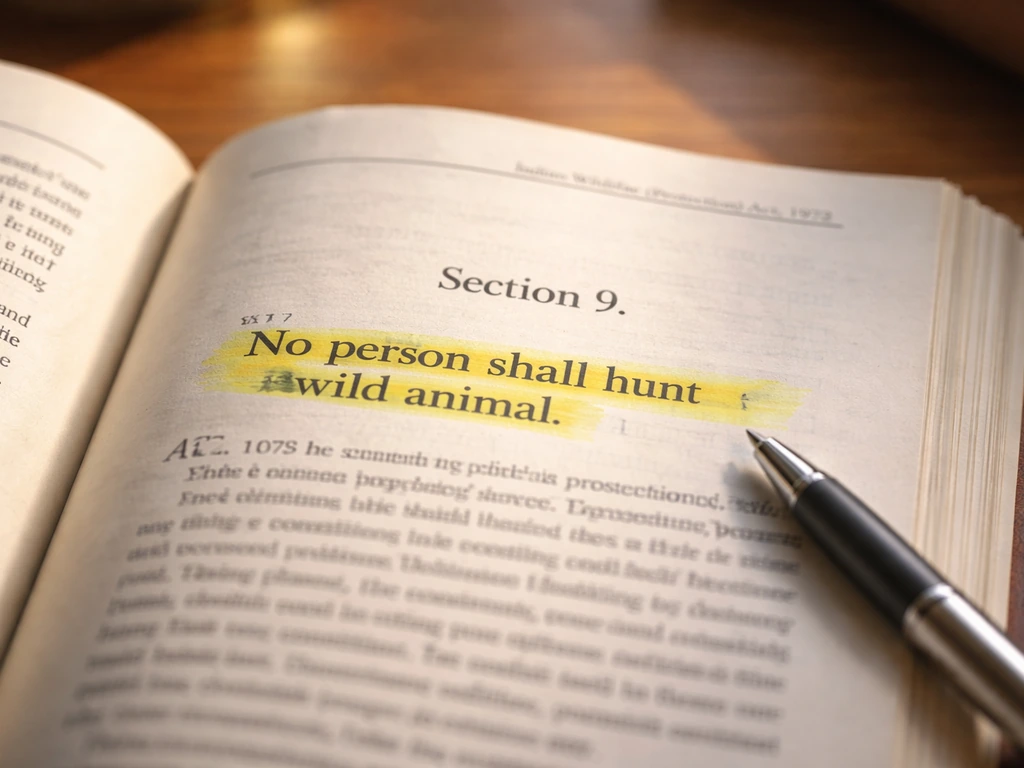
India's primary law governing this is the Wildlife (Protection) Act, 1972. Section 9 of that Act is the core prohibition: 'No person shall hunt any wild animal specified in Schedule I, II, III and IV except as provided under section 11 and section 12.' Since birds are wild animals for the purpose of this Act, they fall squarely under that ban.
What makes this law particularly broad is how it defines 'hunting.' Under Section 2(16), hunting includes not just killing or shooting a bird, but also capturing, snaring, trapping, baiting, poisoning, injuring, or taking any part of a bird. For birds and reptiles specifically, the definition goes even further: disturbing nests or damaging eggs counts as hunting under the Act. So setting a trap, removing a nest, collecting feathers from a live protected bird, or using a net to catch birds can all constitute illegal hunting even if no bird ends up dead.
The Schedules themselves are extensive. Schedule I provides the highest level of protection and includes many familiar and less familiar bird families, from falcons (Falconidae) to cranes (Gruidae) to cracids. Schedules II, III, and IV cover progressively lower levels of protection but still trigger the Section 9 ban. In practical terms, if it's a wild bird in India, there is a very high probability it is protected by at least one schedule.
When hunting is allowed vs. prohibited
The legal exceptions to the hunting ban are narrow and tightly controlled. Section 11 permits the Chief Wild Life Warden to allow hunting of a Schedule I animal only in writing, with stated reasons, and only when the animal has become dangerous to human life or is so disabled or diseased that it is beyond recovery. Even then, the Chief Warden must first be satisfied that the animal cannot be captured, tranquilized, or relocated before ordering it killed. This provision is not a general hunting permit. It is an emergency clause designed for situations like a rogue leopard threatening a village, not recreational or subsistence bird hunting.
Section 12 provides a separate, more structured pathway: the Chief Wild Life Warden can grant a written permit, on payment of a prescribed fee, for hunting wild animals for purposes like scientific research, education, or collection of specimens (not including killing or poisoning for Schedule I species). Permits for Schedule I species require prior Central Government approval. Permits for other schedules require prior State Government approval. There is no provision in the Act for hunting birds purely for sport, recreation, or personal consumption.
Seasonal rules do exist in the form of 'closed areas' under Section 37. The government can declare a closed area and prohibit all hunting within it during a specified period. These notifications are published by state governments, so it's worth checking the relevant state gazette if you're trying to understand local restrictions layered on top of the national framework.
| Situation | Legal Status | Who can authorize |
|---|---|---|
| Sport or recreational hunting of wild birds | Prohibited, no exceptions | No authority |
| Trapping, netting, or snaring wild birds | Prohibited under Section 9 | No authority for sport/food |
| Disturbing nests or damaging eggs of wild birds | Prohibited (counts as hunting) | No authority |
| Hunting a Schedule I bird posing danger to life | Allowed only under Section 11 | Chief Wild Life Warden (written order) |
| Hunting for scientific research/specimen collection | Allowed under Section 12 permit | Chief Wild Life Warden + State/Central Govt approval |
| Any hunting inside a sanctuary or National Park | Prohibited without permit under Section 29/35 | Chief Wild Life Warden + State Govt + National Board |
Permits, licences, and how to check what you're actually allowed to do

There is no general 'hunting licence' for birds in India. Unlike some countries where you pay a fee and get a seasonal hunting permit, India does not operate that system. The only permits that exist under the Wildlife (Protection) Act are the narrow research/education permits under Section 12 and the emergency orders under Section 11, both of which go through the Chief Wild Life Warden of the relevant state.
If you have a genuine need related to scientific research or pest management, here are the practical steps to check what you're allowed to do:
- Identify the exact species you need to deal with and check which Schedule it falls under in the Wildlife (Protection) Act, 1972. The bare text of the Schedules is publicly available on government legal databases.
- Contact the Chief Wild Life Warden (CWLW) office for your state. Each state has one, typically housed within the state's Forest Department. Their contact details are on state Forest Department websites.
- If the activity involves a protected area (sanctuary, National Park, tiger reserve), check with both the CWLW and the Field Director or Area Director of that specific protected area.
- For Schedule I species, any permit requires prior approval from the Central Government (Ministry of Environment, Forest and Climate Change), so factor in significant lead time.
- Check for any state-specific notifications or closed-area declarations on the state's official gazette website, as these add local restrictions beyond the national law.
- Consult India's Wildlife Crime Control Bureau (WCCB) website if you need guidance on what constitutes a wildlife offence, as their enforcement manual provides useful detail on how the law is applied.
State-by-state differences and protected area rules
The Wildlife (Protection) Act is a central law, meaning its core prohibitions apply uniformly across India. However, implementation and enforcement vary significantly by state. Some states have additional wildlife protection rules or notifications under the Act that restrict activities beyond what the central law already prohibits. States with large protected-area networks like Assam, Madhya Pradesh, Rajasthan, and Kerala tend to have more active enforcement and additional local rules.
Protected areas create a distinct legal layer. Inside sanctuaries, Section 29 of the Act prohibits destruction, removal, or disturbance of wildlife and habitat unless done under a permit issued by the Chief Wild Life Warden with State Government authorization. Inside National Parks, Section 35 applies with similar restrictions. Tiger reserves governed by the National Tiger Conservation Authority (NTCA), which was constituted under Section 38L(1) of the Act, operate under additional management rules and standard operating procedures published by the NTCA. NTCA publishes tiger-reserve management rules and standard operating procedure documents through its Documents page, including materials such as the Compendium of Standard Operating Procedures and Tiger Safari Guidelines standard operating procedures published by the NTCA.
India also has Ramsar wetland sites, which are internationally recognized as important wetlands. These are not automatically protected areas under Indian law, but they are typically managed under existing wildlife, forest, or protected-area regulations. Ramsar designation does not create a hunting right; the applicable rules still flow from Indian law. Many Ramsar sites in India overlap with sanctuaries or bird sanctuaries, so hunting there is still prohibited under Sections 9 and 29 of the Act.
The practical upshot: wherever you are in India, assume the national prohibition applies. Then check whether your specific location triggers any additional protections (sanctuary, National Park, tiger reserve, closed area, or state-specific notification) that add further restrictions on top.
Penalties and legal risks

The penalties for illegal hunting in India are not trivial. The baseline penalty under the Wildlife (Protection) Act for contravening the Act or breaching permit conditions is imprisonment of up to three years and/or a fine. For offences involving Schedule I species or species in Part II of Schedule II, or for hunting inside a sanctuary or National Park, the penalties are higher, with mandatory minimum sentences and larger fines. Seized wildlife, equipment (nets, torches, traps, weapons), and vehicles used in the offence are treated as State Government property under Section 39 of the Act, meaning they are forfeited.
Enforcement is real and ongoing. In one reported case, an FIR was filed under Section 9 of the Act for illegal hunting and trapping of migratory birds at Akera-Kotla Lake. In Assam, five people were arrested for illegal trapping of protected birds at Bholakata Beel in Biswanath, with the cotton pygmy goose identified as a Schedule I species and nets and torches seized as evidence. A separate case in Jamshedpur led to the arrest of three people for possession and smuggling of parakeets and cockatiels, with the birds classified under Schedule II. In a recent enforcement action reported from Jamshedpur, seized parakeets and cockatiels were categorised under Schedule II of the Wildlife (Protection) Act, 1972, and three people were arrested. The Wildlife Crime Control Bureau actively investigates such cases and coordinates with state forest departments on enforcement.
Beyond the criminal penalties, being convicted under the Wildlife (Protection) Act can affect employment, travel documents, and professional licences depending on your occupation. The reputational consequences in communities that are increasingly aware of wildlife protection are also real. The risk calculation here is not favorable for anyone considering illegal hunting.
Legal alternatives: what you can actually do
If your interest is in birds in their natural habitat, birdwatching and bird photography are the most accessible legal alternatives, and frankly, they have grown into major activities in India. India has over 1,300 bird species and some of the best birding destinations in the world. No permit is required to watch or photograph wild birds, provided you do so without disturbing nests, chasing birds, or entering restricted zones without authorization. Bird nests can also be covered by wildlife protections, so destroying or disturbing them may be illegal even if no adult bird is harmed are bird nests legally protected.
For situations involving genuine crop damage, livestock predation, or other conflicts with birds, the legal route is to contact your state Forest Department and explain the specific problem. In limited cases, the government may authorize control measures for species classified as 'vermin' under Schedule V of the Act, though most common pest birds in agricultural settings require assessment before any action. Pigeon and crow management in urban areas sometimes falls under municipal authority, but using poisons or traps indiscriminately still risks violating the Act if protected species are harmed as a result.
- Birdwatching and photography: no licence required, widely practiced, and supported by organizations like the Bombay Natural History Society (BNHS) and eBird India
- Wildlife tourism in sanctuaries and National Parks: permitted under controlled conditions with entry fees and guide requirements
- Citizen science participation: bird counts, breeding surveys, and migration monitoring programs are open to the public and contribute to conservation data
- Pest management consultation: for genuine agricultural bird damage, contact the state Forest Department or an accredited wildlife consultant for legally sanctioned options
- Research and education permits: apply through the Chief Wild Life Warden for legitimate scientific study involving birds
Common myths about bird hunting in India
One of the most persistent myths is that hunting 'common' or 'non-endangered' birds is harmless or at least legally tolerable. The reality is that the Wildlife (Protection) Act does not require a species to be endangered for it to be protected. Schedules III and IV include species that are relatively widespread, but hunting them is still prohibited under Section 9. The law does not make exceptions for population size or perceived abundance.
Another common misconception is that small-scale or traditional hunting has no real impact on bird populations. The reality is more complicated. Bird populations are sensitive to hunting pressure precisely because of life-history traits like low reproductive rates for larger species, high site fidelity, and dependence on specific habitats. Migratory birds are particularly vulnerable because they concentrate in predictable locations at predictable times, making them easy targets for trapping. The reported cases of poaching at wetlands in India consistently involve migratory species that can least afford sustained pressure.
There is also a myth that if no one sees you, there is no enforcement risk. The evidence says otherwise. Forest Department officials, wildlife range officers, and WCCB personnel are actively patrolling wetlands, forest edges, and known poaching hotspots. Community members increasingly report wildlife crimes. Equipment like nets and torches, once seized, becomes forfeited property and direct evidence of the offence. The idea that bird trapping is a low-risk activity does not hold up against the documented enforcement record.
Finally, some people assume that owning a trapped bird as a pet is separate from hunting and therefore legal. It is not. Possessing a protected wild bird, or keeping one without authorization, is itself an offence under the Act. This connects directly to why wildlife smuggling busts, like the Jamshedpur case involving parakeets and cockatiels, result in arrests: possession and trade of protected species are treated as serious offences regardless of whether the person holding them is the one who trapped them. The broader question of what birds are illegal to kill or keep is one that runs through Indian wildlife law consistently, and the Wildlife (Protection) Act is the starting point for any of those answers. If you are specifically wondering whether it is illegal to kill a state bird, the answer is generally yes under the Wildlife (Protection) Act unless a narrow legal exception applies is it illegal to kill a state bird.
FAQ
Are there any legal ways to hunt birds for sport in India, even if it’s just occasional?
No. India does not provide a general “hunting licence” for birds for recreation or personal consumption. The only lawful pathways under the Wildlife (Protection) Act are narrowly limited written permits for specific purposes like research or education (and even then, killing protected species is not broadly allowed), or rare emergency situations.
What counts as “hunting” if I am not actually shooting or killing a bird?
Hunting includes more than killing. Capturing, trapping, snaring, baiting, poisoning, injuring, and even taking parts of a bird can qualify as hunting. For birds, actions like disturbing nests or damaging eggs can also be treated as hunting, even if the bird survives.
Is it legal to remove nests, collect eggs, or take feathers if the bird isn’t killed?
In most real-world cases, no. Nest or egg damage is treated as hunting for birds under the Act’s expanded definition. Collecting feathers from a protected wild bird can also create an offence because the law covers taking parts of the bird.
Does the law allow hunting of “common” birds or birds that are not endangered?
Yes, they are still typically protected. The Act’s protection is based on whether the bird is listed in the schedules, not on whether it is endangered. So “non-endangered” or seemingly abundant birds can still be illegal to hunt.
If I hunt only outside protected areas, like fields or open land, am I safe legally?
No. The national prohibition generally applies across India. Protected areas like sanctuaries and national parks add extra restrictions, but illegal hunting can still be prosecuted outside them too.
Can a municipal authority permit bird control for urban areas?
Sometimes municipal bodies handle local nuisance issues, but you still must avoid actions that harm protected birds or rely on indiscriminate traps and poisons. Without a compliant legal basis, you can still trigger offences under the Wildlife (Protection) Act.
What should I do if birds are damaging crops or threatening livestock?
Start by contacting your state Forest Department and describing the exact species, location, and damage pattern. If any control measure is considered, it is usually species specific (for example, through the Act’s framework for certain categories), and you should not use poisons or broad trapping without an authorization that matches your situation.
If I want to do pest management, can I use nets, traps, or bait?
Be cautious. Even “pest” actions can become illegal if protected species are caught, injured, or otherwise affected. Use only methods that are authorized for the relevant species and location, and avoid setups that can unintentionally capture migratory or scheduled birds.
Is birdwatching, filming, or photography always legal?
Generally yes, but legality depends on conduct. You should not disturb nests, chase birds, or enter restricted zones without permission. Even non-harmful activity can become unlawful if it involves nest disruption or trespass into protected areas.
What about owning a trapped bird as a pet, is that different from hunting?
Often it is not different legally. Possession and keeping of protected wild birds can be an offence under the Act, regardless of who trapped them. This is why smuggling cases can result in arrest even for people who only possess the animals.
Do Ramsar sites or wetlands give special rules that make hunting legal there?
No. Ramsar designation does not create a hunting right. If a wetland is within or overlaps with sanctuaries, bird sanctuaries, or other protected areas, hunting remains prohibited under the same Indian legal framework, and additional local rules may apply.
If enforcement is intermittent, can I treat it as low-risk?
No. Enforcement includes patrols and checks around known hotspots like wetlands and forest edges, and communities may report wildlife crime. Nets, torches, traps, and vehicles can become key evidence and may be forfeited, increasing the personal legal risk.
What practical checks should I do before attempting any bird-related activity?
Confirm whether your bird and location are covered by schedule protections and local restrictions by checking the applicable state notifications. If you believe you need an exception, do it through the proper Chief Wild Life Warden permit process, because informal “permission” or assumptions about rarity are not a substitute for authorization.
How can I verify whether the specific bird species I’m worried about is protected?
Use the Wildlife (Protection) Act schedule listings as your starting point and cross-check the species name against the schedules relevant to your region. If you are unsure of the identification, get an expert ID before any action, because misidentification can still lead to an offence.