Yes, you can catch a bird in certain circumstances, but whether you should depends heavily on the species, the situation, and the law. Catching an escaped pet parrot is very different from grabbing a wild songbird that flew into your window, and both are different from trying to trap a goose on an airport runway. The answer is almost never a flat yes or no, and in many cases the right move is to leave the bird alone, call a licensed wildlife rehabilitator, or contact a wildlife agency rather than attempt capture yourself.
Can You Catch a Bird? Safe, Legal Steps for Rescue

Marcus Whitmore
15 Jul 2026
What people actually mean when they ask this question
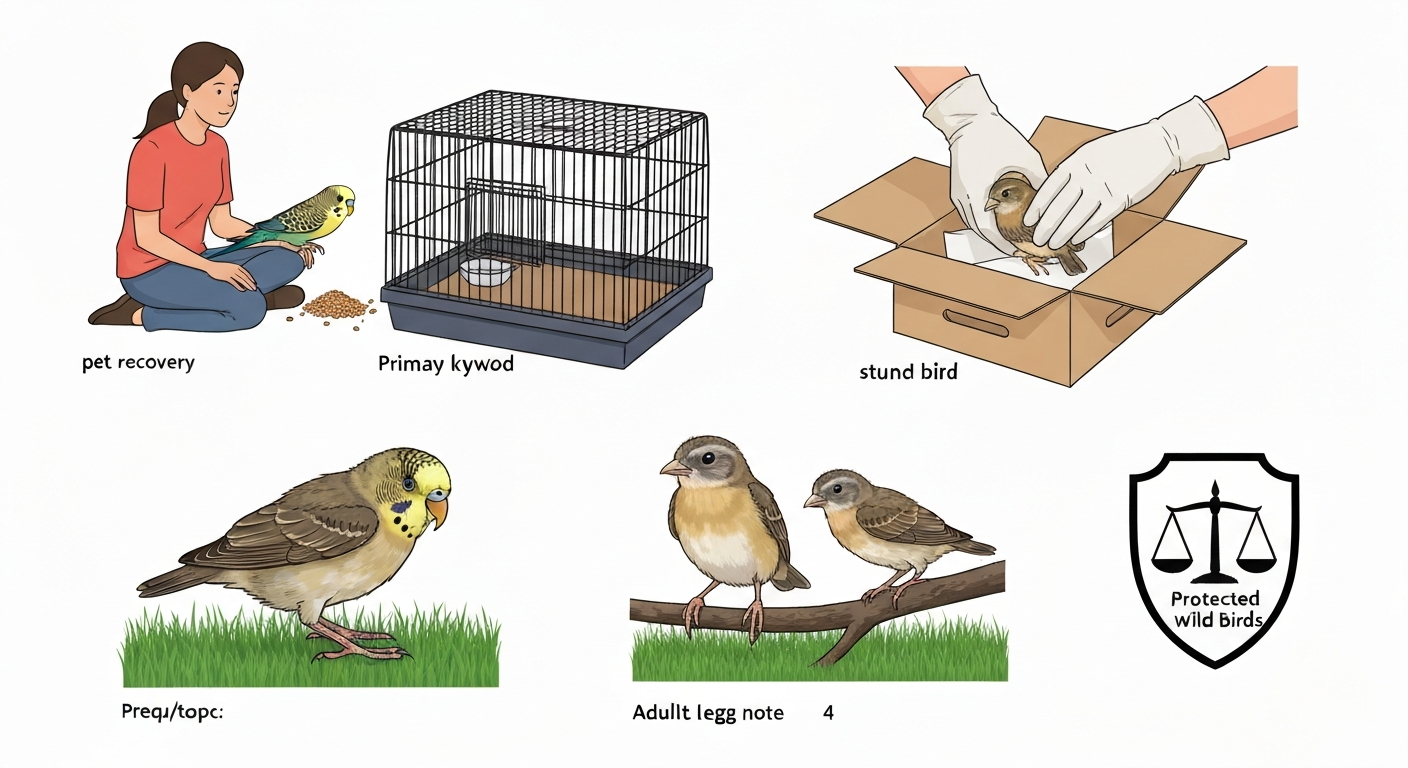
The question comes from several very different directions. Pet owners want to know how to recover an escaped budgie or cockatiel before it disappears for good. Homeowners find a stunned bird on the patio after a window strike and want to help. Parents find a baby bird on the lawn and assume it needs rescuing. Researchers and licensed professionals need to capture birds for banding, population surveys, or medical treatment. And at airports, wildlife officers need to move birds away from active runways before they become a strike hazard. Each scenario carries its own rules, techniques, and risks, so the first step is always identifying which situation you are actually dealing with.
When capturing a bird is actually appropriate
There are four situations where capture makes practical sense, and they range from completely routine to highly specialized.
Escaped pet birds
If your own pet bird escapes, you have a clear legal right to recover it and every reason to act quickly. Domestic birds like budgerigars, cockatiels, parrots, and finches are not adapted to survive in the wild in most climates, and their window to be recovered narrows fast once they orient to the landscape and start covering distance. The techniques here are different from handling wild birds: familiar voices, favorite foods, and the sight of a cage mate or their own carrier can all coax the bird close enough to catch. If you're researching products and techniques for attracting or deterring birds, see does bird b gone work for an evaluation of one commercial option.
Injured or stunned wild birds
A bird that has struck a window, is lying on its side, is bleeding, or cannot stand on both feet is a genuine emergency. Short-term, hands-off containment (placing the bird gently in a ventilated box and keeping it dark and quiet) is appropriate while you arrange professional care. The Government of Canada's guidance on bird-glass collisions confirms that many stunned birds recover if left undisturbed in a dark container for up to an hour, but birds showing more serious signs need a licensed rehabilitator or avian vet, not more human handling.
Scientific research and banding
Licensed ornithologists and permitted banders capture wild birds routinely for population monitoring, disease surveillance, and migration studies. This is tightly regulated work. In the United States, scientific collecting and banding require federal permits from the U.S. Fish and Wildlife Service (USFWS) under 50 CFR Part 21. The equipment (mist nets, bal-chatri traps, cannon nets) and handling protocols used in these contexts are not appropriate for untrained members of the public, and attempting to use them without permits is a federal offense.
Aviation wildlife management
Airports operate structured wildlife hazard management programs that include live capture, hazing, relocation, and sometimes lethal control of birds near runways. These are handled by trained airport wildlife officers, often in coordination with the USDA Wildlife Services. The tools and legal authorizations involved are well beyond what a private individual should attempt.
The legal reality: most wild birds are protected
This is the part that surprises a lot of people. In the United States, nearly all wild migratory birds are protected under the Migratory Bird Treaty Act (MBTA). Capturing, possessing, transporting, or even holding a migratory bird for rehabilitation without USFWS authorization is a federal violation. The USFWS Migratory Bird Permitting Handbook (January 2025 edition) lists specific permit categories including rehabilitation, salvage, scientific collecting, and educational use. Federal rehabilitation permits also require compliance with state-level authorization, and states like California have their own separate Native Wildlife Rehabilitation Permits under Title 14 CCR §679.
The practical implication: if you find a wild migratory bird and want to do more than briefly contain it for emergency transport to a rehabilitator, you need permits you almost certainly do not have. The legally correct and biologically safest path is to contact a licensed wildlife rehabilitator or your state wildlife agency.
Outside the United States, the picture is similarly restrictive. In the UK, most wild bird species are protected under the Wildlife and Countryside Act 1981, and Schedule 1 species carry additional protections with stricter licensing requirements from Natural England. Across the European Union, the Birds Directive (Directive 2009/147/EC) prohibits deliberate capture or killing of protected wild birds except under national permits. The details vary by country but the baseline principle is the same: capture first, ask permission later is not a legal defense.
How bird senses shape your chances of catching one
Understanding why birds are so hard to catch starts with their sensory biology. Birds are not passive targets; they are continuously processing their environment in ways that are often more sophisticated than human intuition assumes.
Vision is where birds have the clearest advantage. Most birds have a very wide visual field (some species exceeding 300 degrees), and many can detect ultraviolet wavelengths invisible to humans. They also have faster temporal resolution than we do, meaning they process motion at higher frame rates. This is one reason why a bird that appears to be calmly sitting on a branch can be airborne before you have taken your second step toward it. The relationship between birds and glass is a notable exception: birds often cannot distinguish transparent or reflective glass from open sky, which is why window strikes are such a common cause of injury. That perceptual gap is relevant here because a stunned bird near glass may not flee from an approaching person the way a healthy bird would.
Hearing is also extremely acute in most species. For more detail on birds' auditory abilities and whether a bird can hear human sounds, see can bird hear. Birds use sound for territory defense, mate attraction, and alarm signaling, and many can localize sounds with remarkable precision. This is directly relevant if you are considering using recorded calls or bird whistles to attract a bird within range. Whether those techniques work depends on the species, context, and time of year, and using playback of calls carelessly near nesting birds raises real welfare concerns worth considering. For guidance on the risks and best practices around using recorded calls, see our related piece on is it bad to play bird calls.
Smell is the sense where birds are most variable and most misunderstood. The common folk belief that you should not touch a baby bird because the mother will smell your scent and abandon it is almost certainly a myth for most songbird species, which have a relatively limited sense of smell. That said, certain bird groups (vultures, kiwis, some seabirds) have well-developed olfaction. For practical capture purposes, smell is rarely the limiting factor. If you’re asking "can a bird smell human", the short answer is some species can detect human scent but for most common songbirds it’s not a major factor in whether they accept or reject young handled by people.
The realistic limits of catching a bird by hand
Hand-catching a healthy, unimpaired wild bird is genuinely very difficult for most people in most situations. Birds evolved to evade terrestrial predators, and a healthy bird with full use of its wings will almost always win. The situations where hand capture is even plausible are quite narrow: the bird is inside a room, it is enclosed in a small outdoor space, it is seriously injured, or it is temporarily stunned after a window strike.
Size matters significantly. Small passerines (sparrows, finches, warblers) are fast and agile but physically fragile, and a clumsy grab can cause injury. Mid-size birds like pigeons and doves are calmer and more catchable when cornered. Larger birds present a different problem: geese, herons, large gulls, and especially raptors can inflict real injuries. A healthy red-tailed hawk has talons capable of gripping with enough force to puncture skin deeply, and a great blue heron can strike at eye level. Rehabilitators and wildlife agencies consistently advise the public not to attempt manual capture of raptors, large waterfowl, or any bird with a stabbing bill.
The fledgling situation deserves special attention because it generates a lot of unnecessary intervention. A fledgling is a fully feathered juvenile bird that can hop and flutter but is not yet a strong flier. It is almost certainly not abandoned. Cornell Lab of Ornithology and the RSPCA both emphasize that parent birds continue feeding fledglings on the ground for days to weeks, and that humans removing apparently healthy fledglings from the wild is one of the most common and most unnecessary forms of wildlife capture. RSPCA guidance states removing fledglings from the wild should be a last resort, and that nestlings (featherless or very underdeveloped) found out of the nest usually need human intervention and referral to a licensed rehabilitator Found a Baby Bird? — RSPCA guidance. The reality is: unless the bird is injured, visibly cold or wet, or in immediate danger from a cat or car, leave it where it is.
Signs that tell you whether to intervene or wait
Before you move toward any wild bird, a quick visual assessment from a few meters away is the most important step you can take. The following signs indicate the bird genuinely needs help:
- Cannot stand or use both feet
- Open wound, active bleeding, or visible fracture
- Severe or labored breathing
- Obvious paralysis or inability to right itself
- Persistent disorientation more than an hour after a window strike
- Featherless nestling found out of the nest on the ground
- Entangled in fishing line, netting, or similar material
If none of those signs are present and the bird is fully feathered, the right move is usually observation from a distance. A bird that hops away from you or watches you alertly is not in distress. The American Bird Conservancy and wildlife rehabilitation organizations all use similar triage criteria, and applying them before you touch anything reduces unnecessary capture attempts substantially.
Risks to humans and to the bird
Capture myopathy: the hidden danger of chasing a bird
Capture myopathy (also called exertional rhabdomyolysis) is a well-documented, potentially fatal condition in wild birds that results from extreme exertion and stress during capture. Peer-reviewed wildlife medicine literature describes muscle fiber breakdown, metabolic acidosis, and organ failure that can occur hours to days after a stressful pursuit or prolonged handling. Prevention is far more effective than treatment, and treatment options are limited even in veterinary settings. The practical implication is that chasing a bird around a yard for ten minutes trying to catch it by hand can kill it even if you never actually touch it. Quiet, calm, low-pursuit containment is the only humane approach.
Physical injury to handlers
Beyond raptors and large wading birds, even small birds can bite hard enough to break skin when frightened. Parrots in particular have a strong grip and a hooked bill capable of drawing blood. Larger waterfowl can strike with wings hard enough to bruise. Disposable or non-porous gloves reduce this risk and are simply good practice.
Zoonotic disease risks
Several pathogens transmissible from birds to humans are worth being aware of when handling any wild bird. For related information on avian respiratory behaviors, see can a bird sneeze. The risks are real but manageable with basic precautions.
| Pathogen / Disease | Transmission route | Key precaution |
|---|---|---|
| Avian influenza (H5N1, H7N9) | Respiratory secretions, feces, direct contact | Avoid touching eyes/mouth, wear gloves, wash hands thoroughly |
| Psittacosis (Chlamydia psittaci) | Dried feces, respiratory dust, direct contact — especially parrots and pigeons | Mask if cleaning dried droppings, wash hands, avoid face contact |
| Salmonellosis | Fecal-oral route, contaminated surfaces | Gloves, handwashing, do not eat/drink while handling |
| West Nile Virus | Not directly transmitted from birds to humans (mosquito vector) | Low direct risk; standard hygiene sufficient |
| Newcastle disease | Respiratory secretions, feces | Primarily a poultry risk; gloves and handwashing appropriate |
| Cryptococcosis | Dried pigeon or corvid droppings (fungal) | Mask when cleaning accumulated droppings, gloves |
In practice, the risk of catching a serious zoonotic disease from brief, properly gloved handling of a single wild bird is low for a healthy adult. But it is not zero, and the precautions are simple enough that there is no reason to skip them.
Should you try to catch the bird, or call a professional?
This decision tree covers the most common scenarios. Work through it from the top.
- Is it your escaped pet bird? Yes: attempt recovery using familiar cues (food, cage, voice) and low-stress containment. No: continue to step 2.
- Is the bird showing any of the emergency signs listed above (cannot stand, bleeding, fracture, disorientation)? Yes: do not chase it. Contain it quietly in a ventilated box, keep it dark and warm, and contact a licensed wildlife rehabilitator or avian vet immediately. No: continue to step 3.
- Is the bird fully feathered and mobile (hopping, perching, watching you)? Yes: it is almost certainly a fledgling or a healthy bird that does not need your help. Observe from a distance and keep pets away. No: continue to step 4.
- Is the bird a raptor, large wading bird (heron, egret), large waterfowl, or any species with powerful talons or a stabbing bill? Yes: do not attempt manual capture. Call a licensed wildlife rehabilitator or your state wildlife agency. No: continue to step 5.
- Is the bird entangled in fishing line, netting, or similar material? Yes: if you can approach calmly without prolonged pursuit, use scissors to cut away as much entanglement as possible, place the bird in a ventilated box, and contact a rehabilitator. Do not attempt to remove embedded hooks yourself. No: continue to step 6.
- Is the bird inside a building or small enclosed space? Yes: low-stress containment using a box or towel is reasonable while you arrange transport to a rehabilitator. No: if the bird is outdoors, uninjured, and mobile, the most likely correct answer is to leave it alone.
If at any point you are unsure, the default is to call your local wildlife rehabilitator, state wildlife agency, or in the UK, the RSPCA or a licensed rehabilitator. Possession of most wild migratory birds beyond brief emergency containment for transport requires a federal permit in the US, and similar restrictions apply in most other countries. When in doubt, get professional help rather than improvising.
How to actually do it: humane techniques by scenario
Stunned or injured small bird
- Approach slowly and quietly; avoid sudden movements or loud sounds.
- Put on disposable gloves before any contact.
- Drape a light towel or cloth (not terry cloth with looped fibers) loosely over the bird to reduce visual stimulation and calm it.
- Cup both hands gently around the bird over the cloth, holding the wings against the body without squeezing the chest (birds breathe by expanding their chest, so chest compression is dangerous).
- Place the bird in a ventilated cardboard box lined with paper towels, not fabric. Punch small holes in the sides.
- Close the box, keep it in a warm, quiet, dark place (around 25–30°C / 77–86°F for small birds), and contact a licensed rehabilitator.
- Do not offer food or water unless a rehabilitator specifically instructs you to; giving water to an unconscious or semi-conscious bird can cause aspiration.
Escaped pet bird
- Bring the bird's own cage outside with food visible and the door open; the familiar smell and sight can draw it back.
- Use a cage mate or another bird (if you have one) as an auditory lure — the escaped bird will often move toward familiar calls.
- Speak calmly using the bird's name; avoid sudden grabs which cause fear biting and flight.
- If the bird lands on you or a perch within reach, move your hand very slowly under its feet to offer a step-up perch.
- If the bird is in a tree and will not come down, wait until dusk when birds become less active and more approachable.
- Have a lightweight towel ready as a backup if the bird needs to be restrained; wrap loosely with the head exposed and wings held against the body.
Fledgling on the ground
- Observe from a distance of at least 10 meters for 30–60 minutes before deciding it needs help.
- If a nest is visible and accessible within a few meters, and the bird is a nestling (featherless or barely feathered), place it back in the nest using gloves. Parent birds will not abandon it because you touched it.
- If it is a fully feathered fledgling with no signs of injury, leave it where it is and keep cats and dogs away.
- If the bird is in immediate physical danger (on a road, directly threatened by a cat), move it the minimum distance necessary into nearby cover and withdraw.
- If the bird is cold, wet, genuinely injured, or has been alone for more than a few hours with no sign of parent activity, contact a rehabilitator.
Bird trapped indoors
- Darken the room by closing blinds and curtains on all windows except one, which you leave open as an exit.
- Leave the room if possible; many birds will find the open window on their own within minutes.
- If the bird does not self-exit, use a large lightweight towel to gently herd it toward the open window rather than trying to grab it.
- As a last resort, gently cover the bird with the towel when it lands, cup it in both hands over the cloth, carry it outside, and release it facing open space.
Tools and equipment: what works and what to avoid
You do not need specialized equipment for most public-level bird capture situations. The NWRA and IWRC Minimum Standards for Wildlife Rehabilitation and guidance from organizations like BirdSafePhilly converge on the same short list of genuinely useful tools.
| Tool | Best use | Important caution |
|---|---|---|
| Ventilated cardboard box | Temporary housing for stunned/injured small to medium birds | Punch air holes before use; line with paper towels, not loose fabric |
| Light smooth cloth or pillowcase | Covering and calming a bird before handling; directing movement indoors | Avoid terry cloth or any looped fabric — loops snag feet and beaks and cause injury |
| Disposable non-latex gloves | All contact with wild birds | Single use; dispose safely after handling |
| Paper towels (unscented) | Box lining; absorbent surface inside carrier | Provides grip for the bird's feet without entanglement risk |
| Small pet carrier (solid sided) | Transporting larger pet birds or calm medium wild birds to a vet or rehabilitator | Line with paper; ensure ventilation; cover exterior to reduce stress |
| Unwaxed paper bag | Short-term calm containment of very small birds (sparrow-sized) | Must be ventilated with small holes; do not use waxed or plastic bags |
| Soft-grip leather or falconry gloves | Large birds with powerful bills or talons — but only if trained | Not a substitute for professional help with raptors; incorrect grip still causes injury |
| Lightweight net (hand net) | Capture of escaped pet birds in enclosed spaces | Never use on injured birds; pursuit stress causes capture myopathy; professional tool only for wild birds |
Mist nets, bal-chatri traps, and cannon nets are professional research tools. They require permits, training, and ongoing monitoring to use safely and legally. They are not options for the general public and are not discussed here as practical equipment.
Temporary housing and transport
Once you have contained the bird, the goal is to minimize further stress during the time before it reaches professional care. Keep the container in a warm, quiet, dimly lit space away from children, other pets, and noise. Do not keep checking on it repeatedly, as each disturbance resets its stress response. Transport to a rehabilitator or vet in the same container if possible; transfers between containers cause additional handling stress. In cold weather, you can place the container on a heating pad set to the lowest setting, with only half the container base on the pad so the bird can move away from the heat if needed.
Disease precautions: a practical checklist
- Wear disposable gloves for any direct contact with the bird, its feathers, droppings, or any surface it has been on
- If handling a bird with suspected respiratory illness or extensive droppings, add a close-fitting mask (N95 or equivalent) to protect against inhaled particles
- Do not touch your face, eyes, or mouth while handling the bird or its container
- Wash hands thoroughly with soap and water immediately after any contact, even if you wore gloves
- Dispose of gloves, paper lining, and any contaminated materials in a sealed bag in an outdoor bin
- Disinfect any surfaces the bird contacted with a household disinfectant; dried droppings are a higher-risk vector than fresh droppings for some pathogens
- If you develop fever, respiratory symptoms, or eye irritation within 10–14 days of handling a wild bird, mention the exposure to your doctor
- People who are immunocompromised, pregnant, or have underlying respiratory conditions should not handle wild birds at all and should call a professional for any capture situation
Permits and reporting: what you may need to document
For most people in a genuine emergency (a stunned bird, a window-strike casualty, a nestling in immediate danger), short-term emergency containment for transport to a permitted rehabilitator is legally defensible in the United States under federal and state guidance, provided the intent is transfer not retention. But the moment the goal shifts from emergency transport to longer-term holding, treatment, or rehabilitation, federal and state permits are required.
- If the bird is a migratory species (which includes virtually all songbirds, raptors, shorebirds, waterfowl, and many others in the US), you need USFWS authorization for anything beyond emergency transport
- Contact your state wildlife agency to identify the nearest permitted wildlife rehabilitator; many states maintain searchable online directories
- If you believe the bird's condition resulted from a specific human-caused event (a building strike, entanglement in commercial netting, a wind turbine impact), document the location, time, and circumstances and report to your state wildlife agency or USFWS regional office
- In the UK, report injured Schedule 1 species to the RSPCA or a licensed rehabilitator and document the location
- Airport and aviation incidents involving bird strikes should be reported to the FAA Wildlife Strike Database in the US (voluntary but strongly encouraged), or to the relevant civil aviation authority in other countries
- Do not band, mark, or tag any wild bird without a federal scientific collecting or banding permit
Alternatives that are often better than catching the bird yourself
Wildlife rehabilitators are licensed, trained, and equipped to handle situations that are genuinely beyond the reach of an untrained member of the public. In the United States, the National Wildlife Rehabilitators Association (NWRA) and the International Wildlife Rehabilitation Council (IWRC) set minimum standards that permitted rehabilitators must meet. Finding your nearest one takes a quick search via your state wildlife agency website, the NWRA directory, or the Wildlife Center of Virginia's national rehabilitator locator.
Animal control services can assist when a wild bird poses an immediate public safety risk (an aggressive goose, a bird trapped in a commercial building) and many have relationships with local rehabilitators. For aviation-specific situations, airport wildlife officers and USDA Wildlife Services staff are the correct contacts. They operate under specific USFWS authorizations that permit capture, hazing, and relocation techniques that would be illegal for the general public to use independently.
The broader lesson across all these scenarios is that the instinct to help a bird by catching it is understandable, but it needs to be checked against what the bird actually needs. A stunned bird that needs an hour in a dark box does not need to be caught repeatedly to be examined. A fledgling that needs its parents to continue feeding it does not need to be picked up and transported to a rehabilitator. And a healthy wild bird going about its business does not need any human intervention at all. The evidence from wildlife rehabilitation practice is consistent: minimal handling, minimal pursuit, and prompt transfer to professionals almost always produces better outcomes than well-intentioned but prolonged amateur intervention.
FAQ
What does the question “Can you catch a bird?” mean in practice?
It can mean: should you attempt to capture a wild or escaped pet bird yourself, how to do so humanely and safely, and whether capturing is legal. Answers depend on species, condition (injured or stunned vs. healthy), location (private yard vs. airport), and local/national laws and permits (e.g., MBTA in the U.S., Birds Directive in the EU).
When is it appropriate for a member of the public to try to catch a bird?
Appropriate when the bird is an escaped pet that belongs to you, a small non‑protected bird that is clearly stunned or injured and immediate short holding is needed to seek professional care, or a nestling in immediate danger where moving it to safety is necessary. Do not attempt capture for protected migratory species, raptors, large waterfowl, or if specialized handling is required — contact a permitted rehabilitator or wildlife agency. (See permit checklist and triage indicators.)
How should I decide quickly: try to catch or call a pro? (Decision flow)
1) Triage for emergencies: visible fractures, severe bleeding, unable to stand/use feet, seizure/respiratory distress, or persistent disorientation → call a wildlife rehabilitator/veterinarian/agency now. 2) If escaped pet and you can safely approach → attempt low‑stress capture. 3) If small stunned bird after window strike → place in ventilated box, keep dark/quiet/warm and contact a rehabilitator. 4) If raptor, large waterfowl, shorebird, or entangled with embedded material → do not handle; call a licensed rehabilitator or agency. When in doubt, call a local wildlife rehabilitator for advice first.
What legal and permit constraints should I know before capturing a wild bird?
Many wild birds (especially migratory species) are protected and require permits for capture, possession, transport, or rehabilitation (e.g., U.S. Migratory Bird Treaty Act and USFWS permits; EU Birds Directive; UK Wildlife and Countryside Act). State/provincial agencies often require additional permits. The public is usually limited to short emergency handling to seek professional care; long‑term possession, rehabilitation, or research requires authorization. Always check local/national rules before intentional capture beyond immediate emergency care. (See USFWS permitting handbook.)
What are the realistic limits of hand‑catching a bird?
Hand‑catching works for small, slow, stunned or grounded birds when approached calmly and covered quickly. It is not appropriate for raptors, large waterfowl, aggressive gulls, or fast wild passerines at full flight; capture attempts for these increase injury risk and capture myopathy. Professional tools and training are required for mist nets, bal‑chatri traps, or large‑bird nets.
What are the main risks to birds and humans during capture?
Risks to birds: stress and capture myopathy (potentially fatal), broken bones, feather damage, and injury from improper restraint or unsuitable carriers. Risks to humans: scratches/bites, talon or bill injuries (especially raptors), and zoonotic disease exposure (salmonella, chlamydia psittaci in parrots, avian influenza in outbreak zones). Use minimal handling, appropriate PPE, and call professionals for hazardous species.