
Bird harnesses are not inherently cruel, but they are not automatically benign either. Whether a harness harms a bird depends on fit, species, training method, duration of use, and the context in which it is worn. Peer-reviewed research shows that back-mounted devices can reduce survival, impair flight, cause abrasion, and elevate stress hormones in some species under some conditions, but the same body of evidence also shows that well-fitted, appropriately sized harnesses used with habituated birds can carry acceptable welfare trade-offs compared to the alternatives. The honest answer is: it depends, and getting the details right is what separates responsible use from genuine cruelty.
Are Bird Harnesses Cruel? Evidence-Based Guide to Safety

Marcus Whitmore
22 Jul 2026
What this guide covers and who it is for
This article is for pet bird owners wondering whether to buy a harness, researchers or wildlife managers fitting tracking devices, falconers managing working birds, and anyone who has seen a claim online that harnesses are torture devices (or, conversely, that they are completely harmless). The goal is to replace opinions with evidence. By the end, you should be able to make a defensible decision about whether a harness is appropriate for your specific bird and situation, know how to fit and use one to minimize harm, recognize when a bird is suffering, and understand how harnesses compare to other common practices like wing-clipping or leg banding.
What a bird harness actually is
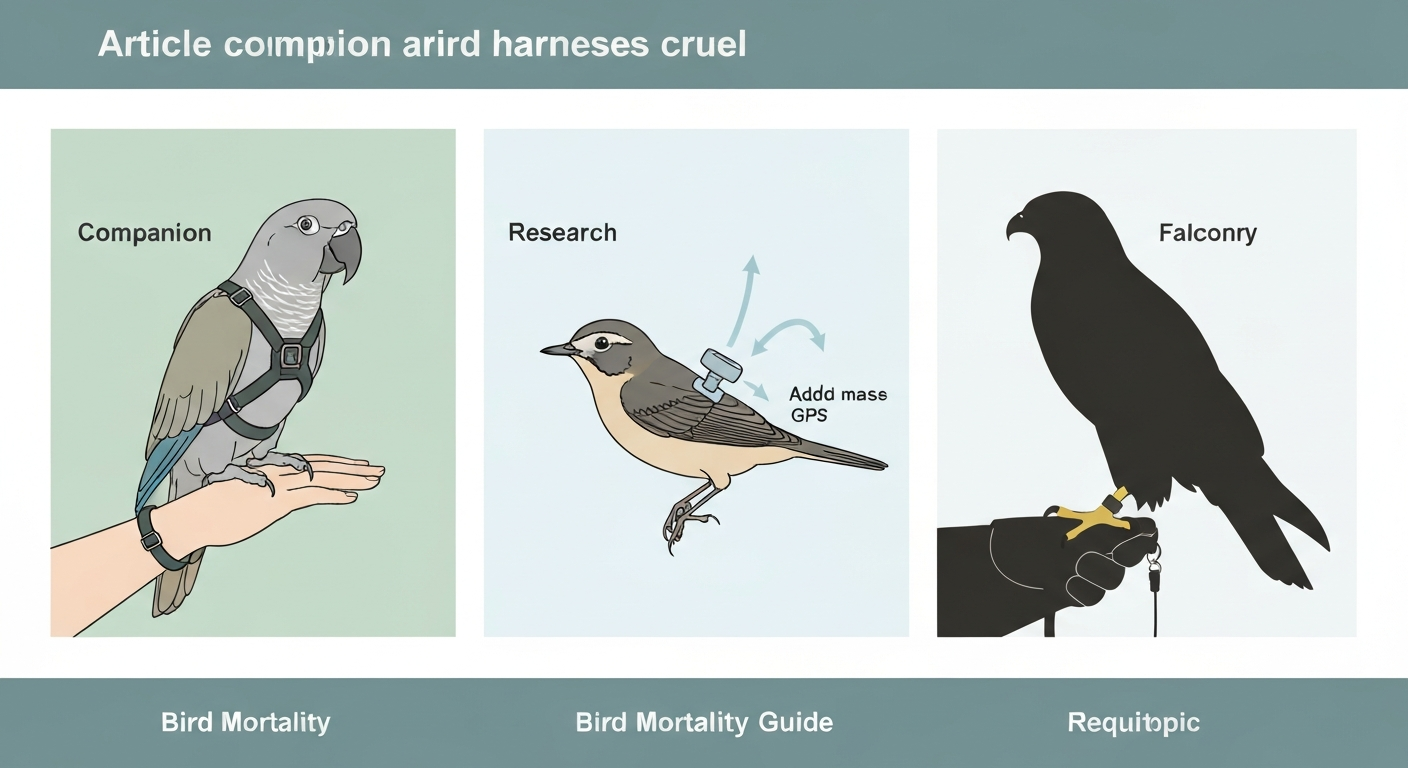
A bird harness is a body-worn restraint or carrier that distributes load across a bird's torso rather than concentrating it at a single point. The term covers a wide range of designs used in three distinct contexts: pet ownership (allowing parrots and other companion birds to go outdoors without escaping), falconry and working-bird handling (securing birds during transport or training), and scientific research or wildlife management (attaching GPS units, satellite transmitters, or data loggers to wild birds for tracking). The principles are similar across all three uses, but the stakes, bird species involved, and duration of wear differ enormously.
Why people put harnesses on birds
The motivations are practical and, in most cases, come from a desire to improve the bird's life or safety rather than restrict it. For companion bird owners, outdoor time on a harness allows parrots in particular to experience sunlight, fresh air, and environmental enrichment that a cage simply cannot provide, while preventing the kind of accidental escape that typically proves fatal for captive-bred birds unequipped to survive outdoors. Related: see the cat collar bird warning guide for advice on preventing predation and collar-related risks. In falconry, a harness or anklet-and-leash system is a centuries-old tool for keeping a working bird safe during transport between the field and the mews. In wildlife science, harness-mounted GPS and satellite transmitters have transformed our understanding of migration, home range, and habitat use for dozens of species, knowledge that directly underpins conservation planning.
- Outdoor enrichment for companion parrots: safe access to sunlight and environmental stimulation
- Escape prevention: critical for clipped or unclipped birds in open or semi-open spaces
- Transport security: used in falconry to secure birds between sessions
- Free-flight training: some trainers use a long-line harness tether during early recall training
- Scientific tracking: GPS, satellite transmitters, and geolocators for migration and ecology studies
- Wildlife management: attachment of data loggers for population monitoring and conservation assessment
Harness types, designs, and what they are made from
Understanding the differences between harness designs matters because the geometry of how load is distributed directly affects welfare risk. The four main types you will encounter are described below, along with the materials commonly used.
Figure-8 harness
The figure-8 is the most common design for companion parrots. Two loops, one around the neck and one around the body at the wings, are connected by a central strap that runs along the sternum or back. It is simple to put on once a bird is trained, and the design keeps the attachment point (usually for a leash) on the bird's back. Brands like Aviator have popularized this design for small to large parrots. The main welfare risk is incorrect sizing: a neck loop that is too tight can restrict breathing or cause trauma, while a body loop that is too loose can allow a wing to become caught.
Backpack or vest harness
Backpack-style harnesses are used almost exclusively in scientific research to carry data-logging devices. A padded body cradle sits on the bird's back, with loops passing under each wing and connecting across the breast. The device (GPS unit, satellite transmitter, or geolocator) is mounted dorsally. This design concentrates added mass on the dorsal surface, directly above the bird's center of gravity, a placement with documented implications for flight performance and survival that are covered in detail in the welfare section below. Vest designs are a softer variation, wrapping more of the torso in a fabric sleeve, sometimes used for larger raptors in tracking studies.
Leash and ankle attachments (falconry)
Traditional falconry uses leather or synthetic anklets attached to the bird's legs, connected by a swivel and leash to a perch or glove. Strictly speaking this is not a body harness, but it is often discussed alongside harnesses in welfare literature because it restricts movement in a similar way. Some falconers also use a modified body harness for transporting birds in vehicles or in boxes, particularly for long-distance travel.
Materials
Pet harnesses use nylon webbing, soft rope, or flexible silicone; the best designs incorporate breakaway or quick-release buckles. Scientific harnesses use Teflon ribbon, elastic cord, or braided loops, often with 'weak-link' sections designed to degrade and release the device after a set period, a design recommendation that has come out of multiple welfare reviews. Hardware includes stainless steel or aluminum swivels and clips. Rough edges, poorly finished knots, and non-degradable materials all increase the risk of abrasion and entanglement, which are among the most commonly reported harms in the peer-reviewed literature.
What the science actually says
The research base here is larger and more rigorous than most people expect. A phylogenetically controlled meta-analysis published by Bodey and colleagues in 2018, drawing on over 450 effect sizes from 214 studies, found that device mass as a proportion of body mass, flight style, migration distance, and attachment type and position all significantly predicted deleterious effects on survival, reproduction, and body condition. Back and tail mounts were linked to reduced survival in some taxa. That is the single most comprehensive synthesis available, and its message is clear: harm is real, measurable, and predictable, but it is not uniform.
At the same time, a separate meta-analysis by Brlík et al. (2020) focused specifically on geolocators fitted to small birds under 100 grams and found only weak overall effects on apparent survival, with no clear overall effects on condition, phenology, or breeding performance. So for very small birds carrying light devices, effects can be minimal. The critical word is 'can': the same analysis found the effects were highly heterogeneous across species and methods, meaning a blanket 'no harm' conclusion is just as wrong as a blanket 'always harmful' one.
A 2024 risk assessment from the Norwegian Scientific Committee for Food and Environment (VKM) reviewed capture, marking, and tracking methods across wild bird species and rated harness-mounted backpack tags as posing species-specific risk ranging from moderate (hawks and falcons) to high or moderate for some waterfowl, corvids, and diving species. The report specifically recommended weak-link designs, careful fit, pre-deployment species evaluation, and post-deployment monitoring, not a ban, but a call for structured caution.
For companion birds, direct experimental data is sparse because almost all the research has been conducted on wild birds in tracking contexts. However, a study on domestic laying hens found that backpack-mounted monitoring devices increased preening frequency, altered peripheral skin temperature, caused weight loss, and increased aggression from cage-mates, demonstrating that device-related behavioral and physiological disruption occurs even in habituated domestic species. The Association of Avian Veterinarians (AAV) acknowledges that outdoor excursions carry risk and recommends harness use or secure containment for birds taken outside, while emphasizing that any nonessential procedure carries welfare risk and should be undertaken only with appropriate veterinary guidance.
Real welfare risks: what can go wrong and how serious it is
The risks below are drawn from peer-reviewed case reports and controlled studies, not anecdote. They vary considerably in severity and likelihood depending on species, fit, and duration of use.
Physical injury: abrasion, entanglement, and pressure lesions
Skin and feather abrasion is the most consistently reported physical harm. In a field trial comparing attachment techniques for Sandwich Terns (Fijn et al., Ibis 2024), the harness group showed lower apparent survival (0.82) compared to controls (0.89), with documented cases of entanglement and abrasion. A clinical case report in the Journal of Avian Medicine and Surgery described an Atlantic yellow-nosed albatross that developed an ulcerative interscapular lesion, a deep wound at the base of the neck between the shoulder blades, directly caused by a 48-gram satellite transmitter in a backpack harness. The bird also developed capture myopathy, a syndrome of severe muscle breakdown associated with stress and restraint, and required aggressive supportive care before it could be released. A 2024 systematic review of capture myopathy in wild birds found multiple species where harness attachment or attempts to remove transmitter harnesses were implicated as contributing factors to exertional myopathy and muscle necrosis.
Flight impairment
Back-mounted devices add mass and aerodynamic drag at a point that directly affects flight biomechanics. Evans et al. (2020) found that back-mounted GPS tags increased mass loss and affected breeding condition in chick-rearing common guillemots, attributing this to added mass and increased drag. A controlled study on great tits (Parus major) found that birds fitted with backpack radio-tags showed reduced escape-flight performance, and crucially, this impairment did not recover over time, suggesting the compensation some researchers assumed would occur simply does not happen in all species. A house sparrow study using mock tags at approximately 5.7 percent of body mass found temporary decreases in takeoff velocity and altered flight trajectory, though this study found negative impacts were actually larger when tags were glued to feathers than when attached with a harness, an important nuance that shows attachment method, not just harness use itself, drives some outcomes.
Stress and corticosterone elevation
Harnessing produces measurable acute stress. An experimental study on rock pigeons measured baseline corticosterone levels and compared them to levels after 30 minutes in a harness-and-tether setup and after a genuine raptor attack. Authentic predator attacks produced larger adrenocortical responses, but harness restraint still produced a measurable physiological stress response. For a bird that has been properly trained and habituated to harness use, acute stress at fitting may be lower, but the data on this in companion birds specifically is limited, and the precautionary interpretation is that stress during fitting should always be taken seriously.
The '5 percent rule' problem
Many harness and tracker guidelines cite a rule that device mass should not exceed 3 to 5 percent of the bird's body mass. This threshold is widely used but has been explicitly criticized by multiple research teams. Bodey et al. (2018) showed that deleterious effects scale with proportional tag mass but also with other covariates including species and attachment type, meaning the 5 percent rule can be misleading in either direction. Portugal (2018) argued that miniaturization of devices has not solved the problem because researchers are now tagging smaller and smaller species, and the rule was never validated for many of them. The practical implication: treating '5 percent or less' as a pass/fail safety certificate is wrong. Species-specific evaluation is what the evidence actually supports.
Signs a bird is suffering because of a harness
Recognizing distress early is the most important thing an owner or researcher can do to prevent a minor problem from becoming a serious one. Some signs are obvious; others require knowing your bird's baseline behavior well enough to notice change.
- Excessive or focused preening at the harness contact points, particularly the neck, breast, or interscapular (upper back) region
- Feather loss or broken feathers at areas where straps contact the skin
- Redness, raw skin, or visible wounds beneath straps — check after every use
- Refusal to move, hunched posture, or reluctance to fly after the harness is removed
- Changes in vocalization: uncharacteristic silence or persistent distress calls during or after wear
- Labored breathing or any audible change in respiratory rhythm while in the harness — this is a medical emergency if the neck loop is involved
- Rapid, shallow breathing or open-mouth breathing at rest
- Reduced appetite or weight loss over a period of regular harness use
- Wing droop, asymmetric posture, or difficulty landing after harness sessions (possible musculoskeletal involvement)
- Increased aggression toward the harness, toward the owner during harness fitting, or toward other birds after sessions
- Entanglement: any situation where a strap has caught on a body part, perch, or environmental feature requires immediate, calm removal
If you observe any of the physical signs above, skin wounds, feather damage, or breathing changes, remove the harness immediately and consult an avian veterinarian. Changes in behavior alone (increased preening, reluctance, aggression) warrant harness-free rest and a reassessment of fit and training approach before continuing. The fact that a bird tolerates a harness does not mean it is comfortable; birds are prey animals with strong instincts to suppress visible signs of distress, which means behavioral signals often appear only after a problem has been developing for some time. For more on the psychological effects of captivity and the specific fears an encaged bird may experience, see the discussion titled "what is the encaged bird fearful of". This is worth keeping in mind when evaluating what might look like acceptance.
How to choose, fit, train, use, and maintain a harness safely
Choosing the right harness
Match the design to the species, body size, and purpose. For companion parrots, a figure-8 or similar wrap-around design with adjustable, smooth-edged straps is appropriate. Check that the harness is species-specific: a harness sized for a macaw will not fit safely on a conure, and generic sizing is a common source of ill-fitting equipment. For research applications, consult the VKM 2024 guidance and species-specific literature before selecting a harness design, and use weak-link release systems whenever the bird will be in the field unsupervised.
Fitting step by step
- Start with the bird calm and relaxed — never attempt first fitting when the bird is already stressed or in a new environment
- Check that the neck loop allows two fingers to slide between the loop and the bird's neck; too tight restricts breathing, too loose allows escape or tangling
- Check that the body loop allows one finger between the strap and the body wall on each side; it should not compress the keel or restrict wing movement
- The leash attachment point on the back should sit between the shoulders, not at the base of the neck — confirm it does not press on the spine
- Verify the bird can extend both wings to their full range without the harness restricting movement
- With the harness on, observe the bird for 5 to 10 minutes before attaching any leash or taking it outdoors — watch for labored breathing, excessive struggle, or immediate attempts to remove the harness
- Remove and recheck fit after the first session: look for redness or feather displacement at contact points
Training for acceptance
Forcing a harness onto an untrained bird is both ineffective and a welfare concern. Desensitization using positive reinforcement is the standard approach: begin by presenting the harness near the bird during feeding to build neutral association, progress to touching the bird with the harness, then to placing it loosely over the head, and only fully fasten it once the bird shows no aversion. This process can take days to weeks depending on the individual bird's temperament. Young birds tend to habituate more readily. Birds that have previously had a frightening harness experience may take significantly longer or may never fully accept harness use without specialist behavioral guidance. The concept of a bird 'freaking out' during early training, a widely searched topic, is a normal part of the desensitization curve if managed carefully, but it becomes a welfare problem if sessions are prolonged or forced. For a concrete example of a severe fear response to sudden human actions, see the report titled "bird freaks out when owner smashes cage" which illustrates how intense panic can develop and why sessions must never be forced.
Cleaning and maintenance
Dirty or degraded harnesses cause harm. Accumulated dirt, dried secretions, or frayed fibers all increase abrasion risk. Clean nylon or fabric harnesses with mild, fragrance-free soap and warm water; rinse thoroughly and allow to dry fully before use. Inspect hardware (buckles, swivels, attachment rings) before every session for sharp edges, corrosion, or cracks. Replace harnesses showing any signs of material fatigue, they are inexpensive relative to the cost of a veterinary visit.
Emergency response if something goes wrong
If a bird becomes entangled, the priority is to reduce struggling, not to pull the harness free. Wrap the bird gently in a light cloth to reduce flapping, which worsens entanglement and increases stress-related injury risk. Use blunt-ended scissors or seam rippers designed for this purpose to cut the harness away, never pull against resistance. Any bird that has struggled significantly during an entanglement event, or that shows wing droop, weakness, or abnormal breathing afterward, should be assessed by an avian veterinarian promptly: capture myopathy can develop within hours of a severe stress event and is potentially fatal if untreated.
Harnesses compared with other common practices
Harnesses don't exist in isolation. Most of the situations where someone considers using a harness involve a trade-off with another practice, leg ringing or banding, wing-clipping, or keeping a bird confined. The question is not whether harnesses are perfect, but whether they are better or worse for welfare in a given context than the realistic alternatives.
| Practice | Primary purpose | Documented welfare risks | Duration of effect | Reversibility | When it may be preferable to alternatives |
|---|---|---|---|---|---|
| Harness (figure-8, pet bird) | Outdoor safety, enrichment, transport | Abrasion, stress at fitting, entanglement if unsupervised | Session-limited | Fully reversible | When a bird needs outdoor access and wing-clipping is not desired or no longer effective |
| Harness (backpack, scientific) | Data logging, tracking | Abrasion, flight impairment, survival reduction in some species, capture myopathy risk | Days to months | Reversible if weak-link used; entanglement risk if not | When migration or movement data is essential for conservation and species-specific risk is assessed as acceptable |
| Leg ringing/banding | Individual identification, population monitoring | Abrasion, ring entanglement, leg injury if poorly fitted or ring retained past growth stage | Permanent (metal) or temporary (plastic) | Removable in research contexts; permanent in some systems | When identification alone is needed with no tracking requirement; generally lower welfare impact than back-mounted devices if fitted correctly |
| Wing-clipping | Escape prevention, manageable flight | Reduced enrichment, impaired escape from predators, feather follicle damage if cut too short, psychological stress in some individuals | Until next molt | Reversible at molt | Debated; may suit some birds in specific indoor environments but denies natural flight behavior |
| Confinement (cage only) | Security, containment | Behavioral restriction, reduced enrichment, potential for feather-destructive behavior and obesity in sedentary environments | Continuous | Not applicable | Appropriate baseline for safety; inadequate as the sole welfare strategy for species requiring high activity levels |
Leg ringing, discussed in more depth in the context of wildlife monitoring elsewhere on this site, shares some of the same abrasion and entanglement risks as harnesses but is generally considered lower risk for welfare when fitted correctly because it does not affect flight biomechanics the way a back-mounted device does. Wing-clipping is sometimes presented as an alternative to harnessing for outdoor safety, but it is worth being clear that clipping removes the bird's primary defense against predators and its capacity for a core natural behavior, that is not trivially less harmful than a well-fitted harness. The welfare comparison genuinely depends on the individual bird, the environment, and the owner's capacity to supervise.
Legal and ethical considerations
In most jurisdictions, harnesses on companion birds are unregulated. For wild birds, the picture is different: capture and tagging of wild birds is subject to licensing requirements in most countries, and welfare review is now a standard part of research ethics approval. The VKM 2024 report and similar national assessments are increasingly shaping the conditions under which harness-mounted devices can be approved for use on protected species. Researchers using backpack harnesses on any wild bird species should expect to demonstrate compliance with species-specific welfare assessments, weak-link release provisions, and post-deployment monitoring protocols as conditions of ethical approval. For pet bird owners, the ethical obligation is more personal than legal, but it is no less real: the AAV's position that nonessential procedures carry risk, and that bird owners should minimize unnecessary restraint and handling stress, applies directly to casual or untrained harness use. The RSPCA welfare standards (UK) similarly state that restraint and handling can cause pain or distress and should be minimised during any procedure The RSPCA welfare standards (UK) similarly state that restraint and handling can cause pain or distress and should be minimised during any procedure..
Practical recommendations
For companion bird owners
- Choose a species-specific, adjustable harness from a reputable avian supplier — not a generic 'small animal' product
- Use positive reinforcement desensitization before the first full fitting; do not force the harness on a bird that has not been trained to accept it
- Check fit every session: two fingers under the neck loop, one finger under body straps, full wing range of motion confirmed
- Never leave a harnessed bird unsupervised outdoors or in a space where the leash could catch on something
- Limit initial sessions to 10 to 15 minutes and extend duration only as the bird demonstrates comfort
- Inspect the harness and the bird's skin after every session; retire any harness showing fraying, sharp hardware, or material degradation
- Consult an avian veterinarian before harnessing birds with pre-existing respiratory, musculoskeletal, or behavioral conditions
For researchers and wildlife managers
- Conduct a species-specific welfare risk assessment before selecting harness design; do not default to the 5 percent body-mass rule as sufficient justification
- Use weak-link release harness designs for any deployment where field removal is not feasible
- Select attachment position and device shape with drag and center-of-gravity effects in mind; back mounts carry documented survival penalties in some taxa
- Plan for post-deployment monitoring to detect abrasion, behavioral change, and survival effects
- Document and report welfare outcomes, including negative outcomes; publication bias toward positive results has historically distorted the evidence base
- For species with high diving, swimming, or sustained flapping flight demands, apply the highest caution tier and consider whether alternative identification methods can meet the study objective
The bottom line
Bird harnesses are not inherently cruel, and calling them torture devices misrepresents both the evidence and the realistic alternatives available to bird owners and researchers. But the research is equally clear that harnesses carry real, measurable, species-specific welfare risks when used incorrectly, fitted poorly, or applied without appropriate training. The difference between a harness that improves a companion parrot's quality of life by enabling safe outdoor time, and one that causes chronic abrasion, stress, or flight impairment, is almost entirely in the details of selection, fitting, and training. Get those right and the welfare balance tips in the bird's favor. Get them wrong and you are causing harm regardless of your intentions.
FAQ
Are bird harnesses inherently cruel?
Not inherently. Evidence shows harnesses and backpack‑mounted devices can be humane when species, design, mass, placement and monitoring are carefully considered. Peer‑reviewed studies report harms (abrasion, flight impairment, altered behaviour, reduced survival) in some taxa, so cruelty depends on how, why and on which species the harness is used. (Supported: Bodey et al. 2018; VKM 2024; species‑specific studies.)
What types of harnesses are used for birds and why?
Common types: figure‑8/wing loops for pet birds (short‑term restraint/outdoor flight training), backpack or vest harnesses for pet/working birds and falconry, and harnesses for attaching GPS/biologging devices in wild birds. Uses include exercise/outdoor access, falconry/working tasks, research telemetry, and conservation tracking.
What does peer‑reviewed evidence say about harms from harnesses/tags?
Meta‑analyses and experimental studies show harms scale with proportional mass, attachment type/position, flight style and species. Documented effects include reduced survival, poorer condition, flight impairment, abrasion/ulceration and increased stress. Effects are heterogeneous: some studies find weak/no effects for certain small birds, but others report significant negative outcomes for diving seabirds, raptors and some waterfowl.
What are the main welfare risks of harness use?
Key risks: mechanical injury (abrasions, ulceration, limb or skin damage), entanglement and snagging, impaired flight performance (takeoff, maneuvering, endurance), physiological stress/capture myopathy, altered behaviour (preening, social aggression), and increased energetic costs leading to condition loss or reduced reproductive success.
What signs indicate a bird is suffering because of a harness?
Watch for: persistent fluffed/closed posture, reduced flight/avoidance of flight, altered gait or asymmetric wing use, visible abrasions/sores at harness contact points, excessive preening/feather damage, weight loss or reduced food intake, lethargy, respiratory distress, or acute panic/escape behaviour. Any sudden collapse, severe bleeding, or inability to perch are emergencies.
How do harnesses compare with alternatives like wing‑clipping, leg bands, or confinement?
Each has tradeoffs: wing‑clipping reduces flight (short‑term but predictable loss of freedom), confinement eliminates flight but can cause chronic stress/poor welfare if prolonged; leg rings/bands are low‑profile but can cause entanglement or limb injury if poorly fitted. Which is more humane depends on purpose: for temporary outdoor access a well‑fitted, trained harness may be preferable to permanent wing‑clipping; for long‑term prevention of flight, responsible confinement with enrichment may be less risky than a poorly fitted harness.