
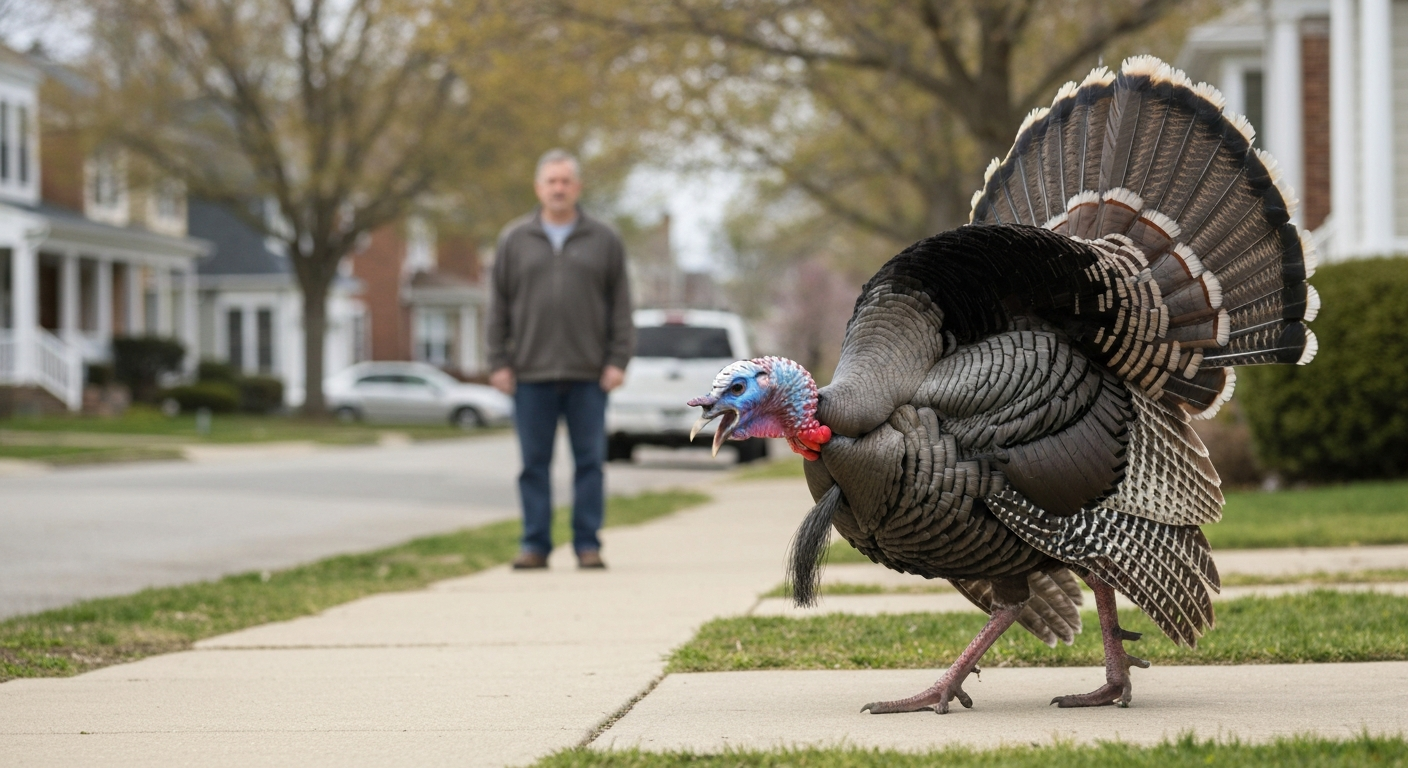
Wild turkeys can be genuinely dangerous to people, children, and pets under the right circumstances, but the risk is nowhere near the level that viral headlines suggest. The most honest answer is: it depends on the bird's history with humans and the time of year. A habituated tom in a suburban neighborhood during spring breeding season is a different proposition from a flock of domestic turkeys in a farmyard. Injuries do occur, spurs and beaks can produce lacerations and puncture wounds that need medical attention, and turkeys crossing roads or runways create real vehicle and aviation hazards. None of that is folklore. But serious turkey-inflicted injuries to healthy adults remain uncommon, and almost every dangerous encounter follows a predictable pattern you can learn to recognize and avoid.
Is Turkey Bird Dangerous? Risks, Injuries, and Prevention

Risk at a glance
| Hazard | Who is most at risk | Likelihood | Potential severity | Seasonality |
|---|---|---|---|---|
| Physical attack (spurring/pecking) | Children, elderly adults, small pets, habituated-bird encounters | Low to moderate in suburban ranges | Mild to moderate (lacerations, punctures, bruising) | Highest: Feb–May (breeding season) |
| Zoonotic disease (Salmonella, avian influenza) | People who handle live or dead birds or their droppings | Low with normal hygiene | Low to severe depending on pathogen | Year-round |
| Tick-borne disease transmission (indirect) | People in turkey habitat | Low to moderate in tick-endemic areas | Variable (Lyme, Rocky Mountain spotted fever) | Spring–fall |
| Road vehicle strike | Drivers in suburban/rural areas where turkeys are common | Low but documented | Property damage; driver injury if swerving | Year-round; higher spring when birds disperse |
| Aircraft bird strike | General aviation and low-altitude commercial operations near turkey habitat | Rare but on record | Airframe damage; potentially serious at low altitude | Year-round |
Wild vs. domestic turkeys: same species, very different behavior
There is only one North American turkey species, Meleagris gallopavo. Domestic turkeys are a selectively bred strain of the same bird, but decades of captive breeding have removed most of the wariness that makes wild turkeys cautious around people. Wild turkeys across much of the eastern and western United States have rebounded dramatically from near-extinction in the mid-20th century; they now inhabit suburban parks, school campuses, and commercial strips. That rebound is a conservation success story, but it has put a bold, territorial bird into close daily contact with people who have no experience reading its behavior.
Domestic turkeys raised for meat or as farm animals are generally calm unless threatened, and serious injuries from them are rare outside of handling accidents. The aggression risk that state wildlife agencies warn about consistently refers to wild birds, particularly adult males (called toms or gobblers) that have become habituated to human presence. Habituation is the key variable. A wild turkey that has learned to associate people with food loses its instinct to flee and may instead test dominance through bluffing charges, blocking, and eventually physical contact.
Range and habitat overlap
Wild turkeys are now present in 49 U.S. states plus southern Canada and parts of Mexico. In suburban settings, their encounters with people, children, and pets happen at close range with little warning. The highest-risk scenario is a neighborhood where residents have fed turkeys (intentionally or not, through accessible compost or bird feeders knocked over by deer), creating a locally habituated population.
Behavioral triggers for aggression: what actually sets a turkey off
Understanding why a turkey becomes aggressive matters far more than simply knowing that it can. The triggers are well-documented and largely predictable.
Breeding season
Elevated testosterone drives most wild-turkey aggression. Toms enter breeding condition in late winter and peak in early spring, roughly February through May depending on latitude. During this window, males gobble, strut with fanned tails, drag their wings along the ground, and challenge anything they perceive as competition, including people, cars, and their own reflections in windows or hubcaps. The New York State Department of Environmental Conservation and Massachusetts Wildlife both explicitly name spring breeding behavior as the primary driver of human-turkey conflicts. This seasonal pattern is important: if you have a turkey problem, it will almost certainly be worst for a defined 8 to 10-week window each year.
Habituation and food conditioning
A wild turkey that is fed by people, or that simply learns over multiple encounters that humans do not pose a threat, will stop retreating. Once retreat stops, the bird may begin testing boundaries, first with close approaches, then with bluff charges. Wildlife agencies uniformly describe this as a learned behavior that escalates if people respond by backing away or, worse, continuing to offer food. The bird is not acting out of malice; it is applying the same dominance-hierarchy logic it uses within its flock to a new context. The practical implication is that the most aggressive suburban turkeys are almost always birds with a history of human contact and inadequate negative reinforcement.
Territory and nesting
Hens can become defensive near nest sites, though they are far less aggressive than breeding toms. A crouching or wing-spreading hen near a shrub or brush pile is probably guarding a nest and is best given wide clearance.
Warning signs to watch for
- Gobbling and strutting (fanned tail, dragged wings) at close range with no attempt to flee
- Bluff charges that stop short and are repeated when you stand still
- Pecking at your shoes, car tires, or windows (often triggered by own reflection)
- Following you across a yard or parking lot
- Blocking a path or doorway and refusing to move
- Lowered head with neck extended straight forward (a pre-attack posture)
How and when turkeys injure people, children, and pets
A tom's two main weapons are its beak and the sharp keratinous spur on the back of each lower leg. Spurs on large adult toms can reach an inch or more in length and are capable of producing deep puncture wounds and lacerations, particularly on the lower legs and ankles of adults. Children are at higher risk than adults for two compounding reasons: their faces and heads are closer to a tom's striking zone, and they are less likely to respond assertively to a bluff charge. Several municipal incident reports describe toms chasing or knocking over young children near school bus stops and in parks.
Pets, especially small dogs and cats, are also documented targets. Wildlife officers report dogs being chased, scratched, and occasionally spurring-injured in suburban yards. A leashed dog is arguably more vulnerable than a free dog because it cannot flee; owners who step between their dog and a charging tom often absorb the contact themselves.
Common real-world injury scenarios include: a jogger or cyclist being chased and falling; a mail carrier or delivery worker encountering a blocking bird on a driveway; a child leaving a school bus into an aggressive bird; a homeowner whose small dog is attacked in a fenced yard. Incidents involving turkeys entering buildings (supermarkets, offices) have been widely reported in suburban Massachusetts, New Jersey, and California, occasionally resulting in property damage and minor injuries.
Injury types and what to do medically
Typical wound types
- Spur puncture wounds: deep, narrow, potentially contaminated with oral and environmental bacteria
- Beak pecks: surface abrasions to deeper lacerations depending on force and location
- Scratch injuries from claws: surface lacerations, usually on lower legs or forearms
- Blunt-force bruising from wing strikes (less common but documented)
- Secondary injuries from falling while fleeing (more common than direct contact in adults)
First aid steps after skin-breaking contact
- Move away from the bird immediately and get to a safe location.
- Irrigate the wound thoroughly with clean running water and soap for at least 5 minutes. This is the single most important step to reduce infection risk.
- Control any bleeding with direct pressure using a clean cloth.
- Cover the wound with a sterile bandage.
- Check your tetanus vaccination status: for puncture or contaminated wounds, a Td/Tdap booster is recommended if your last dose was more than 5 years ago, per ACIP wound-management guidelines.
- Seek medical evaluation for any wound that is deep, involves the face or hands, will not stop bleeding, shows signs of infection (redness, swelling, warmth, discharge), or was inflicted on a child, elderly person, or immunocompromised individual.
When doctors will typically prescribe antibiotics
Clinical guidelines for animal-inflicted puncture and bite wounds commonly recommend empirical antibiotic prophylaxis for higher-risk wounds, particularly deep punctures, wounds to the hand or face, and wounds in immunocompromised patients. Amoxicillin/clavulanate is the standard first-line agent because it covers the mixed aerobic and anaerobic bacteria typical of animal-wound infections. The treating clinician will make the final call based on wound type, time since injury, and patient health history, so do not self-prescribe; present to a physician or urgent care and describe exactly how the injury occurred.
One practical note on injury data: quantifying turkey-inflicted injuries nationally is genuinely difficult. The NEISS database and ICD external-cause coding (ICD-10 code W61, 'contact with bird') record bird encounters as a general class without species-level detail. This means turkey attacks are likely undercounted in formal surveillance, and injury reports in the literature almost always come from local news, wildlife agency records, or individual case reports rather than national registries.
Zoonotic diseases and pathogen risks
Turkeys can carry pathogens that pose health risks to people, though the probability of transmission in a typical outdoor encounter is low for anyone with normal hygiene habits.
Salmonella
Wild and domestic turkeys can shed Salmonella spp. in their droppings. The risk is highest for people who handle live birds, clean up droppings with bare hands, or allow children to touch birds and then touch their faces. Standard hygiene, handwashing after contact with birds or their environments, eliminates most of this risk for casual encounters.
Avian influenza
Highly pathogenic avian influenza (HPAI) strains, including H5N1, can infect turkeys and pose a low but real transmission risk to people who handle infected birds without protective equipment. The CDC and USDA advise avoiding contact with sick or dead wild birds and reporting unusual mortality events to state wildlife agencies. For the vast majority of people who simply share outdoor space with healthy wild turkeys, HPAI transmission risk is negligible.
Tick-borne diseases
This is an indirect but underappreciated risk. Wild turkeys move through tall grass, leaf litter, and brushy habitat that is prime tick territory, and they can carry ticks into yards and onto trails. In tick-endemic regions, spending time in areas where turkey flocks regularly roost or forage increases exposure to deer ticks (Ixodes scapularis) and other species that transmit Lyme disease, anaplasmosis, and Rocky Mountain spotted fever. Wearing long pants and tick repellent (DEET or permethrin-treated clothing) in these areas and performing tick checks after outdoor time is advisable regardless of turkey presence, but the presence of a regular turkey flock is a useful indicator that ticks may be active nearby.
Histoplasmosis
Droppings from birds including turkeys can support growth of Histoplasma capsulatum in soil, particularly in warm, humid climates. Disturbing large accumulations of droppings (cleaning a roost site, for example) without respiratory protection can result in inhalation exposure. This is not a risk from passing outdoor encounters but is relevant for anyone doing cleanup work around established roost sites.
Turkeys as vehicle and aircraft hazards
Wild turkeys are large birds. Adult toms typically weigh 16 to 24 pounds, and some reach 30 pounds. A bird that size crossing a road at speed, or a flock moving across a rural highway, creates a real collision hazard. Drivers who swerve to avoid a turkey, particularly at highway speeds, expose themselves to significantly more injury risk than the bird itself would cause on impact. The practical advice from road-safety authorities is consistent: reduce speed when you see turkeys near the roadway, do not swerve sharply, brake in a controlled manner if possible.
Aviation bird strike risk
For aviation professionals, wild turkeys are a documented aircraft-strike species. The FAA Wildlife Strike Database includes turkey strikes, and they are particularly relevant for general aviation aircraft and helicopters operating at low altitude near rural and suburban airports. A large bird at takeoff or approach speeds can cause significant airframe damage. Unlike waterfowl, which concentrate near water, turkeys can be present on or near airport perimeter fences, grass areas, and wooded buffers in temperate North America year-round.
Reporting wildlife strikes
Pilots and airport operators in the United States should report turkey strikes through the FAA Wildlife Strike Database reporting form (available at the FAA website). Even if the strike causes no damage, reporting it contributes to the national database that informs habitat management and wildlife hazard assessments at airports. Airport wildlife biologists use species-level strike data to design deterrent programs, so turkey reports are specifically useful. Internationally, ICAO member states maintain parallel reporting systems; pilots should check with their national aviation authority for the appropriate form.
Practical prevention for homeowners and pet owners
The most effective prevention strategy is preventing habituation before it starts. State wildlife agencies including MassWildlife and the Pennsylvania Game Commission agree on a consistent set of measures.
- Never feed wild turkeys, intentionally or incidentally (secure compost bins, pick up fallen fruit, and store bird seed in ways that turkeys cannot access).
- Keep pets on a leash or under direct supervision in yards where turkeys are present.
- If a turkey approaches, make yourself look large, make noise, and move toward (not away from) the bird; retreating reinforces its confidence.
- Use an umbrella, broom, or similar object to create a barrier if a bird charges; physical contact is not necessary.
- Install motion-activated sprinklers or noise devices near garden areas that turkeys frequent.
- Block roosting sites (overhanging branches over patios, flat roof areas) with physical exclusion where feasible.
- Contact your state wildlife agency or local animal control when a specific bird poses a recurring public safety risk; lethal control is an option of last resort but is permitted in some jurisdictions for public safety.
If you are physically confronted
- Do not run. Running triggers a pursuit response.
- Face the bird and maintain eye contact.
- Raise your arms, open your jacket, or use an object to appear larger.
- Make loud, assertive noise (shout, clap, use a horn).
- Back away slowly once the bird stops advancing, keeping your eyes on it.
- Use a door, gate, or vehicle as a barrier if available.
- Report the incident to local animal control or your state wildlife agency if the bird is in a high-traffic area or has already injured someone.
How turkeys compare to other birds people find threatening
People sometimes conflate bird-danger questions across very different species. A turkey's threat profile is quite different from that of a falcon, which is built to strike fast-moving prey with precision and whose talons pose a very different injury risk. For a focused comparison of predatory birds and the specific risks posed by falcons, see the article Is Falcon Bird Dangerous which examines falcon hunting behavior and talon-related injury risks. Mynas and other corvid-adjacent species generate concern around disease and property more than physical attack. If you want specific information about myna birds, see the section titled 'is myna bird dangerous' for details on their typical risks and behaviors. The shoebill stork, which comes up in online discussions of dangerous birds, occupies a different ecological and geographic context entirely. If you’re wondering whether a shoebill is dangerous, see is shoebill bird dangerous for a focused discussion of that species’ risk profile. Turkeys sit in a practical middle ground: large enough to injure, common enough to encounter regularly in North America, and aggressive enough under specific conditions to warrant real (if measured) caution.
It is also worth briefly noting that internet searches about 'dangerous birds' sometimes mix in content about the Duolingo owl mascot, which obviously poses zero physical risk to anyone. The turkey question is a legitimate safety question with real answers, which makes it worth treating separately from pop-culture bird memes. For a look at how fictional and meme birds compare to real-world risks, see the related piece entitled "is the duolingo bird dangerous," which examines differences between internet bird lore and actual wildlife behavior.
The bottom line
The turkey is a genuinely interesting case in the bird-danger space because the risk is real, seasonal, predictable, and largely preventable. It is not a predator, and it is not going to stalk you. But a habituated tom during breeding season is not something to dismiss, especially around children or small pets. The evidence base for turkey-inflicted injury is thinner than for dogs or other common animal encounters because surveillance systems do not track bird species specifically, but incident reports from wildlife agencies and local news make clear that these encounters happen and occasionally require medical care. Treat the risk proportionately: take the behavioral triggers seriously, apply the standard prevention practices, and know the first-aid steps if contact occurs. That is about as much preparation as this bird actually warrants. For a comparable assessment of risk from another species, see Is opium bird dangerous for more context and prevention tips.
FAQ
Quick answer: Is the turkey (bird) dangerous to people, pets, vehicles, and aircraft?
Short answer: Usually no — most turkeys are not dangerous — but they can cause injury, property damage, and aircraft/vehicle hazards in specific situations. Wild toms (male turkeys) are largest and can become aggressive during breeding season or when habituated to people. Injuries to people and pets are uncommon but documented (lacerations, punctures, blunt‑force falls), and turkeys have caused vehicle collisions and bird‑strikes that are a genuine concern for aviation safety. (See NYSDEC, state wildlife guidance, and FAA/wildlife‑strike reporting resources.) Links: NYSDEC wild turkey page: https://dec.ny.gov/animals/6977.html; MassWildlife guidance: https://www.mass.gov/info-details/masswildlife-monthly-april-2025.
How do wild and domestic turkeys differ in risk?
Wild turkeys (Meleagris gallopavo) are larger, have spurs on the legs, and display breeding aggression (strutting, wing‑dragging, close approaches). They more often enter suburbs/urban areas and can become bold. Domestic turkeys (farm/pet) are typically less wary of people and rarely aggressive, but individual birds may peck or injure if stressed or mishandled. Management differs: wild turkeys should not be fed and may require wildlife agency intervention; domestic birds need proper handling, enclosure, and husbandry.
What situations or behaviors trigger turkey aggression?
Common triggers: 1) Breeding season (early spring) — male hormonal displays and territoriality; 2) Habituation/food‑conditioning — birds fed by people lose fear and approach yards; 3) Protective behavior — females guarding poults; 4) Cornered or startled birds — may strike or bite; 5) Human provocation (chasing/harassing). State wildlife agencies explicitly link breeding and habituation to higher risk: https://www.mass.gov/info-details/masswildlife-monthly-april-2025; https://www.pa.gov/agencies/pgc/wildlife/discover-pa-wildlife/turkey.
How can turkeys injure people, children, and pets — what are typical injuries?
Mechanisms: pecking with the beak, slashing/puncture from the leg spur, and causing falls by chasing or bumping people. Typical injuries: superficial lacerations, puncture wounds, contusions/abrasions from falls, and occasionally deeper tendon/joint involvement. Children are more vulnerable because of smaller stature. Pets (dogs, cats) can be chased, scratched, or bitten; veterinary reports and local incidents document such encounters.
What immediate first‑aid and medical precautions are recommended after a turkey‑inflicted wound?
Immediate steps: 1) Move to safety and stop bleeding with direct pressure; 2) Irrigate wound thoroughly with soap and water; 3) Cover with a clean dressing; 4) Check tetanus status (for puncture/contaminated wounds, booster if ≥5 years since last dose per ACIP guidance); 5) Seek medical care for deep wounds, wounds to face/hands, uncontrolled bleeding, joint/tendon involvement, signs of infection, or high‑risk patients. Clinicians may consider antibiotics (amoxicillin/clavulanate commonly used empirically for animal puncture wounds) and wound exploration. Sources: AAP animal‑bite guidance and general wound care references; Red Cross first aid.
Are there disease or zoonotic risks from turkeys?
Turkeys can carry pathogens (bacterial agents in bills/feet, fecal organisms like Salmonella) but routine transmission to people from a non‑bite contact is uncommon. Any penetrating wound or contamination with feces/soil raises infection risk; manage as an animal‑bite/dirty wound (irrigation, medical evaluation). For concerns about specific pathogens or sick birds, contact local public‑health or wildlife health officials. For general wound management see clinical guidance (AAP/CDC material) and local health departments.