
"Worst bird production" is a genuinely ambiguous phrase, and what you are actually looking for depends heavily on context. It could mean which bird species produce the most dangerous toxins or venom, which birds are the most aggressively violent, which species are the worst parents in biological terms, or which human-facing industries involving birds, poultry farming, aviation, urban management, carry the most serious hazards. Each of those questions has a real, evidence-based answer, and they are worth keeping separate because they involve completely different species, mechanisms of harm, and practical responses.
Worst Bird Production: Poison, Danger, Parenting Risks

Marcus Whitmore
30 Jul 2026
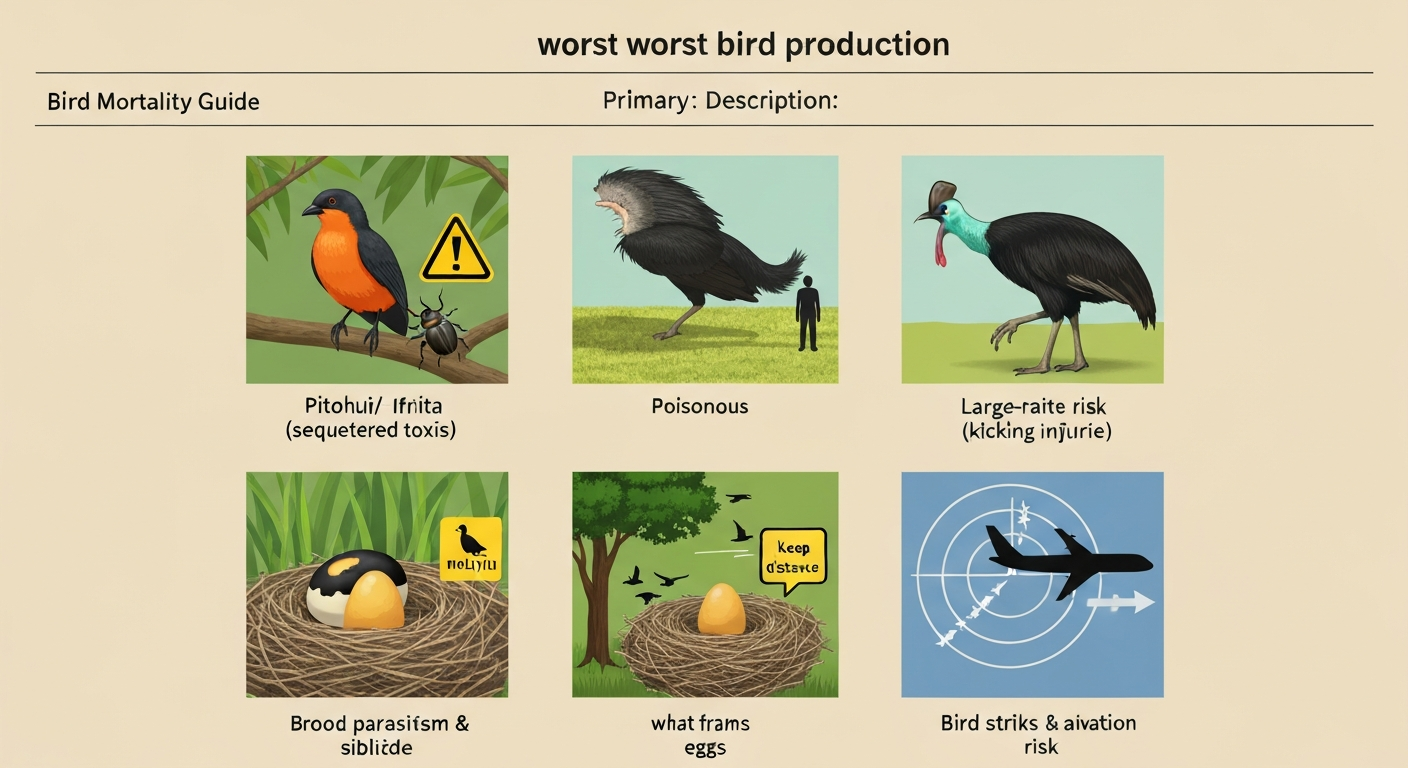
What searchers probably mean by "worst bird production"
When I see this query come up in research contexts, it almost always resolves into one of four distinct user intents. Classic search-intent frameworks sort these into informational, investigative, and practical categories, but for birds specifically the four useful interpretations are: (1) toxin or poison production, which birds produce or carry the most dangerous chemical compounds; (2) venom production, whether any birds can inject toxins the way a snake or bee does; (3) parenting and reproductive quality, which species are the worst at raising offspring or are most destructive to other birds' nests; and (4) human-related production hazards, the risks birds pose to aviation, poultry operations, and urban health through bird strikes, disease transmission, and similar mechanisms. The rest of this article works through each of those in turn, with the species-level detail and risk context that researchers, pet owners, and aviation professionals actually need.
The genuinely poisonous birds: Pitohui, Ifrita, and dietary toxin transfer
The Pitohui (genus Pitohui) from New Guinea became the first bird scientifically confirmed to carry batrachotoxin-like alkaloids in its feathers and tissues, in a landmark 1992 paper by Dumbacher and colleagues in Science. The specific compound found was homobatrachotoxin, a steroidal alkaloid neurotoxin in the same chemical family as the batrachotoxins found in some poison dart frogs. For a concise comparison ranking known poisonous birds, see best bird poison. A subsequent 2004 PNAS study identified the likely dietary source: melyrid beetles in the genus Choresine, which the Pitohui and the closely related Ifrita kowaldi (the blue-capped Ifrita) consume and from which they sequester the toxins rather than synthesizing them endogenously. This dietary-sequestration mechanism is crucial because it means toxicity levels vary depending on what the bird has been eating, and birds kept away from those beetles in captivity lose much of their toxicity over time.
Batrachotoxins are among the most potent sodium-channel activators known to science. They bind to voltage-gated sodium (NaV) channels and hold them in an open, non-inactivating state, which in practice means sustained membrane depolarization, muscle paralysis, cardiac arrhythmia, and, at sufficient doses, death in mammalian models. Mouse LD50 values for batrachotoxin itself are reported in the low microgram-per-kilogram range. Structural work published in Nature Communications in 2024 confirmed the dual receptor-site interactions that explain this extreme potency. The reality is, though, that documented human poisonings from Pitohui or Ifrita are rare precisely because these birds are geographically restricted to New Guinea, and local communities there have historically known to handle them with caution and generally avoid eating them. Field reports and indigenous practice both describe numbness and burning on skin contact with feathers. For a pet owner or casual researcher outside that region, direct exposure to these birds is essentially a non-issue.
Phylogenetic surveys have found that toxicity is patchily distributed across corvoid passerine lineages beyond just Pitohui and Ifrita, suggesting the capacity to sequester dietary alkaloids may be more widespread in that group than originally recognized. The practical exposure routes for anyone who does handle these birds are: contact with feather or skin tissue that transfers toxin to mucous membranes (eyes, mouth), ingestion of meat or feathers, and transdermal absorption where secretions contact broken skin. See Homobatrachotoxin in the genus Pitohui: chemical defense in birds (Dumbacher et al., Science 1992, SI repository) for original documentation that toxin-bearing feathers and tissues cause numbness and burning on contact and outline handling-related exposure routes. All three require fairly direct handling. There is no airborne or projectile hazard.
Venom in birds: what the science actually says
This is where popular media gets things badly wrong, and it is worth being precise. Modern toxinology distinguishes three categories: poisons (harmful when ingested or absorbed), venoms (toxins actively injected into tissues through a specialized delivery apparatus like fangs or a stinger), and toxungens (secretions applied externally to a victim's surface). Pitohui and Ifrita are poisonous birds, not venomous ones. There is currently no broadly accepted, well-documented example of a bird that is venomous in the strict sense, meaning no bird has been confirmed to possess a specialized injection apparatus through which it delivers toxins into prey or predators by biting or stinging. Some birds deploy what toxinologists call toxungenous behavior, such as anointing secretions applied during preening, but this is not classical venom delivery. Reviews in both Biological Reviews (2014) and Acta Zoologica (2021) specifically recommend against using "venomous" to describe any currently known bird, and treat claims to the contrary as misclassifications. If you have seen the venomous-bird claim on a popular science website, it is almost certainly conflating the poison/venom distinction or referring to a species with toxic secretions that do not involve an injection mechanism.
Aggressive and physically dangerous birds: real species, real mechanisms
Physical danger from birds is a different category from chemical danger, and the risk profile is much more concrete for most people. The species that warrant genuine caution are well-documented, and the mechanisms of injury are specific.
Cassowaries
The southern cassowary (Casuarius casuarius) is the species most frequently cited as dangerous to humans, and the evidence supports that reputation in specific circumstances. For more on what is the most violent bird, see the section on the southern cassowary, which is most frequently cited as dangerous to humans due to powerful kicks and a dagger-like inner toe claw. A peer-reviewed review by Kofron (1999, Journal of Zoology) examined 221 cassowary-related incidents in Queensland and found 150 involved direct attacks on humans. Critically, 75 percent of those attacks involved birds that had previously been fed by people, habituation and food conditioning were the dominant risk factor, not random aggression. Seven serious injuries and one fatality were recorded in the dataset. The mechanism of injury is a powerful kick combined with the bird's inner toe, which carries a dagger-like claw up to 12 centimeters long capable of inflicting deep lacerations. The lesson here is not that cassowaries are inherently murderous; it is that feeding wild cassowaries dramatically increases your personal risk.
Ostriches and emus
Ostriches and emus produce documented serious injuries through kicking, particularly in captive or farm settings where handlers must approach the birds regularly. The risks are highest when birds are cornered, feel threatened during breeding season, or are improperly handled. Farm safety guidance for ratite operations emphasizes positional awareness, appropriate restraint equipment, and never approaching a bird in an enclosed space alone. Emus are less dangerous than ostriches in practice due to smaller size, but their claws can still produce significant lacerations.
Raptors and territorial waterfowl
Raptors, hawks, eagles, and owls, occasionally injure or kill small pets, and veterinary case reports document domestic animals attacked by various raptor species. The risk is situational: small dogs and cats left unattended outdoors, particularly during nesting season, face a higher risk than large pets in supervised environments. For humans, serious raptor attacks are rare and usually involve birds that have been habituated to human food sources or are defending a nest. Urban and suburban areas have seen documented cases of territorial raptor behavior, often tied to human food subsidies that concentrate both birds and the behaviors that lead to conflict. Canada geese and swans defending nests will charge and can knock a person down, but fatalities from waterfowl are not documented in the peer-reviewed literature.
Worst bird parents: brood parasitism, siblicide, and reproductive sabotage
"Worst bird production" sometimes leads researchers to questions about parenting and reproductive quality, and this is actually a rich area of behavioral ecology. Two mechanisms stand out: brood parasitism and obligate siblicide.
Brood parasitism: cuckoos and cowbirds
Brood parasites lay their eggs in other species' nests and leave the raising of their young entirely to the host. The common cuckoo (Cuculus canorus) is the textbook example in Europe: the female removes a host egg, lays her own, and the cuckoo chick typically hatches early, ejects the remaining host eggs from the nest, and monopolizes all parental feeding. Brown-headed cowbirds (Molothrus ater) in North America operate similarly, parasitizing over 220 host species. The harm is measurable and conservation-relevant: cowbird parasitism has contributed to population declines in several already-vulnerable songbird species. From a parenting standpoint, the parasite is extraordinarily successful reproductively while contributing zero parental investment, which is why behavioral ecologists sometimes describe this as the most efficient, if ruthless, reproductive strategy in birds.
Siblicide: boobies and other obligate killers
Obligate siblicide is the routine killing of one sibling by another, and it is well-documented in Nazca boobies (Sula granti) and Northern boobies. In Nazca boobies, parents typically lay two eggs but rear only one chick. The elder chick virtually always ejects the younger from the nest within days of hatching, and parents do not intervene. This is not dysfunction, it is a bet-hedging reproductive strategy in an environment where resources are reliably insufficient for two offspring. Eagles, herons, and certain egret species show similar dynamics. The parent bird is not failing; the system is working as evolved. But from a human moral intuition standpoint, it registers as spectacularly poor parenting, which is probably why it keeps appearing in "worst bird" searches.
Human-related production hazards: bird strikes, poultry, and zoonoses
For aviation professionals and public health researchers, "worst bird production" most likely maps to the production hazards that birds create within human systems. There are three primary categories here.
Aviation bird strikes
Bird-aircraft strikes are a well-documented, ongoing aviation safety challenge. The USDA/FAA National Wildlife Strike Database, which has tracked wildlife strikes to civil aircraft in the United States since 1990, records tens of thousands of reported events across its multi-decade series, with birds accounting for the overwhelming majority of reports. Most strikes cause no damage, but a meaningful fraction produce engine damage, airframe damage, or forced landings, and a small number have resulted in fatal accidents. The 2009 US Airways Flight 1549 forced ditching in the Hudson River after a dual-engine bird ingestion remains the highest-profile recent example. The highest-risk bird groups for aviation are large-bodied species (Canada geese, vultures, pelicans) that can cause catastrophic engine ingestion, and flocking species (starlings, blackbirds) whose numerical density makes strike avoidance difficult. Airport wildlife management programs, radar-based bird-activity monitoring, and habitat modification around airfields are the primary mitigation tools used by aviation professionals.
Poultry production problems
Within commercial and backyard poultry production, the main hazards are disease transmission and production losses. Wild birds flying into or near poultry operations can introduce highly pathogenic avian influenza (HPAI), Newcastle disease, and other pathogens that can devastate flocks within days. Biosecurity protocols in commercial operations, controlled access, netting, exclusion fencing, and monitoring for wild bird contact, exist specifically to manage this risk. For backyard poultry keepers, the risk is not zero and spikes during HPAI outbreak periods.
Urban pest risks and zoonoses
Urban bird populations (feral pigeons, starlings, gulls) create documented public health concerns through accumulation of droppings that harbor Histoplasma capsulatum (a fungal pathogen causing histoplasmosis when dried droppings are disturbed and inhaled), Cryptococcus neoformans, and Salmonella. Poultry-associated Salmonella and Campylobacter contamination in food supply chains remains one of the most numerically significant bird-related public health issues in industrialized countries, affecting hundreds of thousands of people annually in the U.S. alone. The reality is that aggregate human health risk from bird-related zoonoses dwarfs the risk from direct bird attacks or toxin exposure by multiple orders of magnitude.
Comparing the risks: frequency, severity, and who is actually at risk
One of the most useful things I can do here is lay out how these different hazards actually compare across the dimensions that matter: how likely an exposure is, how severe the consequence can be, and which groups of people or animals face each risk. This table organizes the main categories covered in this article.
| Hazard type | Frequency of exposure | Potential severity | Who is most at risk | Primary mitigation |
|---|---|---|---|---|
| Poisonous bird (Pitohui/Ifrita) contact | Very rare (geographically limited to New Guinea) | High if toxin reaches mucous membranes; lower on intact skin | Field researchers, indigenous communities in New Guinea | Avoid handling; use gloves; do not ingest |
| Venomous bird injection | Not documented in any confirmed species | N/A | N/A | N/A — not a real hazard |
| Cassowary attack | Low overall; elevated for people who feed wild birds | Moderate to severe (deep lacerations, puncture wounds) | Wildlife feeders, tour operators, farm handlers in Australia/New Guinea | Never feed wild cassowaries; maintain distance |
| Ostrich/emu attack | Low for public; moderate for farm handlers | Moderate to severe (kicking injuries) | Ratite farm workers, zoo staff | Proper handling protocols; restraint equipment |
| Raptor injury to pets | Low to moderate (situational) | Mild to lethal for small pets | Owners of small dogs and cats in rural/suburban areas | Supervised outdoor time; covered enclosures |
| Bird strike (aviation) | High (tens of thousands reported annually in the U.S.) | Low for most; catastrophic in rare large-bird/engine events | Commercial and general aviation crews and passengers | Airport wildlife management; radar monitoring; habitat control |
| Poultry zoonoses (Salmonella, HPAI) | High (widespread food chain and farm exposure) | Moderate (GI illness) to severe (HPAI in immunocompromised) | Consumers, poultry workers, backyard flock owners | Biosecurity, food safety practices, HPAI surveillance |
| Urban bird droppings (histoplasmosis) | Moderate in urban areas with large roosts | Moderate (respiratory illness, serious in immunocompromised) | Construction/remediation workers, immunocompromised individuals | Respiratory protection during disturbance of dried droppings |
The table makes a key pattern visible: the hazards that are most dramatic and most frequently searched (poisonous birds, dangerous bird attacks) are the least statistically likely to affect any given reader. The hazards that are numerically large and affect many people, poultry-associated food pathogens and aviation bird strikes, receive far less attention in popular searches but deserve the most systematic mitigation effort.
Practical steps for pet owners, poultry keepers, and aviation professionals
For pet owners and poultry keepers
- Keep small dogs and cats under direct supervision outdoors, especially in areas with known raptor activity during nesting season (typically March through July in the northern hemisphere).
- Cover outdoor runs and aviaries for pet birds and backyard poultry with welded wire or netting rated for predator exclusion — this also limits wild-bird contact that could introduce disease.
- Never feed wild cassowaries, emus, or other large birds that could become habituated to human contact; habituation is the dominant risk factor for attack, as Kofron's data confirms.
- If you keep backyard poultry, implement basic biosecurity during HPAI outbreak advisories: restrict free-ranging, minimize wild-bird contact with feeders and water sources, and report unusual mortality to your state veterinarian.
- If a pet is struck by a raptor, seek veterinary care promptly — talon wounds are deep punctures that carry high infection risk even when they appear minor externally.
- If you handle any wild bird with unknown provenance and develop burning, numbness, or eye irritation, wash the affected area immediately with soap and water and contact a poison control center; the probability of encountering a genuinely toxic species outside New Guinea is extremely low, but the precaution is costless.
For aviation professionals and airport wildlife managers
- Review FAA Advisory Circular AC 150/5200-33C on hazardous wildlife attractants on or near airports and ensure that land use within the airport's wildlife hazard management zone is consistent with its guidance.
- Prioritize species-identification in wildlife strike reports — large-bodied single birds (geese, vultures, raptors) and dense flocks of small birds (starlings, blackbirds) represent the two highest-risk strike profiles for different reasons, and mitigation strategies differ.
- Radar-based bird-activity systems (such as MERLIN Bird Radar) provide real-time detection of large bird movements near runways; their integration into departure and approach decision-making is expanding at major airports.
- Habitat modification (removing standing water, keeping grass at intermediate heights that are unattractive to large flocking species, reducing seed-bearing vegetation) is more durable than reactive dispersal in reducing resident wildlife populations around airfields.
- Report all strikes to the FAA Wildlife Strike Database — underreporting remains a known problem, and the aggregate data is the primary tool for identifying high-risk species, airports, and seasons.
Immediate steps after an exposure or injury
- After any physical attack by a large bird (cassowary, ostrich, emu): assess wound depth immediately; lacerations from claws can be deceptively deep. Seek emergency medical care for any penetrating wound, control bleeding with direct pressure, and do not assume a wound is minor because it looks small at the surface.
- After handling an unfamiliar wild bird and noticing skin irritation or burning: wash hands and any contact areas thoroughly with soap and water, avoid touching your eyes or mouth, and contact a regional poison control center if symptoms persist or worsen.
- After a suspected raptor attack on a pet: photograph the animal's wounds before cleaning them, provide the images to your veterinarian, and consider reporting the incident to your state or provincial wildlife agency — patterns of habituated raptor aggression near residential areas warrant management follow-up.
- After a bird strike in an aviation context: follow your operator's Bird Strike Reporting procedure immediately, preserve any biological material recovered from the aircraft for species identification by the Smithsonian Feather Identification Lab or equivalent service, and submit a report to the FAA Wildlife Strike Database.
Putting it all together
"Worst bird production" turns out to be a genuinely useful question once you unpack what it is actually asking. The most chemically dangerous birds in the world (Pitohui and Ifrita) are fascinating from a toxinology standpoint but pose essentially zero risk to anyone not in New Guinea handling these specific passerines. The claim that any bird is venomous in the injection sense remains unsupported by the current scientific literature. The most physically dangerous birds to humans are large ratites in contexts where food conditioning has broken down appropriate wariness. The worst bird parents, in reproductive terms, are brood parasites and siblicidal species operating exactly as their evolutionary programming dictates. And the bird-related hazards that actually affect large numbers of people, aviation strikes and poultry-associated pathogens, are managed through systematic, evidence-based programs rather than individual wariness about particular species. Understanding which version of the question you are asking is the first step to getting an answer that is actually useful.
FAQ
What do people mean when they search for “worst bird production”?
The query is ambiguous and typically maps to three user intents: (1) informational — asking which bird species are most dangerous, poisonous, or produce harmful substances/behavior; (2) practical/transactional — seeking ways to reduce harmful bird production outcomes (e.g., bird strikes, poor poultry yields, biosecurity); and (3) investigative/experiential — wanting examples, reports, or media of poor or dangerous bird‑related production (e.g., bad farms, violent bird incidents). Interpreting the intent helps determine whether the user needs species facts, risk mitigation, or operational guidance.
How should threats from birds be classified when answering “worst bird production”?
Use toxinology and behavioral taxonomy: (a) poisons — toxic substances sequestered in tissues/feathers harmful on contact or ingestion; (b) venoms — toxins actively injected via a specialized delivery apparatus (very rare or absent in birds); (c) toxungens — secretions applied externally; (d) aggressive/physical danger — large or habituated birds that can attack; (e) parenting/reproductive ‘quality’ issues — brood parasitism and siblicide that reduce reproductive success; and (f) human‑related production hazards — poultry biosecurity failures and aviation bird‑strike risks. This framework keeps mechanisms of harm distinct and evidence‑based.
Which bird species are known to be chemically poisonous to people or predators?
Documented poisonous birds are rare and geographically limited. Notable examples are some New Guinea passerines (Pitohui species and Ifrita) that sequester batrachotoxin‑like alkaloids (homobatrachotoxin) in skin and feathers from dietary sources (melyrid beetles). These toxins are potent sodium‑channel activators and can harm mammals if significant exposure occurs. Such toxicity is defensive and relates to handling or ingestion rather than an injected venom.
Are any birds truly venomous (able to inject toxins)?
No well‑documented, broadly accepted example of a bird with a specialized venom‑injection apparatus exists. Reviews distinguish poisonous birds (toxic if eaten or handled) and toxungens (surface‑applied secretions) from classical venoms that are actively delivered into tissue. Popular media claims of ‘venomous birds’ are often misclassifications.
Which birds pose significant physical danger through aggression or size?
Large flightless ratites are the primary documented risk: southern cassowaries have caused serious human injuries and at least one recorded fatality in published attack reviews, with feeding/habituation as a major risk factor. Ostriches and emus can also inflict serious injuries, especially in captive or farm settings or when cornered. Raptors can occasionally injure or kill small pets (cats, small dogs) in opportunistic attacks or nest defense situations.
What reproductive or ‘production’ behaviors make some birds ‘worst’ breeders from a biological perspective?
Key problematic behaviors include brood parasitism (e.g., cuckoos) where parasites lay eggs in host nests, reducing host reproductive success, and siblicide or aggressive nestling competition (seen in some raptors and seabirds) where older chicks kill or outcompete younger siblings. These behaviors reduce per‑pair productivity and can be described as ‘poor parenting’ from the host perspective, though they are adaptive for the parasitic or competitive species.