
The 'black bird problem' is not a single, standardized term. When you search it, you land in a sprawling overlap of concerns: a property manager dealing with a grackle roost that's corroding a parking garage, a farmer watching red-winged blackbirds strip a corn field, an airport wildlife officer tracking starling flocks near a runway, and a backyard birder wondering why dozens of glossy, dark birds have taken over the feeder. These are real, evidence-documented situations, not folklore, and each audience needs a slightly different answer. This guide covers all of them.
Black Bird Problem: Identification, Risks, and Management

Marcus Whitmore
13 Aug 2026
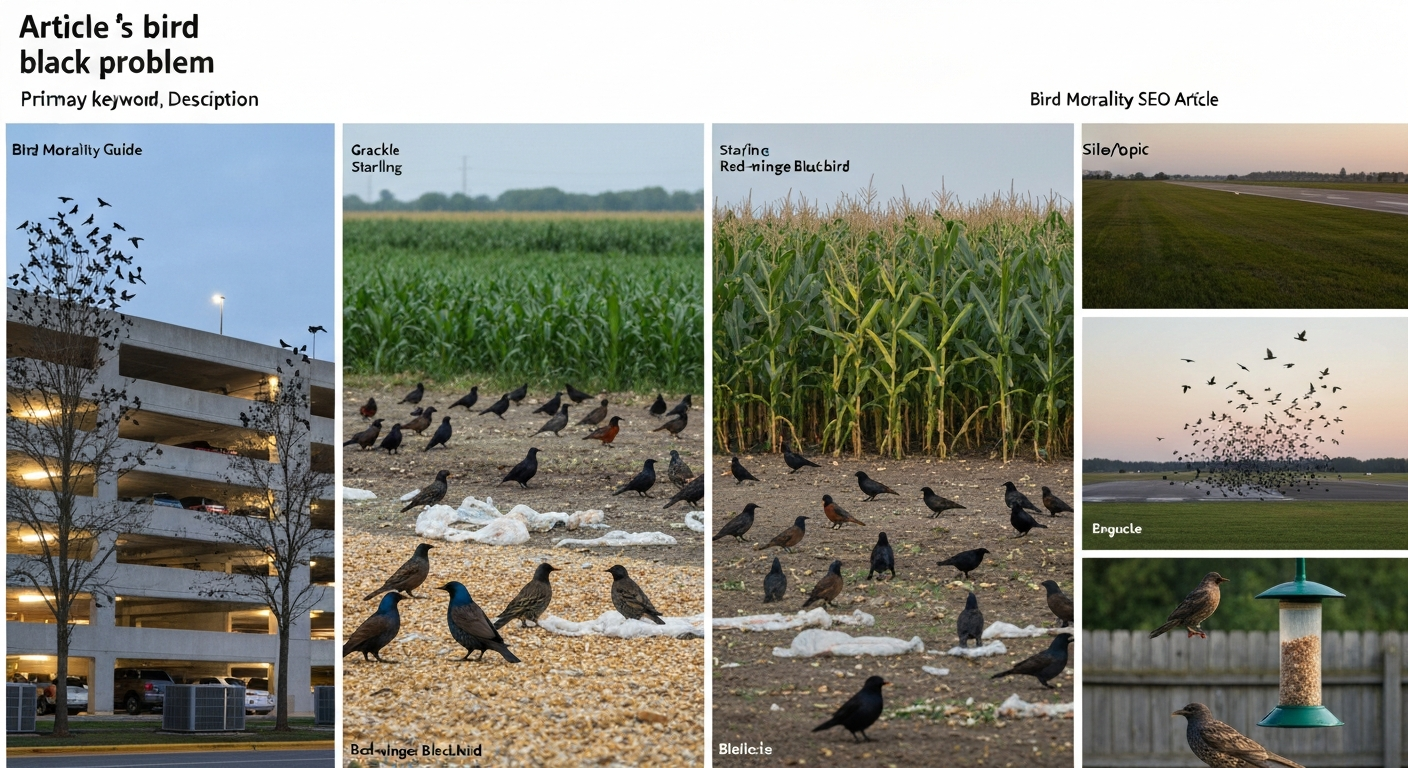
What people actually mean by 'black bird problem'
The phrase shows up in local newspaper headlines, municipal meeting minutes, gardening forums like GardenWeb and Reddit, and airport management reports. In nearly every case it describes a conflict situation involving flocks of dark-plumaged birds rather than a technical classification. The reality is that 'blackbird' means completely different things depending on where you live. In the UK, a 'blackbird' almost always means Turdus merula, the common blackbird, a thrush-family species that occasionally digs up lawns and sings loudly at dawn. In North America, the same word almost always refers to icterids (the New World blackbird family): grackles, red-winged blackbirds, cowbirds, and Brewer's blackbirds. In Australia, complaints about 'black birds' most often point to introduced European starlings, common mynas, or native corvids such as the Torresian crow. A study titled "Communal roosting in a suburban population of Torresian crows (Corvus orru)" documents native corvids forming noisy communal roosts that can damage fruit.
It is also worth clearing up one persistent search collision: a classic recreational math puzzle called the 'two trains and a bird problem' involves a bird flying back and forth between two approaching trains. That is an algebra exercise, not a wildlife issue. If you arrived here from that query, the wildlife content below is a separate topic entirely. If you meant the gaming query "plague inc is it a bird", see our separate explainer on that topic (document be7c46a2-84f0-42f0-8912-5d38a5825d0f).
Who uses this term, and what they need
Different audiences come to the black bird problem from genuinely different angles, and the answers that matter to each are specific enough that they deserve to be named separately.
- Curious researchers and naturalists: looking for species identification, behavioral ecology, population dynamics, and mortality investigation protocols.
- Pet owners: concerned about disease transmission from wild bird flocks near outdoor aviaries or feeding areas, or about backyard bird attacks on small pets.
- Property managers and homeowners: dealing with roost fouling, noise, corrosion from acidic droppings, and structural damage to HVAC equipment, signage, and gutters.
- Farmers and agricultural operators: experiencing direct crop depredation (corn, sunflower, rice, fruit) or feedlot contamination from large mixed-species flocks.
- Aviation and airport professionals: tracking strike risk from flocks near runways, using FAA strike database data, and implementing wildlife hazard management plans.
Forum data and municipal complaint logs consistently show that the overwhelming majority of 'black bird problem' queries are about nuisance damage at feeders, parking-lot roost fouling, and garden or crop depredation. Aviation and disease concerns appear most often in professional and institutional contexts. Understanding which problem you are actually dealing with determines which of the mitigation tools below will be relevant.
Principal species involved, and how to tell them apart
A reliable identification is the first practical step. The species below account for the vast majority of nuisance reports in English-speaking regions. For species profiles and identification tips, see examples of bird pest. Getting the ID right matters because management options, legal protections, and ecological roles differ substantially between them. European starlings, for example, are an introduced species in North America and Australia with no federal protection under the Migratory Bird Treaty Act in the US, while red-winged blackbirds are native and federally protected. See the separate discussion titled are starlings a nuisance bird for a focused look at whether starlings qualify as nuisance birds and what that implies for management. All About Birds, European Starling life history and ID notes notes that European starlings develop yellow bills in the breeding season, a useful field mark to separate them from similarly dark species such as grackles All About Birds — European Starling life history and ID notes. A mistake here has real legal consequences.
Key field marks for common nuisance species
- Common Grackle (Quiscalus quiscula): Long, wedge-shaped or keel-shaped tail held in a distinctive V-shape in flight. Stout, sharply pointed bill. Strong iridescent purple-green sheen on head and body. Long legs. Walks with a striding gait. Year-round eastern North America.
- Great-tailed Grackle (Quiscalus mexicanus): Larger than Common Grackle with an even more exaggerated tail. Pale yellow eyes in adults. Loud, mechanical, varied calls. Southern US through Central America, rapidly expanding northward.
- European Starling (Sturnus vulgaris): Short, squared tail. Compact, triangular silhouette in flight. Heavily spotted white in non-breeding plumage; glossy black with green-purple iridescence when breeding. Bill yellow in breeding season, dark in winter. Probe-feeding behavior on lawns. Worldwide introduced range.
- Red-winged Blackbird (Agelaius phoeniceus): Male has diagnostic red-and-yellow epaulets, easily visible in flight or when perched with wings slightly raised. Smaller than grackles. More fluttery, undulating flight pattern. Widespread North America, especially wetlands and fields.
- Brown-headed Cowbird (Molothrus ater): Chunky, short-tailed. Male has a brown head contrasting with an iridescent black body. Female is plain mottled brown. Brood parasite; often seen near livestock. Widespread North America.
- Brewer's Blackbird (Euphagus cyanocephalus): Male is glossy black with pale yellow eyes; female is plain grayish-brown. Smaller than grackles. Common in western North America, urban and agricultural areas.
- Common Blackbird (Turdus merula): UK and Europe. Male all-black with a bright orange-yellow bill and eye ring; female is brown. Thrush-family hopping gait. Not an icterid; entirely different lineage.
- Torresian Crow (Corvus orru) / Little Raven (Corvus mellori): Australia. All-black corvids forming large communal winter roosts. White bases to neck feathers (visible on wind-ruffled birds). Loud, distinctive calls.
Quick identification reference
| Species | Size (approx.) | Key Field Marks | Typical Behaviors | Geographic Notes |
|---|---|---|---|---|
| Common Grackle | 28–34 cm | Keel-shaped tail; iridescent purple-green; stout pointed bill | Flock foraging; probe-feeding; loud chak calls | Year-round eastern/central North America |
| Great-tailed Grackle | 38–46 cm (male) | Very long tail; pale yellow eyes; loud varied calls | Noisy urban roosts; aggressive at feeders | Southern US, expanding north; Central America |
| European Starling | 19–22 cm | Short square tail; spotted non-breeding; yellow bill (breeding) | Murmurations; probe-feeding on lawns; cavity nesting | Introduced globally; absent only from tropics |
| Red-winged Blackbird | 17–23 cm | Male: red-yellow epaulets; undulating flight | Marsh/field flocking; aggressive nest defense | North America; wetlands and agricultural edges |
| Brown-headed Cowbird | 17–22 cm | Brown head (male); chunky; short tail | Brood parasitism; follows livestock | Widespread North America |
| Brewer's Blackbird | 20–25 cm | Pale yellow eye (male); plain brown female | Urban/suburban flocking; ground foraging | Western North America; urban areas |
| Common Blackbird | 24–25 cm | Orange-yellow bill (male); thrush hopping gait | Territorial singing; lawn foraging; fruit eating | UK, Europe, introduced Australia/NZ |
| Torresian Crow | 48–53 cm | All-black; white feather bases; harsh caw | Communal roosts; intelligence-based foraging | Northern/eastern Australia |
| Little Raven | 48–53 cm | All-black; throat hackles; nasal calls | Communal winter roosts; foraging in groups | Southeastern Australia |
Why these species become pests or hazards
The short ecological answer is that many of these species are generalists that thrive when humans restructure landscapes in their favor. Urbanization concentrates food sources (waste grain, dumpsters, open feedlots), removes predators, creates abundant artificial roost and nest sites, and produces the warmer urban heat-island temperatures that roosting birds actively seek. Research on urban starling roost sites has found roost trees can be several degrees Celsius warmer than the surrounding area, which directly explains why large winter roosts aggregate in city centers rather than dispersing into colder rural areas.
Agricultural practices play an equally large role. Open grain storage, waste grain left in harvested fields, and concentrated livestock feed operations are essentially year-round food subsidies for icterids and starlings. USDA Wildlife Services and the National Wildlife Research Center identify European starlings as a primary avian pest for livestock operations, where they consume and contaminate stored feed. Mixed-species blackbird flocks (including red-winged blackbirds, cowbirds, and grackles) are documented as significant crop pests for corn, sunflower, and rice in North American agricultural regions.
For introduced species, the driver is partly demographic: a population without co-evolved predators or disease pressures can expand rapidly. European starlings were introduced to North America in the 1890s and now number an estimated 200 million individuals across the continent. That population density has no analog in the species' native European range, which helps explain why nuisance reports in North America are so disproportionately dominated by starlings.
Climate and seasonal resource pulses also matter. Many blackbird species form mixed-species flocks outside the breeding season as an anti-predator and foraging efficiency strategy. When those flocks coincide with a concentrated food source (a feedlot, a cornfield at harvest, an urban ornamental berry tree), the conflict intensifies quickly.
The real-world impacts: what the evidence says
Roosting, droppings, and property damage
Large communal roosts are the single most common source of property-related complaints. Roosts of starlings, grackles, and corvids can range from a few hundred birds to millions in extreme cases. Concentrated droppings are acidic, corrode metal infrastructure (particularly HVAC systems, signage, and painted surfaces), and can damage vegetation under heavy-use roost trees. The odor from large roosts is a documented quality-of-life issue in affected neighborhoods, and noise from pre-roost gatherings routinely registers as disruptive in urban environments.
Histoplasma capsulatum, a fungal pathogen associated with accumulations of bird droppings in soil, is a legitimate health consideration for workers disturbing large, long-established roost sites (not casual observers). Risk is primarily occupational, associated with cleaning or demolishing sites with deep droppings accumulations, and requires appropriate respiratory protection. Casual public exposure near active roosts carries a much lower risk than internet discussions often suggest.
Crop and feedlot damage
National-scale economic estimates for bird-caused crop damage are genuinely difficult to pin down because methodology varies widely across studies. What is well-documented is that starlings, grackles, and mixed icterid flocks cause measurable, locally significant losses to corn, sunflower, rice, blueberries, cherries, and wine grapes. Feedlot studies find starlings consume and contaminate feed at rates that represent real operational costs for large livestock facilities. The numbers are real, but they are also heterogeneous: a single large roost near a cherry orchard can cause severe local damage while regional totals remain modest.
Aviation birdstrike risk
The FAA National Wildlife Strike Database (covering 1990 through 2022) identifies European starlings and mixed blackbird groups among the bird taxa most frequently reported in aircraft strikes. The risk is partly a function of flock behavior: starlings and mixed icterid flocks move in dense, rapidly shifting formations at low altitudes near airports, making avoidance difficult for pilots and creating multi-bird strike events. Airports are required under FAA Advisory Circular 150/5200-36 to conduct wildlife hazard assessments and maintain wildlife hazard management plans. Aviation professionals should treat any large dark-bird flock near runway approach corridors as a reportable strike-risk event regardless of exact species.
Risks to birds themselves: mortality, disease, and die-offs
The other side of the black bird problem is mortality in the birds themselves. Mass die-offs of blackbirds and starlings make national news periodically, and speculation about causes ranges from chemical poisoning to weather to mysterious disease. The reality is more prosaic but worth understanding accurately.
The most common documented causes of mass blackbird mortality include: blunt trauma from collision with structures (buildings, vehicles, towers) during nighttime or poor-visibility flight; acute weather events (hail, severe turbulence, lightning strikes during roosting) that can kill hundreds to thousands of birds in a single incident; legal USDA Wildlife Services depredation control operations using registered avicides (primarily DRC-1339) at problem roost or feedlot sites; and, less commonly, disease. Single-bird mortality from window strikes, cat predation, and vehicle collision constitutes a far larger cumulative toll on songbird populations than mass die-off events, even though mass events generate more public attention.
Disease factors for common 'black bird' species include Avian Newcastle Disease, avian influenza (primarily a concern for waterfowl and poultry, but monitored in corvids and starlings), and Mycoplasma gallisepticum (a respiratory pathogen most commonly documented in house finches but occasionally found in other passerines near feeders). If you find multiple dead birds of the same species in the same location over a short time, the appropriate response is not to handle them, but to report them to your state or provincial wildlife agency and follow their sample collection guidance. Standard necropsy protocols involve external exam, internal organ assessment, and virology or bacteriology screening depending on presentation.
Predation is a genuine population-level mortality factor for some species. Peregrines, Cooper's hawks, and urban-adapted raptors actively hunt starling and icterid flocks in cities. Brown-headed cowbirds occupy an unusual ecological position as obligate brood parasites: their own population health is tied to the availability of host nests, and their expansion has been documented as a contributing factor in the decline of several host songbird species, which is a separate conservation concern from the cowbirds' own mortality.
Investigating a black bird mortality or nuisance incident
If you are a researcher, wildlife officer, or property manager trying to document and respond to a black bird incident systematically, the basic protocol follows a short sequence. First, document the scene: photograph carcasses in place, note the date, time, number of birds, species if identifiable, and any environmental context (nearby structures, chemicals, weather in the preceding 24 hours). Do not move carcasses with bare hands. Second, check whether the event meets a reporting threshold for your jurisdiction. In the US, the USGS National Wildlife Health Center provides guidance on mass mortality reporting; most states define 'mass mortality' as five or more birds of the same species in a 24-hour period. Third, contact your state wildlife agency or, for suspected disease, the USDA APHIS Veterinary Services line. For aviation-related strikes, report directly to the FAA Wildlife Strike Database (voluntary but strongly encouraged). The database is the primary national dataset that drives airport risk assessments and research, and underreporting meaningfully degrades its value.
Practical mitigation: what actually works
Mitigation effectiveness depends heavily on matching the tool to the specific problem and species. No single method eliminates a black bird problem permanently; integrated approaches that combine habitat modification with active deterrence consistently outperform single-tool strategies in the management literature.
For homeowners and backyard managers
- Switch to feeders with weight-sensitive perches or caged designs that exclude larger-bodied grackles and starlings while allowing smaller songbirds access.
- Remove or reduce open platform feeders and ground-scattered feed, which disproportionately attract large flocking species.
- Safflower seed and nyjer (thistle) are significantly less attractive to most nuisance icterids than sunflower seeds or mixed millet blends.
- Prune or remove roost trees if they are supporting repeated large roosts; timing tree work outside nesting season avoids legal complications.
- Visual deterrents (reflective tape, predator silhouettes) produce short-term displacement but rarely persist beyond a few weeks as birds habituate.
For property managers and municipal facilities
- Bird exclusion netting over roost structures is the most durable long-term solution for buildings with persistent roost use.
- Physical spike barriers on ledges and signage reduce landing opportunities for large corvids and starlings but are less effective against birds roosting in vegetation.
- Pyrotechnics (propane cannons, shell crackers) and bioacoustic distress-call systems provide active dispersal but require consistent deployment over multiple weeks to shift an established roost; sporadic use is largely ineffective.
- Reducing night lighting near problem roost sites can decrease the thermal and visibility advantages that attract birds to urban locations.
- Document all control activities, especially if depredation permits are involved. Permits are required for active take of most native species regardless of nuisance status.
For farmers and agricultural operators
- Promptly till and incorporate waste grain after harvest to remove the food subsidy that concentrates flocks.
- Scare devices (effigies, pyrotechnics, lasers at night for roosts) are most effective when rotated frequently and deployed before flocks establish a feeding pattern at a given site.
- Row covers and exclusion netting over high-value fruit crops (cherries, blueberries) provide reliable protection at the cost of installation and management.
- In the US, USDA Wildlife Services offers technical and direct assistance for agricultural depredation and can evaluate whether registered avicides are appropriate under a depredation order; do not use avicides without proper authorization.
- Mixed-species flocks that include federally protected native species (red-winged blackbirds, brewer's blackbirds) require depredation permits for lethal control even on private agricultural land.
For airports and aviation operators
- Habitat modification around airport perimeters (reducing standing water, managing grass height, removing berry-producing vegetation) is the foundation of wildlife hazard management plans.
- Active dispersal of flocks from runway approach and departure corridors using vehicles, pyrotechnics, or trained raptors reduces strike exposure.
- Report all confirmed and suspected strikes to the FAA Wildlife Strike Database; include species when identifiable and retain carcass or feather samples for forensic identification when possible.
- Work with a USDA Wildlife Services airport wildlife biologist for site-specific hazard assessments; federal assistance is available for certificated airports under FAA Advisory Circular 150/5200-36.
Legal, ethical, and reporting considerations
The legal landscape for managing black bird species varies sharply by species status and jurisdiction. In the US, most native blackbirds (red-winged blackbirds, common grackles, brown-headed cowbirds, and Brewer's blackbirds) are protected under the Migratory Bird Treaty Act, which prohibits take, possession, or killing without a federal permit. European starlings and house sparrows are explicitly excluded from MBTA protection as introduced species, giving property owners considerably more management latitude. In the UK, all wild bird species including the common blackbird are protected under the Wildlife and Countryside Act 1981; lethal control requires specific general or individual licenses issued by Natural England, NatureScot, or Natural Resources Wales.
In Australia, introduced starlings and common mynas are generally unprotected in most states and territories, while native corvids (Torresian crow, little raven) have variable but generally protected status. Always confirm current regulations with your state or territory wildlife agency before any lethal action.
Ethically, it is worth distinguishing between nuisance management and pest eradication. The goal of most evidence-based management is to reduce conflict to an acceptable level, not to eliminate a species from an area. For invasive species like European starlings, more aggressive local population management is legally and ecologically defensible. For native species like grackles and red-winged blackbirds, the same intensity of control requires stronger justification and proper permitting.
For reporting purposes: mass die-offs go to your state or provincial wildlife agency or the USGS National Wildlife Health Center. Aviation strikes go to the FAA Wildlife Strike Database. Suspected disease outbreaks in wild birds should also be reported to USDA APHIS. If you are in the UK, the Animal and Plant Health Agency (APHA) Wildlife Expert team handles wild bird disease surveillance.
A note on invasive vs. nuisance: they are not the same thing
A frequent misconception in 'black bird problem' discussions is treating 'nuisance' and 'invasive' as synonyms. For a concise definition, see invasive bird meaning which explains what qualifies a non-native species as invasive and why that matters for management. If you're unsure whether a species counts as a pest, see is bird a pest for quick guidance on legal and ecological criteria. They are not. A nuisance bird is one causing a conflict with human interests, regardless of its origin. An invasive bird is a non-native species that has established a self-sustaining population and is causing measurable ecological harm. European starlings are both: introduced to North America and demonstrably displacing native cavity-nesting species. Common grackles are native North American birds that have become locally abundant due to human landscape change. They can be a significant nuisance, but describing them as 'invasive' is ecologically inaccurate and matters for management decisions. Similarly, in Australia, starlings are invasive while native corvids forming urban roosts are simply a nuisance associated with habitat change.
Next steps depending on your situation
- Identify the species accurately before taking any action. Use the field marks and table above, and verify with eBird species maps or Cornell All About Birds for your region.
- Determine the species' legal protection status in your jurisdiction. Contact your state wildlife agency, USDA Wildlife Services (US), or APHA (UK) if uncertain.
- Match your mitigation strategy to the specific impact type (roost fouling, crop damage, aviation risk) using the evidence-based tools listed above.
- Document incidents with photographs, dates, and species notes. This record supports permit applications and reports.
- Report significant events: mass mortality to USGS NHWC or state agencies; aviation strikes to FAA; suspected disease to USDA APHIS or APHA.
- For persistent, large-scale problems (major agricultural depredation, airport wildlife hazard), contact USDA Wildlife Services (US) or your national equivalent for professional technical assistance.
FAQ
What does the phrase “black bird problem” mean in searches and public reports?
“Black bird problem” is a non-technical, catch‑all phrase people use to describe nuisance, damage, roosting or safety issues caused by groups of dark‑plumaged birds (e.g., starlings, grackles, corvids). In English‑language forums, municipal notices and local news it most often refers to urban or agricultural conflicts (feeder/crop damage, fouling, noise, large roosts), not a single species or a riddle. (See local reporting and forum usage.)
Who uses the term and why is it ambiguous?
Homeowners, gardeners, farmers, property managers, pet owners, wildlife researchers and aviation professionals all use it. Ambiguity comes from regional common names: in Europe “blackbird” typically means Turdus merula (a thrush), while in North America nuisance “blackbirds” usually refer to icterids (grackles, red‑winged blackbirds, cowbirds) or introduced starlings. Context (location, damage type) is needed to interpret the phrase. (See BTO and regional guides.)
Which species are most commonly behind “black bird” complaints? — quick list
North America: Common grackle (Quiscalus quiscula), Great‑tailed grackle (Quiscalus mexicanus), European starling (Sturnus vulgaris), Red‑winged blackbird (Agelaius phoeniceus), Brown‑headed cowbird (Molothrus ater), Brewer’s blackbird (Euphagus cyanocephalus). UK/Europe: Common blackbird (Turdus merula), European starling, rooks/jackdaws/crows. Australia: introduced starlings, mynas and native corvids (e.g., Torresian crow). (See All About Birds, BTO, regional literature.)
How can I quickly identify the likely species causing a problem? — field ID clues
Use a few reliable field checks: grackles: long wedge tail, iridescent sheen, long legs and pointed bill; starlings: compact silhouette, short tail, speckled non‑breeding plumage, yellow bill in breeding season; red‑winged blackbirds: male red/yellow shoulder patches; cowbirds: chunky, short‑tailed with brown head (female mottled). Audio, size and behavior (flocking vs solitary) further help. (See Cornell All About Birds and species ID pages.)
Why do these species become nuisances or hazards?
Common drivers: communal roosting (large numbers concentrate fouling and noise), abundant anthropogenic food (feeders, waste, stored grain), habitat change/urbanization (concentrates roost and foraging sites), introductions (European starling) and seasonal or weather‑driven resource pulses. These factors increase local abundance and conflict potential. (See invasion biology and USDA/NRCS resources.)
What risks do these birds pose to people, property and aviation?
Risks include property fouling and corrosion from droppings, crop and feeder damage, disease pathogen vectors (contamination risks), noise and odor nuisance, and aviation hazards: large flocks increase the chance of damaging birdstrikes. FAA and wildlife services identify starlings and mixed blackbird flocks as frequent strike contributors. (See FAA Wildlife Hazard guidance and USDA sources.)