
A bird removal technician is a trained wildlife management professional who assesses, mitigates, and monitors bird-related hazards on commercial, residential, agricultural, and aviation properties. They are not exterminators, and they are not animal control officers. Their work sits at the intersection of wildlife biology, federal and state law, occupational safety, and practical engineering, and most of what they do on a given job is non-lethal. If you are trying to understand who to call when pigeons are roosting on a hospital HVAC unit, when Canada geese are blocking airport runways, or when a flock of starlings is damaging a grain facility, this is the role that applies.
What Is a Bird Removal Technician: Roles, Methods & Safety

Marcus Whitmore
18 Jul 2026
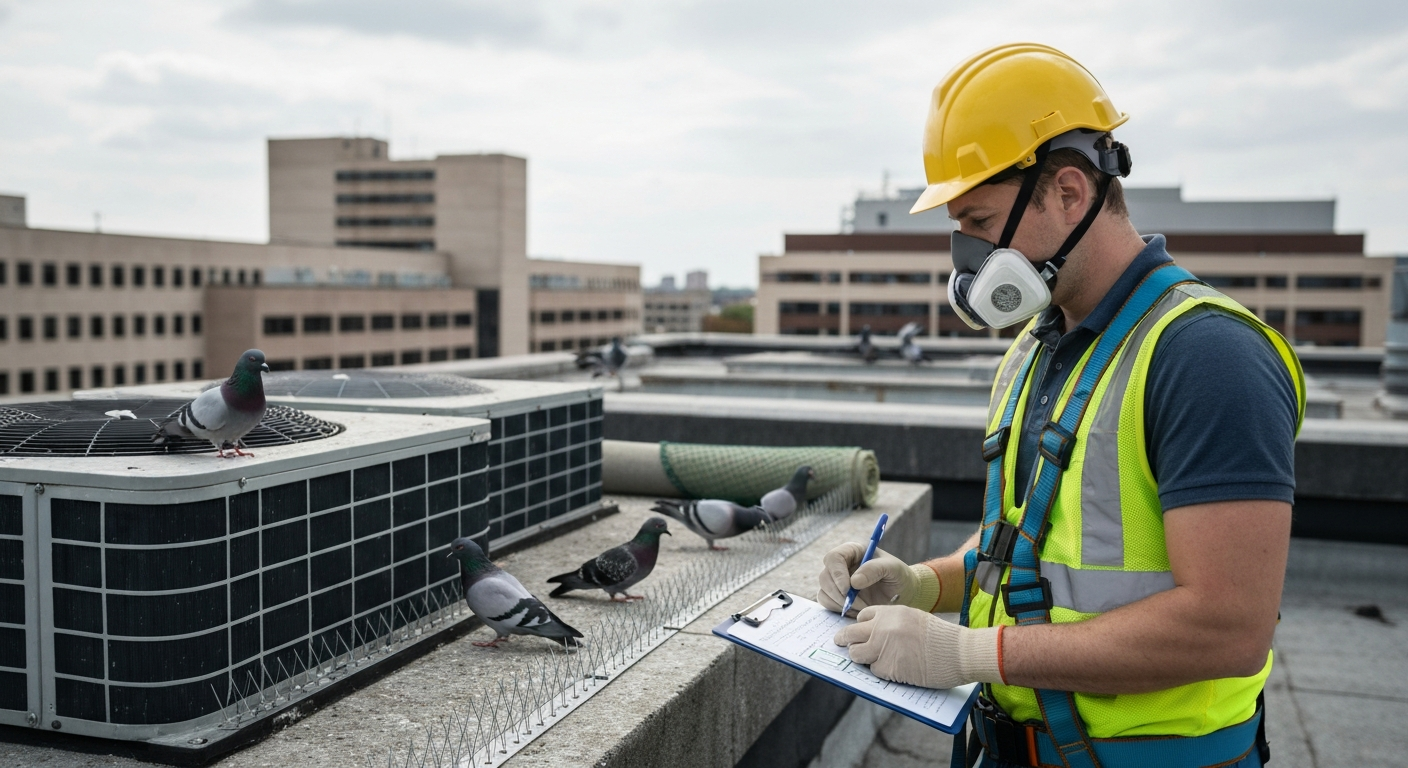
What a bird removal technician actually does
The core job covers four interlocking responsibilities: assessment, removal or exclusion, abatement (long-term deterrence), and follow-up monitoring. Assessment means identifying the species involved, the scale of the problem, the physical site conditions, and the applicable legal constraints before any action is taken. Removal or exclusion means physically separating birds from a structure or area using methods that range from netting and spike systems to pyrotechnic dispersal and, in specific legally permitted situations, lethal control. Abatement means making the site less attractive or accessible so the problem does not simply return a week later. Monitoring means revisiting the site, documenting outcomes, and adjusting the approach based on what the data show.
A competent technician treats these four phases as a cycle, not a one-time visit. Property managers sometimes expect a single treatment to solve a roosting problem permanently. The reality is that bird pressure on a site is dynamic, and the most durable results come from technicians who combine physical exclusion with habitat modification and who return to verify that the measures are holding. This is also why the role overlaps significantly with what the industry calls bird abatement, a broader, often contract-based service focused on preventing birds from establishing in the first place.
On-site workflow: from first inspection to follow-up
The workflow on a typical job follows a structured sequence. Before any tools come out, the technician conducts a site inspection to document species, flock size, roosting and nesting locations, food and water sources, and any existing deterrents. This is not a quick walk-around. At an airport or a large commercial property, a thorough inspection can take several hours and involves mapping attractants, measuring standoff distances, and photographing harborage sites. The inspection directly informs the risk assessment, which determines which methods are legally and practically appropriate.
- Species identification and flock size documentation
- Mapping of roosting, nesting, and feeding locations on site
- Identification of attractants: food sources, standing water, favorable microclimates
- Review of applicable federal, state, and local legal constraints for the species present
- Selection and installation of exclusion or deterrent measures
- Client briefing on what was done, why, and what to expect
- Scheduled follow-up inspections to assess effectiveness and make adjustments
- Record-keeping and, where required, regulatory reporting
The exclusion phase is where most of the hands-on labor happens. Netting a loading dock, installing stainless steel bird spikes on parapet ledges, or setting up optical gel on HVAC equipment requires working at height, using power tools, and handling materials that must be installed correctly to remain effective. A poorly tensioned net or an incorrectly sized spike strip is not just ineffective; it can trap birds, creating both welfare and legal problems for the property owner.
Training, certifications, and credentials worth verifying
There is no single mandatory federal license for bird removal technicians in the United States, which means the quality gap between operators is substantial. That said, several credential pathways signal genuine competence and commitment to legal compliance. The National Wildlife Control Operators Association (NWCOA) offers the Certified Wildlife Control Professional (CWCP) credential, which requires passing modular exams, demonstrating field hours, and completing continuing education units. The Internet Center for Wildlife Damage Management and the National Wildlife Control Training Program both provide curricula that align with state extension systems and include modules on bird biology, damage assessment, legal requirements, and integrated pest management principles.
For technicians who use restricted-use avicides such as DRC-1339 (Starlicide), a state commercial pesticide applicator license is not optional. Pesticide Applicator Certification and Licensing (NC State Extension) explains that restricted-use pesticides and avicides typically require a state commercial or public applicator license and supervised applicator rules. The EPA registers DRC-1339 with strict label requirements governing who may apply it, in what quantities, under what site conditions, and with what PPE. States enforce these requirements through their own certification schemes, and a technician using a restricted pesticide without the appropriate state applicator license is violating federal and state law simultaneously. When hiring a technician who mentions chemical control as a possible method, asking to see their pesticide applicator license is entirely reasonable.
At airports, the FAA adds another layer. Advisory Circular 150/5200-36B specifies qualifications and training curricula for wildlife personnel working under a Wildlife Hazard Management Plan (WHMP). Airport wildlife technicians are typically required to demonstrate species identification competency, familiarity with FAA reporting procedures, and training in the specific dispersal and lethal control methods authorized under their airport's plan. This is a distinct credentialing pathway that most non-aviation technicians do not hold.
The legal landscape: what technicians can and cannot do
The Migratory Bird Treaty Act (16 U.S.C. § 703) is the foundational constraint every technician must understand. It makes it unlawful to take, possess, kill, or attempt to take any migratory bird, their eggs, or active nests without federal authorization. 'Take' is defined broadly, and the list of protected species is extensive. Most of the birds that cause property damage, including starlings, house sparrows, and pigeons, are not protected under the MBTA, but a significant number of common nuisance species are, including Canada geese, double-crested cormorants, and virtually all songbirds. Disturbing an active nest of a protected species, even one you consider a nuisance, can constitute a federal violation.
The USFWS Migratory Bird Permitting Handbook and the Depredation Permit program under 50 CFR Part 21 define the pathway for authorized lethal or handling activities involving protected species. Obtaining a depredation permit requires documenting prior non-lethal attempts, specifying the species and numbers involved, and accepting reporting obligations for any birds taken. The permit is not a blanket authorization. It is species-specific, site-specific, and time-limited. Technicians who offer depredation-authorized services should be able to show current permits on request.
The Endangered Species Act adds a second statutory layer. If a removal action might affect a listed species or its critical habitat, Sections 7 and 10 of the ESA require consultation with USFWS before proceeding. See The Endangered Species Act: Overview and Implementation | U.S. Fish & Wildlife Service for USFWS guidance on Sections 7 and 10 consultation requirements and incidental-take permitting. Incidental take permits or formal Biological Opinions may be required. This scenario is uncommon in routine urban bird removal, but it arises more often than most people expect at coastal facilities, wetland-adjacent airports, and agricultural properties in certain regions.
State and local law compounds this further. New York's DEC, Texas Parks and Wildlife, and California's CDFW each maintain their own depredation and nuisance permit systems with species lists, seasonal restrictions, and procedural requirements that may be more stringent than federal minimums. Some states explicitly prohibit relocation of certain species. Municipal codes add noise ordinances that restrict pyrotechnic use, and some jurisdictions have specific rules governing who may respond to injured birds versus nuisance birds. The legal research for any technician operating across multiple states is genuinely complex.
How bird removal technicians differ from animal control, wildlife rehabilitators, and pest services
These roles sound similar but they serve fundamentally different functions, and calling the wrong one wastes time and may make the situation worse. Animal control agencies deal primarily with domestic animals and immediate public safety threats. Their mandate generally does not extend to wild bird management, and most municipal animal control officers are not trained in bird biology, exclusion installation, or permit applications for migratory species. If you’re asking “does animal control remove bird nests,” the short answer is usually no, municipal animal control typically does not handle wild bird nests and will refer you to wildlife specialists or licensed bird removal technicians. If you call animal control about a Canada goose flock damaging a park, you will likely be referred elsewhere.
Wildlife rehabilitators specialize in the care of injured or orphaned wild animals with the goal of returning them to the wild. Their work is covered by separate permit categories and is focused on individual animal welfare, not population-level damage management. A rehabilitator is the right call for a single injured bird found on a property. They are not equipped for a flock dispersal job and typically are not permitted to conduct damage management activities.
General pest control operators are trained primarily for insect and rodent management. Some larger pest control companies have wildlife divisions with trained bird technicians, but the credential and legal requirements for bird work are distinct from general pest licensing. A company offering bird removal should be able to demonstrate the specific training and permits that work requires, separate from their rodent or insect credentials.
| Role | Primary Focus | Handles Wild Bird Damage? | Holds Bird-Specific Permits? | Physical Exclusion/Abatement? |
|---|---|---|---|---|
| Bird Removal Technician | Bird hazard management, exclusion, abatement | Yes, specifically | Yes (federal/state depredation, pesticide applicator) | Yes, core service |
| Animal Control Officer | Domestic animals, immediate public safety | Rarely, not primary mandate | Generally no | No |
| Wildlife Rehabilitator | Injured/orphaned individual animals | Injured birds only | Rehabilitation permits, not damage management | No |
| General Pest Control Operator | Insects, rodents, structural pests | Sometimes, if wildlife-certified division | Only if specifically credentialed | Sometimes |
| USDA APHIS Wildlife Services | Federal wildlife damage management | Yes, especially large-scale/aviation | Yes, federal authority | Yes, large-scale operations |
Non-lethal methods and tools technicians commonly use
The USDA APHIS Wildlife Services Bird Dispersal Techniques manual is the most comprehensive operational reference for this, and it makes clear that integrated, non-lethal approaches are the professional standard for most situations. See the section on how is big bird control for practical approaches and case examples. The methods below represent the practical toolkit of a working technician, and most jobs use several of them in combination.
- Physical exclusion: netting, bird spikes, electric track systems, wire systems, and sloped ledge modifications that prevent landing or roosting without harming birds
- Bioacoustic deterrents: broadcast of species-specific distress calls and predator calls to discourage roosting; effective as part of an integrated approach but less effective when used alone over time
- Visual deterrents: laser devices, reflective tape, predator decoys, and optical gel; efficacy varies significantly by species and site
- Pyrotechnic dispersal: propane cannons, shell crackers, and screamer sirens used to actively haze birds from an area; requires noise ordinance compliance and repeated application to condition birds to avoid the site
- Trained falconry and raptor dispersal: live falcons or hawks flown by licensed falconers create genuine predator pressure that birds recognize and respond to; used at airports, landfills, and agricultural sites
- Habitat modification: removing food sources (securing waste bins, eliminating standing water, modifying vegetation), altering lighting, and reducing structural harborage points
- Repellent gels and coatings: tactile deterrents applied to surfaces; appropriate for targeted ledge treatment but not large open areas
- Population management under permit: egg oiling or egg addling for Canada geese and other species under federal depredation authorization; prevents recruitment without removing adults
The reality is that no single tool works indefinitely for every species. Pigeons habituate to sound-based deterrents faster than many people expect. Visual deterrents that are not moved or varied lose effectiveness within weeks. Professional technicians design layered programs where multiple methods reinforce each other, and they adjust based on monitoring data. A technician who recommends a single spike strip installation as a complete solution to a serious roosting problem is underselling what the problem requires.
When lethal control is considered: the legal and ethical framework
Lethal control is not the default, and for most bird removal jobs it is never used. It comes into consideration when non-lethal methods have been documented as insufficient, when population size poses a significant public health or safety risk, and when the species involved is not protected under the MBTA or when a depredation permit has been obtained. The most common lethal methods in professional practice include the use of DRC-1339 (registered with the EPA, restricted use, applied only by licensed applicators in authorized site types), CO2 trapping for feral pigeons and European starlings, and, at airports under USDA APHIS Wildlife Services authority, shooting.
The depredation permit requirement from USFWS is not a formality. The application requires documented evidence that non-lethal alternatives were attempted and found inadequate, specifics on the nature and extent of damage, and agreement to report the number of birds taken under the permit. Technicians who skip this step and lethally remove protected species are exposed to substantial federal penalties. The ethical dimension is equally important: professional standards in the industry, including those articulated by NWCOA, frame lethal control as a last resort, not a first response, and legitimate technicians approach it that way.
Safety, PPE, and biosecurity for technicians and property owners
Bird removal work carries real occupational health risks that are underappreciated by clients and sometimes by inexperienced technicians. Bird droppings can harbor Histoplasma capsulatum (the fungal pathogen behind histoplasmosis), Cryptococcus neoformans, Chlamydia psittaci (causing psittacosis), and Salmonella, among other pathogens. Dry fecal material disturbed during exclusion work becomes aerosolized. Work in confined spaces with accumulated guano, such as attic voids or HVAC housings with heavy roost deposits, carries significant inhalation exposure risk.
- N95 or P100 respirator (minimum) for any work involving dry fecal accumulation; powered air-purifying respirators for confined space or heavy accumulation work
- Disposable Tyvek coveralls and gloves to prevent dermal contact and cross-contamination
- Eye protection when working in areas with overhead deposits or during active bird presence
- Decontamination procedures before leaving the worksite to prevent tracking pathogens offsite
- Property owners and bystanders should be kept clear of the work zone during active cleanup and exclusion
- Post-work disinfection of the treated area using EPA-registered disinfectants appropriate for bird-associated pathogens
- Technicians using pyrotechnic devices must comply with ATF regulations governing pyrotechnic acquisition and storage
Property owners sometimes want to observe or assist with the work. This is understandable, but the right answer is to stay back and let the technician control the worksite. Biosecurity protocols exist for a reason, and a client who wanders into an active cleanup wearing street clothes creates a liability and a health exposure problem simultaneously.
Situations that actually warrant calling a technician
Not every bird on a building is a problem that requires professional intervention. A pair of robins nesting near a window is a seasonal inconvenience. The situations below represent genuine scenarios where a trained technician is the appropriate response, either because of scale, safety risk, legal complexity, or the potential for the problem to escalate.
- Large roosting flocks of starlings, pigeons, or grackles on commercial buildings with significant guano accumulation posing slip, contamination, or structural corrosion risks
- Canada geese establishing nesting territories in high-traffic areas near roads, parking lots, or pedestrian paths where aggressive behavior creates injury risk
- Nesting birds blocking or fouling HVAC equipment, exhaust vents, or electrical enclosures in commercial or industrial facilities
- Bird activity at or near airport runway safety areas or approach paths that creates wildlife strike risk to aircraft
- Large bird carcass accumulations, which may indicate disease, require biosafe disposal, and may trigger regulatory notification obligations
- Protected species nesting in locations where construction or maintenance work must proceed under an authorized take permit
- Recurring bird intrusion into food processing, healthcare, or pharmaceutical facilities where contamination compliance is non-negotiable
- Agricultural settings with documented crop or livestock damage from depredating species at sufficient scale to justify a permitted management program
How bird removal technicians reduce aviation bird-strike risk
Bird strikes are not rare. The FAA's National Wildlife Strike Database records tens of thousands of wildlife strikes annually in the United States, with birds accounting for the large majority. The economic and safety consequences of bird strikes range from minor airframe damage to events that cause hull loss and fatalities. For examples of how large, conspicuous birds have entered public discussion about accidents, see coverage under the topic 'Sesame Street Big Bird causes accidents'. See big bird causes accidents for detailed cases and data on how large birds contribute to aircraft accidents. Technicians working at airports operate under a specific regulatory framework: FAA Advisory Circular 150/5200-33B defines hazardous wildlife attractants on or near airports, and AC 150/5200-36B specifies training and qualification standards for wildlife personnel under an airport's Wildlife Hazard Management Plan (WHMP).
At airports, the technician's role expands beyond reactive removal. It includes habitat modification to make airfield grasslands less attractive to gulls, raptors, and waterfowl; active hazing operations during high-risk periods such as migration seasons; coordination with USDA APHIS Wildlife Services for depredation activities that exceed the airport's own authority; and systematic data collection to feed into ICAO's International Bird Strike Information System (IBIS) and FAA strike reporting. ACRP research (including ACRP Reports 125 and 145) has established that integrated habitat management combined with active dispersal programs achieves the most sustained reductions in strike risk, and this is the evidence base technicians at aviation facilities work from.
The large birds that cause the most severe strikes, including Canada geese, vultures, herons, and large gulls, are precisely the species that require the most careful legal navigation. All of them are MBTA-protected, and effective management requires both FAA coordination and valid federal permits. This is not a job for a general pest technician who happens to have a bird spike catalog.
What to expect: timelines, outcomes, and realistic success rates
Clients should approach bird removal with realistic expectations calibrated to the specific problem. Physical exclusion of a well-defined roosting site, such as netting a covered loading dock or installing spikes on a parapet ledge, can produce durable results within days of installation if the work is done correctly. The birds lose access to the roost site and disperse. Problems arise when the exclusion is incomplete (birds find gaps), when the site offers multiple harborage points that are addressed one at a time, or when the attractant (a food source, a water feature, a warm exhaust) is not addressed alongside the roosting surface.
Population-level dispersal programs take longer. Hazing a goose population from an airport or golf course requires consistent pressure over multiple weeks during the appropriate seasonal window, combined with habitat modification, to shift the birds' movement patterns. Results are measurable but not permanent without ongoing management. Egg addling programs for Canada geese typically require two to three seasons before population-level effects become pronounced. Clients who expect one visit to eliminate a chronic problem are usually disappointed; clients who understand they are entering a monitoring and management relationship get better outcomes.
Costs, pricing models, and what drives estimates
Bird removal pricing is highly variable because the cost drivers are highly variable. A straightforward residential job, such as excluding pigeons from a single rooftop section, might run a few hundred dollars for inspection plus material and labor. A complex commercial job involving netting a multi-level parking structure, installing electric track systems on ornamental facades, and follow-up hazing can run into tens of thousands of dollars. Airport wildlife management programs are typically ongoing contracts with annual costs in the six-figure range for major commercial airports.
| Cost Factor | Lower Cost Scenario | Higher Cost Scenario |
|---|---|---|
| Site complexity | Single structure, accessible, defined harborage | Multi-building campus, difficult access, distributed harborage |
| Species involved | Unprotected species (pigeons, starlings) without permit needs | MBTA-protected species requiring depredation permits and reporting |
| Methods required | Spike installation, netting on discrete surfaces | Integrated program: exclusion + hazing + habitat modification + monitoring |
| Permit and compliance requirements | No permits required | Federal and state depredation permits, EPA-licensed pesticide application |
| Follow-up and monitoring | Single treatment, no follow-up contract | Long-term monitoring contract with scheduled revisits and data reporting |
| Biosafety requirements | Minor accumulation, standard PPE | Heavy guano accumulation requiring full hazmat-level remediation |
It depends on your situation, but the strongest predictor of total cost is usually the scope of harborage and the number of attractants on the site. Properties with complex rooflines, active food sources, and water features near the harborage cost more to treat durably because the underlying attractants have to be addressed alongside the physical exclusion. Getting competing quotes is reasonable, but focus on the scope of the proposed work rather than just the price. A cheaper quote that addresses only one component of a multi-factor problem is not a bargain.
Record-keeping, reporting, and compliance obligations
Professional technicians maintain records as a matter of both legal compliance and good practice. USFWS depredation permits require reporting of the number and species of birds taken under authorization. Pesticide applications must be documented in accordance with EPA and state applicator requirements, including product name, application site, rate, date, and applicator name. FAA wildlife strike reports are required for any strike or near-miss at certificated airports. At the state level, nuisance and depredation permit conditions vary but commonly include similar take-reporting requirements.
Beyond regulatory minimums, well-run bird management programs maintain site visit logs, photographic documentation of before and after conditions, monitoring data on flock presence and behavior, and maintenance records for exclusion hardware. This documentation serves multiple purposes: it demonstrates due diligence if a compliance question arises, it provides the data needed to assess whether the program is working, and it supports renewal applications for permits. Property managers should ask for copies of relevant documentation as part of any service agreement.
Long-term prevention strategies for property managers, pet owners, and facilities
The most cost-effective bird management is the management that prevents the problem from establishing in the first place. For property managers, this means treating bird prevention as a routine maintenance consideration rather than a reactive emergency. Buildings with secure waste enclosures, maintained roof drainage systems that do not create standing water, and prompt attention to new harborage points (a broken vent cover, a new gap in soffit material) are dramatically less likely to develop serious roosting problems than those where these issues are allowed to accumulate.
For pet owners, the relevant prevention concerns are different. Outdoor cats and dogs are vulnerable to injury from large birds of prey in certain regions, and this risk is real but highly context-dependent. Backyard bird feeders attract passerine species but also attract the raptors that prey on them, and in rare cases, on very small pets. The practical guidance here is not to stop using feeders but to supervise small pets outdoors in areas with known raptor activity, particularly during active hunting periods at dawn and dusk.
For facilities with ongoing bird pressure, such as food processing plants, airports, and large commercial properties, the evidence consistently supports moving from reactive treatment to a managed program with scheduled inspections, documented monitoring, and a standing relationship with a qualified technician who knows the site. Prevention programs cost less over time than repeated emergency interventions.
When to escalate: wildlife agencies, federal regulators, and specialized responders
Most bird removal situations are handled entirely at the private technician level. Escalation to wildlife agencies or federal regulators is warranted in specific circumstances. If a removal action involves or may involve a listed species under the Endangered Species Act, USFWS consultation under Sections 7 or 10 is not optional. If a problem exceeds the scope of what a private depredation permit covers, USDA APHIS Wildlife Services can be engaged directly, particularly for large-scale agricultural depredation or aviation situations requiring sustained operational support. State wildlife agencies handle depredation cases involving state-protected species and serve as the first escalation point for most permit disputes.
Disease is a separate escalation trigger. If you are dealing with a large unexplained bird mortality event, the appropriate response is to contact your state wildlife agency and potentially USGS National Wildlife Health Center, not a bird removal technician. Investigating the cause of mass mortality, particularly for avian influenza or Newcastle disease, requires diagnostic capacity and regulatory authority that private technicians do not hold. The bird removal technician's role is management, not disease investigation.
How researchers and aviation professionals can work with technicians
Bird removal technicians are often underutilized as data sources by the research and aviation communities. A technician who works a specific airport or agricultural region over multiple years accumulates substantial observational data on species composition, seasonal movement patterns, flock behavior, and the relative effectiveness of different management approaches. This data rarely enters the scientific literature, but it is exactly the kind of ground-level ecological information that complements aerial survey and strike database analysis.
ACRP research has repeatedly identified structured data sharing between airport wildlife personnel, FAA, and USDA APHIS as one of the highest-value investments an airport can make in its wildlife hazard program. Researchers working on bird strike risk models, migration corridor mapping, or deterrent efficacy studies can benefit from establishing formal data-sharing agreements with technicians at relevant sites. This typically requires coordination with the airport's WHMP coordinator and alignment with ICAO IBIS reporting protocols, but the methodological payoff is real. Technicians, in turn, benefit from access to strike probability data and species distribution models that help them prioritize their hazing and exclusion efforts.
Choosing a qualified bird removal technician: what to verify
The absence of a single mandatory federal license means that the burden of vetting falls on the client. Here is a practical checklist of what to verify before hiring.
- Ask for a copy of any current USFWS depredation permits if the work may involve protected migratory species
- Verify their state pesticide applicator license if chemical deterrents or avicides are part of the proposed approach
- Check for NWCOA Certified Wildlife Control Professional (CWCP) credential or equivalent professional certification with documented continuing education
- For airport work, confirm FAA-aligned training consistent with AC 150/5200-36B and experience with Wildlife Hazard Management Plan programs
- Ask for references from comparable jobs (similar species, similar site type) and follow up on them
- Request a written scope of work that specifies which methods will be used, the legal basis for any activities involving protected species, and what follow-up is included
- Ask how they document outcomes and what records they will provide to you at the end of the engagement
- Confirm they carry general liability insurance and, if applicable, workers' compensation coverage
Red flags include any technician who guarantees permanent elimination of birds from a site without an ongoing monitoring component, any company that proposes lethal control of migratory birds without showing you a current depredation permit, any operator who cannot name the specific federal and state legal requirements applicable to your situation, and any quote that is dramatically below competitors without a clear explanation of scope differences. Legitimate bird removal is skilled, regulated, and evidence-based work. The professionals who do it well are not the cheapest option, and they should not be.
FAQ
What legal statutes and federal regulations must be researched to define the lawful limits on a bird removal technician’s activities?
Identify and cite primary statutes and implementing regulations: Migratory Bird Treaty Act (16 U.S.C. §703) and 50 CFR provisions; Endangered Species Act (ESA) sections relevant to take/incidental take and consultation (Sections 7 and 10); EPA pesticide/avicide registrations and labels (e.g., DRC‑1339/Starlicide) and Federal Insecticide, Fungicide, and Rodenticide Act (FIFRA) implications; and the Federal Aviation Administration (FAA) advisory circulars that affect airport operations. Use federal code, agency guidance documents, permit handbooks, and product master labels as primary legal sources.
Which federal agency guidance and permit handbooks are essential to explain what technicians may do under federal permits?
Consult the U.S. Fish & Wildlife Service (USFWS) Migratory Bird Permitting Handbook and USFWS permit webpages (depredation permits, rehabilitation, scientific permits); USDA APHIS Wildlife Services (WS) national directives and technical series (e.g., Bird Dispersal Techniques); and USFWS/DOI policy memos on migratory‑bird enforcement and permitting. These provide permit categories, application requirements, documentation standards, and allowed actions under federal authorization.
What state‑ and local‑level authorities and documents must be reviewed to cover jurisdictional variations and technician compliance obligations?
Compile relevant state wildlife agency statutes/regulations and depredation or nuisance permit pages (examples: NY DEC, Texas Parks & Wildlife, CA CDFW), state pesticide applicator certification rules, and municipal animal‑control codes/ordinances (noise, pyrotechnics, handling of wildlife). Research must be jurisdiction‑specific because states and municipalities commonly add species‑ or season‑specific restrictions, relocation bans, or unique permit procedures.
What aviation and airport‑specific sources are required to accurately describe technician roles, training, escalation, and risk‑reduction at aerodromes?
Use FAA Advisory Circulars (e.g., AC 150/5200‑33B, AC 150/5200‑36B), Airport Cooperative Research Program (ACRP/TRB) reports (best practices, costs, WHMPs), and ICAO materials (Doc 9137, Doc 9332, Annex 14) for international standards. These sources define airport wildlife personnel qualifications, WHMP curricula, hazardous attractant controls, reporting requirements, and criteria for interagency escalation.
Which operational and technical sources document methods, tools, efficacy, and welfare considerations for bird dispersal and removal?
Consult USDA APHIS‑WS technical series (Bird Dispersal Techniques and related WDM manuals), peer‑reviewed literature on deterrents/attraction/habitat modification and efficacy studies (pyrotechnics, bioacoustics, falconry, dogs, netting, exclusion, limited lethal), and manufacturer technical data sheets for devices (sound cannons, lasers, net guns). These provide evidence‑based effectiveness, limitations, recommended integration of techniques, and welfare/human‑safety notes.
What research questions should be asked about training, certification, and professional competency standards for technicians?
Determine which certification programs exist (NWCOA Certified Wildlife Control Professional, state Nuisance Wildlife Operator programs, national training curricula like ICWDM or NWCTP); ask about required course topics, minimum hours, exam/CEU requirements, ethics codes, and recognized airport WHM training. Source curricula, certification standards, course syllabi, and program handbooks to define baseline competencies.