The shoebill is a genuinely formidable bird capable of injuring an adult human, killing small pets, and posing a non-trivial aircraft strike hazard. That said, unprovoked attacks on people are essentially unheard of in the documented literature. The reality is that shoebills are solitary, slow-moving ambush predators built to ambush fish, not to pursue people. Their danger profile is real but narrow: they become aggressive mainly when their nest is approached, when two males are housed together in captivity, or when an inexperienced handler gets too close to that enormous hooked bill. Treat them the way a responsible zoo professional does and the risk is very manageable. Ignore what they are capable of and you may find out the hard way.
Is Shoebill Bird Dangerous? Risk, Incidents, Safety Guide

Marcus Whitmore
11 Aug 2026
What exactly is a shoebill? Size, weight, and that beak
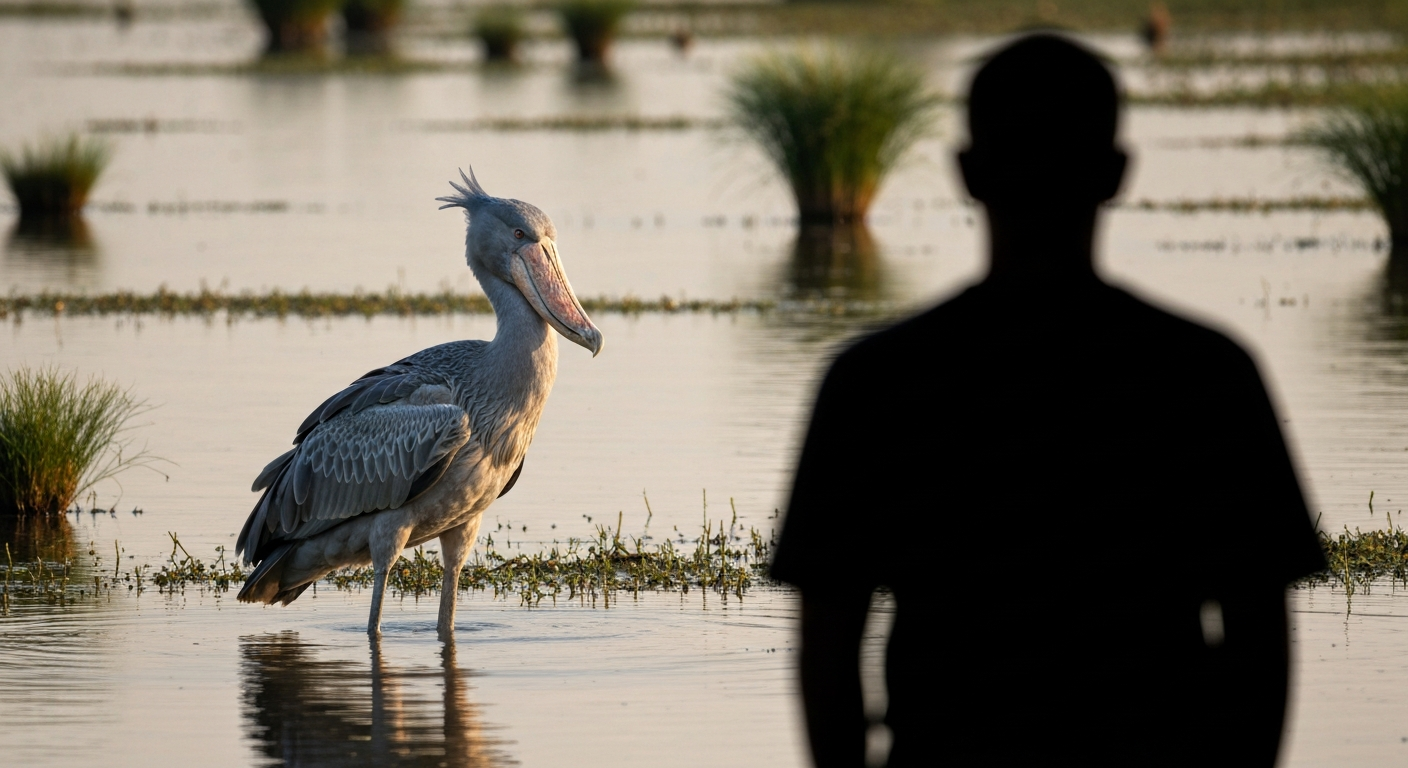
The shoebill (Balaeniceps rex) is a large wading bird native to the tropical freshwater swamps of central and east Africa, particularly the Sudd in South Sudan and the papyrus marshes of Uganda and Zambia. Adults typically measure 100 to 140 cm in total body length and stand roughly 110 to 150 cm tall, which puts them eye-to-eye with a short adult human. Adult shoebills: total length ~100–140 cm, standing height ~110–150 cm, wingspan ~230–260 cm, body mass ~4–7 kg Adult shoebills: total length ~100–140 cm, standing height ~110–150 cm, wingspan ~230–260 cm, body mass ~4–7 kg.. The wingspan runs 230 to 260 cm (roughly 7.5 to 8.5 feet) and body mass is generally reported at 4 to 7 kg (about 8.8 to 15.4 pounds). Females are slightly smaller on average, but not by much.
The defining feature is the bill. At roughly 20 to 25 cm long (published field-guide values cluster around 23 to 24 cm), it is one of the widest, deepest bills of any living bird relative to overall body size. The entire structure ends in a sharp, laterally hooked nail that functions like a grappling hook during prey strikes. Finite-element photogrammetry work published as early as 1985 (Guillet, Doyle and Rüther) confirmed the bill is structurally robust, designed to absorb repeated high-impact strike loads. It is not a delicate probing instrument. It is a weapon adapted for seizing and subduing large, struggling prey.
| Measurement | Reported Range | Comparison Point |
|---|---|---|
| Total body length | 100–140 cm | Comparable to a large great blue heron |
| Standing height | 110–150 cm | Eye level with many adult humans |
| Wingspan | 230–260 cm (7.5–8.5 ft) | Similar to a small golden eagle wingspan |
| Body mass | 4–7 kg (8.8–15.4 lb) | Heavier than a domestic cat |
| Bill length | ~20–25 cm (≈23–24 cm typical) | Longer than a standard ruler |
How the shoebill actually hunts and feeds
Shoebills are piscivores at their core, with a strong preference for large fish: marbled African lungfish, tilapia, and catfish are staples, often ranging 15 to 50 cm in length. The hunting strategy is a prolonged, motionless wait in shallow, oxygen-poor water where prey surface to breathe, followed by an explosive lunge forward known as the 'collapse strike.' An anatomical study by a University of Tokyo team (Japanese Journal of Zoo and Wildlife Medicine, 2014) used CT imaging to document an enlarged, asymmetrical pharynx and hyoid apparatus that allows the bird to swallow remarkably large prey items whole. Beyond fish, shoebills have documented records of taking water snakes, monitor lizards, bichir, and juvenile crocodiles.
The practical takeaway from the feeding ecology is this: a bird routinely overpowering juvenile crocodiles and 50-cm lungfish has the physical equipment to cause serious injury to human skin, soft tissue, and small-to-medium domestic animals. Whether it chooses to do so is a separate question, and that depends heavily on context.
What actually triggers aggression in shoebills
Shoebills are not naturally aggressive toward humans in the way a territorial raptor might be, but they have clear and predictable triggers. Understanding those triggers is the difference between a safe encounter and an injury.
- Nest intrusion: approaching an active nest is the most reliable way to provoke a defensive response. Both sexes become highly agitated and may advance toward or strike at perceived intruders.
- Male-to-male proximity in captivity: captive behavior studies published in Animal Keepers' Forum (2007) report that bill-clattering (the dominant aggressive social display) and overt aggressive behavior are significantly more frequent in males, particularly when housed in close proximity to one another.
- Feeding disruption: interrupting the bird during or immediately after a strike can trigger a redirect response, especially in captivity where the bird cannot simply move away.
- Habituation to humans: paradoxically, zoo-raised birds that have been hand-reared or extensively habituated may be more unpredictable than wild birds because they have lost normal avoidance of humans. Wild shoebills in Uganda are frequently noted by ecotourists for their unusual tolerance of human proximity, but that stillness should not be mistaken for submission.
- Breeding season: hormonal changes during breeding elevate baseline irritability; captive husbandry guidelines consistently recommend increased caution and reduced close-contact handling during this period.
Bill-clattering deserves a specific note. It looks like a display, and it is, but it is also a warning. Repeated, rapid bill-clattering directed at a person or another bird is a reliable pre-aggression signal. Any keeper or field researcher who sees that and continues to close the distance is ignoring a clear communication.
What the documented incident record actually shows
This is where I need to be honest about the limits of the evidence. Systematic searches of indexed zoo, husbandry, and clinical literature do not turn up peer-reviewed hospital case reports or published epidemiological case series attributing severe human injury to shoebill attacks. There are no documented trauma admissions in the clinical literature, no bite-force studies measuring actual strike force in Newtons or PSI on living birds. The International Zoo Yearbook management and husbandry guidelines treat the species as capable of inflicting wounds and requiring strict keeper protocols, but that is precautionary professional guidance based on the bird's anatomy and captive behavior observations, not a response to a documented pattern of serious human injuries.
The reporting gap matters here. The vast majority of the world's wild shoebills live in remote, politically unstable wetland habitats. If a local fisherman or research technician received a serious injury from a defensive shoebill, that incident is unlikely to reach indexed clinical journals. Absence of a published case series does not mean absence of incidents. It means we have limited systematic data. The practical takeaway: the risk is real and consistent with the bird's anatomy and documented behavior, even though the human-injury case record is thin.
Risk to humans: who is actually at risk and how much
The risk profile differs substantially depending on how close you get to a shoebill and why. A casual visitor watching from a viewing platform at Mabamba Swamp in Uganda is not meaningfully at risk. A field researcher wading toward a nest to band chicks is at meaningful risk. A zookeeper doing a voluntary health check in a shared enclosure without protective equipment is at the highest risk of any non-adversarial encounter.
| Person / Context | Risk Level | Primary Hazard | Recommended Precaution |
|---|---|---|---|
| Tourist viewing from safe distance (>10 m) | Very low | Essentially none if space is respected | Maintain distance; do not attempt to touch or feed |
| Ecotourist in guided boat (Uganda/Zambia) | Low | Possible defensive response if boat intrudes too close | Follow guide instructions; avoid nesting areas |
| Field researcher near nest | Moderate | Bill strike, wing strike during nest defense | Protective eyewear, thick gloves, partner system |
| Zoo / wildlife park visitor (viewing enclosure) | Very low | Barrier-separated; institutional protocols reduce risk | Follow all posted visitor guidelines |
| Zookeeper / husbandry professional | Moderate to high (proximity-dependent) | Bill puncture, laceration from hooked nail | Full keeper protocols: protective gear, two-person handling, no solo entry to enclosure during breeding season |
| Wildlife researcher handling or banding birds | High (handling contact) | Bill puncture, laceration, potential fracture of finger bones from strike | Rigid hand and forearm protection, experienced partner, minimize handling time |
First aid if you are injured
If a shoebill bill strike does cause a wound, treat it the same way emergency medicine guidelines recommend treating any large-bird bite. Clean the wound immediately and thoroughly with soap and water or an antiseptic solution. Assess tetanus status per your local public health guidance and update if needed. Because bird bites carry a risk of infection from Gram-negative and avian-associated bacteria, a short course of prophylactic antibiotics (amoxicillin-clavulanate is commonly cited in emergency-medicine reviews of bird bites) is worth discussing promptly with a physician, especially for puncture wounds that are difficult to irrigate fully. One thing you do not need to worry about: rabies. Rabies is a mammalian disease; birds do not transmit it, per CDC guidance.
Risk to pets and livestock
This section is straightforward biology: a bird that routinely subdues prey items 15 to 50 cm long, including juvenile crocodiles, can absolutely kill and attempt to swallow small domestic pets. Small dogs, cats, poultry, rabbits, and similarly sized animals in the same space as a shoebill should be considered at genuine risk, particularly if the bird is hungry or agitated. The feeding-mechanics literature (the University of Tokyo CT study) explicitly confirms the shoebill's pharyngeal anatomy can accommodate very large prey items. A chicken or a small rabbit is, anatomically speaking, well within that range.
For livestock, the practical concern centers on poultry. A shoebill given access to a free-range flock would likely predate individual birds. Larger livestock (goats, sheep, adult dogs) are not realistically at risk of predation but could be injured by a defensive strike if they cornered or startled the bird. The relevant precaution in any context where shoebills and small animals share space is simple: they should not share space without a secure, well-maintained barrier.
It is also worth noting the legal dimension here. Keeping a shoebill as a pet is restricted or prohibited in most countries because the species is listed as Vulnerable on the IUCN Red List and is protected under CITES Appendix II. The very small number of shoebills in institutional care globally (the propagation challenges documented at Tampa's Lowry Park Zoo in the International Zoo Yearbook illustrate how difficult captive management is) means private ownership is both legally fraught and practically dangerous to both the animal and any other animals or people in the home.
Aviation risk: what a 4 to 7 kg bird means for aircraft
Aviation professionals sometimes ask about specific species' birdstrike risk, and the shoebill is occasionally flagged because of its size. The honest answer is that the shoebill is not a meaningful operational aviation hazard for the simple reason that its range (central African wetlands) has very little overlap with high-traffic commercial aviation corridors or with airports handling large aircraft. But the physics question is worth addressing clearly for anyone doing regional risk assessments or academic birdstrike modeling.
Aircraft certification standards (CS-25 / FAR Part 25) use specific bird mass values for impact testing: typically 0.9 kg for small aircraft windshields, 1.8 kg for transport-category windshield and airframe tests, and up to 3.6 kg for some empennage certification impacts. A shoebill weighing 4 to 7 kg exceeds all of these standard test values. FAA/USDA National Wildlife Strike Database analyses (Dolbeer and colleagues) consistently show a strong positive correlation between bird mean body mass and the probability and severity of aircraft structural damage. A shoebill-mass bird striking a windshield, engine intake, or empennage at high relative airspeed would fall into the mass class associated with a non-trivial probability of structural damage or engine failure.
In practice, the flight behavior of shoebills also matters. They tend to fly at low altitudes over wetlands, with slow, deliberate wingbeats, and are not colonial or migratory in ways that create concentrated flocks. They are unlikely to be at the altitudes or in the concentrated numbers that maximize birdstrike risk at airports. But for low-altitude bush aircraft, float planes, and survey aircraft operating over the Sudd or Ugandan wetlands, the species' mass means a strike would not be a trivial event. Local pilots and aviation safety officers operating in those specific geographic areas should include large wading birds in their wildlife strike briefings.
How the shoebill compares to other species people ask about
People often want context when assessing an unfamiliar species. For a direct comparison with a common domestic species, see is turkey bird dangerous to compare threat profiles. For a comparison with a common urban species, see is myna bird dangerous. For a direct species comparison, see the article is falcon bird dangerous. The shoebill sits in a genuinely unusual position in the bird danger spectrum: it is far more physically dangerous than the myna bird or a turkey under most circumstances, roughly comparable in strike hazard to a large falcon (though falcons present a different attack profile, targeting moving prey with talons rather than a beak lunge), and obviously far more dangerous than anything mythologized in internet culture. The shoebill's risk profile is grounded in biology, not sensationalism, which is exactly the framework this site applies across species. For a direct species-to-species comparison, see the related piece "Is Opium Bird Dangerous" for how shoebill risks compare to that species. For a lighthearted comparison, see our article on whether the Duolingo bird (Duo) is dangerous.
| Species | Body Mass | Primary Weapon | Realistic Human Risk | Realistic Pet Risk |
|---|---|---|---|---|
| Shoebill (Balaeniceps rex) | 4–7 kg | Large hooked bill, collapse strike | Low unprovoked; moderate if nest/captivity context | High for small pets (cat, small dog, poultry) |
| Falcon (various species) | 0.3–1.5 kg (varies by species) | Talons, high-speed stoop | Low overall; possible defensive taloning near nest | Moderate for small birds and rodents |
| Wild turkey (Meleagris gallopavo) | 3–11 kg (males) | Spurs, beak, body mass | Low; occasional spur injuries from aggressive males | Low to moderate for small poultry |
| Common myna (Acridotheres tristis) | ~0.1 kg | Small beak | Negligible outside direct handling | Negligible |
Practical precautions that actually matter
The evidence points to a few concrete, actionable safety principles rather than general alarm. For field researchers and ecotourists, the most important rule is distance management around nesting sites. If you are in the field and locating shoebill nests as part of a survey, treat the approach zone the same way you would with any large wading bird at the nest: use the minimum disturbance protocol, work with an experienced local guide, wear protective eyewear when within strike range, and never approach alone.
- Field researchers: maintain at least 10 meters from active nests; use telephoto optics rather than close approach; wear protective eyewear and thick gloves for any banding or health-check work; always work with a partner.
- Zookeepers and husbandry staff: follow institutional protocols strictly; no solo entry to the shoebill enclosure during breeding season or when the bird is displaying; use protective equipment including forearm guards when handling is unavoidable; be aware that hand-reared birds may approach humans without warning and still be capable of serious injury.
- Ecotourists: follow guide instructions at all times; do not attempt to touch or hand-feed shoebills regardless of how calm they appear; keep children at a safe distance.
- Pet and livestock owners: if you are in a geographic region where shoebills are present, ensure poultry enclosures are covered and secured; do not allow small pets to roam near wetland edges in range habitat.
- Aviation professionals operating in central African wetlands: include large wading birds in local wildlife hazard briefings; treat any large bird encounter at low altitude with the same caution as any mass-significant species.
The bottom line on shoebill danger
The shoebill is a genuinely dangerous bird in the right context and an essentially harmless one from a safe distance. It is not a man-hunter, it has no documented history of pursuing or seriously injuring humans in the peer-reviewed clinical record, and it is not going to cause an aviation incident at a major hub airport. What it is, is a large, powerfully built predator with a structurally robust hooked bill capable of inflicting serious puncture wounds, a documented ability to take prey comparable in size to a small domestic pet, and a body mass well above the threshold where bird-aircraft collisions become structurally significant. Take it seriously in proportion to the actual situation: from a respectful distance, it is one of the most extraordinary birds on earth; in an enclosed space without proper precautions, it is a genuine hazard.
FAQ
Quick answer: is the shoebill bird dangerous?
Short answer: conditionally. Shoebills are not instinctively aggressive toward humans but are large, powerful birds with very large hooked bills that can cause serious lacerations. They are treated as potentially hazardous in captivity and by fieldworkers. There are few published hospital case reports of severe human injury, but husbandry guidance and captive‑breeding reports document that shoebills can injure keepers if mishandled or if provoked (territoriality, nest defence, or during mate/sex competition).
How big is a shoebill and how powerful is its beak?
Adult shoebills are very large wading birds: length ~100–140 cm, standing height commonly 110–150 cm, wingspan ~230–260 cm, and body mass typically ~4–7 kg. The bill is very large and deep (commonly ~20–25+ cm long) with a hooked ‘nail’ tip and robust bone structure. Structural and finite‑element analyses show the bill is adapted to seize and kill large aquatic prey, but there are no peer‑reviewed in‑vivo bite‑force (PSI/Newtons) measurements available in the indexed literature.
What is the shoebill’s typical behaviour and what triggers aggression?
Shoebills are largely solitary, sedentary ambush hunters. In captive and field observations, aggression is most often associated with: nest defence (especially by breeding pairs), territorial disputes, competition between males, and stress from close human handling. Bill‑clattering is the main social display; aggressive strikes or defensive pecking occur when birds feel cornered or when handlers breach safety protocols.
Are there documented human injuries from shoebills?
Systematic searches of zoo, husbandry and medical literature find husbandry cautions and keeper‑reports of potential for injury, but few or no peer‑reviewed hospital case series or published trauma reports specifically documenting severe shoebill attacks on people. Institutions nonetheless treat the species as capable of inflicting wounds; zoo reports and propagation notes describe strict procedures used to avoid keeper injury.
Could a shoebill seriously harm or kill a small pet?
Yes. Shoebills routinely capture and swallow large aquatic prey (fish 15–50 cm), water snakes, juvenile monitors and even small crocodilians. That diet and feeding mechanics show they are biologically capable of killing and ingesting small pets (small dogs, cats, rabbits, and similar‑sized animals) if such pets are within the bird’s reach and size range of natural prey.
Do shoebills pose a danger to aircraft (bird‑strike risk)?
Potentially. Bird‑strike research shows a strong correlation between bird mass and probability/severity of aircraft damage. Shoebills (4–7 kg) exceed many regulatory single‑bird certification test masses (which are often <3.6 kg), so a high‑speed strike by a shoebill into critical components (windshield, engines, empennage) would fall into a mass range associated with a non‑trivial probability of structural or system damage. Actual incidents involving shoebills are rare or not specifically documented in public strike databases, but the engineering logic is clear.