
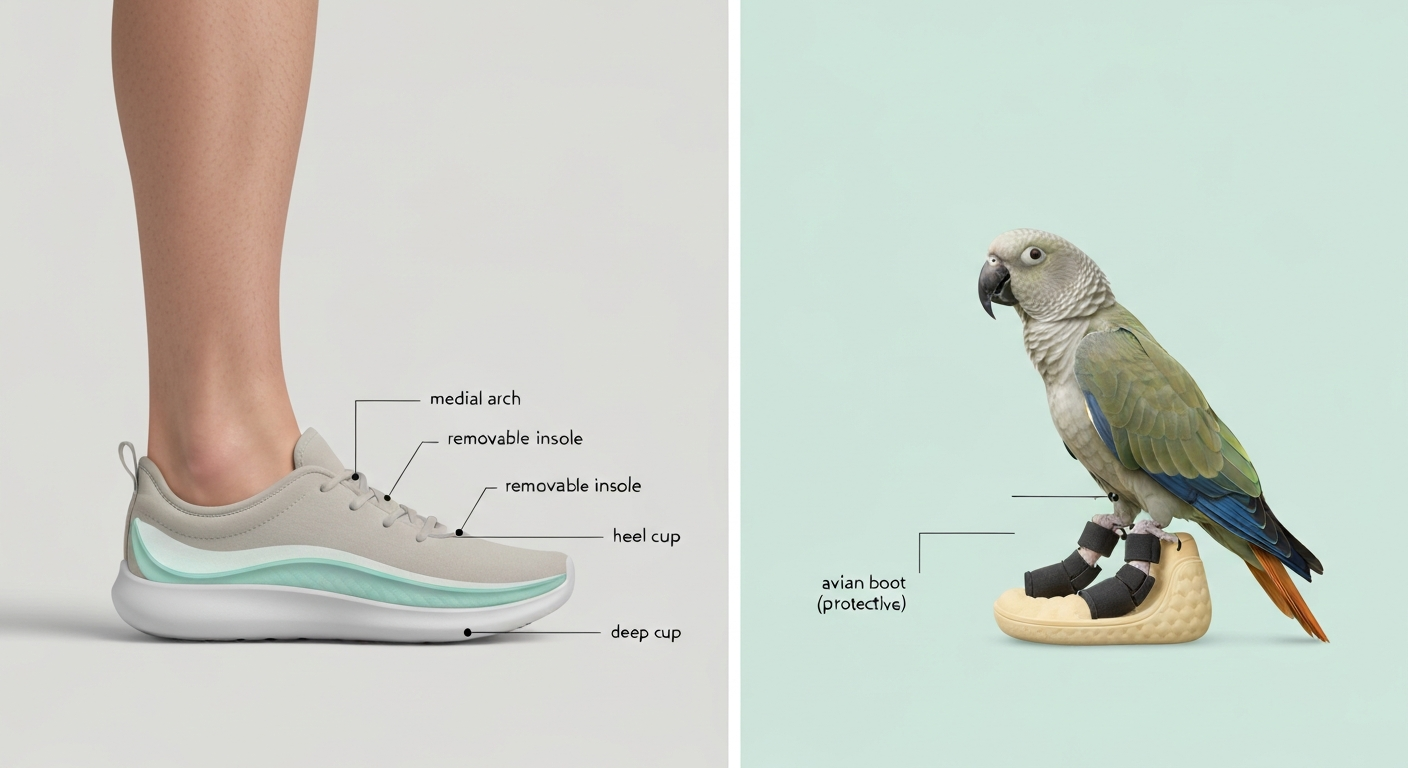
No, not all 'Bird' shoes are good for plantar fasciitis, and the honest answer depends heavily on which interpretation of the question you mean. If you're asking about Allbirds (the human footwear brand), their shoes offer mild arch contour and decent cushioning, but clinical evidence does not support any single consumer shoe brand as universally effective for plantar heel pain. The features that actually matter, medial arch support, heel cup depth, midsole cushioning, orthotic compatibility, and sole stiffness, vary across specific Allbirds models and across individuals. If you somehow arrived here wondering about literal shoes made for birds, those exist for medical and rehabilitative purposes in avian care, but they have nothing to do with human plantar fasciitis. Either way, the answer is nuanced, evidence-dependent, and worth unpacking properly.
Are All Bird Shoes Good for Plantar Fasciitis? Human vs Bird

Two very different questions hiding in one search
The query 'are all Bird shoes good for plantar fasciitis' genuinely splits into two separate threads depending on who's asking. The first and most common interpretation is about Allbirds, the consumer footwear company known for wool-, eucalyptus-fiber-, and sugarcane-based shoes. It's a reasonable question, the brand has a strong comfort reputation, and people with foot pain naturally wonder whether comfort-focused shoes will help a painful condition. The second interpretation, less common but entirely plausible for readers of this site, involves actual footwear made for birds: protective boots, splints, and wraps used in avian veterinary and rehabilitation contexts. These do exist, they serve real medical purposes for injured birds, and they occasionally surface in discussions alongside other bird-gear safety topics like harnesses, backpacks, and leashes. Both interpretations deserve a clear, honest answer.
Allbirds as a brand: what you're actually buying
Allbirds markets shoes made from natural and low-carbon materials, merino wool uppers, eucalyptus tree-fiber fabric, and a midsole foam called SweetFoam derived from sugarcane. Their main product lines include the Tree Runner, Tree Dasher, and Wool Runner, among others. The company's pitch centers on comfort and sustainability, not podiatric medicine. Third-party reviews consistently describe the footbed as having a mild arch contour and soft foam cushioning, pleasant for everyday wear, but not aggressive medical-grade arch correction. Most models include a removable insole, which matters clinically because it determines whether you can swap in a custom or prefabricated orthotic. Consumer feedback on Allbirds and plantar fasciitis is genuinely mixed: some users report meaningful pain relief, others report heel pain worsening with prolonged wear. That heterogeneity is itself informative, it reflects individual biomechanical differences more than any uniform quality of the shoe.
Bird footwear made for actual birds
Avian boots and foot wraps are real items used in bird medicine and wildlife rehabilitation. Raptors and other birds of prey can develop bumblefoot (pododermatitis), a pressure-related skin condition aggravated by hard perch surfaces, and protective footwear is sometimes part of treatment alongside wound care and perch modification. Avian rehabilitators also use foam or fabric booties to protect injured feet during recovery and to prevent further trauma. These are fitted, species-specific, and used under veterinary supervision, they are not consumer products, and they have absolutely no application to human plantar fasciitis. It's worth noting that the welfare considerations around bird-worn gear extend beyond boots: bird harnesses, backpacks, leashes, and protectors all carry fitting, escape-risk, and overheating considerations that avian vets flag regularly, a topic covered in related discussions on this site. The core principle across all bird-worn gear is the same: fit matters enormously, duration of wear should be limited, and the bird should be monitored closely for distress or injury signs.
How plantar fasciitis actually works
Plantar fasciitis is an overuse-related degenerative condition of the plantar fascia, the thick fibrous band running from the medial calcaneal tubercle (the inner heel) to the bases of the toes. The classic presentation is sharp, stabbing pain at the medial heel, worst with the first few steps in the morning or after prolonged sitting, and easing somewhat with continued walking before worsening again with extended activity. Diagnosis is primarily clinical: history, palpation of the medial tubercle, and a positive windlass test (dorsiflexing the toes while standing reproduces pain). Imaging is generally reserved for atypical or recalcitrant cases.
Biomechanically, the problem involves repeated high-strain loading of the fascia at its calcaneal insertion. Factors that increase this loading include low or high arch height (both alter fascia tension), reduced ankle dorsiflexion, prolonged standing or walking on hard surfaces, sudden increases in activity volume, and wearing footwear with inadequate cushioning or arch support. Finite-element and biomechanical studies confirm that medial arch support and contoured footbeds change plantar pressure distribution and can reduce peak strain at the fascial insertion during gait, this is the mechanistic basis for why footwear and orthotics get recommended in the first place.
The shoe features that actually matter
Evidence from biomechanical research and clinical trials points to a specific set of footwear characteristics that are likely to reduce plantar fascia loading. Practical shoe features that affect orthotic compatibility and clinical effect, removable footbed, internal height/depth, a stable heel counter/deep heel cup, and midsole stiffness, are measurable with in‑shoe plantar pressure mapping and are discussed in the study "Rocker-sole footwear versus prefabricated foot orthoses: study protocol describing biomechanical measures including in-shoe plantar pressure (BMC Musculoskeletal Disorders).". No consumer brand has a monopoly on these features, and the presence or absence of each varies by specific model, not by brand. Here is what the evidence identifies:
| Feature | What it does | Evidence strength |
|---|---|---|
| Medial arch support / contoured footbed | Redistributes plantar pressure, reduces strain at the fascial insertion | Moderate (biomechanical and RCT evidence) |
| Deep heel cup | Controls rearfoot motion, reduces pronation-related fascia stress | Moderate (clinical guidelines, biomechanical studies) |
| Adequate midsole cushioning | Attenuates impact loading at heel strike | Low-to-moderate (indirect, limited RCTs) |
| Removable insole (orthotic compatibility) | Allows custom or prefabricated orthotic insertion | Moderate-to-high (APTA guideline-supported) |
| Stable, firm heel counter | Prevents excessive heel inversion/eversion | Moderate (clinical consensus) |
| Rocker sole or stiff forefoot | Reduces metatarsophalangeal extension and fascia tension during toe-off | Moderate (biomechanical rationale, mixed trial results) |
| Mild heel lift (positive heel-to-toe drop) | Reduces tension at the Achilles-calcaneal-fascia chain | Low-to-moderate (limited RCT evidence) |
Allbirds shoes score reasonably on cushioning and moderate arch contour, and most models have removable insoles, meaning orthotic compatibility is their strongest clinical asset. Where they fall short for many plantar fasciitis patients is arch support intensity: the stock insoles provide comfort-level contouring, not the firmer medial support that research-supported orthoses deliver. Whether that gap matters to you personally depends on the severity of your condition and your individual foot mechanics.
What the research actually shows
The reality is that high-certainty evidence for specific shoe brands in plantar fasciitis simply does not exist. What research does show is that foot orthoses, both prefabricated and custom, provide modest short-term pain reduction compared to flat or sham insoles. A JAMA Network review (Effectiveness of Foot Orthoses to Treat Plantar Fasciitis: A Randomized Trial / meta-analytic data) found that prefabricated orthoses can provide modest short-term pain benefit, with small-to-moderate effect sizes and variable confidence intervals. A 2016 Cochrane review of physical interventions for plantar heel pain found low-to-moderate certainty evidence for orthoses and splints, with significant heterogeneity across trials. Randomized controlled trials comparing orthosis-shaped sandals to flat sandals and to in-shoe orthoses found that contoured supportive footwear performed comparably to in-shoe orthoses and better than flat alternatives. That's an important finding: the shape and stiffness of the footbed matters more than the specific delivery mechanism (sandal vs. shoe vs. insert).
Multiple systematic reviews comparing custom to prefabricated orthoses consistently find no large or durable advantage for custom devices in long-term outcomes. Prefabricated orthoses are recommended as first-line by most clinical guidelines (including the 2023 APTA/Orthopaedic Section clinical practice guideline) because they deliver similar short-term benefit at substantially lower cost. Heel lifts show low-to-moderate certainty benefit. Rocker-sole shoes have a plausible biomechanical rationale but mixed trial results. The bottom line from the evidence is: features matter, brands don't; conservative measures work for most patients in the short term; and no single shoe is universally effective because individual biomechanics and symptom severity drive outcomes.
When you need more than better shoes
Footwear changes are a reasonable first step, but they sit within a broader conservative-care pathway. Clinical guidelines recommend that most patients start with education, load management, stretching (calf and plantar fascia), and strengthening before escalating to more involved interventions. Common clinical triggers for stepping up to specialty footwear, custom orthoses, or other interventions include:
- Pain lasting more than 6 to 8 weeks despite activity modification and basic footwear changes
- Significant first-step pain that is not improving week over week
- High activity demands (running, prolonged standing occupations) that exceed what consumer shoes can manage
- Biomechanical findings on assessment (high or low arch, significant overpronation, reduced ankle dorsiflexion) that require corrective orthotic prescription
- Bilateral symptoms or rapid-onset heel pain, which warrant ruling out inflammatory arthropathy or other systemic causes
- Failure of two or more conservative measures tried sequentially over 3 months
If you hit any of these triggers, the appropriate next step is a consultation with a podiatrist, orthopedic specialist, or physical therapist with experience in lower-limb musculoskeletal conditions, not a shoe upgrade. A clinical assessment can identify whether custom orthoses, targeted exercise programs, corticosteroid injection, extracorporeal shockwave therapy, or another intervention is indicated. Trying to self-manage beyond the initial conservative window with shoe choices alone risks prolonging a condition that responds well to structured care.
Practical guidance for choosing shoes with plantar fasciitis
When evaluating any shoe, Allbirds or otherwise, for plantar fasciitis, treat it as a clinical decision, not a brand loyalty choice. Here is a workable framework for what to look for and how to test it in practice.
What to look for when shopping
- Removable insole with enough internal depth to accept a 3/4-length or full-length orthotic without creating heel or dorsal pressure
- Firm, structured heel counter (press the heel from both sides — it should resist compression)
- Visible medial arch contour in the stock footbed, not a flat foam sheet
- Midsole with moderate firmness — soft memory foam alone often lacks the rebound and support needed for fascia offloading
- Heel-to-toe drop of 8 to 12 mm, which reduces load on the Achilles-calcaneal insertion complex
- Rocker geometry or a moderately stiff forefoot if you have significant first-step pain or metatarsal involvement
What to avoid
- Completely flat, zero-drop shoes or minimalist styles during an active flare (these increase strain at the calcaneal insertion)
- Worn-out shoes with collapsed arch support — midsole degradation is invisible but measurable by pressing the foam
- Flip-flops, slides, or backless footwear for prolonged wear — no heel cup, no stability, and known to aggravate heel pain
- Very soft, highly flexible midsoles that compress fully under bodyweight (pleasant to squeeze in-store, but inadequate support under load)
- Any shoe you cannot fit your prescribed orthotic into without the heel slipping or the forefoot feeling cramped
How to test fit before committing
- Remove the stock insole and check that your orthotic sits flush without bowing or compressing
- Stand in the shoe with full bodyweight and verify the heel cup holds your heel centered — no lateral slipping
- Walk at least 50 steps in-store or around the house; the first 10 steps in the morning are the diagnostic gold standard for plantar fasciitis, so morning trials are more informative than afternoon store visits
- Check for a thumbnail's width of space between your longest toe and the shoe tip — cramping the toes increases forefoot pressure and indirectly loads the fascia via the windlass mechanism
- If you experience any new heel or arch ache within the first 20 minutes of a trial walk, that shoe is not a good match regardless of its comfort ratings
A safety checklist for bird-related gear products
Because this site regularly addresses the safety of products worn by or used around birds, from harnesses and backpacks to leashes, protectors, and ultrasonic deterrents, it's worth having a clear, evidence-grounded checklist for evaluating any such product. For a brand-specific safety check, see our short guide on whether a particular product is safe, for example, is HexClad Bird safe. The same critical thinking that applies to evaluating shoe claims for plantar fasciitis applies to evaluating the safety and efficacy claims on bird-gear packaging. See our guide Are bird protectors safe for a focused review of safety, fitting, and veterinary recommendations for bird footwear and gear.
- Materials: Are the materials non-toxic, bird-safe, and free from zinc, lead, or small-part ingestion hazards? Natural fiber ropes and bird-safe plastics are preferable to dyed or galvanized materials.
- Fit and sizing: Is the product species- and size-specific? Ill-fitting harnesses, leashes, or boots can cause pressure sores, feather damage, or circulatory restriction — the same principle as orthotic fit in humans.
- Escape risk: Does the design prevent entanglement or self-tightening under movement? Poorly designed leashes and harnesses are documented causes of wing and neck injury in avian accidents.
- Thermal risk: Does the product trap heat against skin or restrict ventilation? Birds thermoregulate differently from mammals and are highly sensitive to overheating, especially in enclosed carriers or backpacks.
- Duration of use: Is the product designed for supervised, time-limited use? No bird-worn gear should be left on unsupervised, and most should be removed after short sessions.
- Regulatory status and sourcing: Is the product from a reputable supplier, ideally with avian veterinary endorsement? Unregulated bird gear sold on general marketplace platforms varies enormously in quality and safety.
- Non-target effects: For deterrent or control devices (ultrasonic repellers, bird spikes, chemical deterrents), consider impacts on non-target animals. Ultrasonic bird repellers, for example, can emit frequencies audible and distressing to dogs and other companion animals — a concern worth investigating before installation.
- Monitoring after introduction: Any new bird-worn product should be introduced gradually with close monitoring for behavioral stress signs (feather fluffing, reduced vocalisation, aggression, lameness, or self-trauma).
Comparing shoe options for plantar fasciitis
If you're deciding between different types of footwear interventions rather than specific brands, the clinical literature gives a reasonably clear picture of relative value. Here's how the main options compare on the features and evidence that matter.
| Footwear type | Arch support | Orthotic compatibility | Evidence quality | Cost | Best for |
|---|---|---|---|---|---|
| Consumer comfort shoe (e.g., Allbirds) | Mild contour | Generally good (removable insole) | Low (no brand-specific trials) | Mid-range | Mild symptoms, daily comfort wear paired with orthotic |
| Running/stability shoe | Moderate to firm medial post | Good in most models | Low-to-moderate (indirect) | Mid-to-high | Active individuals, mild-to-moderate fasciitis |
| Orthosis-shaped sandal | High contour | N/A (built-in) | Moderate (direct RCT evidence) | Low-to-mid | Home use, warm climates, early-stage fasciitis |
| Prefabricated orthotic in any compatible shoe | High | Requires compatible shoe | Moderate (multiple RCTs) | Low | First-line clinical recommendation |
| Custom orthotic in prescribed footwear | Highest (patient-specific) | Prescribed together | Moderate (no large advantage over prefab long-term) | High | Complex biomechanics, failed prefab trial |
| Rocker-sole shoe | Variable | Moderate (some models) | Moderate (biomechanical rationale, mixed trials) | Mid-to-high | Forefoot-dominant pain, post-surgical, diabetic foot |
The takeaway from this comparison is that no single category dominates across all patients. Consumer comfort shoes like Allbirds occupy a legitimate niche, mild symptoms, orthotic-ready design, daily comfort, but they are not a substitute for a prefabricated or custom orthotic in moderate or severe cases. The clinical evidence most consistently supports contoured foot support (whether from an orthotic, a shaped sandal, or a stability shoe with a firm medial post) over flat or minimally structured alternatives.
When to see a professional and who to call
For human plantar fasciitis: consult a podiatrist, sports medicine physician, or physiotherapist if pain has persisted beyond six to eight weeks, if it is worsening despite shoe changes and stretching, or if you have any bilateral symptoms, systemic signs, or a history of inflammatory arthritis. Self-directed shoe shopping is a reasonable first step for mild, recent-onset heel pain, but it has a ceiling. For avian footwear or bird-gear safety concerns: consult a board-certified avian veterinarian or a licensed wildlife rehabilitator before placing any footwear, harness, or restraint device on a bird. If you have specific questions about a product called Hum Skinny Bird, search for assessments titled "is Hum Skinny Bird safe" or consult an avian veterinarian to confirm species‑specific safety. The fitting requirements are species-specific, the welfare risks of incorrect fit are real, and well-intentioned but improperly fitted gear can cause the kind of pressure injury it's meant to prevent. For questions about deterrent devices and non-target effects on companion animals, veterinary input is equally worthwhile before installation.
FAQ
What does the query “are all Bird shoes good for plantar fasciitis” likely mean?
There are two plausible meanings: (1) The user is asking about human consumer shoes branded “Bird” or “Allbirds” (popular soft, sustainable shoes) and whether those styles help plantar fasciitis. (2) The user is asking about footwear or boots made for birds (avian protective boots or splints). These are entirely different topics—human shoe design and clinical footwear for plantar fasciitis versus avian‑welfare gear for birds.
Short answer: are all “Bird” or Allbirds shoes good for plantar fasciitis?
No. No single consumer brand or model (including Allbirds) is universally effective for plantar fasciitis. Some people report symptom relief in shoes with certain features, others do not. Effectiveness depends on individual foot shape, severity, and shoe features (arch support, heel cup, cushioning, removable insole/orthotic compatibility, midsole stiffness or rocker). Clinical guidelines recommend individualized conservative care and, when needed, orthoses or other interventions.
What shoe features have a plausible, evidence‑based role in helping plantar fasciitis?
Key, evidence‑linked features include: a contoured (medial arch) footbed or ability to accept a contoured orthotic; a deep, stable heel cup; adequate midsole cushioning to reduce impact; removable insole and enough internal volume to fit orthoses; moderate heel height or heel lift in some cases; and, for some patients, a stiffer midsole or rocker sole to change rollover mechanics and reduce plantar‑fascia strain. These features alter plantar pressures and can produce short‑term pain relief in trials.
What does the research say about shoes and orthoses for plantar fasciitis?
Systematic reviews and randomized trials show prefabricated and custom orthoses and contoured sandals can reduce short‑term pain versus flat or sham devices; effect sizes are small‑to‑moderate and long‑term superiority is unclear. Clinical practice guidelines recommend conservative measures (education, stretching, load management) and considering orthoses or footwear changes—no brand is endorsed as universally therapeutic. Prefabricated orthoses are often recommended first due to similar short‑term benefit and lower cost versus custom devices.
Are Allbirds specifically known to help or harm plantar fasciitis?
There is no high‑quality clinical trial proving Allbirds cure plantar fasciitis. Allbirds models often have removable footbeds and mild arch contours, which some users find comfortable; others report insufficient support or heel pain. Reviewers call many Allbirds models 'orthotic‑friendly' because insoles are removable, but people needing stronger arch correction typically pair consumer shoes with prefabricated or prescription orthoses.
When should I consider specialty footwear, orthoses, or seeing a professional?
Consider professional assessment (podiatrist, orthopedist, physical therapist) when heel pain limits function, fails to improve with basic measures (stretching, activity modification, supportive shoes) after several weeks, or is severe. Seek an avian vet or rehabilitator if your question concerns bird footwear or a bird’s welfare. A clinician can confirm diagnosis (history/exam), prescribe stretching/strengthening, and advise prefabricated vs custom orthoses and appropriate footwear features.