
Bird leashes can be safe for the right species, in the right size, fitted correctly, and used under direct supervision, but they carry real anatomical and behavioral risks that vary considerably by bird size, species, health status, and how the gear is designed and attached. The honest answer is: used carefully and appropriately, a well-fitted harness-style leash on a habituated adult parrot poses manageable risk; used on a small passerine, a sick bird, an unhabituated bird, or with poorly designed hardware, the same category of equipment can cause respiratory compromise, skin lesions, entanglement injury, or chronic stress. The evidence from wildlife biology, veterinary case reports, and avian professional guidelines consistently supports a cautious, species-specific, supervised approach, not a blanket yes or no.
Are Bird Leashes Safe? Evidence, Risks, and Safe Use - Guide for Owners & Pros

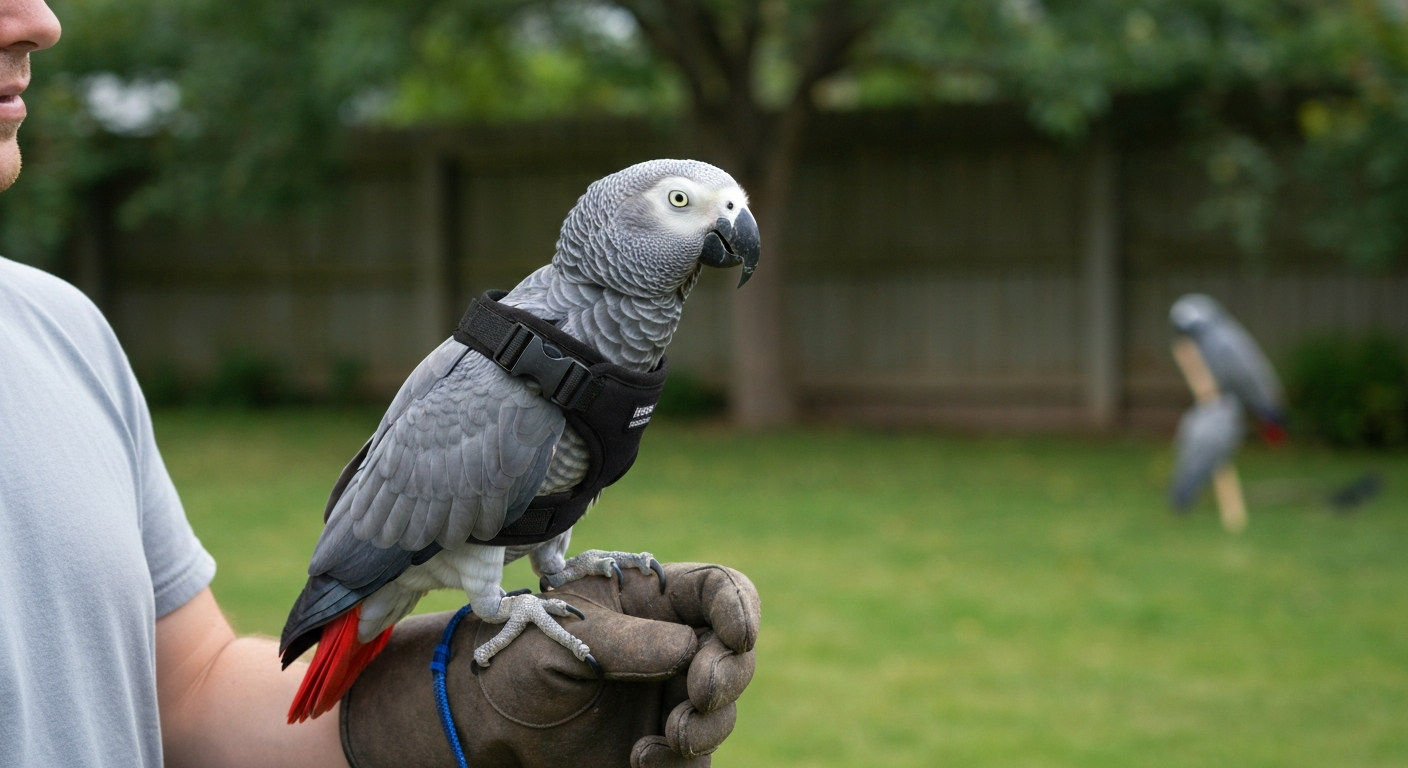
The short version: what the evidence actually says
A 2018 phylogenetically controlled meta-analysis (Bodey et al., Methods in Ecology and Evolution) found statistically significant deleterious effects on survival, reproduction, and behavior across bird species fitted with biologging devices including harnesses and backpacks. Effect sizes tracked with device mass relative to body mass, attachment style, and avian guild. A 2019 literature review (Geen, Robinson, and Baillie, Journal of Avian Biology) reached a similar conclusion: harms are real, variable across species, and poorly standardized in reporting. Neither study looked specifically at companion-bird leashes, but the underlying biology and mechanical hazards are the same. On the companion-animal side, the Association of Avian Veterinarians (AAV) supports harness use for pet birds under supervision and with proper training, and a 2025 case report from Animals documented a captive peregrine that developed squamous cell carcinoma at chronic harness contact sites after a year of use, a rare but sobering reminder that long-term friction is a tissue-level hazard. The professional consensus, from the AAV to the International Association of Avian Trainers and Educators (IAATE), is that leashes and harnesses are tools, not toys, appropriate when chosen and used correctly, harmful when not.
- Bird leashes are safest on medium-to-large parrots (budgies and up) that have been gradually trained to accept the equipment
- Device mass should stay below 5% of the bird's body weight — and that threshold alone does not guarantee safety
- Attachment style, padding, and hardware quality matter as much as weight
- Always supervise a leashed bird directly; never tether and walk away
- Sick birds, molting birds, chicks, and most wild or unhabituated birds should not be placed in leash equipment
- Signs of distress during fitting or use require immediate removal and, if persistent, veterinary evaluation
What bird leashes, harnesses, backpacks, and protectors actually are
The terms get used loosely, so it helps to be precise. A bird leash by itself, a simple cord attached to a leg band or ankle cuff, is the oldest and riskiest form. Leg-loop or ankle-tether leashes connect at the tarsometatarsus (the lower leg) and transfer restraint force directly to that joint and the soft tissue around it. Without careful sizing and padding, they constrict, abrade, and in documented cases have caused ischemia, necrosis, and tendon damage in parakeets and parrots (USGS / Patuxent Wildlife Research Center technical documentation). This style is now largely discouraged by avian veterinarians for companion use.
A harness-style leash is the current standard for companion birds. It routes a soft loop around the neck and another around the body (usually behind the wings), with a short tether attached to the back or chest piece. Force is distributed across the torso rather than concentrated at a limb. The Aviator harness is the most commonly referenced product in this category. Bird backpacks, used in research and occasionally in enrichment contexts, are dorsal-mounted units secured by a chest-and-back loop, essentially the same attachment geometry as a research transmitter backpack. Bird protectors (a looser category) include mesh travel covers, flight suits, and anti-predator jackets; these are primarily worn around the body and are less about restraint and more about physical protection or hygiene during outdoor time. For more detail on safety considerations for mesh covers, flight suits, and similar items, see the section on are bird protectors safe.
All of these devices share a common risk profile: they wrap around or press against a bird's body, and birds are anatomically and physiologically different from mammals in ways that make compression a more serious concern than most owners realize. The distinctions between these product types matter when evaluating safety, and the evidence for harnesses is meaningfully different from the evidence for bare leg-tether leashes.
Design features that genuinely reduce harm
Not all leash or harness products are equivalent, and design differences translate directly to injury risk. The features below are not marketing language, they correspond to mechanisms identified in veterinary pathology and wildlife biologging literature as causes of harm, and their absence or presence meaningfully changes the risk profile.
- Quick-release or breakaway hardware: allows fast removal if a bird panics or entangles, reducing the window for constriction or self-injury
- Soft, non-abrading contact materials (neoprene, padded nylon, cotton-lined straps): reduces friction at contact sites; the 2011 Peniche et al. veterinary case series found chronic friction was a primary driver of harness-associated lesions in red kites
- Correct size scaling: straps narrow enough not to impede wing movement but snug enough not to shift and create friction hotspots — most reputable manufacturers publish species-specific sizing charts
- Lightweight construction: keep total device mass below 5% of body weight; for a 100 g budgerigar that means under 5 g total, and for a 450 g African grey under 22.5 g
- Rounded or flat profile hardware (no protruding buckles or sharp edges against skin): pressure points under raised hardware replicate the mechanism behind documented 'bar lesions' in research transmitter harnesses
- Smooth, non-porous leash line (not rough cord): rough cord at leg or torso contact points is the same mechanism behind the constriction injuries documented in leg-band surveillance reports
- Adjustable fit with measurement guides: a harness that cannot be sized to the individual bird will inevitably sit too tight (constriction risk) or too loose (entanglement and abrasion risk from shifting)
One point worth emphasizing: the widely cited '5% rule' (device mass under 5% of body weight) is a useful starting point but not a complete safety guarantee. A 2018 analysis by Portugal in Methods in Ecology and Evolution specifically critiqued the rule, showing that miniaturization alone does not eliminate device effects when attachment method and long-term friction are uncontrolled. A perfectly light harness worn for hours every day on a bird that was never properly habituated is still a harm risk.
How bird anatomy creates specific leash risks
The respiratory system
This is the anatomical point that surprises most people. Birds do not have a muscular diaphragm. Their ventilation depends on movement of the sternum (keel) and the compliance of a network of air sacs that extend through the body cavity. Any device that compresses the keel, restricts sternal excursion, or squeezes the body wall can directly impair breathing. As Ludders' anaesthesia theme paper (Royal Society, 2024) details, this makes restraint, including tight harnessing, a genuine respiratory risk in many species. A too-tight chest loop on a harness is not just uncomfortable; it can compromise ventilation within minutes. In practice this is one of the most important reasons fitting must be checked carefully: you should be able to slide one finger easily under any strap against the body.
Skin and feathers
Bird skin is thinner and more fragile than mammalian skin, with less subcutaneous fat to cushion hardware or straps. Feather follicles are embedded in the skin, and chronic pressure or abrasion disrupts feather growth in addition to causing skin breakdown. The Peniche et al. (2011) post-mortem series identified chronic necrogranulomatous inflammation and deep muscular exposure in roughly 22% of red kites with harness transmitter histories, not from a single traumatic event, but from long-term contact friction. The 2025 Animals case report of a peregrine falcon with squamous cell carcinoma at harness contact sites after one year of wear adds a rare but real carcinogenic risk from chronic skin irritation, even if causation there remains a differential rather than a confirmed mechanism.
Bones and musculoskeletal structure
Bird bones are often pneumatized (hollow and air-filled) and, particularly in smaller species, are structurally light and brittle relative to body size. Falls, panicked flapping against a tether, or sudden restraint forces can fracture bones that would flex in a mammal. The coracoid, furcula, and wing bones are particularly vulnerable in a sudden lunge or fall on a leash. This is a supervision argument as much as an equipment argument: the leash does not prevent injury from panic; it can cause it if the bird hits the end of the tether at speed.
Stress physiology
Even when no physical injury occurs, fitting and wearing a harness reliably triggers an acute stress response. Romero and Romero (The Condor, 2002) documented that corticosterone levels in wild birds rise measurably within minutes of capture and handling. Chronic or repeated stress elevates baseline corticosterone, which suppresses immune function, disrupts reproductive cycles, and contributes to stereotypic behaviors. The practical implication is that a bird that shows persistent behavioral stress markers while wearing a harness, feather-fluffing, wing-drooping, biting at equipment, prolonged freezing, is not 'getting used to it over time'; it may be experiencing chronic stress that compounds over sessions. Habituation must happen gradually and at the bird's pace, not on the owner's schedule. Controlled studies on penguins (Cockrem et al., Zoological Science, 2008) confirmed that restraint technique and calming covers reduce corticosterone responses, which supports using a slow, low-stress approach to harness introduction.
Which birds are suitable, and which are not
The answer really does depend heavily on species and life stage. Here is a practical breakdown, drawing on veterinary guidance and the biological characteristics that determine risk.
| Bird type | Leash suitability | Key considerations |
|---|---|---|
| Medium-to-large parrots (African grey, Amazon, cockatoo, macaw) | Best candidates with proper training | Body size allows safe harness geometry; well-studied behaviorally; habituation generally achievable; regular fit and skin checks required |
| Small parrots (budgerigar, lovebird, parrotlet) | Possible with purpose-built micro harnesses; moderate risk | Very low body weight means device mass is critical; respiratory risk from even moderate compression; requires expert fitting |
| Cockatiels | Possible; moderate risk | Some commercial harnesses designed for cockatiel size exist; stress response can be pronounced; slow habituation essential |
| Passerines (finches, canaries, sparrows) | Generally not recommended | Extremely small body mass, delicate bones, high metabolic stress response; no purpose-built leash equipment validated for this guild |
| Raptors (falconry birds: falcons, hawks, eagles) | Specialized jesses and anklets used under strict training protocols | Traditional falconry equipment is different from pet leashes; requires falconry training and in many jurisdictions a permit; chronic lesion risk documented even in experienced setups |
| Chicks and juvenile birds | Not appropriate | Skeletal and integumental development incomplete; stress physiology more sensitive; no established safety data |
| Molting birds | Avoid during active molt | Feather follicles are highly vascularized during growth ('blood feathers'); pressure on pin feathers is painful and can cause hemorrhage |
| Sick or recovering birds | Contraindicated | Compromised immune and respiratory function raises risk from any restraint or compression |
Raptors deserve a separate note. Falconry jesses and leashes are a distinct tradition with centuries of refinement, but even that system carries documented harm. The Peniche et al. (2011) red kite harness data came from wild raptors fitted with research transmitters, not pet birds, but the tissue pathology reflects risks relevant to any long-term harness contact on a raptor. Falconry equipment use is also subject to wildlife permitting laws in the US, EU, and most other jurisdictions; keeping a raptor on a leash without a falconry permit is illegal in those regions regardless of safety considerations.
What the science and veterinary community actually agree on
The scientific literature on bird leash safety specifically is thin, most rigorous studies address wildlife telemetry devices, which share the same physical attachment mechanisms but differ in context and duration. The honest scientific position is that direct randomized controlled evidence for companion-bird harness safety does not exist at the level it does, for example, for canine leash safety. What we have is: (1) mechanistic evidence from anatomy and physiology showing plausible harm pathways; (2) case reports and post-mortem series documenting real harms in harness-wearing birds; (3) meta-analyses of biologging device effects showing consistent signals of harm at the population level; and (4) professional guidelines from the AAV and IAATE that support cautious, supervised use with proper fitting and training.
The 2019 Geen et al. review is worth quoting directly in spirit: reported effects are variable across studies, and the evidence base calls for careful, species-specific evaluation rather than broad generalization. That is an accurate summary for companion bird contexts too. The AAV's published guidance (updated 2025-2026) endorses harness use for companion birds who are flight-trained, habituated, and supervised, and adds current biosecurity advice: avoid contact with wild birds during high-pathogenicity avian influenza circulation periods, since outdoor harness walks create exposure risk. The IAATE position statements consistently emphasize that handling and equipment choices must be tailored to each individual bird's behavior and welfare, responsibility sits with the owner and trainer, not with any equipment brand.
The reality is that there is no universal safety certification for bird leashes or harnesses. No regulatory body in the US or EU certifies companion bird leash products for safety the way, say, climbing hardware is tested. Product quality varies enormously, and the absence of a governing standard means buyers cannot assume a commercially available product is safe simply because it is sold.
Real hazards to plan around
Entanglement and constriction
This is the most acutely dangerous hazard. A bird can become entangled in its own leash within seconds, wrapping a leg, wing, or neck around the tether when startled or during normal movement. Constriction injuries can sever blood supply to a limb within minutes; wildlife rehabilitation documentation (ARCC guidance) links cord entanglement to limb ischemia, necrosis, tendon damage, and permanent loss of flight or foraging capacity. The leg-loop leash is the highest-risk configuration for this reason. Harness-style tethers reduce but do not eliminate entanglement risk, particularly when the leash line is long enough to loop around a limb.
Falls and sudden impact
A tethered bird that takes flight will reach the end of the leash and be pulled back or stopped abruptly. In a small bird or at a long leash extension, this can generate enough force to cause fractures, soft tissue trauma, or internal injury. The risk scales with body mass, leash length, and the speed of the attempted flight. Short tethers reduce impact force but increase entanglement probability, there is a real design tension here that no single product has fully resolved.
Predator exposure
A leashed bird is a tethered target. It cannot escape, and its natural evasion behavior, rapid flight, is blocked. Predator ambush by cats, dogs, hawks, or even large corvids can be lethal, and the bird's stress response to a predator approach while restrained can itself cause cardiac or respiratory crisis. Outdoor use requires active, direct supervision with eyes on the bird at all times.
Temperature and weather
Birds thermoregulate differently from mammals. In hot weather, a bird that cannot fully extend its wings or move freely (due to a harness) may have reduced ability to dissipate heat through wing spreading and panting. In cold or wet conditions, wet feathers lose insulating capacity rapidly. Most companion parrots are tropical-origin species with limited cold tolerance; ambient temperatures under roughly 10°C (50°F) carry hypothermia risk for outdoor use, and direct sun above 35°C (95°F) in still air carries heat stress risk.
Escape
Paradoxically, escape is a major safety hazard from leashes. A poorly fitted harness can slip off, parrots are dexterous and motivated escape artists, leaving the bird loose outdoors without the flying skills to navigate safely and without shelter, food, or protection. Wing-clipped birds allowed outdoors on a harness that slips can be unable to fly to safety. The lesson: fit must be verified before every outdoor session, and a snug fit (without being constrictive) is essential.
How to choose safe gear: a practical buyer's guide
Given the absence of formal safety certification standards, selection comes down to evaluating specific design and material features against what the evidence identifies as harm mechanisms. Here is what to look for and what to avoid. For owners evaluating specific brands or models, consult the page titled "is hexclad bird safe" for discussion of product compatibility, materials, and real-world user reports relevant to harness and leash safety.
Features to prioritize
- Species-specific sizing: choose a product with published weight and measurement ranges for your exact species, not just 'small/medium/large'; verify your bird falls within the stated range before purchase
- Soft, padded contact surfaces: neoprene or cotton-lined nylon at all body-contact points; reject products with unpadded webbing directly against skin
- Quick-release or slide-buckle hardware: every harness should allow rapid removal in an emergency without needing to thread the bird's head or wings back through loops under stress
- Rounded hardware profile: no raised buckle edges or D-rings positioned against the skin or keel
- Leash line of 1.2–1.8 m (4–6 feet) maximum for most companion parrots: longer leashes increase fall-impact force and entanglement risk
- Smooth leash line material (not rough braided cord): round, smooth nylon or cotton reduces friction if the line contacts a leg or wing
- Adjustable fit points: a minimum of two adjustment points (neck loop and body loop) to accommodate individual variation
- Reputable manufacturer with accessible customer support and replacement parts: you need to be able to refit or replace worn components
Red flags to avoid
- Products marketed as 'one size fits most birds' with no species or weight specifications
- Thin rope or cord designs (especially leg-loop styles) without padding — these replicate the mechanism of constriction injuries documented in leg-band literature
- Harnesses with protruding metal hardware (buckles, rivets, rings) on body-contact surfaces
- Products with no adjustment capability — a fixed-geometry harness cannot be correctly fitted to biological variation across individuals
- Novelty or costume-style 'bird leashes' (elastic string, decorative ribbon) not designed for load-bearing use
- Any product that requires the bird's wings to be folded in an unnatural position to put on or take off
- Extremely low-price products with no manufacturer information — material quality and construction tolerances matter
Fitting and training: the steps that matter most
- Introduce the harness as a training object first: let the bird inspect, step onto, and interact with the harness over multiple sessions before any wearing attempt
- Use positive reinforcement (food rewards, praise) at every stage; never force the harness onto an unwilling bird
- First wearing sessions: harness on for under one minute in a safe indoor environment, reward immediately, remove before any stress behavior escalates
- Gradually extend duration over days to weeks — this habituation timeline is not negotiable if you want a low-stress response (Cockrem et al. penguin data supports this approach)
- Check fit every session: slide one finger under every strap; if you cannot, the fit is too tight; if straps shift when the bird moves, the fit is too loose
- Inspect skin and feathers under harness contact points after each session; any redness, feather damage, or skin abrasion is a reason to stop and reassess fit or product
- First outdoor sessions: short duration (under 15 minutes), familiar low-stress environment, direct hands-on supervision, no other pets present
- Never leave a harnessed bird unattended, tied to a perch, or in a cage wearing the harness
When to see an avian vet immediately
- Open-mouth breathing, tail-bobbing, or labored breathing during or after harness use — possible respiratory compromise
- Any visible swelling, bruising, or break in skin at harness contact sites
- Limping, wing-drooping, or reluctance to bear weight after use
- Entanglement that resulted in the bird pulling against the leash at force — fracture evaluation needed even if no visible injury is apparent
- Feather loss, redness, or skin thickening under any harness contact point that persists for more than a day or two
- Prolonged lethargy, fluffed posture, or reduced appetite following harness sessions
Alternatives worth considering
A leash or harness is one tool, not the only way to give a bird safe outdoor access. Supervised free flight (trained recall with an experienced avian trainer) eliminates the constriction and entanglement hazards entirely, though it introduces escape and predator risk of a different kind. An outdoor aviary or flight cage provides enrichment without restraint. For owners whose primary goal is companionship on walks, understanding that a harness requires genuine training investment, not just equipment purchase, is the realistic starting point. For birds that consistently show distress during harness training despite a slow, reward-based approach, forced harness use is not ethically appropriate; an outdoor enclosure or indoor enrichment is a better answer.
Legal and permit considerations
For companion parrots that are captive-bred and legally purchased, leash use in public spaces is generally legal in most US states and EU countries, subject to local ordinances on animals in public. Raptors are a different matter entirely: keeping, transporting, and flying a raptor requires a falconry permit under the US Migratory Bird Treaty Act and equivalent legislation in the UK and EU. Using a leash-style device on any wild-caught native bird species is illegal under those same frameworks. If you are an aviation professional or researcher asking about this from a bird-strike or field-capture standpoint, be aware that any restraint device applied to a migratory or native species in the field requires appropriate wildlife handling permits and institutional oversight, the biologging literature on harness effects applies directly to that context, and the ethical and legal bar for justifying device attachment is set by those studies' findings.
The bottom line is that bird leash safety is a question with a real, evidence-grounded answer that sits between 'perfectly safe' and 'always harmful.' The risks are specific, documented, and manageable, but only when owners take the anatomy seriously, choose purpose-built equipment, fit it correctly, train the bird patiently, and supervise actively every time. If that describes your setup, a harness-style leash for a healthy adult parrot is a reasonable choice. For product-specific guidance, see is hum skinny bird safe. If it does not, the risks are not theoretical. For related guidance on pet footwear and orthopedic safety, see are all bird shoes good for plantar fasciitis.
FAQ
Are bird leashes, harnesses and backpacks safe for pet birds in general?
Short answer: sometimes — but safety depends on species, device design, fit, owner training and supervision. Evidence from wildlife telemetry and veterinary pathology shows that poorly designed or poorly fitted harnesses and attachments can cause feather and skin abrasion, pressure sores, constriction injuries, behavioral stress and reduced survival or reproduction in some species (Bodey et al. 2018; Geen et al. 2019; Peniche et al. 2011). Professional veterinary and trainer guidance therefore favors cautious, species‑specific use, minimal device mass/profile, thorough habituation and active monitoring rather than routine unsupervised use.
What types of leashes and restraint/carry devices are used with birds and how do they attach?
Common types: - Flight harnesses (figure‑of‑eight, vest style) that loop around wings/body and attach to a leash at the back. - Backpack style carriers that sit over the dorsal feathers and fasten with straps under the body. - Leg‑loop or leg‑ring attachments for telemetry or tethering (used in some fieldwork). - Protective vests/soft carriers and backpacks for transport. Attachment methods vary: over‑wing loops, chest/underbody straps, leg loops, or back pads. Each attachment point has different mechanical and anatomical risks (abrasion, constriction, restriction of sternal movement). Wildlife telemetry deployments also use adhesive, tape or harnesses for transmitters; analogous risks apply.
What design and material features reduce harm?
Look for: - Quick‑release buckles and breakaway points to prevent prolonged entanglement. - Lightweight, low‑profile design (but remember the 5% rule is an imperfect guideline). - Soft, wide, padded straps to spread pressure and reduce abrasion. - Smooth, non‑abrasive materials (neoprene, soft webbing) and no sharp edges or exposed stitching. - Adjustable fit with secure but not constrictive fastenings. - Corrosion‑resistant hardware and minimal dangling parts. - Clear manufacturer sizing and weight limits, and validated designs for the target species/size. Contemporary guidance emphasizes species‑specific testing and post‑fitting monitoring rather than relying solely on mass limits (guidelines 2024; Portugal 2018).
How does bird anatomy change the risk profile of leashes and harnesses?
Birds have a unique respiratory and musculoskeletal system: - They lack a muscular diaphragm and breathe via sternal/keel movement and air sacs — tight or compressive harnesses that restrict keel motion can impair ventilation. - Feathers and skin are thin and sensitive; pressure and friction can cause feather loss, skin abrasion, sores and infection. - Lightweight skeletons and pneumatic bones increase fracture risk from falls or entanglement struggles. - High wing mobility and preening behavior mean harnesses can rub or be disturbed by the bird. These anatomical features make correct placement, padding and avoidance of sternal compression essential (Ludders 2024).
Which species and life stages are more or less suitable for leash/harness use?
General suitability: - Parrots (large cockatoos, amazons, macaws): many companion parrots can be flight‑trained to wear harnesses safely with careful training and supervision; however, their strong beaks and curiosity raise entanglement/chewing risks. - Smaller parrots and cockatiels: can sometimes wear lightweight harnesses but are at higher risk from constricting straps or leg attachments. - Finches and most passerines: generally unsuitable — harnessing is difficult and higher risk relative to body mass and behavior. - Raptors: some falconry harnesses exist but require expert use; prolonged harnesses can cause severe lesions in raptors. - Chicks, molting, sick or stressed birds: avoid harnessing — fragile growing tissues, feather loss and illness increase risk. Always assess on an individual basis and prefer species‑tested designs (Geen et al. 2019; IAATE/AAV guidance).
What are the most common hazards and injuries from leashes and harnesses?
Documented hazards include: - Skin/feather abrasion and pressure sores under straps or back mounts. - Constriction from thin cords or misfitted straps causing ischemia, necrosis or loss of digits/limbs. - Entanglement in vegetation, furniture or leash hardware leading to falls, fractures or strangulation. - Respiratory compromise from devices restricting sternal movement. - Behavioral stress causing escape attempts, self‑mutilation or learned avoidance of handlers. - Secondary infection of damaged tissues and chronic lesions (reports in telemetry and captive cases; Peniche et al. 2011; veterinary case series 2025). These hazards can be acute or cumulative over time.