Yes, many bird nests can and do survive storms, but the answer depends heavily on the nest type, where it's placed, how it's built, and what kind of storm you're talking about. A well-anchored cavity nest in a tree hollow will shrug off a thunderstorm that flattens an open cup nest in a shrub. A hurricane that strips an entire canopy is a different story than a spring downpour.
Can a Bird Nest Survive a Storm? What to Expect and Do

Marcus Whitmore
29 Jun 2026
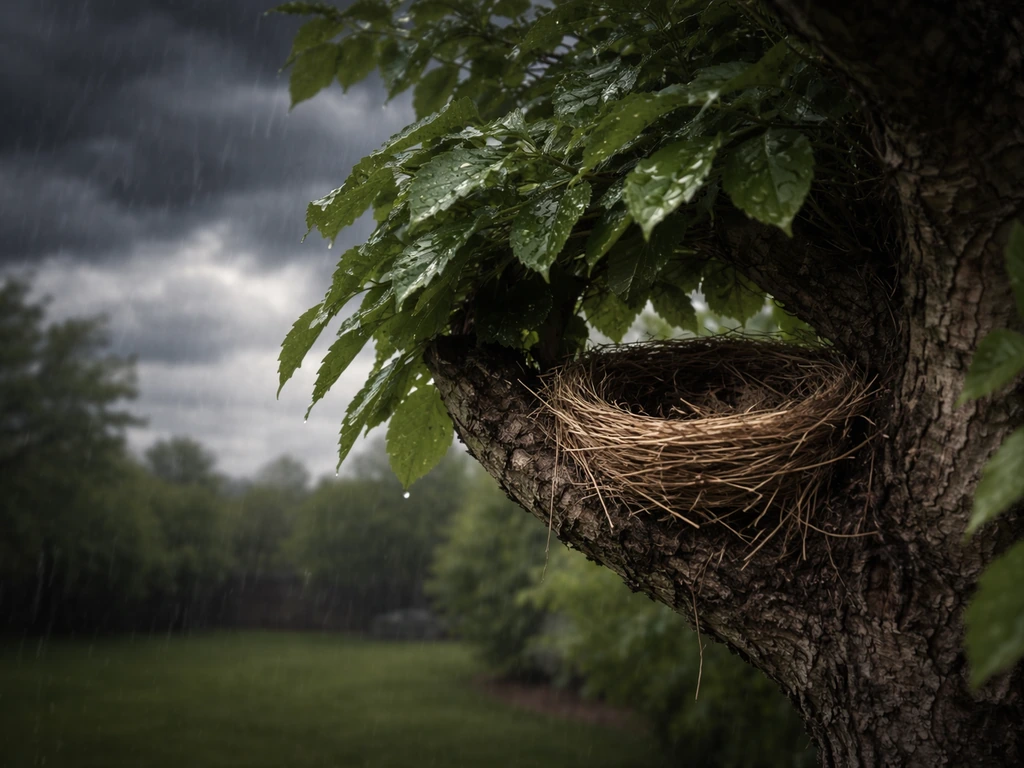
The most useful way to think about it: storms don't automatically destroy nests, and they don't automatically mean adults abandon eggs or chicks. What actually breaks first is usually not the nest itself but the conditions inside it, and that distinction changes everything about how you should respond if you find a damaged nest after a storm.
How storm damage affects different nest types
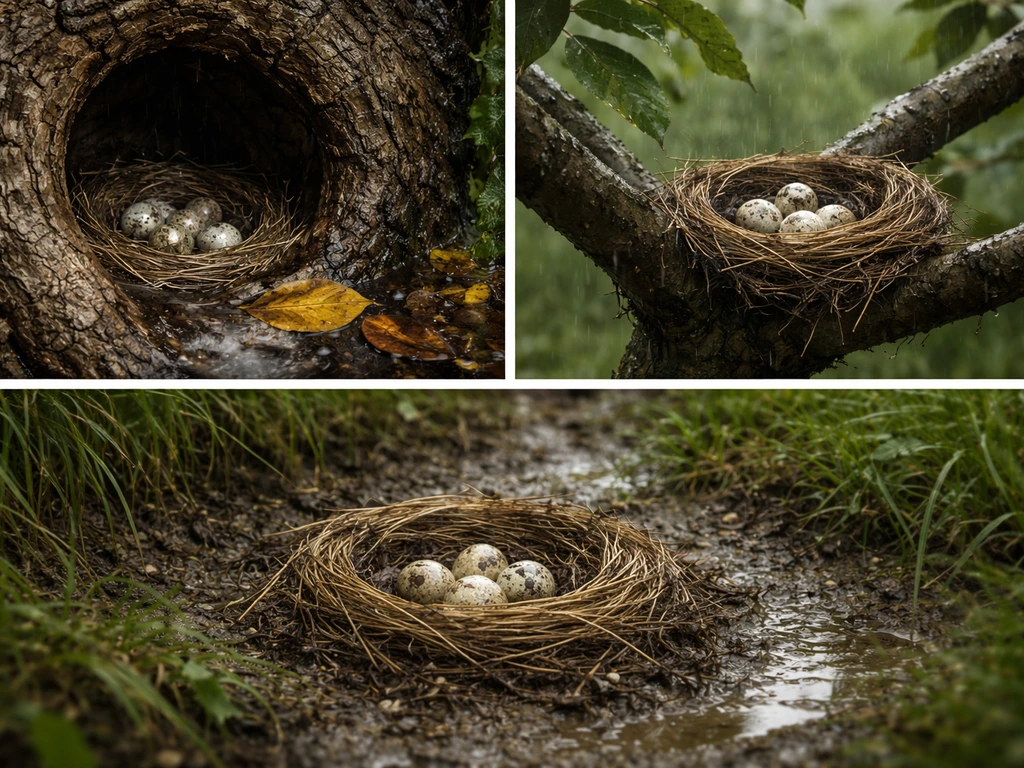
Not all nests are built the same, and storms hit each type differently. The broad categories worth knowing are cup nests, cavity nests, ground nests, platform/stick nests, and cliff or shore nests. Each has a different failure mode under wind, rain, hail, and flooding.
Cup nests (think robin, warbler, or sparrow) are the most common type people find and worry about. They're woven into shrubs and tree forks and are surprisingly resilient under moderate rain, but they have real vulnerabilities. Research on the aerodynamics of cup-shaped nests shows that increasing wind speeds can roughly halve the time it takes for a nest to lose heat compared to still conditions. The nest itself may stay intact, but the eggs inside get dangerously cold faster. Biomechanical modeling also points to the rim of a cup nest as a brittle failure point: under enough lateral force, the rim can crack, which can put eggs directly at risk depending on exactly how it fails.
Cavity nests, used by species like woodpeckers, bluebirds, and owls, are the most storm-resistant of the group. The tree or wooden structure around them absorbs most of the mechanical stress. Rain doesn't pool inside a proper cavity the way it can in an open cup. The main risks are the tree itself coming down and flooding if the cavity entrance faces the wrong way during a torrential rain event.
Ground nests are the most vulnerable. They have essentially no structural protection, and studies bear this out. Research on greater sage-grouse nests found that both maximum wind speed on the day of nest failure and precipitation the day before were significant negative predictors of daily nest survival. That lag effect matters: the worst day for a ground nest isn't always the day of the storm. It's often the next day, when the nest is still wet, the ground is saturated, and the adult is struggling to maintain warmth. Flooding is a direct kill mechanism for ground nests. Reviews of aquatic bird ecology note that ground-nesting species sometimes need elevated platforms just to survive raised water levels.
Platform and stick nests, like those built by ospreys, herons, and eagles, are large and heavy, which generally anchors them well. The main storm risk is catastrophic wind loading. A barn swallow mud-nest study used aerodynamic modeling to estimate that at wind speeds of 35 meters per second (roughly 78 mph, well within strong hurricane range), the aerodynamic force on a mud nest reaches about 8 newtons, which is approximately twice the combined weight of the nest and the birds. That gives you a rough sense of where the breaking point is for nests that rely on adhesion and weight for stability.
Cliff and shore nests, used by terns, gulls, and some alcids, face a specific threat: storm surge and overwash. Research on least tern nests in South Carolina specifically identified overwash events as a direct mortality mechanism, alongside high wind and heavy rain. These birds nest low, often nearly at the waterline, and a surge can wipe a colony site clean in minutes.
What actually determines whether a nest makes it
There are five overlapping factors that determine nest survival: wind speed and gusting pattern, rainfall volume and intensity, hail, flooding, and storm duration. Understanding how they interact is more useful than treating any one factor as decisive.
Wind
Wind is the most mechanically direct threat. Gusts apply sudden force spikes that a nest built to handle steady loading may not resist. The aerodynamic modeling data referenced earlier gives a concrete example: at 35 m/s, force on an adhesive mud nest exceeds twice its own weight. In fact, birds typically avoid getting electrocuted during thunderstorms because they rely on sheltering and body insulation rather than being struck in the way movies suggest.
For cup nests in branches, the risk is more often displacement or rim fracture than total destruction. The branch or fork the nest sits in also matters enormously. A nest anchored in a solid crotch survives gusts that peel an identical nest off a thin outer limb.
Rain
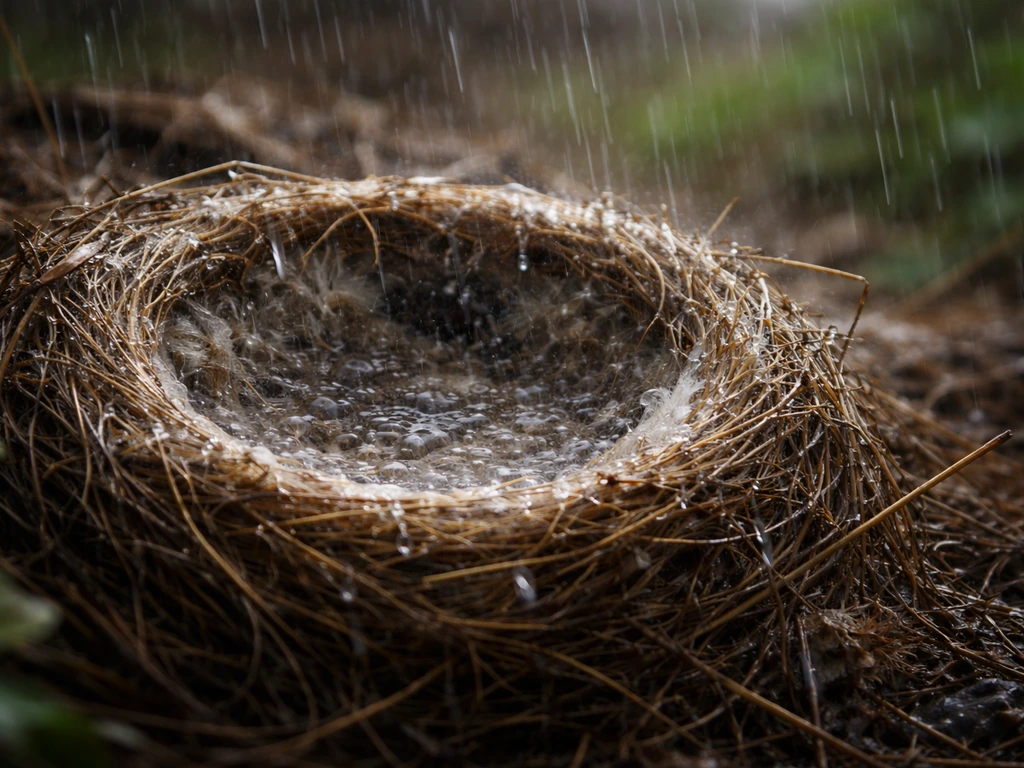
Rain alone rarely destroys a well-built cup or cavity nest, but heavy persistent rain creates two serious problems: it saturates nest material, reducing its insulating value, and it can force adults off the nest, exposing eggs to dangerous cold. Research on arctic peregrine falcons provides a striking example: long-term monitoring linked increasing frequency of heavy rain events to declining nestling survival, with hypothermia and starvation (when soaked parents couldn't feed) as the likely mechanisms. Rain can also be a direct trigger for nest abandonment, with at least one study in the journal Ardea finding that rain had a stronger influence on abandonment decisions than temperature in some species.
Hail
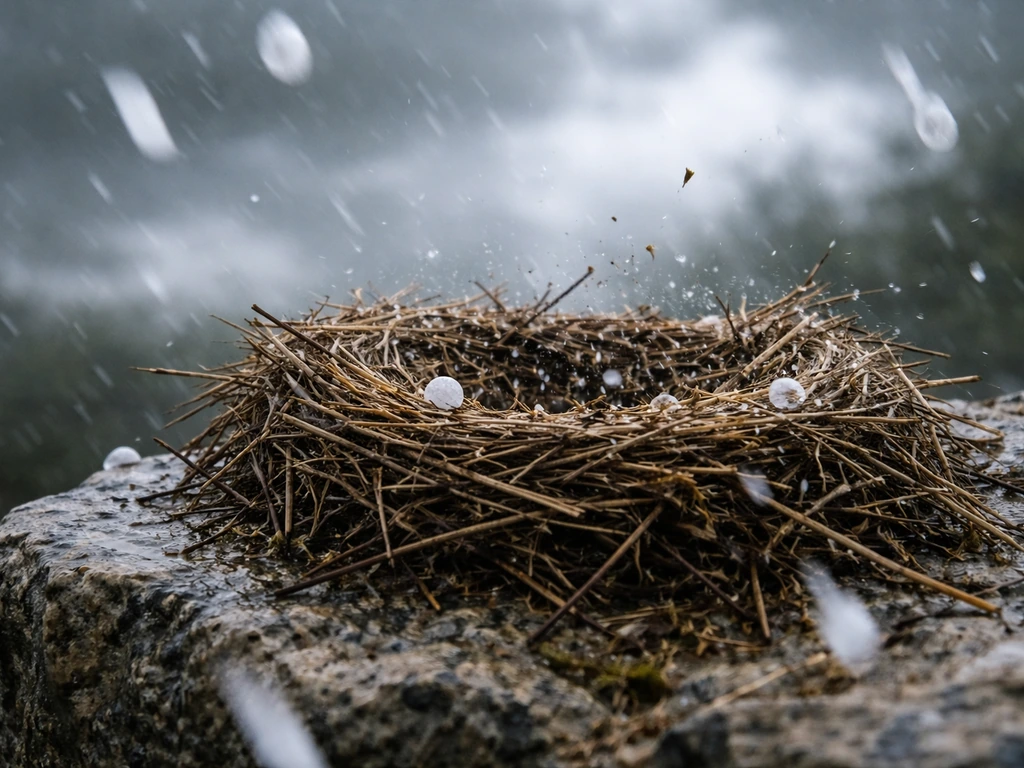
Hail is in its own category of danger because it's both a physical impact threat and a rapid thermal shock to eggs. The published evidence here is unambiguous: documented case studies exist of hail-induced nest failure and adult mortality in ground-nesting and shrubland species. Hail-induced nest failure and adult mortality in a declining ground-nesting forest songbird provides a documented case study of these hail effects in ground-nesting contexts. USGS-backed research modeling hail-induced mortality in grassland birds found that hail size combined with wind shear was the most parsimonious predictor of mortality. If you're dealing with the aftermath of a hail event, the damage to nests is likely worse than it looks from a distance.
Flooding
Standing water is lethal for ground nests and can overtop shore nests with no warning. For tree nests, flooding is typically less of a direct threat unless the flood carries debris that strikes the nest. The key factor is drainage: a cup nest with woven material that sheds water survives a downpour far better than one sitting in a natural depression that pools.
Duration and timing in the breeding cycle
A brief intense storm during mid-incubation is a very different situation from a multi-day weather event during the first 48 hours after eggs are laid. Eggs can tolerate short cold spells better than extended chilling. Chicks, which can't thermoregulate, are far more vulnerable. Duration also matters for adult behavior: research on ferruginous hawks found females spent increasing time on the nest as wind speed rose, which is an adaptive response. But a storm long enough to exhaust that behavioral buffer crosses a threshold where even a motivated parent can't maintain nest temperature.
Species and nest placement: who's most at risk
| Nest type | Examples | Primary storm risk | Typical resilience |
|---|---|---|---|
| Cavity nest | Woodpeckers, bluebirds, owls | Tree falls, entry flooding | High |
| Cup nest (tree/shrub) | Robins, warblers, sparrows | Wind displacement, rim fracture, heat loss | Moderate |
| Platform/stick nest (high) | Ospreys, herons, eagles | Extreme wind loading | Moderate-high |
| Ground nest | Sage-grouse, killdeer, terns | Wind, rain saturation, flooding, hail | Low |
| Cliff/shore nest | Terns, gulls, alcids | Storm surge, overwash, wave action | Very low in surge events |
| Mud/adhesive nest | Barn swallows, cliff swallows | Force exceeding adhesion at high wind speeds | Moderate below ~35 m/s |
Nest placement within those categories also matters. A ground nest with overhead grass concealment survives better than one in open terrain, both because the cover interrupts direct rainfall and wind, and because concealment affects predation risk in the post-storm period when adults may be disturbed. Research specifically linking nest concealment characteristics to nest fate confirms that microhabitat cover is a meaningful survival predictor. Similarly, a cup nest positioned in the interior of a dense shrub is mechanically better protected than one on an exposed outer branch.
Myths vs. reality about what storms do to eggs and chicks
There's a lot of folklore about storm damage to nests, and most of it makes things worse by pushing people toward interventions that cause more harm than the storm did. You might also wonder why birds typically do not get electric shock when they’re near power lines or electrical equipment why bird not get electric shock. Here are the claims worth addressing directly.
- Myth: Storms always destroy nests. The reality is that most cup and cavity nests survive typical spring thunderstorms intact. Storm severity matters enormously. A 20-minute gust event is not a hurricane.
- Myth: Birds abandon nests after storms. The reality is that adults are strongly motivated to return. Research on American kestrels found high proportions of nesting attempts continued even after disturbance events, depending on timing and severity. 'Abandoned' usually means the adult is hiding nearby, not gone.
- Myth: Rain ruins eggs. The reality is that brief wetting doesn't kill eggs. Eggs have a cuticle layer that provides some protection. The real danger is sustained chilling from cold rain combined with adult absence, not moisture itself. Incubation physiology research confirms that nest humidity and temperature interact, but brief exposure is far less damaging than extended temperature drops.
- Myth: Moving a nest saves it. The reality is that relocating a nest usually makes things worse, not better. Adults return to the site location, not the nest. Moving eggs disrupts the incubation microclimate they're adapted to. And under the Migratory Bird Treaty Act, most nests with eggs or young are federally protected: handling them without permits is illegal.
- Myth: A nest that looks damaged is abandoned. The reality is that a nest can look tilted, disheveled, or partially collapsed and still be actively used. Adults will repair nests and return. Observing from a distance for several hours before drawing any conclusion is the right move.
What to do if you find a nest after a storm
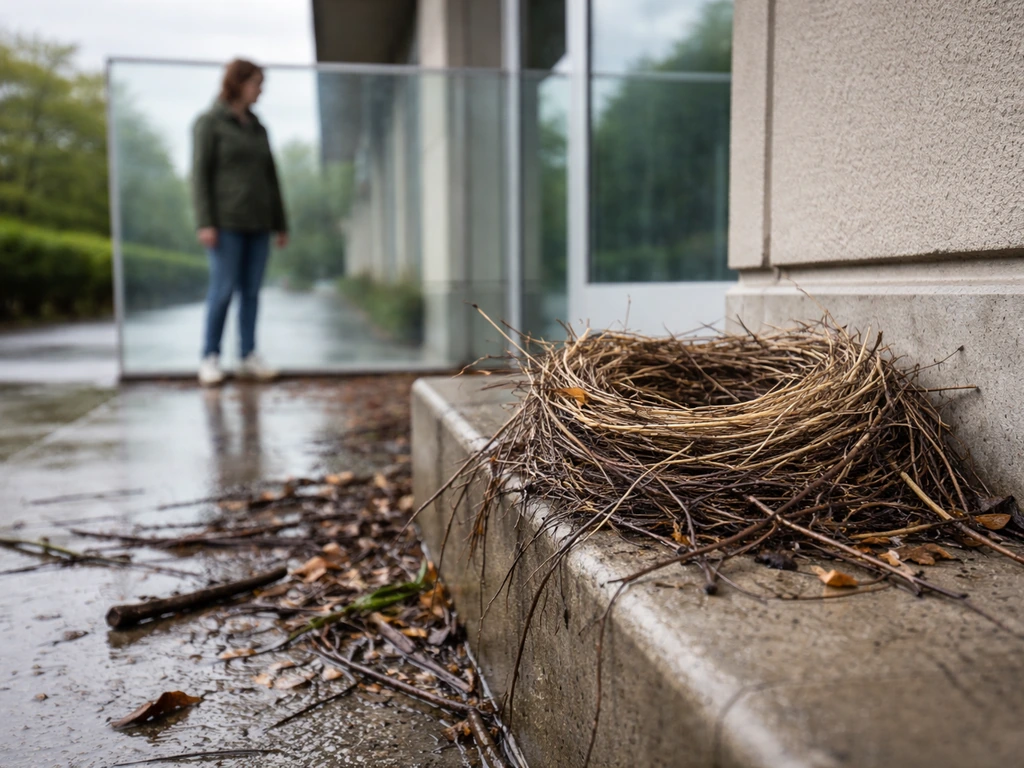
The default response for most situations is: observe, don't touch. If you see a bird perched on a wire after a storm, it may still be safe, which is why is the bird on the wire safe is a common question. That's not passivity, it's the action most likely to result in the best outcome for the birds. Here's how to think through what you're actually seeing.
- Watch from a distance first. Give the nest 1 to 2 hours without human activity nearby. Use binoculars if you have them. The Smithsonian's nest monitoring guidelines recommend exactly this: monitor from distance, avoid creating foot traffic near the nest, and check for adult activity before assuming anything.
- Check if the nest is structurally accessible. If the nest has fallen to the ground but is still intact and contains eggs or living chicks, it can sometimes be placed back in the same tree at roughly the same height, secured gently in a small container like a berry basket wedged in a branch fork. This is one of the few cases where limited intervention is generally accepted. Do not move it to a different location.
- Check for chicks vs. eggs. A nestling (feathered chick) found on the ground after a storm may be a fledgling that was near leaving anyway. A fledgling with feathers and some mobility is not in crisis the same way a naked hatchling is.
- Do not handle eggs unless a rehabilitator specifically tells you to. Federal protection under the Migratory Bird Treaty Act applies to nests, eggs, and chicks of most native species. US Fish and Wildlife Service guidance states that permits are required for interference with nests and are generally issued only when there's a human health or safety concern or immediate danger to the birds.
- Do not feed nestlings or chicks. Feeding the wrong food can kill birds faster than hunger. This is not an area where well-intentioned improvisation helps.
- If chicks are cold but alive, warmth matters more than food in the short term. A wildlife rehabilitator can advise on bridging care while you arrange transport.
Safe actions for pet owners and bystanders
If you have cats, dogs, or children near a storm-damaged nest, the immediate priority is reducing access to the nest area, not moving the nest. You should also keep birds away from downed or live wires, since a bird can get electrocuted on a wire can a bird get electrocuted on a wire. State wildlife agency guidance consistently recommends keeping cats indoors and dogs leashed during spring nesting encounters, and a storm-damaged nest situation is exactly when this matters most. A disoriented adult bird or grounded nestling is extremely vulnerable to a free-roaming cat, and the legal and ethical stakes are real.
Practically, use temporary barriers: a ring of garden stakes or a piece of lawn furniture placed around the nest area is usually enough to redirect foot and paw traffic. You don't need to cover the nest or intervene with the birds at all. The goal is to create a buffer zone while adults return and assess their own situation.
Avoid the temptation to waterproof or cover the nest yourself. Covering a nest with a tarp or plastic blocks the adults from accessing it, raises internal humidity in ways that aren't necessarily beneficial, and signals to the adult that something is wrong with the site. It also risks trapping a returning adult. Do nothing to the nest structure itself.
If a nest is in a location that creates a genuine human safety hazard (a damaged nest over a frequently used walkway, for example), document what you see, then contact wildlife rehab or your state wildlife agency before removing anything. Birds can also be injured around downed or damaged power lines, so treat any electrical hazard as a serious safety issue and contact the utility if you see one why dont bird get electrocuted on power lines. Federal protections apply even to nests that are inconveniently placed.
When to call wildlife rehab and how to actually help

The Washington Department of Fish and Wildlife's guidance is direct about this: attempting to intervene without expertise can be harmful or fatal, and you should contact a wildlife rehabilitator for advice before taking action. That's a reasonable rule. But it helps to know which specific situations actually warrant that call.
- A naked hatchling (eyes closed, no feathers) is on the ground and you cannot locate or safely reach the nest to return it
- A nestling is visibly injured, not just wet or cold
- The entire nest structure has been destroyed or is unrecoverable and eggs or live young are exposed
- Adults have not returned to a nest with live eggs or young after 4 to 6 hours of undisturbed observation
- A chick is in immediate danger from a predator, flooding, or traffic and cannot wait
- You found an adult bird that appears injured near a storm-damaged nest (injured adults cannot protect or warm eggs)
To find a licensed rehabilitator, the National Wildlife Rehabilitators Association (NWRA) and Wildlife Rehabilitators of North America maintain searchable directories. Your state wildlife agency will also have a referral list. The CDC's guidance on wildlife encounters is clear: leave handling to professionals, both for the animal's welfare and for your own health. Contacting a rehabilitator doesn't mean they'll take the bird. Often they'll walk you through exactly what you should and shouldn't do over the phone, which is exactly the guidance you need.
One more thing worth saying plainly: the post-storm period is often harder for birds than the storm itself. A US Forest Service review of hurricane effects on birds specifically notes that the greatest stress often comes after passage, not during it, because of increased predation vulnerability and disrupted food access. The same logic applies to smaller storms. Keeping the area calm, keeping pets away, and letting adults return on their own schedule does more good than almost anything else you can do. If the storm involved lightning, you should also consider whether can a bird get struck by lightning even when the nest appears intact, because lightning risk is a related safety factor.
Quick decision checklist for after a storm
- Is the nest still in place, even if tilted or disheveled? If yes, do nothing. Watch from a distance for adult activity.
- Has the nest fallen but remains intact with eggs or live chicks? If yes, consider carefully replacing it in the same tree at the same height in a small open container. Call a rehabilitator first if unsure.
- Are there live chicks on the ground? If they are feathered (fledglings), leave them. Parents are likely nearby. If they are naked hatchlings, call a rehabilitator immediately.
- Have adults been absent for more than 4 to 6 hours from a nest with live eggs or young, with no disturbance from you? Call a wildlife rehabilitator.
- Is there a genuine human safety hazard from the nest's location? Document it, then call your state wildlife agency before touching anything.
- Are pets or children near the nest? Create a physical barrier around the area right now. Keep cats in. Keep dogs leashed.
- Are you tempted to feed, cover, move, or waterproof the nest? Stop. Call a rehabilitator instead.
FAQ
How can I tell if a nest that looks damaged is still likely being cared for?
Look for signs that the nest is still accessible to adults, not just that it looks “intact.” If adults are still flying in and out normally within a few hours, the eggs or chicks are more likely to be okay even if debris is present. If you see repeated adult absence plus exposed eggs or soaked nest material, that is a stronger indicator you should contact a wildlife rehabilitator for advice.
Should I check on a nest immediately after the storm or wait?
Rain soaked into a nest often worsens heat loss after the storm, so “when to check” matters. Avoid frequent visits, instead make one careful look from a distance, then check again later. If chicks or eggs are exposed, the guidance is still observe first, because adults may resume incubation or brooding later once conditions stabilize.
Is it okay to move debris back into place if the nest is partially knocked over?
It can be dangerous and usually isn’t helpful, because moving nest contents changes scent and can break the eggs’ position or cooling pattern. Even if the structure seems loose, adults typically rework their nests if conditions allow. If you need to act, prioritize blocking access for pets and people, and contact a rehabilitator if there are obvious injuries, persistent abandonment, or severe flooding.
What specific post-storm situations mean I should contact a wildlife rehabilitator?
Yes, but timing is critical. If you see a grounded bird, a cold, immobile chick, or an egg with visible cracking after weather extremes, that is a case for contacting a rehabilitator. If an adult is present and actively responding, focus on keeping the area quiet and pet-free rather than intervening.
Should I clean out the nest or remove wet debris after a storm?
Avoid cleaning the nest yourself, especially with detergents, because residual chemicals and altered odors can discourage return. If debris is dangerous to people, document it and get professional guidance before removal. For most storm-damaged nests, the best “cleanup” is simply keeping people away while adults decide whether to reuse or rebuild.
If adults aren’t around right after the storm, does that mean the nest failed?
Not automatically. Some storms displace nests without immediate egg loss, and adults may relocate, rebuild, or keep caring if the eggs stay warm and protected. If you find an apparently abandoned nest, give a window of time for adult return while maintaining a calm, barrier-protected area.
What should I do if a storm-damaged nest is in a high-traffic spot?
The fastest decision aid is to judge human safety first. If the nest is over a frequently used walkway or near a hazardous electrical area, keep people away and contact the right agency or utility before any intervention. If it is only inconveniently placed but not a safety hazard, observation and keeping access limited is usually the safest approach.
What’s the safest way to keep pets and kids away from a storm-damaged nest?
Staying away from the nest during and after storms is one piece, but you also need to manage your pets and your own behavior. A ring of stakes or furniture is usually enough to prevent pawing and accidental contact, and you should avoid covering the nest with tarps or plastics that block adult access and trap humidity.
What should I do if the nest is near power lines or a downed wire after the storm?
If the nest is near power lines, treat it as an electrical safety issue even when it looks intact. Do not attempt to move birds, nests, or branches, and avoid climbing or using ladders. Keep a buffer zone, keep pets indoors or leashed, and contact the utility for downed line hazards.
Does hail change how I should respond to a nest after a storm?
If hail struck, damage can be worse than it appears because hail can cause rapid thermal stress to eggs and injury to ground or low nests. After hail, the “observe only” rule still applies to nest handling, but it increases the likelihood that a ground nest, exposed nestlings, or an injured adult will need professional help.