
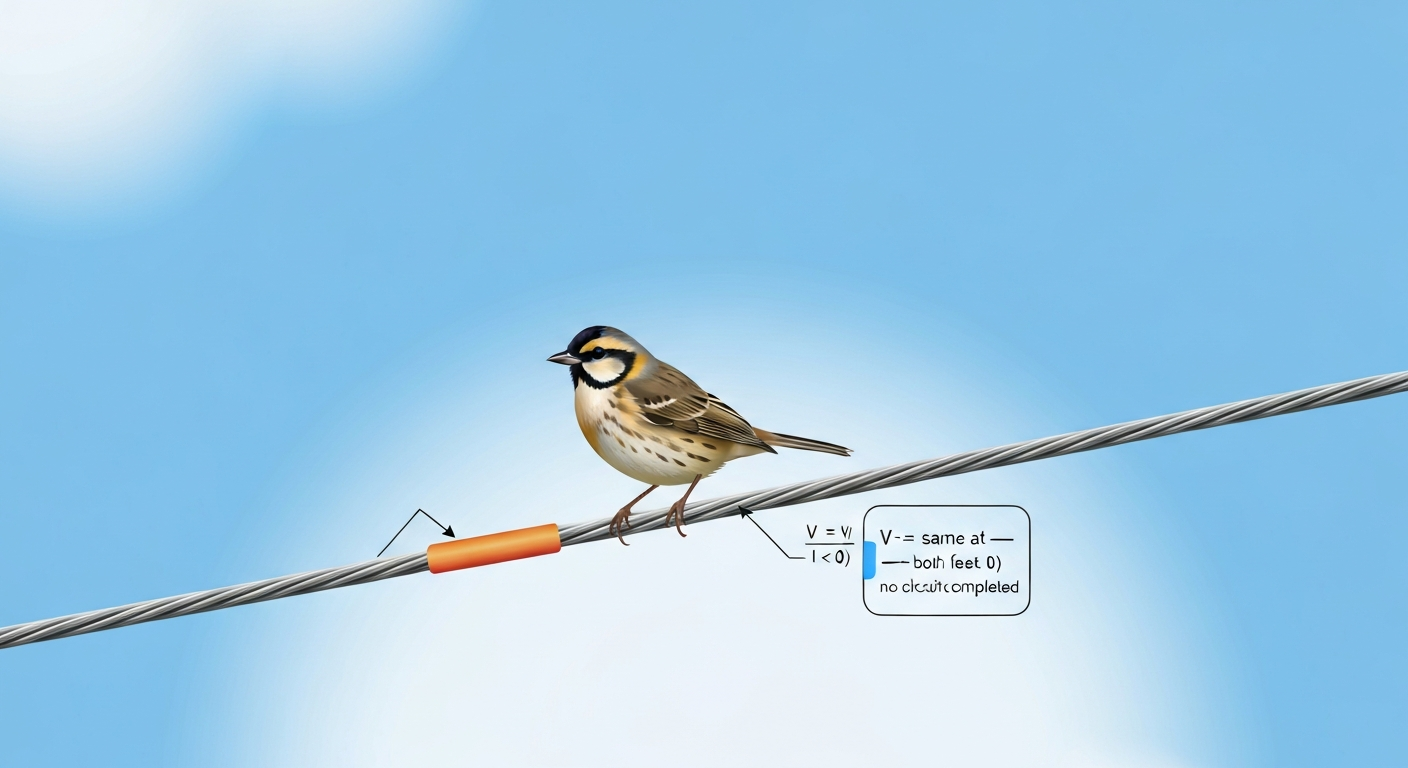
A bird perched on a single power line doesn't get shocked because both of its feet are touching the same wire at essentially the same electrical potential. With no meaningful voltage difference across its body, Ohm's law means virtually no current flows through it. The bird is, in electrical terms, just a small resistor connecting two points at the same voltage. The danger only arrives when a bird simultaneously contacts two conductors at different potentials, or one conductor and any grounded component, completing a circuit and allowing current to rush through its tissue. If you'd like a short, focused answer, read our piece on why don't birds get electrocuted on power lines.
Why Bird Doesn't Get Shock on Power Lines: Explained

Marcus Whitmore
9 Aug 2026
A quick primer on electricity (for everyone who isn't an electrician)
To understand why birds are usually safe on wires, you need three concepts: voltage, current, and potential difference. Voltage is electrical pressure. Current (measured in amperes) is the actual flow of electrons through a material. Ohm's law ties them together: current equals voltage divided by resistance (I = V/R). The critical word here is difference. What drives current through any object, including a bird's body, is not the absolute voltage of the wire but the difference in voltage between two points of contact.
Grounding is the other piece. The earth itself is treated as a reference point of zero volts. Any metal structure, transformer casing, or neutral wire physically connected to the earth shares that reference. The moment a bird bridges a live, energized conductor and anything connected to earth, it has completed a circuit between a high voltage and zero volts. That potential difference is enormous, and the resulting current can easily kill.
Why a single wire is usually safe for a perched bird
When a bird lands on a single energized conductor, both feet rest on the same wire. The tiny stretch of wire between those two feet is at essentially the same voltage at both points of contact, so the potential difference across the bird's body is negligible. Even though the wire itself might be energized at 12,000 volts or more above ground, the bird doesn't experience that voltage because it isn't connected to ground. It's sitting on the wire but not in the circuit. For a concise explanation of this phenomenon, see why is the bird on the wire safe. This is the equipotentiality principle, and it's the same reason a lineworker wearing fully insulating gear can handle a live conductor without being killed: if you're not part of a complete circuit between two different potentials, current can't flow.
The bird's body does have resistance, but resistance only matters when there's a voltage driving current through it. Without the voltage difference, even a low-resistance path carries negligible current. This is Ohm's law in plain terms: divide a near-zero voltage by any resistance, and you get a near-zero current. That's genuinely reassuring, and it's why millions of birds sit on power lines every day without incident.
When birds do get electrocuted: the conditions that make it lethal
The U.S. Geological Survey is clear on this: electrocution requires a completed path between two points at different potentials. For birds, that almost always means one of three scenarios identified by the Avian Power Line Interaction Committee (APLIC). Understanding these scenarios is the difference between a safe perch and a fatal one.
- Phase-to-phase contact: the bird simultaneously touches two conductors carrying current at different phases of the electrical supply. The voltage difference between them can be hundreds or thousands of volts depending on the line type.
- Phase-to-ground contact: the bird touches one energized conductor and any component that is bonded to earth, such as a grounded neutral strap, a transformer tank, a metal pole fitting, or a guy wire anchor. The full phase-to-ground voltage drives current through the bird.
- Arcing or flashover: under high humidity, during rainfall, or when a conductive wet nest bridges a gap, current can arc across air without direct physical contact. The bird doesn't need to touch both conductors if a water or nest streamer does the bridging for it.
The experimental literature on electrical injury in birds gives us a rough sense of what lethal current looks like. Controlled studies on domestic poultry report that currents in the range of 100 to 400 milliamps traversing the heart or brain are sufficient to stun or produce cardiac fibrillation. A ScienceDirect article titled "Head‑to‑cloaca electrical stunning of broilers (poultry electrical‑stunning literature)" provides experimental benchmarks consistent with the 100–400 mA range reported for stunning or inducing cardiac fibrillation in domestic fowl ScienceDirect — Head‑to‑cloaca electrical stunning of broilers (poultry electrical‑stunning literature). These figures come from engineered exposures and can't be applied directly to every wild species, but they establish a key point: the currents that kill birds are not exotic. A modest voltage difference across a low-resistance contact path can easily generate current well above those thresholds.
Other electrocution hazards beyond the wires themselves
Transformer casings are one of the most dangerous structures a bird can perch on. The outer metal enclosure of a distribution transformer is bonded to ground. EWT (Endangered Wildlife Trust), Manual/utility guidance (discussion of transformer electrocutions & grounded components) documents that transformer cases, grounded neutral hardware, and grounded pole fittings are repeatedly cited as common electrocution sources because their metal enclosures are tied to earth, so a bird touching an energized conductor and any grounded component completes a circuit to ground and will be electrocuted EWT (Endangered Wildlife Trust) — Manual/utility guidance (discussion of transformer electrocutions & grounded components). If a bird touches the casing while its wing, foot, or tail simultaneously contacts an energized bushing or conductor entering the transformer, it completes a direct phase-to-earth circuit. Utility manuals and incident reports repeatedly identify transformer top hardware as a common site of electrocution, particularly for large raptors that use these elevated structures as hunting perches.
Damaged or contaminated insulators are another underappreciated hazard. Insulators are designed to electrically isolate live conductors from the grounded pole hardware. When an insulator cracks, becomes coated with salt spray, industrial pollution, or significant moisture, it can develop a partial conductive path. A bird perched near a compromised insulator may inadvertently complete a circuit that wouldn't exist on a clean, dry pole. Similarly, metal cross-arms, grounded jumper wires, and pole bands that connect hardware back to the earth all represent phase-to-ground hazards when they're within a bird's wingspan of a live conductor.
Wet or conductive nests present a less obvious but real risk. A nest built in or near a transformer compartment or between live hardware and a grounded surface can act as a slow-growing conductive bridge, especially after rain soaks nest material. This is one of the scenarios APLIC flags for arcing and flashover risk, and it's also one reason utilities actively manage nest locations on high-risk structures.
How high-voltage and high-tension lines change the risk calculation
It's tempting to assume that higher voltage means higher risk to birds, but the relationship is more nuanced than that. In North America, primary distribution lines typically operate at 4.8 to 34.5 kV, with 12.47 kV being very common. Subtransmission and transmission lines range from 69 kV up to 765 kV. Counterintuitively, distribution lines, not the giant transmission towers, are where most bird electrocutions happen.
The reason is conductor spacing. Transmission lines at 69 kV and above are engineered with very large phase-to-phase and phase-to-ground clearances, often several meters between conductors, and they use long suspension insulators that keep hardware well separated. The physics of high voltage demands these clearances. Distribution poles, operating at lower voltages, can place conductors and hardware much closer together, sometimes within the wingspan of a large hawk, eagle, or heron. The gap that's electrically safe to maintain at 12 kV can be bridged by a bird that would have no trouble at a 345 kV tower where spacing is far greater.
| Line type | Typical voltage range | Common conductor spacing | Main bird electrocution risk |
|---|---|---|---|
| Primary distribution | 4.8–34.5 kV (often 12.47 kV) | Relatively close; varies by pole design | High: spacing often within wingspan of raptors and large wading birds |
| Subtransmission | 26–69 kV | Moderate; design-dependent | Moderate: depends on pole hardware and configuration |
| Transmission | 69–765 kV | Large; suspension insulators standard | Lower: clearances usually exceed wingspan of any bird |
A peer-reviewed analysis published in PLOS ONE by Loss and colleagues estimated that U.S. distribution lines kill between 0.9 and 11.6 million birds annually, with a median around 5.6 million per year. Distribution feeders dominated those estimates precisely because of the spacing and hardware configurations described above. Large raptors, storks, and herons are overrepresented in electrocution records because their wingspans can bridge gaps that smaller birds never reach.
Can birds be struck by lightning, and how does it work?
Yes, birds can be struck by lightning, but the event is genuinely rare in proportion to the bird population. For a focused discussion on lightning strikes to birds, see can a bird get struck by lightning. Lightning kills through a combination of direct strike current, ground current radiating outward from a strike point, and side flash to nearby conductive objects. A bird in flight or perched in an exposed tree is theoretically at risk from all three mechanisms, but the probability for any individual bird on any given storm day is extremely low.
Direct strikes to birds in flight occur but are hard to document because the birds are rarely recovered. Ground current is probably a more common mechanism: when lightning strikes the ground, current spreads outward in a gradient. A bird standing on the ground with its feet some distance apart (or a roosting flock on wet ground) can experience a voltage difference between contact points, much like the power-line scenario described earlier. In documented mass mortality events linked to lightning, ground current flowing through a flock is often cited as the mechanism rather than a direct bolt.
Side flash, where lightning jumps from a struck object (a tree, a tower) to a nearby conductor or animal, is an additional pathway. Birds roosting in dense canopy near a struck tree may be killed by this mechanism. The relative contribution of each pathway in field incidents is difficult to determine without detailed forensic investigation. The broader point is that lightning represents a real but low-probability hazard for birds, quite different in character from the chronic, predictable electrocution risk posed by distribution infrastructure.
Can bird nests survive storms, and what are the real risks to eggs and chicks?
Most bird nests are more resilient than they look, but they are not indestructible. Whether a nest survives a storm depends on its placement, construction material, the species that built it, and the severity of the weather. For more detailed information about how nests fare in severe weather and which factors predict survival, see can a bird nest survive a storm. Cup nests in sheltered forks or dense shrubs generally fare better than exposed platform nests on open branches. Studies of nest survival rates during storm events consistently show that nest site selection is the primary predictor of survival, not nest construction quality.
For nests on or near power infrastructure, storms introduce secondary risks beyond direct wind damage. A lightning strike to a pole or nearby tree can ignite a nest, scorch eggs, or kill nestlings through heat or fire. If a nest is built on a structure that conducts the strike, current may travel through the nest itself. Even without a direct strike, high winds can swing wet nest material into live conductors, creating the arcing hazard mentioned earlier. Flooding and rapid temperature drops following severe storms also threaten egg viability and nestling thermoregulation, particularly for ground-nesting species.
The practical takeaway is that nests on power pole hardware are at elevated risk during storms, not just from wind but from fire, electrical arcing, and structural damage to the pole itself. Utilities managing these sites try to relocate at-risk nests to nearby safe platforms before nesting season, which protects both the birds and the reliability of the infrastructure.
What electrocution actually looks like in a bird
Electrocuted birds don't always show dramatic external injuries. In many cases the most visible signs are singeing or burn marks at the points of electrical contact, typically the feet, wingtips, or beak, depending on which parts bridged the circuit. Feathers near contact points may be charred or fused. Internally, cardiac arrhythmia, ventricular fibrillation, or neurological shutdown can occur with currents of tens to hundreds of milliamps, often leaving no obvious external sign at all.
A bird that survives initial electrocution may be found on the ground beneath a power line, alive but unable to stand, fly, or maintain posture. Loss of motor control, seizure activity, or apparent disorientation can all follow an electrical insult. Immediate survival prospects depend on the magnitude and duration of current, the pathway through the body (current crossing the heart is most dangerous), and how quickly the bird receives veterinary attention. Many electrocuted raptors and large birds that appear to survive the initial event die within hours or days from delayed cardiac effects or tissue damage.
One important forensic note: a bird found dead beneath a power line has not necessarily been electrocuted. A USGS necropsy-based study found that in some western U.S. datasets, illegal shooting rivals or exceeds electrocution as a documented cause of death in birds found near power-line corridors. Assuming electrocution without a proper necropsy leads to underestimates of other mortality causes and misallocates conservation effort. If you find a dead bird under infrastructure, report it and, where possible, support necropsy-based investigation rather than guessing the cause.
What to do if you find an injured bird near power lines
The first rule is simple: don't touch a downed power line or any wire on the ground, ever, regardless of whether a bird or other animal is nearby. Downed lines may still be energized. Ground current from a downed line can radiate outward several meters from the point of contact, meaning you can be injured without touching the wire at all. Keep bystanders at least 10 meters away and call your local utility's emergency line and emergency services.
- Keep yourself and others well away from any wire, pole hardware, or grounded metal near the scene.
- Do not attempt to move an injured bird if doing so requires approaching a potentially energized structure or wire.
- Once you are certain the area is safe (utility confirmation, not assumption), you may carefully contain the bird in a ventilated box using gloves. Avoid prolonged direct skin contact with an injured raptor's talons.
- Contact a licensed wildlife rehabilitator or your regional wildlife agency. In the U.S., most states have a directory through the National Wildlife Rehabilitators Association or equivalent state agency.
- Note the exact location, the type of structure (distribution pole, transformer, substation), and whether you observed the bird fall or found it already on the ground. This information is important for both veterinary triage and incident reporting.
- If the bird is dead, do not dispose of it. Report it to your state or federal wildlife agency. In the U.S., most bird species are protected under the Migratory Bird Treaty Act, and unauthorized possession is prohibited.
Guidance for aviation professionals and infrastructure managers
For aviation professionals, bird-electricity interactions matter primarily in two contexts: bird-strike risk assessment near infrastructure and the electromagnetic environment around transmission corridors. Large raptors attracted to power poles as perch sites and hunting platforms can aggregate in numbers near runways and approach paths when distribution lines run close to airports. Knowing that electrocution risk on distribution structures can drive raptor mortality, while also concentrating survivors at those same sites, is relevant to wildlife hazard management planning.
For infrastructure managers and utility safety officers, the risk-prioritization framework is well established. The highest-risk structures share a specific profile: distribution-voltage poles with short phase-to-phase or phase-to-ground spacing, uninsulated hardware, transformer tops accessible to large birds, and locations within the home range of raptors, herons, storks, or other large species. APLIC and IEEE publish design checklists and retrofit catalogs that allow systematic prioritization of which structures to address first. Utilities that have conducted audits in raptor habitat typically find that a small fraction of poles account for a disproportionate share of electrocutions, meaning targeted retrofitting delivers large returns per dollar invested.
Coordination with federal and state wildlife agencies is both a legal and a practical necessity in many jurisdictions. In the U.S., the Bald and Golden Eagle Protection Act and the Migratory Bird Treaty Act create liability exposure for utilities where preventable electrocutions of protected species occur. Working proactively with the U.S. Fish and Wildlife Service on avian protection plans is standard practice for utilities operating in high-risk areas.
How utilities and wildlife organizations are reducing bird electrocutions
The mitigation toolkit is mature and evidence-based. Field trials by Dixon and colleagues reported reductions in electrocution rates of 59 to 73 percent at retrofitted sites. National programs in Hungary, Mongolia, and across the Mediterranean have documented similar reductions alongside measurable decreases in power outages caused by bird contacts, making the business case straightforward: retrofitting high-risk poles is good for birds and good for grid reliability.
| Mitigation measure | How it works | Evidence of effectiveness |
|---|---|---|
| Insulating covers on conductors and hardware | Rigid polymer caps or sleeves over live parts prevent contact | Substantial reduction in electrocutions at treated sites; 59–73% reductions reported in field trials |
| Increased phase-to-phase and phase-to-ground spacing | Reconfigures or replaces pole hardware to exceed wingspan clearances | Eliminates phase-to-phase bridging risk for target species; standard in new construction guidelines |
| Safe nest platforms | Provides an elevated, grounded-neutral structure placed at safe clearance distance from live parts | Redirects nesting behavior; reduces nest-related arcing events |
| Perch deterrents at hazardous points | Physical deterrents (spikes, rotating devices) discourage landing at high-risk spots | Effective at specific high-risk points; may shift birds to nearby safe structures if installed alongside those options |
| Transformer guard covers | Insulating covers or bird guards over transformer bushings and energized entry points | Removes phase-to-ground hazard at transformer tops; widely deployed in raptor-rich areas |
Prioritization matters. Because a small fraction of poles typically accounts for most documented electrocutions, systematic risk audits combined with targeted retrofitting consistently outperform blanket programs. APLIC's Suggested Practices for Avian Protection on Power Lines and IEEE Standard 1264 (Guide for Animal Deterrents for Electric Power Supply Substations) are the primary reference documents for utilities undertaking this work.
Common myths about birds on wires, addressed directly
The most persistent myth is that birds on power lines are somehow immune to electricity, or that their feet have special insulating properties. The reality is that bird feet are not meaningfully insulating. Ordinary skin has moderate resistance, but it doesn't protect against substantial voltage differences. What protects birds on a single wire is the absence of a voltage difference, not any special biology. A bird would be just as 'immune' on an uninsulated wire carrying a million volts, provided it stayed on that single conductor and wasn't grounded. The physics is entirely about circuit completion, not species physiology.
Another myth is that only high-voltage lines are dangerous to birds. As covered above, the opposite is often true in practice: medium-voltage distribution lines kill far more birds annually than high-voltage transmission lines, purely because of conductor spacing. The giant transmission towers crossing landscapes are actually among the safer structures for birds, not the most dangerous.
A third myth worth correcting: if a bird is found dead under a power line, electrocution must be the cause. That assumption has measurably distorted conservation data. The USGS necropsy work showing illegal shooting as a rival cause of death near power corridors is a clear reminder that cause of death requires evidence, not inference. Birds also die of collision with lines and structures (a separate and equally significant mortality source), predation, starvation, and disease near infrastructure. Assuming electrocution skews both the statistics and the management response.
How and when to report injured or dead birds
Reporting matters both for individual bird welfare and for population-level monitoring. In the U.S., any bird death at power infrastructure that may involve a protected species should be reported to the U.S. Fish and Wildlife Service through its regional office or the online reporting portal. State wildlife agencies often have parallel reporting requirements. When reporting, provide the precise GPS location or address, the date and time of discovery, a description of the infrastructure (pole, transformer, substation), whether the bird was found dead or alive, and if possible the species or a description with photographs.
For living injured birds, contact a licensed wildlife rehabilitator immediately. The National Wildlife Rehabilitators Association (NWRA) maintains a directory, as does the International Wildlife Rehabilitation Council (IWRC). Many state wildlife agencies operate 24-hour hotlines for raptor incidents specifically, given the protected status of eagles and hawks. If you're a utility worker or infrastructure manager who encounters a raptor electrocution at a company site, your legal and operational protocol should include both immediate notification to wildlife authorities and internal incident documentation for the avian protection plan on file.
Where to learn more
For anyone wanting to go deeper, the Avian Power Line Interaction Committee's Suggested Practices for Avian Protection on Power Lines (2006, updated editions) remains the most comprehensive practical reference for mitigation. The PLOS ONE paper by Loss et al. (2014) is the standard reference on mortality estimates. USGS maintains accessible guidance on electrocution and necropsy-based cause-of-death investigation. For the underlying electrical physics, OpenStax College Physics (freely available online) covers voltage, current, and Ohm's law clearly and without prerequisites. IEEE Standard 1264 covers deterrent design for substations specifically.
If you're exploring related questions, the same electrical principles covered here apply directly to understanding why high-tension transmission lines present a different risk profile than distribution lines, whether and how a bird can be electrocuted on a wire under specific contact conditions, and what makes certain wire configurations safer than others. The physics doesn't change across those questions; what changes is the structure, the voltage class, and the contact geometry.
FAQ
Why doesn’t a bird perched on a single power line usually get an electric shock?
A bird on one energized conductor is usually safe because both of its feet (and therefore its body) sit at essentially the same electrical potential. Electric current requires a potential difference (voltage) between two points to flow (Ohm’s law: I = V/R). If the bird only touches a single wire, there’s little or no voltage difference across its body, so negligible current flows and the bird is not electrocuted.
What is the difference between voltage and current, and which one actually causes electrocution?
Voltage (potential difference) is the force that can push electric charge; current is the flow of charge through a conductor. Electrocution depends on current through the body: if enough current flows through critical tissues (heart, brain), it can incapacitate or kill. The amount of current depends on the voltage across the body and the body’s electrical resistance (I = V/R), so a high voltage only becomes dangerous if it creates a significant potential difference across the bird.
Under what electrical circumstances can a bird be electrocuted on power lines?
Electrocution occurs when a bird completes a path between two points at different potentials. Common scenarios are: 1) touching two energized conductors at different phases (phase‑to‑phase), 2) touching an energized conductor and a grounded or neutral part (phase‑to‑ground), or 3) creating or being part of a conductive path (arcing/flashover), especially when wet or when nests/streamers bridge gaps. Distribution poles with closer conductor and hardware spacing present the greatest risk.
Why are distribution lines (lower voltage) often more dangerous to birds than high‑voltage transmission lines?
Distribution lines (commonly 4.8–34.5 kV) have conductors and pole hardware placed much closer together than high‑voltage transmission lines. That closer spacing makes it easier for a bird’s body or wingspan to simultaneously contact two different potentials (phase‑to‑phase or phase‑to‑ground). Transmission lines have larger phase‑to‑phase spacing and often suspension insulators, so small birds are less likely to bridge dangerous gaps.
How do transformer enclosures, grounded pole parts, and metal hardware cause bird electrocutions?
Transformer tanks, grounded neutral straps, metal pole fittings and grounded guy wires are tied to earth potential. If a bird touches an energized conductor and any grounded component at the same time, it completes a circuit to ground and current flows through the bird. These grounded parts are common electrocution sources because they reduce the distance (and voltage difference) a bird needs to bridge to make a deadly path.
Can birds be electrocuted by arcing or flashover without physically touching two parts?
Yes. Under high humidity, rain, or when conductive nest material or debris bridges gaps, a voltage can cause an arc (flashover) across an air gap or through conductive material. Arcing can create a sudden current path that can injure or kill birds even if they don’t make solid contact with two conductors.