Playing bird calls is not automatically harmful, but it can cause real, documented damage to individual birds and local populations when used carelessly. The harm depends on context: what type of call you play, how long, how often, the time of year, and how close you are to active nests or migration corridors. Occasional, brief playback in a low-pressure environment causes little lasting harm. Repeated, prolonged, or poorly timed playback during breeding season, near nesting sites, or in heavily visited locations is a different story, and the evidence supports taking that seriously.
Is It Bad to Play Bird Calls? Evidence, Risks, and Guidance

Marcus Whitmore
12 Aug 2026
How birds hear and what a playback actually sounds like to them
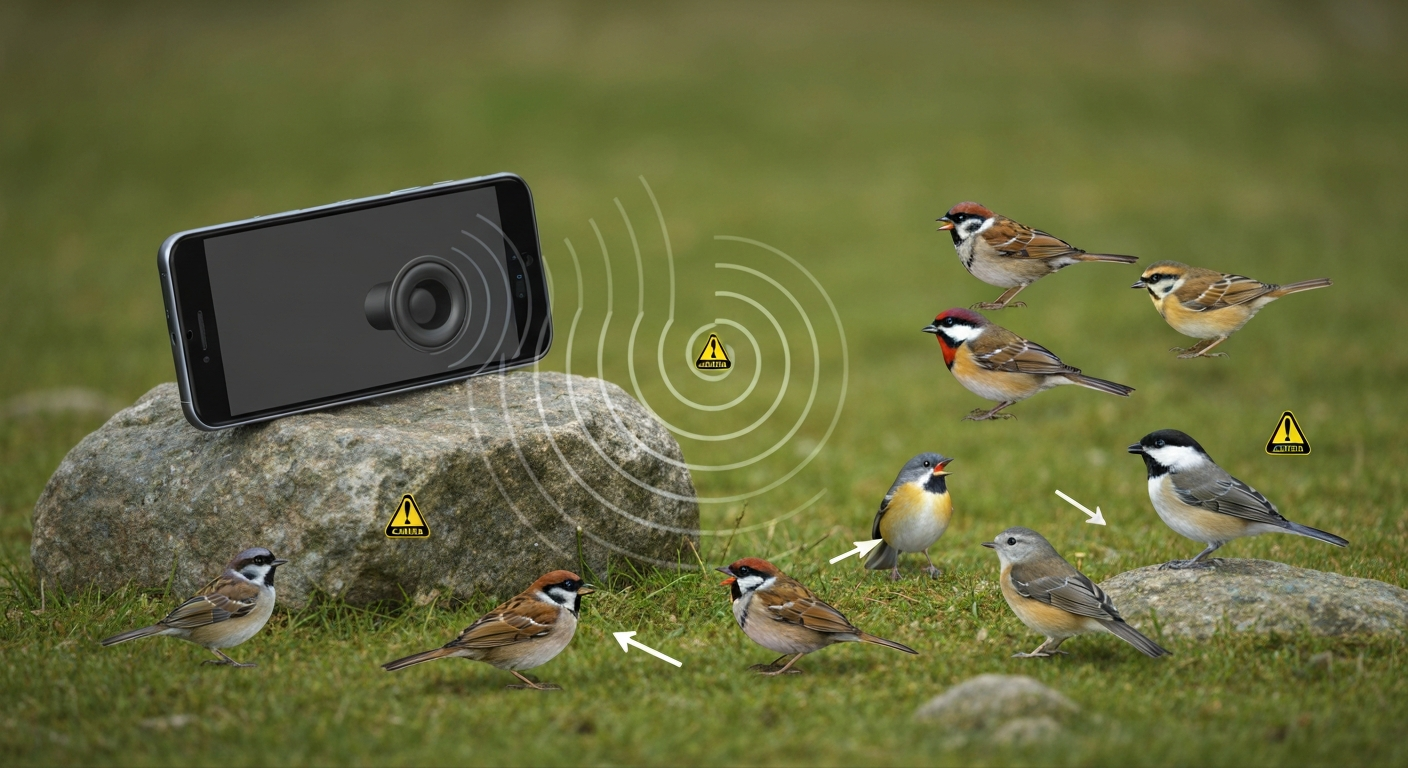
Before evaluating harm, it helps to understand what a bird actually perceives when you press play on a smartphone app. For more detail on avian auditory range and perception, see Can birds hear Can birds hear?. Most songbirds hear within a range of roughly 0.5 to 6 kHz, with peak sensitivity between 1 and 4 kHz. That range aligns closely with the frequencies of their own songs and calls, which makes evolutionary sense: they need to hear their own species most clearly. Comparative auditory physiology research by Dooling and colleagues places songbirds as "auditory generalists" tuned to the acoustic space their vocalizations occupy, rather than specialists with extraordinary high-frequency hearing like bats or owls.
A phone speaker playing a conspecific song at close range is perfectly audible and, more importantly, perfectly interpretable to the target species. It does not sound like background noise. It sounds like a rival bird or a potential mate, which is the whole reason playback works at all. That clarity of signal is precisely what makes casual playback worth examining carefully rather than dismissing.
Why birds call in the first place: territory, mating, and alarm
Bird vocalizations are not decorative. They carry specific, actionable information. Territorial songs tell rivals to stay away. Contact calls keep flock members coordinated. Alarm calls communicate predator presence and type, sometimes with remarkable specificity, including separate calls for aerial versus ground predators. Mating songs advertise quality to potential partners and synchronize breeding readiness.
When a bird hears a conspecific song, it does not weigh the philosophical question of whether the source is genuine. It responds to the content of the signal. A territorial male hearing a rival's song will mobilize energy and attention toward defense. A female hearing a male's song during breeding season may shift her behavior toward pair assessment. An individual hearing an alarm call may freeze, flush, or redirect foraging away from the signal source. These responses are fast, automatic, and metabolically costly, which is the biological foundation for why playback can cause harm.
The physiological cost: stress responses and heart rate
Radiotelemetry experiments on European blackbirds have recorded rapid heart-rate increases in response to conspecific song playback. This is an acute physiological reaction, not a mild curiosity response. Cardiovascular arousal is energetically expensive, and when it is triggered repeatedly by an unresolvable stimulus (a speaker that never yields territory, never retreats, and never stops), the bird spends resources it cannot recover.
The hormonal picture is more nuanced. Some meta-analytic work on simulated territorial intrusions finds that playback elevates glucocorticoids (specifically corticosterone, a primary avian stress hormone) in some species, particularly single-brooded species with more to lose from a territorial challenge. Hormonal Responses to Male–Male Social Challenge in the Blue Tit: single‑broodedness as an explanatory variable (Landys et al. 2007), PubMed reports elevated corticosterone after simulated territorial intrusions in this single‑brooded species. But other studies show strong behavioral aggression from playback in the complete absence of measurable corticosterone or testosterone changes. The practical takeaway is that behavioral disruption can occur even when the endocrine response is not detectable. You cannot conclude that a bird is "not stressed" simply because a hormone assay comes back flat.
Breeding, territory, and social behavior: what the field experiments show
The behavioral effects of playback on territory and breeding are well-documented. Song sparrows respond to simulated territorial intrusions with escalated, retaliatory behavior. Good neighbour, bad neighbour: song sparrows retaliate against aggressive rivals, Animal Behaviour / ScienceDirect documents retaliatory responses of song sparrows to simulated intruders Good neighbour, bad neighbour: song sparrows retaliate against aggressive rivals — Animal Behaviour / ScienceDirect. Sedge warblers show strong territorial aggression in response to playback both before and after pairing, meaning the disruption window is not limited to unpaired males. These patterns are consistent across a broad range of songbird species.
There is also a settlement effect worth flagging. Experimental broadcasts of American Redstart songs increased local settlement rates at the playback sites, meaning playback can concentrate birds in an area beyond the normal carrying capacity of that habitat. This sounds benign or even positive until you consider the knock-on effects: more competition for the same food patches, more aggressive interactions, and potentially drawing birds into unsuitable habitat or sites with higher human disturbance.
At popular birdwatching sites where multiple visitors are using playback throughout the day, a territorial bird may face dozens of simulated intrusions in a single morning. Each one triggers a behavioral response. Energy spent on territorial display is energy not spent on foraging, incubation, or nestling provisioning. The cumulative effect at high-traffic locations is a legitimate conservation concern, not an overreaction.
Predator attraction and nest risk
This is where playback moves from behavioral disruption into direct reproductive cost. Two experimental lines of evidence matter here.
First, playbacks of predator calls or predator alarm cues can reduce parental provisioning rates and produce measurable decreases in nestling body mass. One study (Grade et al., 2021) recorded a roughly 10% decrease in nestling mass at 12 days old in areas where predator soundscapes were broadcast, along with documented cases of nest abandonment. A 10% mass deficit at 12 days is not trivial. It affects fledgling survival probability. Second, playbacks of nestling begging calls have been shown to attract nest predators in controlled experimental settings, because those calls serve as acoustic cues that reveal nest location. Broadcasting those calls, or any calls that draw birds toward a specific point, can inadvertently flag that location for predators already operating in the area.
The interaction effect matters too. Playback that draws a territorial bird into aggressive display behavior may suppress its vigilance, making it less likely to detect an actual predator approaching the nest. The bird is paying attention to the wrong threat.
Playback, glass, roads, and collision hazards
Collision risk adds a physical dimension to the behavioral harms. A field experiment found that song playback increased local songbird density near low- to moderate-traffic roads, drawing birds closer to road edges than they would naturally settle. In areas with glass buildings, windows, or reflective surfaces, increasing local bird density through playback raises the probability of collision events. Understanding how birds perceive and fail to perceive glass is directly relevant here, and the short version is that many species cannot reliably distinguish a glass reflection from actual sky or vegetation. For more on whether birds can see glass, see can bird see glass.
For aviation contexts, the picture is handled by professionals rather than casual playback users, but it is worth noting that acoustic attraction is a recognized mechanism in wildlife hazard management literature. Playback designed to concentrate birds, or playback that inadvertently draws birds toward airport perimeters, is a liability in airspace where bird strikes are a documented safety hazard. The FAA and ICAO both list wildlife hazard management as a formal discipline, and that guidance focuses on trained, targeted, monitored deployment rather than improvised use.
Sound-based repellents: do Bird-B-Gone and bird whistles actually work?
Sound-based deterrents occupy a different category from recreational playback, but they carry some of the same risks and face additional problems of their own. It is worth evaluating them on the evidence rather than their marketing claims. For a focused evaluation of whether bird whistles work, see the article 'do bird whistles work' for evidence and practical guidance.
Acoustic repellents (alarm and distress calls)
Products that broadcast alarm calls or predator vocalizations, including systems used in airport bird management and commercial agricultural settings, have documented efficacy in some controlled trials but mixed results overall. For a focused review of consumer products, see the summary titled "does Bird-B-Gone work" which evaluates commercial ultrasonic and alarm-call devices and their evidence of effectiveness. An experimental broadcast of perceived predation risk playbacks did reduce Red-winged Blackbird abundance in agricultural nesting habitat late in the breeding season. That is a real positive result. However, Transport Canada's evaluation of airport bird-control products is direct about the limitations: habituation is a primary failure mode. Birds learn that the threatening sound is never followed by actual predation, and they stop responding. The guidance from professional wildlife management consistently stresses sparing, targeted deployment and combining acoustic methods with physical or visual deterrents rather than relying on sound alone.
Long-range acoustic devices (LRADs) and frequency-masking technologies like the Sonic Net have been evaluated with similarly mixed results. Some trials report dispersal success, particularly when deployed from helicopters or in combination with other hazing. Others report little deterrent effect when used in isolation. The consistent thread across evaluations is that no acoustic repellent works indefinitely if applied continuously and without variation.
Bird whistles for training
Bird training whistles, used primarily with pet parrots and other captive birds to establish recall cues or condition specific behaviors, operate in a very different context from broadcasting wild bird calls outdoors. In a controlled indoor environment with a known individual bird, whistle training works well because the trainer controls repetition, reinforcement, and context. The evidence base for harm here is minimal when used appropriately, because the bird in question is not a wild territorial individual and the training signal is paired with positive reinforcement rather than simulating a rival or predator. That said, bird whistles designed to mimic wild calls and used outdoors near wild birds carry the same behavioral disruption risks as any other playback.
| Method | Documented benefit | Documented risk | Key limitation |
|---|---|---|---|
| Recreational conspecific song playback | Improved birder views; research attraction tools | Territorial disruption, stress, breeding impact, collision concentration | Cumulative harm at high-traffic sites; timing critical |
| Predator call playback (repellent) | Reduced target species density in some trials | Nest abandonment, reduced nestling mass, parental provisioning decline | Habituation; must be combined with other methods |
| Alarm/distress call devices (Bird-B-Gone type) | Short-term dispersal of some species | Habituation within days to weeks; may not deter all species | Loses effectiveness when used continuously |
| LRAD / Sonic Net (professional use) | Mixed dispersal results; some airport efficacy | Initial attraction in some cases; species-dependent response | Requires trained operators; not reliable as sole method |
| Training whistles (captive birds) | Effective recall and behavior conditioning in pet birds | Negligible indoors; outdoor use near wild birds carries playback risks | Context-dependent; limited to captive settings for safety |
Legal exposure: when playback is not just an ethics question
Legality is not uniform across jurisdictions, and that matters. Canada's Migratory Birds Regulations (2022) explicitly restrict the use of electronic bird calls except where specifically authorized. Using an app to lure a migratory songbird in Canada can put you in legal violation without any harmful intent. Other jurisdictions have similar frameworks under their own wildlife protection statutes. Facilitating capture through playback, which is a real and documented use of these tools by poachers, is illegal virtually everywhere.
The American Birding Association's ethics guidance limits playback use, particularly for rare or threatened species, heavily birded sites, and during breeding season. These are not legally binding rules for most birders, but they reflect the documented risk of cumulative impact at locations that see high visitor volume. A rare warbler that encounters playback from twenty different visitors on a single May morning is facing a genuinely different situation than one that hears a single brief broadcast. For practical guidance on the risks and legal issues around luring or capturing birds, see can you catch a bird.
When playback is acceptable and when to leave the speaker off
The reality is that context determines whether playback is defensible. Scientific research conducted under institutional review with appropriate protocols, including monitoring for distress and limiting session duration and frequency, represents the clearest justification. Captive pet bird training using whistles indoors, where the bird is known and the context is controlled, is another low-harm application. Brief, infrequent playback in a non-breeding season at a site with low visitor pressure, away from active nests, is qualitatively different from extended broadcasting during peak breeding.
These are the situations where it makes sense to leave the speaker off:
- During breeding season (spring and early summer in most temperate regions), particularly near known or suspected nest sites
- For rare, threatened, or protected species where individual-level harm has population-level consequences
- At heavily visited birdwatching sites where cumulative playback exposure across many visitors is likely
- Near windows, glass structures, or road corridors where drawing birds closer increases collision risk
- At or near airport perimeters where attracting birds into airspace creates a safety hazard
- When using predator calls or alarm calls near active nests, given the documented reduction in nestling condition and nest abandonment
- In any jurisdiction where local law restricts electronic calls for migratory birds
Safer alternatives and practical best practices
If your goal is to attract birds for observation, pishing (making soft, repetitive sounds with your mouth) and squeaking are lower-intensity alternatives that produce milder responses and allow the bird to disengage more naturally. Habitat improvement through planting native vegetation, providing water, and reducing nighttime light pollution draws birds reliably without the behavioral cost of playback. Patience and stillness near known territories will often produce better observations than any acoustic shortcut.
For sound-based repellents in commercial or property management contexts, the evidence supports using acoustic deterrents as one component of an integrated approach rather than a standalone solution. Rotate signal types, vary timing and location, combine acoustic hazing with physical exclusion or habitat modification, and expect to retrain the system periodically as birds habituate. That is what Transport Canada's professional guidance prescribes for airport operators, and the same logic applies at smaller scales.
Understanding the broader biology of how birds sense and respond to their environment, including how they process sound, navigate toward or away from signals, and respond to perceived threats, gives you a much better foundation for making these judgment calls than any simple rule of thumb. For related information on avian physiology and reflexes, see can a bird sneeze. If you're curious about other senses, see can a bird smell human for a concise summary of avian olfaction and how some species can detect and recognize people by scent. The question is not whether bird calls are ever acceptable to play. It is whether the specific use, in the specific context, is worth the specific cost to the individual birds involved.
FAQ
Is it bad to play bird calls?
It can be. Playing bird calls (playback) frequently changes bird behaviour and can cause stress, altered territorial or breeding activity, increased predation risk, and concentration of birds near hazards. Effects are species- and context-dependent — short, well‑controlled scientific playback may be justified, while casual, repeated, or poorly timed playback often carries risk.
What kinds of harms have been documented from playback?
Documented harms include acute physiological stress responses (e.g., increased heart rate), elevated glucocorticoids in some contexts, persistent territorial aggression or wasted energy, reduced parental provisioning and lower nestling mass after predator‑cue playbacks, attraction of predators to nest‑like sounds, and increased local bird density near roads or hazards that may raise collision risk.
Do birds always show hormonal stress responses to playback?
No. Playback reliably changes behaviour (approach, singing, aggression) in many species; endocrine responses (testosterone, corticosterone) are species‑ and context‑dependent. Some experiments show strong behavioural effects without measurable hormone changes, while others show elevated glucocorticoids in certain species or breeding contexts.
When is playback acceptable or justified?
Acceptable uses include: 1) regulated scientific experiments following ethical review and minimising duration/intensity; 2) targeted, contained training of captive birds or pets when done briefly by experienced handlers; and 3) professional wildlife‑hazard mitigation at airports or facilities when conducted by trained staff as part of a multi‑tool program. Even in these cases use should follow best practices to reduce harm.
When should I avoid playing calls?
Avoid playback during breeding and egg/nestling stages, during migration stopovers, near glassed buildings or busy roads/airports, at sites with threatened or rare species, and in places where playback could attract predators. Also avoid prolonged, high‑repetition broadcasting that invites habituation or concentrates birds around hazards.
Do bird‑scaring sounds and devices (alarm calls, LRADs, Sonic Net) reliably work?
They can work in some situations but effectiveness is mixed. Predator or alarm call playbacks can repel birds short‑term or reduce local abundance in some studies, but may initially attract some species, lose efficacy through habituation, or be ineffective for certain species. Best results occur when sound is one element of a broader, professionally managed control program.