
For most people with an up-to-date vaccination record, a bird bite does not automatically require a tetanus shot. For more detail on transmission risks and when to seek care, see can a bird bite. Bird mouths are not a recognized environmental reservoir for Clostridium tetani spores, the bacterium that causes tetanus. The real driver of your tetanus risk is your immunization history and the nature of the wound, not the species that bit you. That said, a clinician will still apply the same CDC wound-management framework to a bird bite that they would to any other puncture or laceration: if you have not had a tetanus booster within 5 years and the wound is considered 'tetanus-prone,' a booster is indicated. If your vaccination history is unknown or incomplete, you may need passive immunization with tetanus immune globulin (TIG) as well.
Do You Need a Tetanus Shot After a Bird Bite? Clear Guide

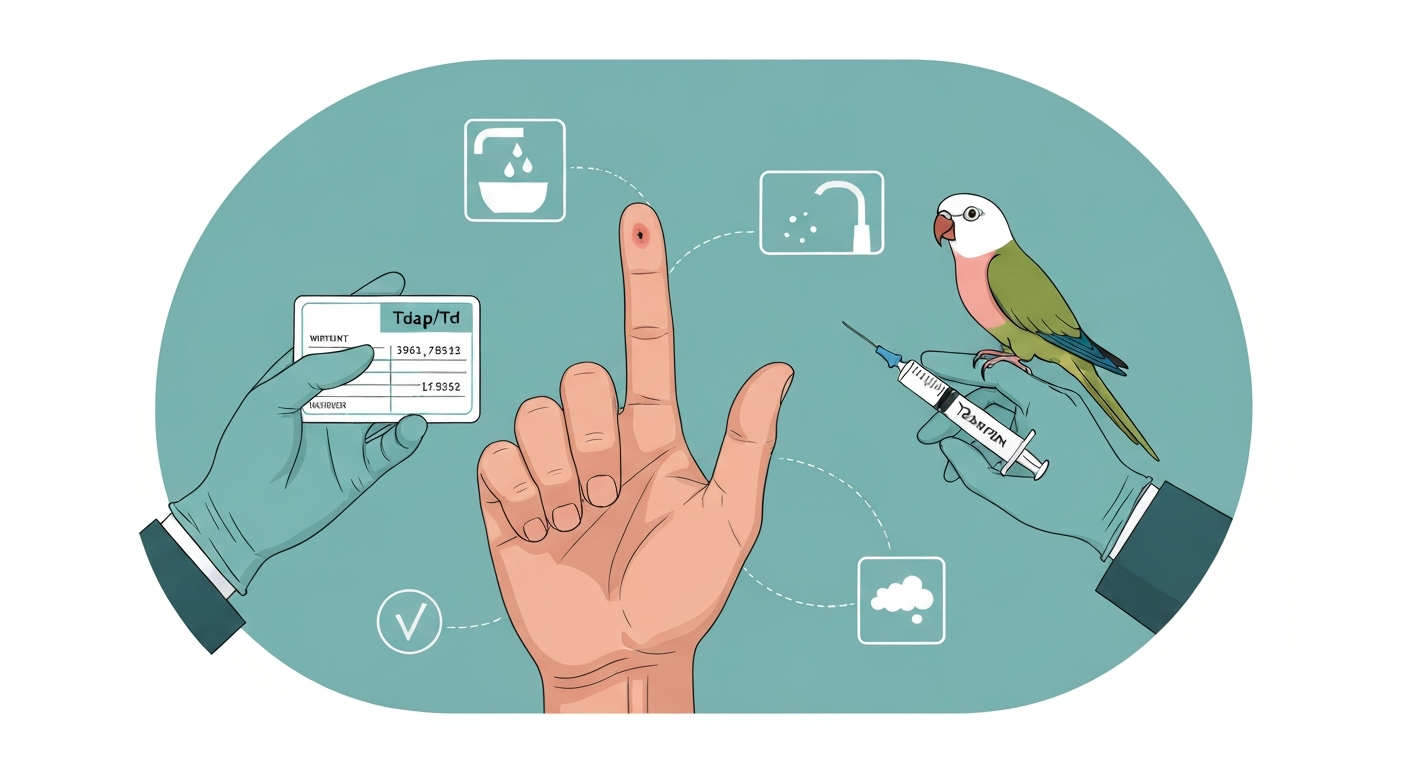
What tetanus actually is and where it comes from
Tetanus is caused by tetanospasmin, a potent neurotoxin produced by Clostridium tetani. The bacterium itself is not particularly dangerous on its own. The problem arises when its spores enter a wound with low oxygen levels, germinate, and start producing toxin. The toxin travels through the nervous system and causes the hallmark symptoms: trismus (lockjaw, usually the first recognizable sign), followed by generalized muscle rigidity and spasms, and potentially life-threatening autonomic instability. See the WHO Tetanus fact sheet, Tetanus fact sheet, WHO, which summarizes these clinical features (trismus, generalized muscle spasms, autonomic instability) and notes an incubation period of about 3–21 days Tetanus fact sheet — WHO. The incubation period typically runs 3 to 21 days. Without treatment in an ICU setting, severe tetanus carries substantial mortality.
The critical ecology point is where C. tetani spores live. They are ubiquitous in soil, dust, and animal manure. That is their primary environmental reservoir. When someone develops tetanus after a wound, the contamination almost always traces back to soil or manure contact, not to the animal's mouth. This is exactly why rusty nails, garden injuries, and farm wounds are the textbook examples taught in medical schools, rather than clean punctures from captive animals in sterile environments. CDC tetanus surveillance data from 2009 to 2023 consistently point to inadequate vaccination as the dominant risk factor in modern cases, with environmental contamination (soil, manure) as the usual source.
Why bird bites are low on the tetanus risk scale
The reality is that bird mouths are not soil. Birds do not chew grass or dig in dirt with their beaks the way dogs root around with their snouts, and their oral flora is dominated by species very different from C. tetani. There are no documented, peer-reviewed case reports in the medical literature attributing human tetanus disease specifically to a bird bite. That absence is meaningful. It is consistent with the known ecology: C. tetani spores are not a recognized constituent of avian oral microbial communities.
This does not make bird bites completely risk-free from an infection standpoint. It simply means the specific risk of tetanus from a bird's mouth is extremely low compared to a wound contaminated with soil or animal feces. The calculus changes if a bird bites you outdoors on soil, the wound is then pressed into the ground, or there is obvious environmental contamination involved. In that scenario, the contamination concern shifts from the bird itself to the environment the wound contacted.
Peck, bite, scratch, puncture: getting the terminology straight
When clinicians assess an injury from a bird, the terminology matters because it shapes how the wound is classified and managed. For a quick definition of common terms and to answer the question 'what is a bird bite called,' see our terminology guide to peck, bite, scratch, and puncture. A peck is typically a quick, superficial contact from a beak, often producing a small abrasion or minor laceration with minimal depth. A true bite involves sustained pressure, potentially lacerating tissue and producing a deeper wound, especially from larger parrots or raptors. A scratch from a talon can range from superficial to a deep puncture depending on the bird's size and behavior. A puncture wound, regardless of what caused it, is specifically concerning in tetanus and infection risk assessment because its narrow entry channel limits oxygen exposure and is harder to clean thoroughly.
The term 'bird bite' in the clinical literature often encompasses all of these contact types, which matters when you are looking for guidance. What clinicians actually need to know is the wound's depth, contamination level, location on the body, and your vaccination history. Whether a bird's beak technically pecked or bit you is less important than whether it produced a puncture wound on your hand, since hand wounds are consistently flagged as high-risk regardless of animal source.
How wound type and location raise or lower tetanus risk
Not all wounds carry the same tetanus risk, and this is where a bird bite can shift from 'low concern' to 'act now' territory depending on specifics. Both the CDC and WHO classify certain wound types as 'tetanus-prone,' meaning they warrant a lower threshold for intervention regardless of how clean the biting animal was.
- Puncture wounds: narrow entry point limits irrigation and reduces oxygen, creating conditions where C. tetani can germinate
- Wounds with devitalized (dead or crushed) tissue: anaerobic pockets are ideal for toxin production
- Wounds contaminated with soil, feces, or manure: direct introduction of environmental spore reservoirs
- Wounds more than 6 hours old before treatment, or presenting with signs of clinical sepsis
- Burns, frostbite, and high-velocity missile injuries: tissue destruction creates anaerobic environments
- Hand and face wounds: anatomically complex, harder to irrigate, and higher consequence if infection progresses
A clean, superficial peck on the forearm from a captive indoor parrot is on one end of the spectrum. A deep talon puncture on the hand from a wild bird that occurred outdoors and went untreated for several hours is on the other. The latter meets multiple tetanus-prone criteria and warrants the same response as any other tetanus-prone wound, even though the bird itself is not a tetanus reservoir.
How your vaccination history changes what happens next
Your personal immunization record is the single most important variable in this entire decision. The CDC's wound-management guidance is built around two variables: whether the wound is 'clean and minor' or 'tetanus-prone,' and how many prior tetanus-toxoid doses you have received and when the last one was given. Here is how those variables play out:
| Prior tetanus doses | Wound type | Vaccine indicated? | TIG indicated? |
|---|---|---|---|
| 3 or more, last dose within 5 years | Any wound, clean or tetanus-prone | No | No |
| 3 or more, last dose 5–10 years ago | Clean and minor only | No | No |
| 3 or more, last dose 5–10 years ago | Tetanus-prone wound | Yes (Tdap or Td) | No |
| 3 or more, last dose more than 10 years ago | Any wound type | Yes (Tdap or Td) | No |
| Fewer than 3 doses or unknown history | Clean and minor | Yes (Tdap or Td) | No |
| Fewer than 3 doses or unknown history | Tetanus-prone wound | Yes (Tdap or Td) | Yes (TIG 250 units IM) |
The CDC and ACIP prefer Tdap over plain Td when an adult has not previously received Tdap, because it also covers pertussis. Routine booster intervals for adults are every 10 years, but wound management can trigger a booster earlier than that schedule would otherwise require. The 5-year threshold for tetanus-prone wounds is not arbitrary: it reflects the lower antibody levels that accompany a longer gap since immunization, combined with the higher bacterial load or anaerobic conditions of a tetanus-prone wound.
First aid for bird bites and scratches: what to do immediately
Good first aid for a bird bite follows the same core principles as for any animal bite wound. Speed and thoroughness of cleaning matter more than almost anything else in reducing infection risk, including bacterial pathogens far more likely than tetanus to cause you problems after a bird bite.
- Control bleeding: apply direct pressure with a clean cloth or bandage. Elevate the limb if the wound is on an arm or hand.
- Irrigate thoroughly: wash the wound under running water for at least 5 minutes, using soap. This is the most important infection-prevention step. A syringe or squeeze bottle can increase irrigation pressure for puncture wounds.
- Do not squeeze or scrub a deep puncture: this can push contamination deeper into the tissue.
- Remove any visible debris gently. Do not probe the wound deeply yourself.
- Cover with a clean dressing or bandage.
- Do not close the wound yourself with tape or butterfly strips if it is a puncture or appears contaminated: occlusion without proper debridement can trap bacteria.
- Check your tetanus vaccination record and note the date of your last booster.
- Seek medical evaluation for any wound on the hand or face, any deep puncture, any wound that will not stop bleeding after 10–15 minutes of pressure, or if you cannot verify your vaccination history.
Decision guide: when to get a tetanus booster after a bird bite
Use the following flow to work through the decision quickly. This mirrors CDC-style guidance applied to the specific context of a bird bite or scratch.
- Step 1 — Classify the wound: Is it clean and minor (superficial peck, no contamination, wound edges not crushed), or is it tetanus-prone (deep puncture, contaminated with soil or feces, devitalized tissue, hand wound, untreated more than 6 hours)?
- Step 2 — Check vaccination history: How many lifetime tetanus-containing vaccine doses have you received? Three or more is a complete primary series. Fewer than three, or unknown, puts you in a different category.
- Step 3 — Check timing: When was your last tetanus booster? Less than 5 years ago? 5–10 years ago? More than 10 years ago?
- Step 4 — Apply the rule: Clean/minor wound + complete series + booster within 10 years = no booster needed now. Tetanus-prone wound + complete series + booster within 5 years = no booster needed. Tetanus-prone wound + complete series + booster more than 5 years ago = get Tdap or Td now. Any wound + incomplete series or unknown history = get Tdap or Td now. Tetanus-prone wound + incomplete series or unknown history = get Tdap or Td AND TIG 250 units IM.
- Step 5 — Go to a clinician: You cannot self-administer TIG, and a clinician should inspect any wound that may be tetanus-prone. Let them confirm the wound classification and administer what is needed.
When clinicians give tetanus immune globulin (TIG)
TIG provides immediate passive immunity by supplying pre-formed antibodies against tetanospasmin. It is reserved for situations where a person cannot generate a rapid immune response from vaccination alone: specifically, anyone with fewer than 3 prior tetanus-toxoid doses or an unknown vaccination history who presents with a tetanus-prone wound. The standard prophylactic dose is 250 units administered intramuscularly as a single injection, given at the same visit as the tetanus toxoid vaccine but at a different anatomical site. The CDC monograph 'Immunization Against Disease' specifies that the recommended prophylactic TIG dose for wounds of average severity is 250 units given intramuscularly as a single dose prophylactic dose is 250 units administered intramuscularly (single dose). TIG is not a standard supply item held by the CDC and must be sourced through commercial channels (the product Hyper TET is the most widely available in the United States). In practice this means a hospital pharmacy or urgent care with a well-stocked formulary is where you will receive it.
Red flags that mean you need urgent or emergency care
Most bird bites can be handled by a primary-care physician or urgent care. Some cannot wait. Go to an emergency department if you notice any of the following:
- Bleeding that will not stop after 10–15 minutes of continuous direct pressure
- Wound on the face, near the eye, or on the hand with suspected involvement of a tendon, joint, or bone
- Rapidly spreading redness, warmth, or swelling beyond the wound margins within hours of the bite
- Tight, swollen compartment of the hand (classic early sign of compartment syndrome, a documented complication of parrot bites specifically)
- Fever over 38.5°C (101.3°F) or chills developing after a bite
- Lymph red streaks radiating from the wound (lymphangitis)
- Any wound in an immunocompromised person, someone on immunosuppressants, a diabetic, or anyone who has had a splenectomy
- Jaw stiffness or muscle spasms developing in the days after a bite: these are early tetanus signs and constitute a medical emergency
Infection risks from bird bites: the real bacterial story
The bigger practical infection concern after a bird bite is not tetanus but bacterial wound infection from the organisms that actually live in bird mouths and on their feathers and skin. The pathogens consistently identified in bird bite infection cases include:
- Pasteurella species: one of the most common aerobic pathogens in animal bites including birds; causes rapid, aggressive local infection
- Staphylococcus and Streptococcus species: standard skin flora contributors to wound infection
- Atypical mycobacteria (Mycobacterium chelonae and M. abscessus): documented in parrot and exotic bird bites; can cause chronic, difficult-to-treat granulomatous infections
- Chlamydia psittaci: the cause of psittacosis, transmitted by inhalation of dried bird droppings or respiratory secretions; not a direct bite-transmitted pathogen but relevant for those in close contact with parrots and psittacine birds
For high-risk bird bite wounds (hand wounds, deep punctures, wounds in immunocompromised patients), current IDSA guidelines and clinical reviews support empiric antibiotic prophylaxis with amoxicillin-clavulanate as the first-line choice. It covers the aerobic and anaerobic spectrum most relevant to animal bite pathogens. For penicillin-allergic patients, clinicians typically use alternative regimens such as a fluoroquinolone plus metronidazole. The decision to prescribe antibiotics is based on wound risk stratification, not on routine post-bite treatment for every minor peck.
Clearing up the rabies and avian influenza questions
Two viral concerns come up repeatedly when people search about bird bites, and both deserve a direct answer. Rabies is a mammalian virus. Birds do not carry or transmit rabies. Post-exposure prophylaxis for rabies is not indicated after a bird bite under any circumstances. This is a firm, evidence-based statement, not a hedged one. If someone tells you to worry about rabies from a bird bite, that is folklore, not medicine.
Avian influenza (including H5N1) is a genuine public health concern in certain wild bird and poultry contexts, but it is not transmitted through bites. The documented transmission routes for avian influenza involve inhalation of respiratory droplets or aerosols, or direct contact with infected birds' respiratory secretions and feces, particularly in high-exposure occupational settings like poultry farms. A single bite from a healthy pet bird or a common wild bird does not constitute an avian influenza exposure event. Aviation professionals and wildlife handlers who work with large numbers of wild birds in active outbreak zones would follow separate occupational health protocols, but those go well beyond the scope of a standard bird bite first-aid response.
Do bird bites hurt, and how dangerous are they really?
Whether a bird bite hurts depends enormously on which bird did the biting. For a clear overview of what happens if a bird bites you, including expected injuries, first aid, and when to seek medical attention, see our dedicated guide. A budgerigar's beak produces a minor pinch that most adults barely notice. A large macaw or a cockatoo bite can generate substantial force and genuinely break skin. Raptors (hawks, eagles, falcons) have talons designed to pierce and grip, and a strike from one is a serious injury requiring prompt medical attention. Wild birds, including geese, swans, and herons, can deliver powerful strikes with their beaks that produce significant bruising and lacerations. For a concise overview of risks, first aid, and when to seek care, see is bird bite dangerous. For more on pain and injury severity from different species, see the 'Do bird bites hurt' guide.
The danger from a bird bite scales with the size of the bird, the location of the wound, and how quickly it is treated. Most pet-bird bites from small species treated with prompt wound care do not develop significant complications. Hand wounds from any bird species carry higher complication risk because of the anatomical complexity of the hand, the high density of tendons and joints, and the limited soft tissue that would normally contain infection. Compartment syndrome of the hand following a parrot bite has been documented in case reports, making hand wounds a specific reason to seek medical evaluation rather than waiting at home.
What happens if a bird gets your hair is a different kind of concern. A bird tangled in hair typically scratches and claws as it tries to free itself. Those scratches should be treated the same as any other bird scratch: clean the wounds thoroughly, assess depth, and evaluate vaccination status. For concise guidance on what happens if a bird scratches you, including first aid steps and when to seek medical care, see our dedicated Q&A. The scratches themselves are usually superficial, but talon scratches from larger birds can be deep enough to require the same assessment as a puncture bite wound.
Prevention for pet owners, bird handlers, and aviation professionals
The most effective way to avoid the entire tetanus and infection decision tree is to not get bitten in the first place. That sounds obvious, but bird-handling practices among even experienced owners and professionals often become casual over time, which is exactly when bites occur.
- Keep your tetanus vaccination current: a 10-year booster schedule means you are always within the clean-wound safety window, and within 5 years of your last dose for most of the decade
- Use appropriate gloves when handling unfamiliar birds, wild birds, or large parrots: thick leather or Kevlar-lined gloves for raptors and large psittacines
- Do not handle stressed, injured, or territorial birds without proper restraint equipment and a second person present
- Secure long hair before working with or near birds: a simple bun, braid, or hat eliminates the most common scenario for hair entanglement and the panicked scratching that follows
- Aviation professionals working in bird-strike mitigation or wildlife management around airfields should follow occupational health protocols for wild bird handling, including PPE and updated vaccination schedules
- Wash hands thoroughly after any bird contact, even without a visible wound, to reduce pathogen transmission from feathers and feces
- Keep first-aid supplies stocked and accessible in bird-handling environments: irrigation syringe, saline or clean water source, dressings, and a record of vaccination dates
Follow-up wound care at home and signs to watch for
After initial treatment, whether by yourself for a minor wound or by a clinician for a more serious one, daily monitoring for the first 5 to 7 days matters. Most wound infections from bird bites will declare themselves within 24 to 72 hours, though atypical mycobacterial infections can take weeks to manifest. Clean the wound daily with soap and water, change the dressing, and inspect the wound margins each time.
- Increasing pain, redness, or warmth at the wound site after the first 24 hours (early improvement is expected; worsening is not)
- Purulent (pus) discharge from the wound
- Swelling extending beyond the immediate wound margins
- Red streaks extending from the wound toward the body
- Fever, chills, or feeling generally unwell
- Wound that is not visibly healing within 3 to 5 days
- Any joint stiffness or reduced range of motion if the wound is near a joint (especially the hand)
- Jaw tightness or difficulty opening the mouth fully in the days following the bite: call emergency services immediately
If you were prescribed a course of antibiotics, complete the full course even if the wound looks better. Stopping early is one of the most common reasons bite-wound infections recur or become harder to treat.
Quick-reference decision summary
Here is the full sequence condensed for quick reference, covering both immediate steps and the tetanus-shot decision.
- Immediately: control bleeding, irrigate the wound thoroughly with soap and running water for at least 5 minutes, cover with a clean dressing
- Classify the wound: clean and minor (superficial, not on hand/face, no contamination) OR tetanus-prone (puncture, contaminated, hand/face, devitalized tissue, untreated more than 6 hours)
- Check your record: 3 or more prior tetanus doses? Last booster date?
- Apply the booster rule: last booster within 5 years and tetanus-prone wound = no booster needed; last booster 5–10 years ago and tetanus-prone wound = get Tdap or Td; last booster more than 10 years ago (any wound) = get Tdap or Td; fewer than 3 doses or unknown history + tetanus-prone wound = get Tdap or Td AND TIG 250 units IM
- Seek same-day medical care for: hand or face wounds, deep punctures, wounds in immunocompromised individuals, inability to verify vaccination history, or any tetanus-prone wound
- Go to emergency care for: uncontrolled bleeding, rapidly spreading infection, compartment-syndrome signs, fever with a recent bite, or any jaw stiffness after the injury
- Monitor daily for 5 to 7 days and return to a clinician if signs of infection develop or the wound is not improving
- Do not confuse bird bites with rabies risk (birds do not carry rabies) or with avian influenza transmission (not bite-transmitted)
- Prevent future bites: keep vaccinations current, use appropriate PPE, secure hair, and handle unfamiliar birds with proper restraint
FAQ
Do you need a tetanus shot after a bird bite?
Usually no urgent tetanus-specific treatment is required simply because a bird bit you. Tetanus risk comes from Clostridium tetani spores in soil/dust/manure rather than bird mouths. Clinicians follow standard wound rules: if your tetanus vaccinations are up to date, a bird bite that is clean and minor needs a booster only if >10 years since your last tetanus shot; for tetanus‑prone wounds (see below) a booster is recommended if >5 years since last dose. If you have fewer than 3 prior tetanus‑toxoid doses or your history is unknown and the wound is tetanus‑prone, you may need both tetanus vaccine and human tetanus immune globulin (TIG). (Sources: CDC, WHO).
What is tetanus and how does it happen?
Tetanus is a serious disease caused by toxin (tetanospasmin) produced by Clostridium tetani. The bacterium’s spores live mainly in soil, dust and animal manure; they enter and germinate in devitalized tissue or deep puncture wounds with low oxygen. Symptoms include jaw stiffness (trismus), muscle spasms, and autonomic instability; incubation is commonly 3–21 days. Prevention is by vaccine and, if needed, TIG for passive protection. (Sources: WHO, CDC).
Why are bird bites usually low risk for tetanus?
Bird mouths and beaks are not recognized reservoirs of C. tetani spores. Most human tetanus cases follow wound contamination with soil, dust or manure and wounds with devitalized tissue. While bird bites can transmit bacterial infections, documented tetanus from a bird bite is not described in the medical literature reviewed. Risk is therefore low unless the wound is contaminated with soil/manure or has other tetanus‑prone features. (Sources: CDC, PMC reviews).
What’s the difference between a peck, bite and scratch?
Peck: a rapid jab or pick with a bird’s beak, often superficial but can puncture. Bite: the bird grasps or crushes tissue with its beak; may produce lacerations or punctures. Scratch: claws or talons cause linear abrasions or punctures. Severity depends on force, depth, location and contamination; deep punctures and crush injuries are higher risk for infection. Clinicians treat all as potential bite wounds and assess wound type and contamination. (Sources: clinical wound guidelines).
Which wound types are considered 'tetanus‑prone' after a bird bite?
Tetanus‑prone features: deep puncture wounds, wounds with devitalized or crushed tissue, wounds contaminated with soil/manure/dirt, wounds older than ~6 hours before cleaning, burns, frostbite, or wounds on the hand/foot. Facial wounds are less tetanus‑prone but still require assessment. If a bird bite meets these features and immunization is incomplete/unknown, clinicians consider vaccine plus TIG per guidance. (Sources: CDC, WHO).
Immediate first aid steps after a bird bite (checklist)
1) Stop bleeding with gentle pressure. 2) Rinse and irrigate thoroughly with running water and soap for several minutes; saline also OK. 3) Remove visible debris and trim dirt if practical. 4) Apply clean dressing and keep wound covered. 5) Seek medical care for deep punctures, hand/face wounds, heavy bleeding, suspected tendon/joint injury, or if you are immunocompromised or not up to date with tetanus shots. 6) Watch for infection signs (increasing pain, redness, swelling, drainage, fever). (Sources: WHO, NHS).},{