
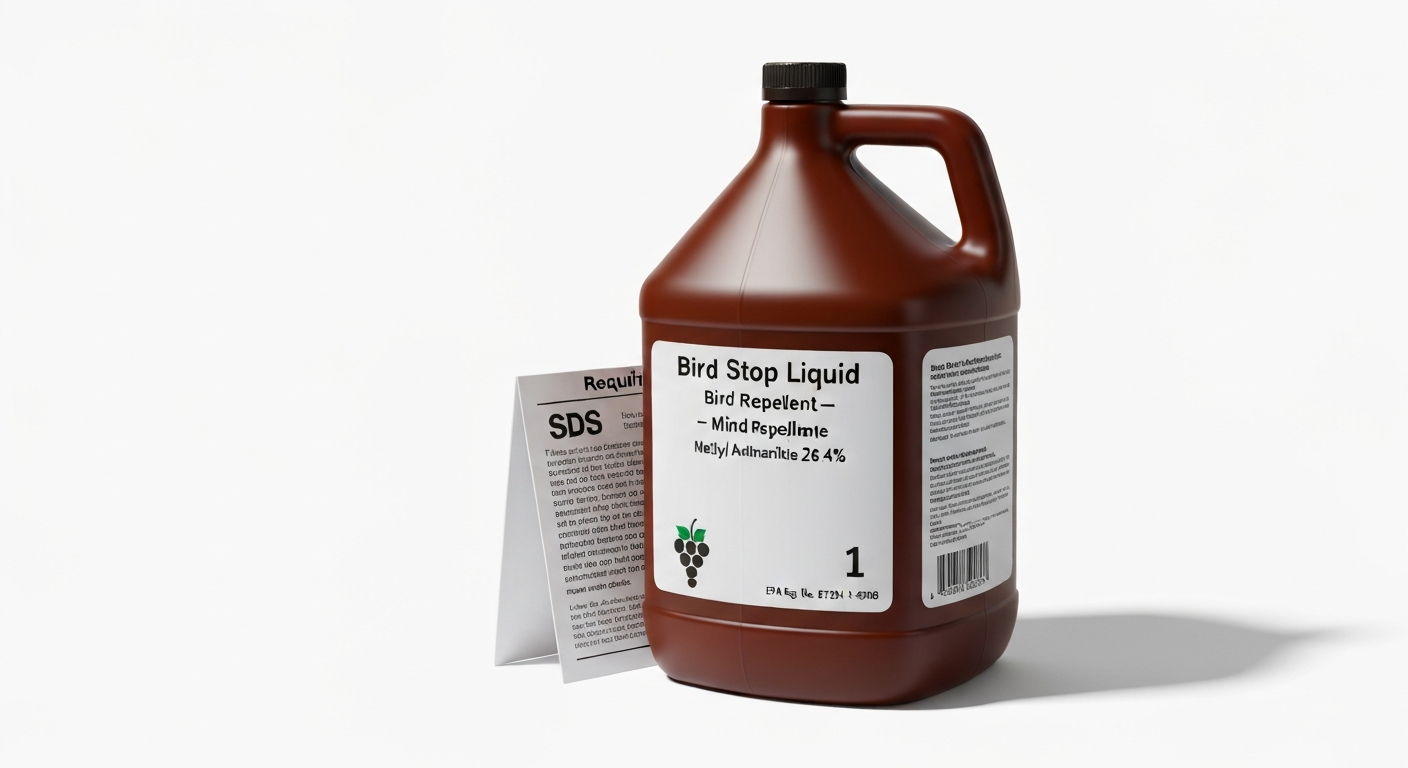
Bird Stop liquid most commonly refers to Bird-X Bird Stop (product code BS-GAL), a commercially sold avian repellent concentrate whose active ingredient is methyl anthranilate at roughly 26.4%, a naturally derived grape-fragrance compound that irritates birds' sensory systems without killing them. That said, 'Bird Stop liquid' is not always a single product: it is also used loosely to mean any liquid marketed to deter birds, including tacky polybutene gels and other chemical repellent sprays. The answer to whether it is toxic, how dangerous it is to birds and pets, and whether it contaminates water sources depends almost entirely on which product is actually in your hands, so the first practical step is always to check the label and Safety Data Sheet (SDS).
What Is Bird Stop Liquid: Uses, Risks, Safety & Alternatives

Who actually searches for 'Bird Stop liquid', and why it matters
The question comes from very different people with very different stakes. Researchers and wildlife biologists want to understand how registered avian repellents work and whether field efficacy data holds up. Property managers and facility teams are trying to keep birds off rooftops, solar panels, ledges, or airport runways without violating Migratory Bird Treaty Act protections. Pet owners and backyard birders stumble across the term when a neighbor applies something to a shared fence or when they find a product residue near a bird bath. Aviation professionals at bird-strike-risk airfields need to know whether liquid repellent programs are evidence-based enough to justify use near runways and whether treated puddles or grassy areas pose secondary exposure risks to wildlife. Each group needs a slightly different answer, but they all start in the same place: identifying exactly what formulation is being discussed.
How to identify the specific product you're dealing with
Before you can evaluate any risk, you need to know what you are actually holding. Labels and SDSs are not optional reading, they are the authoritative source on what a product contains, how it behaves, and what to do in an emergency. Follow this checklist in order.
- Read the front label fully: find the product name, the EPA registration number (for U.S. pesticides this appears as XX-XXXX format), the manufacturer name and address, and any signal word (Caution, Warning, or Danger).
- Locate the active ingredient section: this is legally required on pesticide labels in the U.S. and will list the chemical name and percentage. For Bird-X Bird Stop, you will see 'Methyl Anthranilate... 26.4%' and EPA Reg. No. 87304-1-8708.
- Request or download the Safety Data Sheet (SDS): the SDS must be provided by the manufacturer or distributor. In the U.S. it follows the 16-section GHS/HazCom 2012 format. Section 2 lists hazard classifications, Section 3 gives the full ingredient list, Section 4 covers first aid, and Section 11 has toxicological information.
- Check Section 12 of the SDS for ecological/aquatic hazard data: this section will tell you whether the product has documented toxicity to fish, invertebrates, or other non-target wildlife.
- If the SDS is unavailable, call the manufacturer's emergency line listed on the label. For Bird-X Bird Stop, the SDS lists INFOTRAC (1-800-535-5053) and CHEMTREC (1-800-424-9300).
- If you still cannot identify the product, contact your regional poison control center (in the U.S.: 1-800-222-1222) with as much label information as you can read — they can look up the formulation from the EPA registration number.
- Photograph the label and SDS front page for your records before any use, cleanup, or emergency response.
Is 'Bird Stop' a specific brand or just a generic term?
Strictly speaking, Bird Stop with a capital B and capital S is a registered trademark of Bird-X, Inc., a Chicago-based pest-management company that has sold the methyl anthranilate concentrate under that name for years. The EPA registration number 87304-1-8708 is tied to that specific formulation. In practice, however, people use 'bird stop liquid' as a generic descriptor for any liquid product marketed to stop birds from landing or roosting, the same way people say 'Xerox' when they mean photocopy. You will find distributors and hardware stores using the phrase on packaging for completely different active ingredients, including polybutene-based sticky gels, capsaicin sprays, and essential-oil blends. This ambiguity is exactly why the label-and-SDS step above is non-negotiable before drawing any conclusions about toxicity or safety.
To verify whether you have the Bird-X branded product specifically: look for the Bird-X logo, the phrase 'Bird Stop Liquid Bird Repellent,' and EPA Reg. No. 87304-1-8708 on the label. If none of those are present, you have a different product that happens to use similar marketing language.
The main types of liquid bird deterrents and how they work
Not all liquid bird deterrents work the same way. There are broadly five categories on the market, and confusing one for another leads to misjudging both efficacy and hazard.
Taste and olfactory irritants (the most common category)
These are sprayed or fogged onto turf, vegetation, crop surfaces, or water. Methyl anthranilate (MA) is the gold-standard example. Birds that contact or inhale the compound experience sensory irritation via their trigeminal nerve system, causing an immediate aversion response. It does not damage the bird; it just makes the treated area unpleasant enough that the bird leaves. Field and pen trials, including controlled studies published in Crop Protection (Belant et al., 1995), showed that MA formulations can reduce gull and mallard use of treated water and surfaces for periods typically ranging from a few days to about one to two weeks, depending on application rate, species, and weather. For a broader cultural perspective on human–bird interactions and deterrence perceptions, see the essay titled "how absurd to swallow a bird.".
Sticky gels and tacky polymer coatings
Products in this category use polybutene or similar non-drying sticky polymers applied in beads to ledges, signs, window sills, or structural perches. The deterrent mechanism is purely physical: the sticky sensation on a bird's feet is unpleasant enough that it avoids the surface. These are not repellents in the chemical/biological sense. Bird-B-Gone Transparent Bird Gel (approximately 93% polybutene) is a widely sold example. These products are sometimes confused with liquid sprays even though application typically requires a caulking-gun or applicator tube. The critical hazard distinction: sticky gels carry documented entrapment risk, which taste/irritant liquids generally do not.
Oils and surfactants
Some commercial products use petroleum oils, mineral oils, or surfactant solutions to make landing surfaces uncomfortable or to disrupt the waterproofing of feathers on water birds. This category carries the highest risk of feather fouling and is the most ethically fraught of the liquid deterrent types. Regulatory scrutiny of these products is significant precisely because of the feather-contamination hazard.
Capsaicin and botanical chemical deterrents
Capsaicin-based sprays exploit the fact that birds lack the mammalian pain receptor (TRPV1) that makes hot peppers unpleasant for us, so these are actually targeted primarily at squirrels and mammals, not birds. Some botanical blends use essential oils (peppermint, citrus, cinnamon) and are marketed as bird deterrents, though peer-reviewed field evidence for these is sparse compared to the MA literature.
Visual and behavioral liquids
A smaller product category includes solutions sprayed to create iridescent or UV-reflective surface effects meant to startle or disorient birds. These are generally low in chemical hazard but also low in documented field efficacy for most species.
Common active ingredients and what they do in the bird's body
| Active Ingredient | Product Type | Primary Mechanism | Regulatory Basis |
|---|---|---|---|
| Methyl anthranilate (MA) | Liquid spray/fog concentrate | Trigeminal nerve irritation; taste and olfactory aversion | EPA-registered biopesticide; tolerance exemption in force |
| Polybutene | Tacky gel/liquid | Physical tactile aversion on feet and feathers | EPA-registered; R.E.D. review completed; entrapment warnings required on label |
| Anthraquinone | Spray (primarily turf/crop) | Post-ingestive illness conditioning; taste aversion after feeding | EPA-registered; used in Canada Goose management programs |
| Capsaicin | Spray | TRPV1 receptor activation in mammals; birds largely unaffected | Often sold as exempt/minimum-risk pesticide depending on formulation |
| Essential oil blends (clove, peppermint, citrus) | Spray | Olfactory aversion; limited evidence base | Often sold as minimum-risk exempt under FIFRA 25(b) |
For the Bird-X Bird Stop product specifically, methyl anthranilate is the only active ingredient. It is derived from grape skin oil and is used as a food flavoring at trace levels in human food products, which is part of why its acute mammalian toxicity is low. The aversion response in birds is real and fast: studies show birds leave treated areas within seconds to minutes of contact. The effect is reversible, there is no lasting neurological damage at field-use concentrations.
Toxicity and poisoning risk to birds
The reality is that the Bird-X Bird Stop formulation is not designed to poison birds and, at registered use concentrations, carries a low acute avian toxicity profile. Regulatory toxicity data show bobwhite quail oral LD50 values above 2,036 mg/kg for methyl anthranilate, this is a high number, meaning a very large dose would be required to cause death by ingestion. The product works by sensory aversion, not by causing harm. That said, low acute toxicity does not mean zero risk, and several factors can shift outcomes. See Is Bird Stop poisonous? for a concise answer.
Acute toxicity scenarios
Acute poisoning of birds from methyl anthranilate at label-use concentrations is not well-documented in the peer-reviewed literature. The more realistic risk is behavioral disruption: birds repeatedly disturbed from feeding or watering sites during critical periods (breeding, migration, heat stress) can experience secondary effects including dehydration or energy deficit. These are not poisoning events in the toxicological sense, but they are real welfare considerations, particularly when repellents are applied to the only available water source in an area.
Aquatic and sublethal concerns
The aquatic toxicity picture is more nuanced. Regulatory data report fish LC50 values for methyl anthranilate in the range of approximately 9 to 42 mg/L for species like bluegill sunfish. These concentrations could be reached in small, enclosed water bodies like ornamental bird baths if a product were over-applied or spilled directly into standing water. This is one reason the label and SDS specify dilution rates carefully, and why applying repellent products to active bird baths requires a precise, low-dose approach rather than a heavy soak. The product does not belong in water that birds will drink or bathe in at concentrations above label specifications.
Polybutene entrapment: a different and more serious risk
If the product in question is polybutene-based rather than MA-based, the risk profile to birds is qualitatively different and substantially more serious. The EPA's reregistration eligibility decision for polybutene explicitly warns that birds whose feathers contact tacky polybutene gels can become temporarily or permanently entrapped, and that entrapment can be fatal. Consumer reports and product reviews corroborate this: small birds, particularly sparrows, finches, and hummingbirds, have been found stuck to polybutene-treated surfaces in real-world use. Once feathers are coated in sticky polymer, waterproofing and insulation are compromised, raising risks of hypothermia and loss of buoyancy in water, a drowning risk that mirrors what happens to oiled seabirds. EPA-required label language for polybutene products must warn against application in locations where small protected species may contact the material.
Factors that increase risk to birds
- Application to the only available water source in an area, forcing birds to choose between exposure and dehydration
- Over-application above label rates, especially into small enclosed water bodies
- Use of polybutene products in areas frequented by small songbirds or hummingbirds
- Application near active nests during breeding season, when adults cannot easily relocate
- Use in extreme heat or drought when alternative food and water sources are limited
- Runoff from treated surfaces into ponds, ditches, or puddles used by waterfowl
Toxicity and safety risks to humans and pets
For the methyl anthranilate Bird Stop formulation, the human health profile is low-hazard but not zero-hazard, and the SDS is clear about this. The rat oral LD50 for MA is approximately 2,900 to 3,900 mg/kg, in the same low-toxicity tier as table salt. The real exposure concern for people is not systemic poisoning from normal use; it is local irritation from concentrated product.
Hazard statements on the Bird Stop SDS
The GHS hazard classifications on the Bird-X Bird Stop SDS include H315 (skin irritation), H320 (eye irritation), and H333 (harmful if inhaled, meaning at high vapor concentrations). These are Category 2 or equivalent ratings, they indicate irritant potential rather than acute danger. The strong grape/fruity odor of methyl anthranilate that makes it unpleasant to birds is also detectable and potentially irritating to humans at close range during application, which is why the SDS recommends working in a ventilated area and wearing gloves and eye protection.
Vulnerable groups and higher-risk scenarios
- Skin contact with concentrate: wash thoroughly with soap and water; the undiluted product is more irritating than the diluted spray
- Eye contact: flush immediately with water for 15 minutes; seek medical attention if irritation persists — this is the most likely route of meaningful harm during application
- Inhalation during fogging or spray operations: move to fresh air; people with asthma or reactive airways should not apply MA-based foggers without respiratory protection
- Ingestion: unlikely in normal use but call Poison Control (1-800-222-1222 in the U.S.) immediately if a child or pet ingests any quantity of concentrate
- Pets (dogs and cats): MA concentrate has the same low LD50 profile for mammals; the main risk is skin/eye irritation from direct contact or ingestion of treated vegetation shortly after application before the product has dried
- Pet birds kept outdoors: these are at elevated risk if the product is applied to nearby surfaces or water sources — the same sensory irritation that deters wild birds applies equally to pet birds, and enclosed housing concentrates vapors
For polybutene-based products, the human hazard profile shifts: low systemic toxicity, but significant nuisance from sticky residue on skin and clothing. The bigger concern is secondary harm, a pet or small animal that walks through a polybutene-treated surface and then grooms the material could ingest a meaningful quantity of the gel. The EPA considers this low-risk given polybutene's insolubility and low gastrointestinal absorption, but veterinary advice is warranted if a pet has significant gel exposure.
Bird baths, water contamination, and the drowning question
This comes up frequently, and the answer genuinely depends on which product and which situation. Methyl anthranilate is used intentionally on some turf water bodies to deter geese, the product is labeled for that use at specific dilution rates. Applied at those rates to a large open water body, it does not create a toxic pond; it creates an aversive-smelling area that geese and some waterfowl will try to avoid. The concern arises when the product is applied incorrectly to a small bird bath at high concentration, or when MA-treated runoff accumulates in a small enclosed basin. At fish LC50 concentrations (roughly 9-42 mg/L for bluegill), small aquatic organisms could be harmed. For a bird bath, the practical guidance is: do not add any repellent product directly to water that birds will drink or bathe in unless the label explicitly permits it at a specified rate. For more on when treated water can become hazardous to birds and aquatic life, see the discussion on 'Is bird bath water toxic?'. If you’re also wondering whether bird pee is dangerous, see our guide on 'is bird pee dangerous' for information on health and contamination risks from avian urine.
The drowning risk question is more specifically tied to polybutene and oil-based products than to MA. When sticky gel or oil contaminates a bird bath or other water surface, birds that enter the water can experience feather fouling that impairs buoyancy and thermoregulation, the same mechanisms that kill oiled seabirds. A backyard songbird with gel-coated feathers sitting in a bird bath is genuinely at risk of hypothermia and drowning, not from the chemical toxicity of the compound but from the physical disruption of its plumage. For discussion on the ethics and legality of intentionally drowning birds, see is drowning a bird humane. For practical guidance and examples, see further discussion on whether birds can drown in a bird bath can birds drown in a bird bath. This is a real scenario documented by wildlife rehabilitators and is worth taking seriously if polybutene products are used near bird water features.
What to do if a bird is contaminated: first response
If you find a bird coated in sticky gel or liquid, the professional protocol mirrors oiled-wildlife response, and attempting a thorough wash without experience often does more harm than good. If a bird is contaminated and bleeding, see our guidance on whether bird blood is dangerous for human contact and how to handle potential exposure is bird blood dangerous. See the Wildlife Rehabilitation Site Implementation Manual (oiled bird washing & wastewater guidance) for professional protocols on initial stabilization, detergent-based washing (Dawn is commonly recommended), repeated warm soapy baths with specialized nozzles, long rinses, and proper wastewater handling rather than attempting complex washing without skilled guidance. The standard guidance from wildlife rehabilitation organizations is clear: stabilize first, wash second, and do not attempt complex rehabilitation without skilled guidance.
- Contain the bird gently in a cardboard box lined with a clean towel; keep it warm (around 85-90°F for a stressed small bird) and in a dark, quiet environment to reduce further stress.
- Do not offer food or water immediately — a stressed bird in shock can aspirate.
- Contact your nearest licensed wildlife rehabilitator immediately. In the U.S., the National Wildlife Rehabilitators Association (NWRA) and International Bird Rescue maintain directories.
- If professional help will be delayed by hours and the bird is alert, rehabilitators may advise gentle removal of surface-level gel using a small amount of cooking oil to loosen the adhesive, followed by a dilute dish soap (Dawn is the standard in many protocols) wash in warm water — but only if you have received specific guidance.
- Rinse thoroughly; residual soap on feathers disrupts waterproofing almost as badly as the contaminant itself.
- Allow the bird to dry fully in a warm, draft-free space before any attempt at release assessment.
- Document what product was involved, including the SDS or label if available, and pass this information to the rehabilitator.
Emergency response for human and pet exposure
For human or pet exposure to Bird Stop or a similar repellent liquid, the SDS first-aid section is your primary guide. The two emergency contact numbers listed on Bird-X Bird Stop SDSs are INFOTRAC at 1-800-535-5053 and CHEMTREC at 1-800-424-9300. See the Bird‑X Bird Stop MSDS (contact & emergency phone numbers) for the listed emergency response telephones: INFOTRAC 1-800-535-5053 and CHEMTREC 1-800-424-9300. For suspected human poisoning, call the U.S. Poison Control Network at 1-800-222-1222. For skin or eye contact with the concentrate, the SDS first-aid steps are: flush eyes with water for at least 15 minutes and seek medical evaluation; wash skin with soap and water; move to fresh air for inhalation exposure. For ingestion, do not induce vomiting and call Poison Control immediately.
Correct use, label compliance, and the legal picture
In the United States, Bird Stop and similar avian repellents registered under FIFRA (Federal Insecticide, Fungicide, and Rodenticide Act) must be used only in accordance with label directions. The label is the law. Using an MA product at rates above what the label specifies, in locations not permitted (such as directly in a water supply used for drinking), or in ways that cause documented harm to migratory birds covered by the Migratory Bird Treaty Act could carry legal liability. For polybutene products specifically, the EPA's reregistration requirements impose label language restricting use in areas where small protected bird species are known to frequent, and violating those restrictions is a federal label violation. Property managers and facilities teams using these products commercially should retain the label and SDS and document their application rates and locations.
Spill response and safe disposal
For small spills of MA-based concentrate, the SDS generally specifies: absorb with inert material (sand, vermiculite, or dry earth), sweep up and place in a properly labeled waste container. Do not wash the concentrate into stormwater drains or waterways, given its aquatic toxicity potential at concentrated levels. For larger spills, ventilate the area, the odor is intense and irritating, and contact your local hazardous waste disposal service. Empty concentrate containers should not be disposed of in regular trash; check your municipal hazardous household waste (HHW) program for drop-off options, or follow the triple-rinse and puncture protocol specified on the label before disposal. For polybutene gels, the material is essentially insoluble and low-mobility, but the same HHW guidance applies to disposal of unused product.
Evidence-based alternatives that avoid chemical risk entirely
If the goal is deterring birds from a specific location without any chemical exposure risk, several non-chemical approaches have documented efficacy and zero toxicity concerns. The evidence base for these is variable by species and context, but for many property-management scenarios they represent the lower-risk starting point before chemical intervention.
| Method | How It Works | Evidence Level | Practical Limitations |
|---|---|---|---|
| Physical exclusion (netting, spikes, wire mesh) | Prevents physical access to the surface | High — most reliable long-term solution for ledge/perch exclusion | Installation cost; aesthetic impact; must be correctly sized to avoid entanglement |
| Predator decoys (owl silhouettes, hawk kites) | Visual deterrence via perceived predator presence | Moderate — effectiveness degrades as birds habituate; works better when moved regularly | Labor-intensive if repositioned frequently; minimal in species already habituated to site |
| Sonic/ultrasonic devices | Distress calls or ultrasonic frequency aversion | Mixed — audible distress calls have some evidence for open areas; ultrasound has weak support | Noise ordinance concerns; neighbor impact; habituation common |
| Laser deterrent systems | Green laser light causes alarm response without harm | Emerging — peer-reviewed trials show promise for large open areas and airport contexts | Expensive; requires trained operators; only effective at low ambient light levels |
| Habitat modification (removing food/water/nesting sites) | Eliminates the attractant rather than deterring the bird | High — addresses root cause; most sustainable long-term outcome | Not always feasible; requires identifying and removing specific attractants |
The honest answer for most residential situations is that habitat modification, removing the specific food source, water feature, or nesting structure that is attracting birds, is more durable and less risky than any chemical deterrent. Chemical repellents, including well-studied MA products, wear off within days to two weeks and require repeated application to maintain efficacy. That is a reasonable use case for a managed turf area or a commercial property with a recurring goose problem, but it is not a permanent solution for any context, and it always carries the reapplication-related exposure risks described above.
Putting it all together: a practical decision guide
If you have a product called 'Bird Stop liquid' or something marketed similarly, the sequence is: identify it precisely via label and SDS, determine whether it is an MA-based irritant or a polybutene-based gel (or something else entirely), then assess risk in context. The Bird-X Bird Stop methyl anthranilate concentrate is a low acute toxicity product when used at label rates, but it does have real aquatic hazard potential at high concentrations and should never be added to enclosed water sources at above-label rates. See the detailed discussion 'Is Bird Stop toxic?' for a focused summary of toxicity, exposure scenarios, and safety precautions. Polybutene gel products are a categorically different hazard, with documented entrapment and feather-fouling risk that can cause drowning and death in small birds. Knowing which product you are dealing with is not a formality, it is the entire foundation of an accurate risk assessment.
FAQ
What exactly is “Bird Stop liquid” and how can I identify the product?
“Bird Stop” is a commercially sold liquid bird repellent concentrate (sold by Bird‑X). The manufacturer and Safety Data Sheet (SDS) identify the active ingredient as methyl anthranilate (MA) at roughly 25–30% a.i., list EPA registration information, precautionary statements, PPE recommendations and emergency contact numbers (INFOTRAC, CHEMTREC). To identify a bottle: check the product/brand name, read the label for active ingredient and concentration, and obtain the SDS (manufacturer website or labelSDS copies). If you have doubts, photograph the label and contact the manufacturer or call INFOTRAC/CHEMTREC listed on the SDS.
What types of liquid formulations are marketed to deter birds?
Two broad classes are common: (1) Taste/irritant liquids and fogs whose active is methyl anthranilate (MA) intended for turf, puddles, bird baths or area fogging; (2) Sticky/tactile gels or liquid concentrates based on polybutene or similar tacky polymers applied to ledges and perches. Examples: Bird‑X Bird Stop (MA) and transparent bird gels (≈polybutene).
How does methyl anthranilate (MA) repel birds?
MA acts by sensory irritation/aversion: strong odor and taste trigger olfactory/trigeminal irritation and taste aversion so birds avoid treated water, turf or food surfaces. Peer‑reviewed field and pen trials show rapid, short‑term repellency (days to ~1–2 weeks) that varies by species, dose, formulation and site conditions.
How does polybutene‑based gel repel birds and what hazards does it pose?
Polybutene works by tactile aversion: its tacky, non‑drying surface feels unpleasant on birds’ feet, discouraging perching. However, polybutene can physically soil feathers if birds contact it; labels and EPA R.E.D. notes warn of potential temporary entrapment or feather fouling that, in some cases, can be fatal (hypothermia, loss of buoyancy). Labels require application limits to reduce such risks.
Is Bird Stop (methyl anthranilate) toxic or poisonous to birds, humans, or pets?
Regulatory toxicity data indicate MA has low acute systemic toxicity for mammals and birds (oral LD50s in the gram/kg range for rodents and >2,000 mg/kg for bobwhite quail). It can irritate skin, eyes and respiratory tract (SDS GHS statements). MA is moderately toxic to some fish at high concentrations. Overall: not highly systemically toxic at label use rates, but irritation, gastrointestinal upset or respiratory effects can occur with exposure; aquatic risk exists if high concentrations enter small water bodies.
Can Bird Stop or sticky gels make bird baths or treated water dangerous (cause drowning or poisoning)?
Methyl anthranilate applied at label rates to water usually produces a taste/odor deterrent and is not expected to coat feathers or directly cause drowning. Sticky/tacky gels (polybutene) that contact feathers can foul waterproofing and insulation, increasing hypothermia, loss of buoyancy and drowning risk. Do not apply tacky gels where they can contaminate bird baths, puddles, or where falling/flowing runoff can reach water used by birds.